Your new post is loading...

|
Scooped by
Antonios Bouris
August 5, 2020 1:57 AM
|
SpaceX successfully flew a prototype of its next-generation, deep-space rocket at the company’s test facility in Boca Chica, Texas. The test sent the vehicle up to 500 feet before it landed back down on Earth.
|
|
Scooped by
Antonios Bouris
July 31, 2020 4:46 AM
|
NASA's Mars 2020 Perseverance rover entered "safe mode" after a successful launch Thursday (July 30), but should recover, NASA says.
|
|
Rescooped by
Antonios Bouris
from Amazing Science
July 31, 2020 4:38 AM
|
A Nature study authored by a global team of scientists and led by Sumit Chanda, Ph.D., professor at Sanford Burnham Prebys Medical Discovery Institute, has identified 21 existing drugs that stop the replication of SARS-CoV-2, the virus that causes COVID-19. The scientists analyzed one of the world’s largest collections of known drugs for their ability to block the replication of SARS-CoV-2, and reported 100 molecules with confirmed antiviral activity in laboratory tests. Of these, 21 drugs were determined to be effective at concentrations that could be safely achieved in patients. Notably, four of these compounds were found to work synergistically with remdesivir, a current standard-of-care treatment for COVID-19.
Via Dr. Stefan Gruenwald
|
|
Scooped by
Antonios Bouris
July 27, 2020 8:52 PM
|
Technology companies are developing their own contact tracing systems to help prevent coronavirus outbreaks in their offices as countries begin to ease lockdown measures and a return to the workplace is in the offing.
|
|
Scooped by
Antonios Bouris
July 24, 2020 12:54 AM
|
This week LinkedIn released its 2019 Global Talent Trends research, a study that summarizes job and hiring data across millions of people, and the results are quite interesting. (5,165 talent and managers responded, a big sample.
|
|
Scooped by
Antonios Bouris
July 18, 2020 10:17 AM
|
It’s a good thing it’s probably never going to happen, because if the Moon hit Earth, it doesn’t look like it would be good news. This neat simulation from
|
|
Rescooped by
Antonios Bouris
from COMPARE RISK COMMUNICATION
July 18, 2020 4:15 AM
|
As the coronavirus pandemic continues, it’s becoming clear that, for the foreseeable future at least, face masks are here to stay. They’re mandatory on public transport, they’re compulsory in shops in Scotland, and from July 24, shoppers will need to wear them in England or face a £100 fine. But as we all don our masks as evidence in favour of the garment’s effectiveness in curbing the spread of coronavirus mounts, obscuring part of our face is having a detrimental effect on how some of us communicate with each other.
Via Emilio Mordini
|
|
Rescooped by
Antonios Bouris
from Amazing Science
July 18, 2020 2:43 AM
|
After China imposed a restrictive national security law on Hong Kong, tech companies find themselves at a crossroads. Giants like Google and Facebook stopped responding to requests for user data in the city, but they may eventually have to pull out altogether. One marquee name to exit Hong Kong already is TikTok, which remains eager to prove its distance from its China-based parent company. TikTok also found itself embroiled in a confusing episode on Friday, when an internal Amazon email indicated that the company was ordering employees to remove the app from their phones; hours later, Amazon stated that the email was sent in error. Hate it when the drafts go live, especially when they cause an international furor.
Via Dr. Stefan Gruenwald
|
|
Rescooped by
Antonios Bouris
from Amazing Science
July 9, 2020 11:14 PM
|
A new study reveals that changes in the direction of the Earth’s magnetic field may take place 10 times faster than previously thought. Their study gives new insight into the swirling flow of iron 2800 kilometers below the planet's surface and how it has influenced the movement of the magnetic field during the past hundred thousand years. Our magnetic field is generated and maintained by a convective flow of molten metal that forms the Earth's outer core. Motion of the liquid iron creates the electric currents that power the field, which not only helps guide navigational systems but also helps shield us from harmful extra terrestrial radiation and hold our atmosphere in place.
Via Dr. Stefan Gruenwald
|
|
Scooped by
Antonios Bouris
July 9, 2020 11:05 PM
|
This chart shows how many artificial intelligence startups selected tech companies have acquired since 2010.
Cette semaine, Ira Stehmann Fine Art présente les photographies de Michael Kenna issues de son nouveau livre "Buddha" disponible en août 2020. Cette présentation exclusive en ligne est un aperçu avant l'exposition qui ouvrira plus tard cette année.
Via ECAL Library
Last Friday, it was reported that Canadian smart glasses startup North was on the verge of being snapped up by Alphabet, Google’s parent company. Today, it’s official.
North announced the acquisition on both Twitter and in an official blog. Details regarding the terms of the sale were scant, though a Globe and Mail scoop from Friday put the number at around $180 million. North’s remaining staff will, however, be staying in Kitchener-Waterloo, Canada and joining a Google team also based there. Learn more / En savoir plus / Mehr erfahren: https://www.scoop.it/t/21st-century-innovative-technologies-and-developments/?&tag=Acquisitions
Via Gust MEES
|
|
Scooped by
Antonios Bouris
June 26, 2020 6:26 AM
|
DeepMind researchers have developed EATS, a generative model trained adversarially in an end-to-end manner that achieves performance comparable to SOTA models.
|
|
|
Scooped by
Antonios Bouris
July 31, 2020 11:17 PM
|
Here are the COVID-19 vaccine prospects that have made it to phase three trials and beyond.
|
|
Rescooped by
Antonios Bouris
from Amazing Science
July 31, 2020 4:38 AM
|
Strategic networking is key to career success, and not just for humans. A new study of wild bottlenose dolphins reveals that in early life, dolphins devote more time to building connections that could give them an edge later on. Researchers at Georgetown University and Duke University report that dolphins under age 10 seek out peers and activities that could help them forge bonds and build skills they'll need in adulthood. The results were published July 14 in the journal Behavioral Ecology.
Via Dr. Stefan Gruenwald
|
|
Rescooped by
Antonios Bouris
from Amazing Science
July 27, 2020 8:55 PM
|
Scientists at the University of California, Davis, have successfully produced a bull calf, named Cosmo, who was genome-edited as an embryo so that he’ll produce more male offspring. The research was presented in a poster today (July 23) at the American Society of Animal Science meeting. Using the genome-editing technology CRISPR, researchers can make targeted cuts to the genome or insert useful genes, which is called a gene knock-in.
Via Dr. Stefan Gruenwald
|
|
Rescooped by
Antonios Bouris
from Amazing Science
July 24, 2020 12:55 AM
|
Just how old is the Universe? Astrophysicists have been debating this question for decades. In recent years, new scientific measurements have suggested the universe may be hundreds of millions of years younger than its previously estimated age of approximately 13.8 billions of years. Now new research published in a series of papers by an international team of astrophysicists, including Neelima Sehgal, PhD, from Stony Brook University, suggest the universe is about 13.8 billion years old. By using observations from the Atacama Cosmology Telescope (ACT) in Chile, their findings match the measurements of the Planck satellite data of the same ancient light.
Via Dr. Stefan Gruenwald
|
|
Rescooped by
Antonios Bouris
from Amazing Science
July 24, 2020 12:52 AM
|
Virginia Tech researchers have proven that a single gene can convert female Aedes aegypti mosquitoes into fertile male mosquitoes and identified a gene needed for male mosquito flight. Male mosquitoes do not bite and are unable to transmit pathogens to humans. Female mosquitoes, on the other hand, are able to bite. Female Aedes aegypti mosquitoes require blood to produce eggs, making them the prime carriers of the pathogens that cause Zika and dengue fever in humans.
Via Dr. Stefan Gruenwald
|
|
Rescooped by
Antonios Bouris
from COMPARE RISK COMMUNICATION
July 18, 2020 6:34 AM
|
If you have to wear a face mask to exercise outdoors under coronavirus stay-at-home orders, here's how to make sure you get enough oxygen and stay safe.
Via Emilio Mordini
|
|
Rescooped by
Antonios Bouris
from COMPARE RISK COMMUNICATION
July 18, 2020 2:44 AM
|
As the coronavirus pandemic tears through Brazil, researchers and pharmaceutical companies are turning to the South American giant in search of a vaccine.
Via Emilio Mordini
|
|
Scooped by
Antonios Bouris
July 9, 2020 11:21 PM
|
New observations could challenge previous theories of how the Moon was formed Life on Earth would not be possible without the Moon; it keeps our planet’s axis of rotation stable, which controls seasons and regulates our climate. However, there has been considerable debate over how the Moon was formed. The popular hypothesis contends that the Moon was formed by a Mars-sized body colliding with Earth’s upper crust which is poor in metals. But new research suggests the Moon’s subsurface is more metal-rich than previously thought, providing new insights that could challenge our understanding of that process.
|
|
Rescooped by
Antonios Bouris
from Amazing Science
July 9, 2020 11:11 PM
|
Though Pluto is now famously frigid, it may have started off as a hot world that formed rapidly and violently, a new study finds. Video is here Though Pluto is now famously frigid, it may have started off as a hot world that formed rapidly and violently, a new study finds. This result suggests Pluto may have possessed an underground ocean since early on in its life, potentially improving its chances of hosting life, researchers said.
Via Dr. Stefan Gruenwald
|
|
Rescooped by
Antonios Bouris
from Amazing Science
July 3, 2020 10:27 AM
|
Solar power has become a focal point of the battle to mitigate climate change. The potential of solar power is massive – Earth receives as much solar energy in an hour as all of humanity uses in a year. Even with that much energy hitting the Earth, it is only a tiny fraction of the sun’s overall output. Some of that other solar energy hits other planets, but most is just lost to the void of deep space. There are a number of groups that are leveraging various technologies to capture some of that lost energy. One of the most common technologies being pursued is the idea of the power satellite. Recently, one of those groups at America’s Naval Research Laboratory (NRL) hit a milestone in the development of power satellite technology by launching their Photovoltaic RF Antenna Module (PRAM) test satellite. The idea underlying power satellites is called “power beaming”. Power beaming systems use one of three different frequencies of light to transmit significant amounts of power over a distance wirelessly. Last year NRL had a successful demonstration of a land-based power beaming system using an infrared laser.
Via Dr. Stefan Gruenwald
|
|
Rescooped by
Antonios Bouris
from Amazing Science
July 3, 2020 10:26 AM
|
It’s an approach officials are considering for ramping up coronavirus testing. Also known as batch testing, pool testing combines samples from several people and tests them for the coronavirus all at once, cutting down on the time and supplies required. The protocol was first invented to test for syphilis during World War II and has been used in the past for outbreaks of other sexually transmitted diseases, including HIV. “If everyone is negative, then you’re done,” Ashish Jha, director of the Harvard Global Health Institute at Harvard’s T.H. Chan School of Public Health, explained. If the test detected the presence of the virus, then each person would have to be tested and the results individually analyzed to determine whose sample produced the positive result. “You can rapidly increase the capacity of testing,” said Benjamin Pinsky, director of the Clinical Virology Laboratory at Stanford University’s School of Medicine. “The trade-off is that there’s reduced sensitivity. It’s kind of a balance.” Samples with low viral loads are more likely to go undetected in a pool, he said.
Via Dr. Stefan Gruenwald
|
|
Rescooped by
Antonios Bouris
from Amazing Science
July 3, 2020 10:24 AM
|
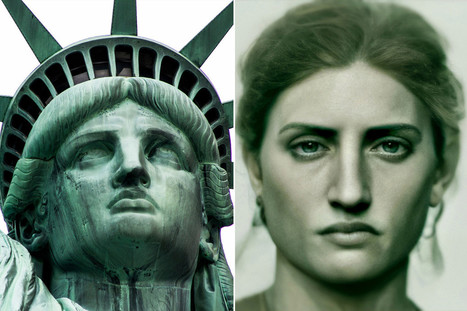
Bas Uterwijk, an Amsterdam-based artist, is using AI to create extremely lifelike photographs of historical figures and monuments such as the Statue of Liberty, artist Vincent van Gogh, George Washington and Queen Elizabeth I. Using a program called Artbreeder, which is described as “deep learning software,” Uterwijk builds his photographs based on a compilation of portraits, reports the Daily Mail. The program pinpoints common facial features and photograph qualities to produce an image. “I try to guide the software to a credible outcome. I think of my work more as artistic interpretations than scientifically or historically accurate,” the artist tells the outlet. On Instagram, he details the many variations that go into creating his work. So far, he’s created more than 50 of these images.
Via Dr. Stefan Gruenwald
|