In Chapter 15 of 17 designer and educator Jon Kolko shares how design schools can improve how they teach.
Your new post is loading...
In Chapter 15 of 17 designer and educator Jon Kolko shares how design schools can improve how they teach. No comment yet.
Sign up to comment
A “Vintage” normally refers to items that are at least 25 years old and especially the vintage advertisements of the 1950’s and 60’s are the most pleasing of all. It had an incredible typography and layout which attracted the attention of everybody.
From
artinfo
A new exhibition at the Princeton Day School's Anne Reid ’72 Art Gallery shows how the postmodern architect brought kettle design to a boil.
Judith Van Praag's comment,
April 6, 2012 10:46 AM
That Target carries Graves Design reminds me of the Dutch equivalent HEMA (Hollandsche Eenheidsprijzen Maatschappij Amsterdam) which differs in that they don't attract top names, but carry their own top designs. Started in 1926 as the Dutch Unity Price Company where all products were either 25 or 50 cents, later also ten and 75 cents (compare 10 cent or dollar store). After WWII this unity pricing was dropped. But what remains is everyman's and Ladies' alike favorite place to by everyday utensils, clothes, food and wine. The H&M of NL.
"Australians are biggest consumers in the world of Easter Eggs"
Let's take a look at some of the interesting facts and figures behind the yearly chocolate binge...
By Kochies Business Builders - http://bit.ly/Hq2afX Via maxOz
A very interesting comparison of several measurement tools and what they really measure. [note mg]
For marketers, PR professionals and customer service teams, personal influence measurement tools can save time and help facilitate business decisions. Tools such as Klout, PeerIndex, Kred and TweetLevel are being used by brands to rank the relative importance of customers and prospects, prioritize customer service responses, and identify groups of influencers to target with perks and product sampling promotions.
But what are these personal influence measurement tools really measuring? Are they really an effective way to understand which of your customers are more influential?
It is easy to understand influence as a concept; if you can get other people to do something, you have influence. But it’s not at all easy to define how you would measure influence. As Nathan Gilliatt has pointed out, there is no such thing as a “unit of influence” – an observable, measurable event that reflects influence.
Read more: http://therealtimereport.com/2012/04/03/influence-what-are-tools-like-klout-really-measuring/ Via Martin Gysler
Stephen Dale's curator insight,
April 14, 2014 11:56 AM
Social reputation and social influence are becoming as important (if not more important) than your paper-based CV and your real-world network. But can they be empirically measured, and if so, what does your score actually mean? This article gives an overview of some of the products/services that purport to give you an influence score. Whether you take it seriously is entirely up to you!
After some really appreciated articles on vodka and beer, we have gathered an impressive collection of 35 Brilliant Whisky Bottle Designs and I’m sure that you’ll simply love them! Via Desife
"It is not enough that we build products that function, that are understandable and usable - we also need to build products that bring joy and excitement pleasure and fun, and yes, beauty, to people's lives." Via Pedro Costa Neves, Michael Allenberg
Are you the friend who always has the new gadget first? Or, are you more of the back-to-basics, stick-with-what-works type? This Infographic created with American Express suggests how you choose to pay for things amidst new payment options might say a lot about what type of consumer you really are. By Column Five - http://bit.ly/HflNxk Via maxOz
Located in the former vault of a historic bank on Rembrandtplein, the new shop will be a showcase for sustainable interior design and slow coffee brewing, with small-batch reserve coffees and Europe’s first-ever Clover, a high-end machine that brews one cup at a time. But the most radical departure is in the aesthetic: the multilevel space is awash in recycled and local materials; walls are lined with antique Delft tiles, bicycle inner tubes, and wooden gingerbread molds; repurposed Dutch oak was used to make benches, tables, and the undulating ceiling relief consisting of 1,876 pieces of individually sawn blocks. The Dutch-born Liz Muller, Starbucks concept design director, commissioned more than 35 artists and craftsmen to add their quirky touches to the 4,500-square-foot space. Via axelletess
From
gigaom
"We've gotten used to the content industries arguing that what happens when people download or make copies is "theft." "
But as Mathew Ingram explains on GivaOm, when A downloads illegally B's content, B only lost a potential sale; nothing real yet. Interesting to read to understand what's at stake with copyright law. Via Guillaume Decugis
The gamification bandwagon continues, promising customer engagement and loyalty. What some marketers miss is that gamification means a lot more than badges, points, mayorships, and leader boards.
More importantly, gamification can’t make an un-engaging brand engaging. It may be the shiny new thing, but it’s not a silver bullet. Game mechanics are enablers to big ideas. They aren’t the big ideas themselves. As games designer Sebastian Deterding said, “games are not fun because they’re games, but when they are well-designed.” By Tom Fishburne - http://bit.ly/yXQpSQ Via maxOz |
Aspects of creative thinking that are not usually taught.
From
skyje
Nowadays the internet is changing from a unilateral platform that fed the consumer information without the benefit of live interaction, into more of a meeting place that allows instant contact (for example thanks to social networks any novice can... Via Rebeca Zuniga
"The Sloan Consortium is a professional leadership organization dedicated to helping online learning move into the mainstream of higher education. As part of this mission they have published numerous effective practices for online education including their 5 Pillars of Quality Online Education. A closer look at these 5 principles and the associated resources serves as a gateway for examining and evaluating the effectiveness of online instruction. Here’s what they show us..."
Via Jenny Pesina
I’m sure a lot of you guys have looked into curation software available ... Obviously with the radically different price points they all do different things, but here’s the gist – a whole lot of this you can do for free.
Step One – Define your Parameters Define your parameters by where you want the goods to go. Make sure everything is accessible from the beginning so you can leverage your curated content efficiently from the start. Step Two – Choose your Weapons e.g. Timely.is; G+ and FB
Step Three – Be Intentional with your Schedule I can’t speak to your industry/niche but I can tell you that when I do my curation at somewhere between 6 and 8am EST I find a goldmine of posts that are brand-flipping-new
Step Four – Be Crazy Time Sensitive I make sure to only curate content that is timely [less than 1% of the time curate something more than 24 hours old] Open up a google search and type in “content marketing” at the beginning of my day, and set it to the last 24 hours.
Step Five – Be Consistent As long as you are curating the same general stuff over and over it will work for you. Notice: Steps 1-5 are all about the setup or protocol. Steps 6-9 are the actual daily work.
Step Six – Prepare for Battle Open windows to the following places: Google search
Step Seven – Get Rolling e.g. search for the term “content marketing” in the last 24 hours as shown above; grab 5 or 6 posts that are relevant and make tweets about them and put them on timely/buffer/scoopit
Step Eight – Natural Overflow Doing twitter first thing after curation is great, if you have the time. 20-30 minutes after you have your automated posts in place to interact with your feed, clean out the spam tweeps, follow back the real people, etc.
Step Nine – Use what you Learn Use your curation is as the basis for your own blogs Not regurgitation, but rather letting your new-found knowledge fuel your next post. Or, add to the list of blog ideas you have on a running list somewhere.
Setting aside this 45 minutes a day to get the most relevant pieces of content your industry has to offer can not only fill your feeds, but it can also fuel your entire day. And it should, because you should be talking about the latest things in your industry.
Great ideas by Amie Marse - http://bit.ly/HfET6B Via maxOz, janlgordon
Matmi's comment,
April 5, 2012 8:16 AM
Some great tips. Would you also spend the time commenting on the curated posts? I know there are some who believe that it is a necessity and others who feel there is no need as you are merely helping others to filter the noise. I try to mix it up depending on time available.
Pedro Campos (46), is an incredible hyperrealist painter from Madrid, Spain. Using oil paints he recreates incredibly realistic still life shots that many might mistake for a photograph. He’s worked in a variety of creative fields from interior decorating, illustration (at an ad agency), to art restoration on furnishings, paintings and sculptures. He actually didn’t even begin oil painting until the age of 30. Via Barb Jemmott
Nowadays, various graphic applications made all current poster designs possible. Such posters are equipped with different styles and layouts that paved way to (Fresh #typography #poster #designs http://t.co/OrYNcyJy... Via Desife
Learn more at http://google.com/insidesearch/plus.html Search has always brought you information from across the web. Now, search gets better by including ph...
Robin Good: Timeline is a Javascript open-source solution that allows anyone to create a visual timeline that integrates text, tweets, images, maps, audio recordings and video clips on an infinite scrollable bar. A project funded by the Knight News Innovation Lab, Timeline works great with stories that have a strong chronological narrative. It does not work well for stories that need to jump around in the timeline. Mashable Sonia Paul writes about it: "Timeline is similar to Storify in that it allows users to aggregate media on the web, it differs in its operation. With Storify, users can drag and drop content into a post. With Timeline, users can either embed the code onto their website using JSON, or — if they don’t want to mess with any coding — they can fill in a ready-made Timeline template on Google Docs. The project is currently hosted on GitHub, and users can find specific directions on how to both embed the code and use the Google Doc template there, too. Future plans for the project include support of more media type, as well as iPhone compatibility, B.C. time support and better seconds and milliseconds support." Here is the GDoc ready-made template: https://docs.google.com/previewtemplate?id=0AppSVxABhnltdEhzQjQ4MlpOaldjTmZLclQxQWFTOUE&mode=public&ndplr=1&pli=1# Download: https://github.com/VeriteCo/Timeline/zipball/master More info, including how to embed it on your site and what file formats are supported: http://timeline.verite.co/ Via Robin Good
Qualilangues's comment,
April 12, 2012 6:04 AM
Design unfortunately doesn't seem to be ready for ipads yet.
The company is targeting its new ad products to small business owners with the help of American Express.
By Anthonia Akitunde, contributor FORTUNE -- Twitter has its sights trained on a group many have looked to to spur growth: small business. Via zackrizmanic, ABroaderView
From
gigaom
"We've gotten used to the content industries arguing that what happens when people download or make copies is "theft." "
But as Mathew Ingram explains on GivaOm, when A downloads illegally B's content, B only lost a potential sale; nothing real yet. Interesting to read to understand what's at stake with copyright law. Via Guillaume Decugis
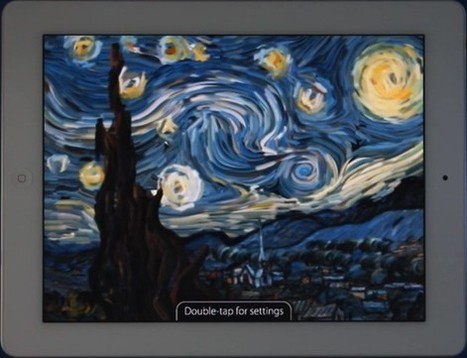
Greek Artist Petros Vrellis is a big admirer of Vincent Van Gogh, which prompted him to produce an interactive version of Starry Night.
Via David Miller |
Your new post is loading...