 Your new post is loading...
First, there was web1 – aka the internet we all know and love. Then there was web2 – the user-generated web, heralded by the arrival of social media. Now, wherever we look, people are talking about web3 (or sometimes, web 3.0) – the supposed next big evolutionary leap forward of the internet. But what is it, exactly?
What is Web3 All About? An Easy Explanation With Examples
Well, opinions on this differ somewhat. Web3 is currently a work-in-progress and isn’t exactly defined yet. However, the main principle is that it will be decentralized – rather than controlled by governments and corporations, as is the case with today’s internet – and, to some extent, connected to the concept of the “metaverse."
Before we start – just to avoid confusion – it’s worth mentioning that, until a few years ago, the term “web 3.0” was frequently used to describe what is now known as the “semantic web." This was a concept put forward by the original "father of the internet," Sir Tim Berners-Lee, for a machine-to-machine internet. Language is defined by its use, and the term is more frequently used to describe something else now. However, Berners-Lee’s concepts are considered to be a part of what we now call web3, although not the entirety of it.
Learn more / En savoir plus / Mehr erfahren: https://www.scoop.it/t/21st-century-innovative-technologies-and-developments/?&tag=Tim+BERNERS+LEE Read the full article at: www.forbes.com
Via Gust MEES

|
Scooped by
Antonios Bouris
January 22, 2022 9:55 PM
|
BigQuery Explainable AI allows you to interpret your ML models. Read the full article at: cloud.google.com
|
|
Scooped by
Antonios Bouris
January 22, 2022 9:38 PM
|
Web feature describing significant works of landscape architecture designed by Dan Kiley. Includes original photography, in-depth descriptions, and recollections from colleagues. Read the full article at: www.tclf.org
|
|
Rescooped by
Antonios Bouris
from Amazing Science
January 15, 2022 7:11 PM
|
Scientists just collected the first measurements of violent eruptions from a dense, magnetic star that spat out as much energy as a billion suns — and it happened in a fraction of a second. This type of star, known as a magnetar, is a neutron star with an exceptionally strong magnetic field, and magnetars often flare spectacularly and without warning. But even though magnetars can be thousands of times brighter than our sun, their eruptions are so brief and unpredictable that they're challenging for astrophysicists to find and study. A neutron star forms when a massive star collapses at the end of its life. As the star dies in a supernova, protons and electrons in its core are crushed into a compressed solar mass that combines intense gravity with high-speed rotation and powerful magnetic forces, according to NASA. The result, a neutron star, is approximately 1.3 to 2.5 solar masses — one solar mass is the mass of our sun, or about 330,000 Earths — crammed into a sphere measuring just 12 miles (20 kilometers) in diameter. Matter in neutron stars is so densely packed that an amount the size of a sugar cube would weigh more than 1 billion tons (900 million metric tons), and a neutron star's gravitational pull is so intense that a passing marshmallow would hit the star's surface with the force of 1,000 hydrogen bombs, according to NASA. Magnetars have magnetic fields that are 1,000 times stronger than those of other neutron stars, and they are more powerful than any other magnetic object in the universe. Our sun pales in comparison to these bright, dense stars even when they aren't erupting, study lead author Alberto J. Castro-Tirado, a research professor with the Institute for Astrophysics of Andalucía at the Spanish Research Council, said in the statement. "Even in an inactive state, magnetars can be 100,000 times more luminous than our sun," Castro-Tirado said. "But in the case of the flash that we have studied — GRB2001415 — the energy that was released is equivalent to that which our sun radiates in 100,000 years." A giant energy flare The magnetar that produced the brief eruption is located in the Sculptor Galaxy, a spiral galaxy about 13 million light-years from Earth, and is "a true cosmic monster," study co-author Victor Reglero, director of UV's Image Processing Laboratory, said in the statement. The giant flare was detected on April 15, 2020 by the Atmosphere–Space Interactions Monitor (ASIM) instrument on the International Space Station, researchers reported Dec. 22 in the journal Nature. Artificial intelligence (AI) in the ASIM pipeline detected the flare, enabling the researchers to analyze that brief, violent energy surge; the flare lasted just 0.16 seconds and then the signal decayed so rapidly that it was nearly indistinguishable from background noise in the data. The study authors spent more than a year analyzing ASIM's two seconds of data collection, dividing the event into four phases based on the magnetar's energy output, and then measuring variations in the star's magnetic field caused by the energy pulse when it was at its peak. It's almost as if the magnetar decided to broadcast its existence "from its cosmic solitude" by shouting into the void of space with the force "of a billion suns," Reglero said. Read the full article at: www.space.com
Via Dr. Stefan Gruenwald
|
|
Rescooped by
Antonios Bouris
from Technology in Business Today
January 14, 2022 7:58 PM
|
Technology News
The smallest micro robots and nano drones ever designed. Robotics is getting more and more micro! I hope you all enjoy today's post.
Credit Paradigm Read the full article at: www.technology-in-business.net
Via TechinBiz
|
|
Rescooped by
Antonios Bouris
from Amazing Science
January 8, 2022 3:47 AM
|
Webb often gets called the replacement for Hubble, but we prefer to call it a successor. After all, Webb is the scientific successor to Hubble; its science goals were motivated by results from Hubble. Hubble's science pushed us to look to longer wavelengths to "go beyond" what Hubble has already done. In particular, more distant objects are more highly redshifted, and their light is pushed from the UV and optical into the near-infrared. Thus observations of these distant objects (like the first galaxies formed in the Universe, for example) requires an infrared telescope. This is the other reason that Webb is not a replacement for Hubble; its capabilities are not identical. Webb will primarily look at the Universe in the infrared, while Hubble studies it primarily at optical and ultraviolet wavelengths (though it has some infrared capability). Webb also has a much bigger mirror than Hubble. This larger light collecting area means that Webb can peer farther back into time than Hubble is capable of doing. Hubble is in a very close orbit around the earth, while Webb will be 1.5 million kilometers (km) away at the second Lagrange (L2) point. Webb will observe primarily in the infrared and will have four science instruments to capture images and spectra of astronomical objects. These instruments will provide wavelength coverage from 0.6 to 28 micrometers (or "microns"; 1 micron is 1.0 x 10⁻⁶ meters). The infrared part of the electromagnetic spectrum goes from about 0.75 microns to a few hundred microns. This means that Webb's instruments will work primarily in the infrared range of the electromagnetic spectrum, with some capability in the visible range (in particular in the red and up to the yellow part of the visible spectrum). The instruments on Hubble can observe a small portion of the infrared spectrum from 0.8 to 2.5 microns, but its primary capabilities are in the ultra-violet and visible parts of the spectrum from 0.1 to 0.8 microns. Why are infrared observations important to astronomy? Stars and planets that are just forming lie hidden behind cocoons of dust that absorb visible light. (The same is true for the very center of our galaxy.) However, infrared light emitted by these regions can penetrate this dusty shroud and reveal what is inside. At left are infrared and visible light images from the Hubble Space Telescope of the Monkey Head Nebula, a star-forming region. A jet of material from a newly forming star is visible in one of the pillars, just above and left of centre in the right-hand image. Several galaxies are seen in the infrared view, much more distant than the columns of dust and gas. Read the full article at: www.jwst.nasa.gov
Via Dr. Stefan Gruenwald
|
|
Rescooped by
Antonios Bouris
from Amazing Science
January 8, 2022 3:36 AM
|
In late November 2021, more than 110 people gathered at a crowded Christmas party at a restaurant in Oslo, Norway. Most of the guests were fully vaccinated. One had returned from South Africa just a few days earlier and was unknowingly carrying the omicron variant of SARS-CoV-2. Ultimately, about 70% of the partygoers were infected. Scientists who traced this superspreader event concluded it was evidence that omicron was "highly transmissible" among fully vaccinated adults. Just over a month later, omicron's speedy worldwide ascent now makes it abundantly clear that the party wasn't an isolated example. In country after country, the new variant has outcompeted its predecessor, the delta variant, with one case of omicron sparking at least three other new infections on average. Cases have soared to record highs in parts of Europe and now the U.S., where about half a million new infections have been recorded in a single day. "This is a game-changing virus, especially in the vaccinated population where people have had a level of invincibility," says Sumit Chanda, a professor in the Department of Immunology and Microbiology at Scripps Research. Indeed, in a world where vaccinations and infections have built up immunity, other variants were having trouble gaining a foothold. Yet omicron is thriving. "This changes the calculus for everybody," says Chanda. And so scientists are trying to figure out: What accounts for omicron's lightning-quick spread? While it's still early, they're starting to piece together why the new variant is so contagious — and whether that means old assumptions about how to stay safe need to be revamped. Read the full article at: www.npr.org
Via Dr. Stefan Gruenwald
|
|
Scooped by
Antonios Bouris
January 8, 2022 3:19 AM
|
Bad Design is everywhere, and Norman breaks down our interactions with both good and bad designs around us. The classic example is the Push/Pull door that we encounter regularly. Have you ever come across a door that you are unsure of whether it is a push or a pull? Yanking at the handle to no avail? The observation of this phenomenon earned these doors the descriptor of "Norman Doors". Norman breaks down how this happens, how we allow this to happen and how we can change the spaces and objects around us to not only work well, but provide joy and pleasure. Read the full article at: www.tomrichards.com.au
|
|
Rescooped by
Antonios Bouris
from Amazing Science
November 27, 2021 9:42 PM
|
UK Biobank offers easy access to genomic database for researchers around the world In the largest single release of whole genomes ever, the UK Biobank (UKBB) this week unveiled to scientists the entire genomes of 200,000 people who are part of a long-term British health study. The trove of genomes, each linked to anonymized medical information, will allow biomedical scientists to scour the full 3 billion base pairs of human DNA for insights into the interplay of genes and health that could not be gleaned from partial sequences or scans of genome markers. “It is thrilling to see the release of this long-awaited resource,” says Stephen Glatt, a psychiatric geneticist at the State University of New York Upstate Medical University.
Read the full article at: www.science.org
Via Dr. Stefan Gruenwald
|
|
Scooped by
Antonios Bouris
October 17, 2021 4:43 AM
|
Better data infrastructure has provided a big boost to AI’s growth, but some things still require a human. We’ve been overselling current capabilities of AI for years, but that doesn’t mean it doesn’t have a bright future. That’s perhaps why Stanford University researchers conceived of a “One Hundred Year Study on Artificial Intelligence” (100 years!) back in 2016, with plans to update the report every five years through 2116, charting the progress of AI along the way. Five years after the inaugural report, the study authors recently released the second report.
Read the full article at: www.infoworld.com
|
|
Rescooped by
Antonios Bouris
from Educational Technology News
October 17, 2021 4:30 AM
|
Teachers got a crash course in creating video content when schools shifted online. They relied on videos out of necessity to explain concepts and model strategies while students learned from home. As teachers transitioned back into classrooms, many abandoned video in favor of live instruction. However, if teachers are going to say the same thing the same way for all students, I encourage them to make a video. That way, they can use their synchronous time for more engaging and differentiated learning experiences. Read the full article at: catlintucker.com
Via EDTECH@UTRGV
|
|
Scooped by
Antonios Bouris
October 10, 2021 10:20 PM
|
The DART spacecraft will crash into the asteroid Didymos at 15,000 miles per hour. Will it make a dent? NASA has announced the launch date for an upcoming mission to punch an asteroid in the face with a high-speed spacecraft. The mission, called the Double Asteroid Redirection Test (DART), is scheduled to launch at 10:20 p.m. PST (7:20 p.m. EST) on Nov. 23, and it could help the world's space agencies figure out how to divert potentially lethal asteroids from impacting Earth, according to a NASA statement.
Read the full article at: www.livescience.com
|
|
|
Rescooped by
Antonios Bouris
from Amazing Science
January 27, 2022 5:19 PM
|
On January 24th, 2022, Webb fired its onboard thrusters for nearly five minutes (297 seconds) to complete the final post-launch course correction to Webb’s trajectory. This mid-course correction burn inserted Webb toward its final orbit around the second Sun-Earth Lagrange point, or L2, nearly 1 million miles away from the Earth. The final mid-course burn added only about 3.6 miles per hour (1.6 meters per second) – a mere walking pace – to Webb’s speed, which was all that was needed to send it to its preferred “halo” orbit around the L2 point. “Webb, welcome home!” said NASA Administrator Bill Nelson. “Congratulations to the team for all of their hard work ensuring Webb’s safe arrival at L2 today. We’re one step closer to uncovering the mysteries of the universe. And I can’t wait to see Webb’s first new views of the universe this summer!” The James Webb Space Telescope is the world’s largest, most powerful, and most complex space science telescope ever built. Webb will solve mysteries in our solar system, look beyond to distant worlds around other stars, and probe the mysterious structures and origins of our universe and our place in it. Webb is an international program led by NASA with its partners, ESA (European Space Agency) and the Canadian Space Agency. Read the full article at: blogs.nasa.gov
Via Dr. Stefan Gruenwald
|
|
Rescooped by
Antonios Bouris
from Educational Technology News
January 27, 2022 5:11 PM
|
One and a half billon students around the world, according to UNESCO(link is external), were engaged in remote learning at the height of the COVID-19 pandemic in March 2020. Some students were able to access the Internet to do so, but not all. The majority of students around the world, who have access to smartphones, are able to use these as learning devices. Others are more fortunate and have tablets, laptops or desktops. Their instructors, some with no previous experience of teaching online or at a distance, discovered new approaches to teaching and learning and imaginative work was undertaken to overcome the very real challenges this current reality gives rise to. Read the full article at: teachonline.ca
Via EDTECH@UTRGV
|
|
Scooped by
Antonios Bouris
January 22, 2022 9:47 PM
|
|
|
Rescooped by
Antonios Bouris
from Amazing Science
January 15, 2022 7:12 PM
|
Researchers show how intelligent aliens might draw nearly-limitless power from a black hole using a Dyson sphere. The search for extraterrestrial intelligence (SETI) has been conducted for nearly 60 yr. A Dyson sphere, a spherical structure that surrounds a star and transports its radiative energy outwards as an energy source for an advanced civilization, is one of the main targets of SETI to identify intelligent aliens around galactic energy sources.
Read the full article at: www.livescience.com
Via Dr. Stefan Gruenwald
|
|
Rescooped by
Antonios Bouris
from Amazing Science
January 15, 2022 7:06 PM
|
ESA's exoplanet mission Cheops has revealed that an exoplanet orbiting its host star within a day has a deformed shape more like that of a rugby ball than a sphere. This is the first time that the deformation of an exoplanet has been detected, offering new insights into the internal structure of these star-hugging planets. The planet, known as WASP-103b is located in the constellation of Hercules. It has been deformed by the strong tidal forces between the planet and its host star WASP-103, which is about 200 degrees hotter and 1.7 times larger than the sun. We experience tides in the oceans of Earth mainly due to the Moon tugging slightly on our planet as it orbits us. The sun also has a small but significant effect on tides, however it is too far from Earth to cause major deformations of our planet. The same cannot be said for WASP-103b, a planet almost twice the size of Jupiter with 1.5 times its mass, orbiting its host star in less than a day. Astronomers have suspected that such a close proximity would cause monumental tides, but up until now they haven't been able to measure them. Using new data from ESA's Cheops space telescope, combined with data that had already been obtained by the NASA/ESA Hubble Space Telescope and NASA's Spitzer Space Telescope, astronomers have now been able to detect how tidal forces deform exoplanet WASP-103b from a usual sphere into a rugby ball shape. Cheops measures exoplanet transits—the dip in light caused when a planet passes in front of its star from our point of view. Ordinarily, studying the shape of the light curve will reveal details about the planet such as its size. The high precision of Cheops together with its pointing flexibility, which enables the satellite to return to a target and to observe multiple transits, has allowed astronomers to detect the minute signal of the tidal deformation of WASP-103b. This distinct signature can be used to unveil even more about the planet. "It's incredible that Cheops was actually able to reveal this tiny deformation," says Jacques Laskar of Paris Observatory, Université Paris Sciences et Lettres, and co-author of the research. "This is the first time such analysis has been made, and we can hope that observing over a longer time interval will strengthen this observation and lead to better knowledge of the planet's internal structure." Read the full article at: phys.org
Via Dr. Stefan Gruenwald
|
|
Rescooped by
Antonios Bouris
from Amazing Science
January 8, 2022 3:47 AM
|
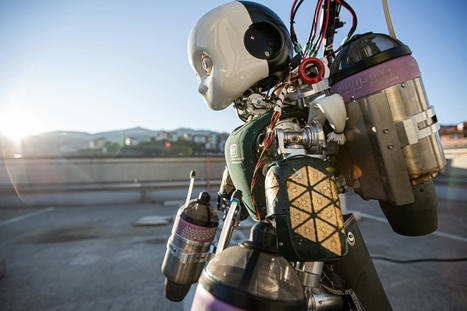
Researchers at the Italian Institute of Technology (IIT) have recently been exploring a fascinating idea, that of creating humanoid robots that can fly. To efficiently control the movements of flying robots, objects or vehicles, however, researchers require systems that can reliably estimate the intensity of the thrust produced by propellers, which allow them to move through the air. As thrust forces are difficult to measure directly, they are usually estimated based on data collected by onboard sensors. The team at IIT recently introduced a new framework that can estimate thrust intensities of flying multi-body systems that are not equipped with thrust-measuring sensors. This framework, presented in a paper published in IEEE Robotics and Automation Letters, could ultimately help them to realize their envisioned flying humanoid robot. "Our early ideas of making a flying humanoid robot came up around 2016," Daniele Pucci, head of the Artificial and Mechanical Intelligence lab that carried out the study, told TechXplore. "The main purpose was to conceive robots that could operate in disaster-like scenarios, where there are survivors to rescue inside partially destroyed buildings, and these buildings are difficult to reach because of potential floods and fire around them." The key objective of the recent work by Pucci and his colleagues was to devise a robot that can manipulate objects, walk on the ground and fly. As many humanoid robots can both manipulate objects and move on the ground, the team decided to extend the capabilities of a humanoid robot to include flight; rather than developing an entirely new robotic structure. "Once provided with flight abilities, humanoid robots could fly from one building to another avoiding debris, fire and floods," Pucci said. "After landing, they could manipulate objects to open doors and close gas valves, or walk inside buildings for indoor inspection, for instance looking for survivors of a fire or natural disaster." Initially, Pucci and his colleagues tried to provide iCub, a renowned humanoid robot created at IIT, with the ability to balance its body on the ground, for instance standing on a single foot. Once they achieved this, they started working on broadening the robot's locomotion skills, so that it could also fly and move in the air. The team refer to the area of research they have been focusing on as 'aerial humanoid robotics." "To the best of our knowledge, we produced the first work about flying humanoid robots," Pucci said. "That paper was obviously testing flight controllers in simulation environments only, but given the promising outcomes, we embarked upon the journey of designing iRonCub, the first jet-powered humanoid robot presented in our latest paper." Read the full article at: techxplore.com
Via Dr. Stefan Gruenwald
|
|
Rescooped by
Antonios Bouris
from Amazing Science
January 8, 2022 3:37 AM
|
Machine learning algorithms provide a way to detect misinformation based on writing style and how articles are shared. On topics as varied as climate change and the safety of vaccines, you will find a wave of misinformation all over social media. Trust in conventional news sources may seem lower than ever, but researchers are working on ways to give people more insight on whether they can believe what they read. Researchers have been testing artificial intelligence (AI) tools that could help filter legitimate news. But how trustworthy is AI when it comes to stopping the spread of misinformation? Researchers at the Rensselaer Polytechnic Institute (RPI) and the University of Tennessee collaborated to study the role of AI in helping people identify whether the news they’re reading is legitimate or not. The research paper, “Tailoring Heuristics and Timing AI Interventions for Supporting News Veracity Assessments,” was published in Computers in Human Behavior Reports. It discussed how crowdsourcing marketplace Amazon Mechanical Turk (AMT) can be used to identify misinformation for fresh news and specific heuristics, which are rules of thumb used to process information and consider its veracity. In other words, heuristics are essentially “shortcuts for decisions,” explained Dorit Nevo, an associate professor at RPI’s Lally School of Management and a lead author for the paper. The study found that AI would be successful in flagging false stories only if the reader did not already have an opinion on the topic, Nevo said. When study subjects were set in their beliefs, confirmation bias kept them from reassessing their views. Read the full article at: spectrum.ieee.org
Via Dr. Stefan Gruenwald
|
|
Scooped by
Antonios Bouris
January 8, 2022 3:21 AM
|
The NFT space is going to blow up in 2022. Today, Opensea is valued at 13.3B. We believe that's still a small number. Millions of new users will join the space, and a lot of them will want to launch their own collections. Website development, smart contract minting setup, and marketing video are all on us. If you are a developer, and you want us to connect you to top artists, we can do that as well. We are here to make frens and connect frens. We accept 5% fees post-launch. No payment upfront whatsoever. Frens trust each other. Read the full article at: www.apelaunch.io
|
|
Rescooped by
Antonios Bouris
from Amazing Science
January 8, 2022 3:17 AM
|
Ocean Worlds are an emerging class of celestial bodies critical to the search for life in the solar system and beyond, especially for studies of habitability, planetary formation, planetary evolution, and volatile transport. Ocean Worlds' exploration began with the Galileo mission to Jupiter, where the geologically young satellite Europa was discovered to possess a likely global saltwater ocean, and later the discovery of putative oceans at Ganymede and Callisto. This exploration continued with the Cassini mission, which observed the spectacular water jets at the south pole of Enceladus and the organic-rich landscape of Titan resting on top of a planetary ice shell and water ocean. The Dawn mission to Ceres and New Horizons mission to Pluto broadened the potential diversity of Ocean Worlds. Today, NASA is planning the flagship Clipper mission to Europa and New Frontiers-class Dragonfly mission to Titan, while ESA is planning the L-Class JUICE mission to Jupiter's Ocean Worlds. In its extended mission, NASA's New Frontiers-class Juno spacecraft will perform limited flybys of Jupiter's Ocean Worlds. Future in situ exploration may target icy surfaces, planetary oceans, plume samples, and exotic traverses. The in situ exploration of Ocean Worlds is increasingly feasible, with specifically enabling advancements in instrumentation, technologies, and techniques facilitated by several, dedicated NASA-funding streams. Leveraging such developments, several mission concepts have been put forward in response to recent Discovery and New Frontiers announcements of opportunity, and multitudes more were submitted for consideration to the 2023-2032 Planetary Science and Astrobiology Decadal Survey. This wealth of scientific opportunity and the numerous pathways to exploration match the rich diversity of Ocean Worlds targets. No one mission to a single Ocean World can address the full breadth of driving scientific questions across this class of body. More research will be critical to convincingly answer the questions of whether and why these hidden oases are inhabited. Read the full article at: iopscience.iop.org
Via Dr. Stefan Gruenwald
|
|
Rescooped by
Antonios Bouris
from Amazing Science
November 27, 2021 9:38 PM
|
A data set of more than 170,000 microscopic images allows for the training of neural networks for the identification of bone marrow cells with high accuracy. Diagnosing blood disorders relies on a century-old method of using optical microscopes to analyze and classify samples of bone marrow cells. The method used to look for rare, but diagnostically important, cells is well-established, albeit laborious and time-consuming. Artificial intelligence (AI) has the potential to improve this method. However, training an AI algorithm requires a large amount of high-quality data. Now a team has used a data set of more than 170,000 microscopic images to train neural networks to identify bone marrow cells with high accuracy. The Helmholtz Munich researchers developed the largest open-access database on microscopic images of bone marrow cells to date. The database consists of more than 170,000 single-cell images from over 900 patients with various blood diseases. It is the result of a collaboration from Helmholtz Munich with the LMU University Hospital Munich, the MLL Munich Leukemia Lab (one of the largest diagnostic providers in this field worldwide), and Fraunhofer Institute for Integrated Circuits.
This work was published in Blood, in the paper, “Highly accurate differentiation of bone marrow cell morphologies using deep neural networks on a large image data set.”
Read the full article at: www.genengnews.com
Via Dr. Stefan Gruenwald
|
|
Scooped by
Antonios Bouris
October 17, 2021 4:33 AM
|
In the beginning, there was … well, maybe there was no beginning. Perhaps our universe has always existed — and a new theory of quantum gravity reveals how that could work."Reality has so many things that most people would associate with sci-fi or even fantasy," said Bruno Bento, a physicist who studies the nature of time at the University of Liverpool in the U.K.In his work, he employed a new theory of quantum gravity, called causal set theory, in which space and time are broken down into discrete chunks of space-time. At some level, there's a fundamental unit of space-time, according to this theory. Bento and his collaborators used this causal-set approach to explore the beginning of the universe. They found that it's possible that the universe had no beginning — that it has always existed into the infinite past and only recently evolved into what we call the Big Bang.Related: Big Bang to civilization: 10 amazing origin events Read the full article at: www.space.com
|
|
Scooped by
Antonios Bouris
October 10, 2021 10:32 PM
|
Sykuro Manabe, Klaus Hasselmann and Giorgio Parisi share award for advancing climate knowledge Three scientists have won the 2021 Nobel prize in physics for their groundbreaking contributions to our understanding of complex physical systems – including how humanity influences the Earth’s climate. The winners, Syukuro Manabe, Klaus Hasselmann and Giorgio Parisi, will share the award, announced on Tuesday, presented by the Royal Swedish Academy of Sciences and worth 10m Swedish kronor (£870,000).
Read the full article at: www.theguardian.com
|









First, there was web1 – aka the internet we all know and love. Then there was web2 – the user-generated web, heralded by the arrival of social media. Now, wherever we look, people are talking about web3 (or sometimes, web 3.0) – the supposed next big evolutionary leap forward of the internet. But what is it, exactly?
What is Web3 All About? An Easy Explanation With Examples
Well, opinions on this differ somewhat. Web3 is currently a work-in-progress and isn’t exactly defined yet. However, the main principle is that it will be decentralized – rather than controlled by governments and corporations, as is the case with today’s internet – and, to some extent, connected to the concept of the “metaverse."
Before we start – just to avoid confusion – it’s worth mentioning that, until a few years ago, the term “web 3.0” was frequently used to describe what is now known as the “semantic web." This was a concept put forward by the original "father of the internet," Sir Tim Berners-Lee, for a machine-to-machine internet. Language is defined by its use, and the term is more frequently used to describe something else now. However, Berners-Lee’s concepts are considered to be a part of what we now call web3, although not the entirety of it.
Learn more / En savoir plus / Mehr erfahren:
https://www.scoop.it/t/21st-century-innovative-technologies-and-developments/?&tag=Tim+BERNERS+LEE