




Genetic Engineering in the Press by GEG
39.4K views |
+0 today
 Your new post is loading...
 Your new post is loading...
Your new post is loading...
 Scoop.it!

"Cas9-mediated genetic perturbation is simple and scalable, empowering researchers to elucidate the functional organization of the genome at the systems level and establish causal linkages between genetic variations and biological phenotypes." 
Scoop.it!

IT SOUNDS like science fiction, and for years it seemed as though it was just that: fiction. But the idea of gene therapy—introducing copies of healthy genes into...
Scoop.it!

The engineering of biomimetic materials is accelerated by combining high-throughput RNA sequencing and proteomics.
Scoop.it!

Alnylam Pharmaceuticals and a small group of other drug firms are rekindling interest in once-hot gene technology abandoned by big drug makers. The technology seeks to disable molecules called ribonucleic acids, or RNA, from translating genetic code into disease-causing proteins.
Scoop.it!

Researchers for the first time have created microbes containing artificial DNA, expanding the universal genetic code that guides life. The advance one day could lead to new antibiotics, vaccines and other medical products.
Scoop.it!

China tries to feed a fifth of the world's population on a seventh of its available land—and not the world’s most fertile, Beijing often complains. So not speed up use of genetically modified food?
Scoop.it!

From
www

A key next step in synthetic biology is to combine simple circuits into higher-order systems. In this work, we expanded our synthetic riboregulation platform into a genetic switchboard that independently controls the expression of multiple genes in parallel. First, we designed and characterized riboregulator variants to complete the foundation of the genetic switchboard; then we constructed the switchboard sensor, a testing platform that reported on quorum-signaling molecules, DNA damage, iron starvation, and extracellular magnesium concentration in single cells. As a demonstration of the biotechnological potential of oursynthetic device, we built a metabolism switchboard that regulated four metabolic genes, pgi, zwf, edd, andgnd, to control carbon flow through three Escherichia coli glucose-utilization pathways: the Embden–Meyerhof, Entner–Doudoroff, and pentose phosphate pathways. We provide direct evidence for switchboard-mediated shunting of metabolic flux by measuring mRNA levels of the riboregulated genes, shifts in the activities of the relevant enzymes and pathways, and targeted changes to the E. colimetabolome. The design, testing, and implementation of the genetic switchboard illustrate the successful construction of a higher-order system that can be used for a broad range of practical applications insynthetic biology and biotechnology.
|
Scoop.it!

(Reuters) - U.S. drugmaker Pfizer, which failed last month in a $118 billion bid to buy AstraZeneca, said on Wednesday it had signed a deal with French biotech Cellectis to develop immunotherapy drugs
Scoop.it!

SOME diseases, such as haemophilia and cystic fibrosis, are caused by broken genes. Doctors have long dreamed of treating them by adding working copies of these...
Scoop.it!
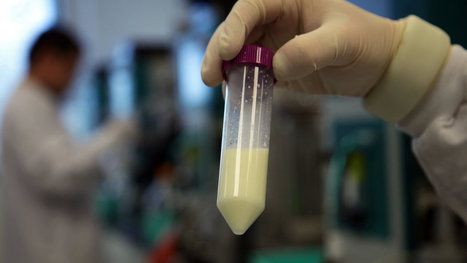
Companies are beginning to use synthetic biology in producing cosmetics and household cleansers, but there is reluctance in how much to publicize it.
Scoop.it!
The drug industry leads the US in lobbying spending. What does all that money get them? Melanie Senior investigates.
Scoop.it!
Thermo Fisher Scientific posted a 62% jump in first-quarter profit as the laboratory-equipment maker's results benefited from a recent acquisition, and broad growth in other business segments.
Scoop.it!
From
www
Pigs have many features that make them attractive as biomedical models, especially in regenerative medicine. Here, we have introduced inactivating mutations simultaneously into both alleles of the recombination activating gene (RAG) 2 gene in fibroblasts derived from minipigs and then used somatic-cell nuclear transfer to produce RAG2−/− cloned animals with a severe immune deficiency (SCID) phenotype and lacking T and B cells. When human induced pluripotent (iPS) cells were injected into these SCID pigs, the animals readily form teratomas representing a wide range of human tissues. Provided they can be protected from pathogens, these genetically engineered pigs could be a valuable resource as models for human patients with analogous immunodeficiencies and for testing the safety and regenerative capacity of grafts derived from iPS cells.
|







www.geg-tech.com