 Your new post is loading...

|
Scooped by
Kim Flintoff
February 12, 2018 9:34 PM
|
Huge quantities of networked sensors have appeared in cities across the world in recent years. These include cameras and sensors that count the number of passers by, devices to sense air quality, traffic flow detectors, and even bee hive monitors. There are also large amounts of information about how people use cities on social media services such as Twitter and foursquare.
Citizens are even making their own sensors – often using smart phones – to monitor their environment and share the information with others; for example, crowd-sourced noise pollution maps are becoming popular. All this information can be used by city leaders to create policies, with the aim of making cities “smarter” and more sustainable.
|
|
Scooped by
Kim Flintoff
February 4, 2018 6:04 PM
|
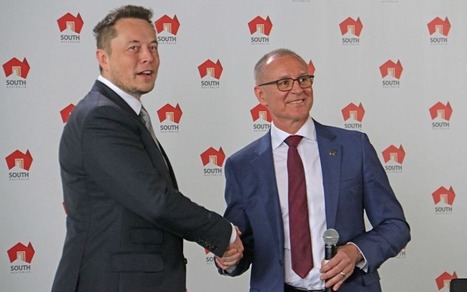
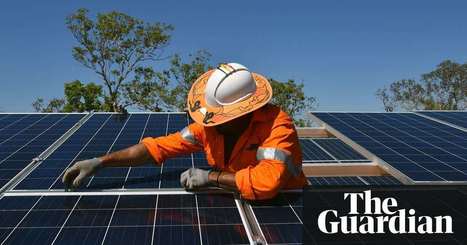
At least 50,000 South Australian homes will be given solar panels and batteries in a scheme by Elon Musk’s Tesla and the SA government to build the world’s largest virtual power plant, slashing household power bills in the process.
Under the deal unveiled by Premier Jay Weatherill, solar systems and batteries will be supplied and installed free of charge.
The cost of the project will be financed through the sale of electricity, generated by the panels, in what Mr Weatherill said would be the largest project of its kind.
The government will this week issue an expression of interest for a retailer to deliver the program, with the intention of bringing additional competition to the market.
|
|
Scooped by
Kim Flintoff
January 22, 2018 9:25 PM
|
Just when you thought vehicle manufacturing in Australia had gone the way of the dodo, billionaire UK investor Sanjeev Gupta has popped up with a bid to buy some of GMH’s old Elizabeth plant in South Australia to build electric vehicles here.
Mr Gupta is executive chairman of UK-based GFG Alliance and is already renowned as a rejuvenator of declining assets.
In the UK he is called the “man of steel” for rescuing 25 British steel mills, car plants and engineering workshops from closure, and the company website claims Mr Gupta has since 2013 acquired and relaunched 35 businesses worldwide, saving 11,000 jobs.
|
|
Scooped by
Kim Flintoff
January 18, 2018 4:46 PM
|
The economic damage of a successful major cyber-attack against a large cloud services provider could be similar in scale to the financial impact of a destructive hurricane.
The destructive tropical cyclone hurricane Katrina hit the US in 2005, causing $108bn in damage -- but that could be exceeded by the cost of a major cyber-attack, according to one expert.
|
|
Scooped by
Kim Flintoff
November 26, 2017 2:43 PM
|
Australia can meet its 2030 greenhouse emissions target at zero net cost, according to our analysis of a range of options for the National Electricity Market.
Our modelling shows that renewable energy can help hit Australia’s emissions reduction target of 26-28% below 2005 levels by 2030 effectively for free. This is because the cost of electricity from new-build wind and solar will be cheaper than replacing old fossil fuel generators with new ones.
|
|
Scooped by
Kim Flintoff
November 6, 2017 6:11 AM
|
Abstract
Industrialised countries have applied increasingly restrictive measures to deter people from seeking asylum. Drawing on in-depth interviews with 29 people seeking asylum living in the Australian community who arrived in Australia by boat, this article explores how restrictive policies, including delays in processing refugee claims and the denial of the right to work and access to basic standards of living, are experienced as fundamentally dehumanising. It also explores how interviewees negotiated this in ways that reasserted their humanity. Thematically, many of the responses mapped onto Haslam’s “animalising” conceptualisations of dehumanisation in relation to being subject to restrictive policies. Despite the conditions in the community being described as dehumanising, many interviewees were also working hard to find action-orientated activities that were affordable in order to regain a sense of control and independence over their daily lives, such as accessing education and building social connections with others. A number of interviewees also appealed to human rights via speech when describing dehumanising treatments, in effect realigning themselves as humans deserving of rights. Implications for understandings of dehumanisation and for Australia’s asylum-seeker policies are discussed.
|
|
Scooped by
Kim Flintoff
October 26, 2017 7:49 PM
|
Machine learning isn't just for simple tasks like assessing credit risk and sorting mail anymore -- today, it's capable of far more complex applications, like grading essays and diagnosing diseases. With these advances comes an uneasy question: Will a robot do your job in the future?
|
|
Scooped by
Kim Flintoff
October 26, 2017 6:51 PM
|
It sometimes feels like we get a lot of “record-breaking” weather. Whether it’s a heatwave in Europe or the “Angry Summer” in Australia, the past few years have seen temperature records tumble.
This is the case both locally – Sydney had its hottest year on record in 2016 – and globally, with the world’s hottest year in 2016 beating the record set only the year before.
Some of 2016’s heat was due to the strong El Niño. But much of it can be linked to climate change too.
|
|
Scooped by
Kim Flintoff
October 26, 2017 6:47 PM
|
This article is the third in the Black Lives Matter Everywhere series, a collaboration between The Conversation, the Sydney Democracy Network and the Sydney Peace Foundation. To mark the awarding of the 2017 Sydney Peace Prize to the Black Lives Matter Global Network, the authors reflect on the roots of and responses to a movement that has re-ignited a global conversation about racism. The 2017 Sydney Peace Prize will be presented on November 2 (tickets here).
|
|
Scooped by
Kim Flintoff
October 15, 2017 12:33 AM
|
Since the platform’s launch, back in 2014, we have strived to leave no one behind as we train people on the key aspects to understand and address climate change. For this reason, all of the courses currently offered are free of charge and in an increasing number of languages, including English, French, Spanish, Mandarin Chinese, Thai, Khmer, and Portuguese.
We are committed to bringing the best of the world of e-learning to our platform through constant technological enhancements and innovative sectoral thematics. Earlier this year the e-platform was enhanced and brought various features to facilitate users’ navigation. Our portfolio currently includes 8 courses ranging from climate science and finance to the interactions of climate change with children and health. Courses on gender, aviation, and agriculture related matters will be coming soon to continue complementing climate change learning with the most relevant happenings and themes.
|
|
Scooped by
Kim Flintoff
October 6, 2017 9:15 PM
|
Today we face many problems, from epidemics to climate change. Grand challenges call for grand ideas – new tech, clever science, and smart solutions. Discover the best o
|
|
Scooped by
Kim Flintoff
October 2, 2017 7:51 PM
|
Climate-KIC is Europe’s largest public-private innovation partnership focused on climate innovation to mitigate and adapt to climate change.
Climate-KIC is one of three Knowledge and Innovation Communities (KICs) created in 2010 by the European Institute of Innovation and Technology (EIT). The EIT is an EU body whose mission is to create sustainable growth.
We support this mission by addressing climate change mitigation and adaptation.We integrate education, entrepreneurship and innovation resulting in connected, creative transformation of knowledge and ideas into economically viable products or services that help to mitigate climate change.
|
|
Scooped by
Kim Flintoff
September 20, 2017 11:16 PM
|
Electricity storage is vital to the stability of a renewable energy grid. The world's favourite form of storage is pumped hydro – and researchers have located thousands of candidate sites.
|
|
|
Scooped by
Kim Flintoff
February 11, 2018 11:01 PM
|
A record-breaking month of rooftop installations and a flood of large-scale solar farms could almost double Australia’s solar power capacity in a single year, industry analysts say.
A massive solar energy boom is being predicted for 2018, after an unprecedented number of industrial solar farms were approved by the New South Wales and Queensland governments last year.
|
|
Scooped by
Kim Flintoff
January 22, 2018 10:50 PM
|
Should we assess global competence? Every school should encourage its students to try and make sense of the most pressing issues defining our times. The high demands placed on schools to help their students cope and succeed in an increasingly interconnected environment can only be met if education systems define new learning objectives based on a solid framework, and use different types of assessment to reflect on the effectiveness of their initiatives and teaching practices. In this context, PISA aims to provide a comprehensive overview of education systems’ efforts to create learning environments that invite young people to understand the world beyond their immediate environment, interact with others Introduction: The importance of an international global competence assessment with respect for their rights and dignity, and take action towards building sustainable and thriving communities. A fundamental goal of this work is to support evidence-based decisions on how to improve curricula, teaching, assessments and schools’ responses to cultural diversity in order to prepare young people to become global citizens.
|
|
Scooped by
Kim Flintoff
January 22, 2018 9:12 PM
|
Perth’s Christ Church Grammar School will soon be home to Australia’s largest school solar powered system.
Chairman John Poynton said the 670 kilowatt solar photovoltaic system was expected to save around $195,000 and also provide an example of effective clean energy.
“Christ Church Grammar School has made an investment in solar power because not only do we want to reduce our carbon footprint for the benefit of future generations, we know that it will deliver financial benefits,” he said.
|
|
Scooped by
Kim Flintoff
January 7, 2018 5:26 PM
|
It seems there is a gap between what Australian companies publicly state they are doing with the United Nations Sustainable Development Goals and what they are actually doing. Our research found that companies are still not meaningfully disclosing the way these goals are measured and reporting their contributions.
These UN goals show business how they can contribute to solving the world’s biggest sustainable development challenges.
|
|
Scooped by
Kim Flintoff
November 8, 2017 1:12 AM
|
Waymo today plans to announce its driverless vehicles have been operating on US roadways for weeks with total freedom. Tesla recently told shareholders it was on the verge of updating its Autopilot software for full autonomy. And Las Vegas will tomorrow become the first city in history to offer the public a ride in a completely driverless shuttle on regular roads with real traffic.
We’ve officially entered the age of level four autonomy for driverless cars.
On Wednesday November 8th the general public will have the opportunity to ride through a half-mile stretch of Las Vegas in a new shuttle built by French AI company Navya. The shuttle is autonomous; it doesn’t have a steering wheel or brake pedal. It’s being operated by non-profit American Automobile Association (AAA) as part of an initiative to help spread positive awareness for the technology.
|
|
Scooped by
Kim Flintoff
November 5, 2017 4:22 PM
|
The 2017 Boyer Lectures explore what it is to be human in a digital world. In her four addresses, Professor Genevieve Bell discusses how we as Australians can build a digital future that is right for us.
For many Australians and indeed people around the world, views of the future are caught up in a binary narrative: “technology good” or “technology bad”.
In this dichotomy, technology is considered to be a thing that humans have and humans do. I would like to put forward a different notion: that technology is what humans are. ================
Each year since 1959, the ABC has sparked conversation about critical ideas with the Boyer Lectures.In 2017, Professor Genevieve Bell’s series is called Fast, Smart and Connected: What is it to be Human, and Australian, in a Digital World?
http://www.abc.net.au/radionational/programs/boyerlectures/
|
|
Scooped by
Kim Flintoff
October 26, 2017 7:46 PM
|
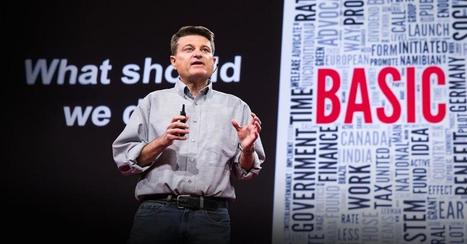
Machines that can think, learn and adapt are coming -- and that could mean that we humans will end up with significant unemployment. What should we do about it? In a straightforward talk about a controversial idea, futurist Martin Ford makes the case for separating income from traditional work and instituting a universal basic income.
This talk was presented at an official TED conference, and was featured by our editors on the home page.
|
|
Scooped by
Kim Flintoff
October 26, 2017 6:48 PM
|
Australian cars are using 23% more fuel than advertised, according to a report from the Australian Automobile Association, which also claims that eco-friendly hybrid electric cars emit four times more greenhouse gas than the manufacturers advertise.
The report on real-world (that is, on-road) emission testing was commissioned by consultancy firm ABMARC to test 30 cars twice on Melbourne roads. The method used to measure both the emissions and the fuel consumption was a so-called Portable Emissions Measurement System (PEMS).
|
|
Scooped by
Kim Flintoff
October 22, 2017 7:07 PM
|
Researching her film The Story of Stuff, Annie Leonard discovered that of the materials flowing through the consumer economy, only 1% remain in use six months after sale(1). Even the goods we might have expected to hold onto are soon condemned to destruction through either planned obsolescence (breaking quickly) or perceived obsolesence (becoming unfashionable).
But many of the products we buy, especially for Christmas, cannot become obsolescent. The term implies a loss of utility, but they had no utility in the first place. An electronic drum-machine t-shirt; a Darth Vader talking piggy bank; an ear-shaped i-phone case; an individual beer can chiller; an electronic wine breather; a sonic screwdriver remote control; bacon toothpaste; a dancing dog: no one is expected to use them, or even look at them, after Christmas Day. They are designed to elicit thanks, perhaps a snigger or two, and then be thrown away.
|
|
Scooped by
Kim Flintoff
October 11, 2017 8:44 PM
|
A new techno bubble is inflating above the meadows of Silicon Valley: lab-grown meat, which plays a major part in what’s being called cellular agriculture (CA).
Based on a seductive story of providing food with zero consequences, CA promises to get rid of the ethical, environmental and health costs of animal husbandry. How? By growing animal products without the animal and its body.
This movement is very much aligned with the inflated rhetoric of the innovation economy. Hundreds of millions of dollars are being sunk into the promise of CA. People like Sergey Brin, Bill Gates, Peter Thiel and other venture capitalists are reportedly among notable investors.
But does this techno-capitalist mindset really fit our food system?
In my view, these initiatives are aimed at prolonging the West’s excessive consumption of meat, rather than genuine attempts to deal with the problems they claim to solve.
|
|
Scooped by
Kim Flintoff
October 3, 2017 6:15 PM
|
The majority of Liberal voters support a strong clean energy target, putting them at odds with the government over its hostile stance on the issue.
A survey of more than 2000 Australians, commissioned by the Climate Council, found 77 per cent believed the government should implement Chief Scientist Alan Finkel’s clean energy target.
More interestingly, 61 per cent of Liberal voters said they supported the implementation of the clean energy target. Just 34 per cent believed the CET was “unimportant”.
|
|
Scooped by
Kim Flintoff
September 23, 2017 8:54 PM
|
Earlier this month, I set off for Bonn to help launch ‘2030 Hive Mind’, a Sustainable Development Goals (SDGs) game at the ODI’s first annual Global Festival of Ideas – the world’s first playable conference on sustainable development.
The idea was to bring influential people, policy-makers, development wonks (like me), and activists together to get a sense of the knock on effects – both positive and negative – that focusing on one SDG can have on other. We aimed to find ways to collaborate and coordinate through the pushes and pulls of many different actors, objectives and motivations.
|




















Huge quantities of networked sensors have appeared in cities across the world in recent years. These include cameras and sensors that count the number of passers by, devices to sense air quality, traffic flow detectors, and even bee hive monitors. There are also large amounts of information about how people use cities on social media services such as Twitter and foursquare.
Citizens are even making their own sensors – often using smart phones – to monitor their environment and share the information with others; for example, crowd-sourced noise pollution maps are becoming popular. All this information can be used by city leaders to create policies, with the aim of making cities “smarter” and more sustainable.