Your new post is loading...
|
One of the limitations for any camera is the shutter speed – and on the Fuji X Series, the shutter speed tops out at 1/4000. Normally this isn’t an issue, you rarely even have to think about it. But if you’re using fast glass, and shooting with wide apertures in bright daylight, that 1/4000 shutter speed can start to become a real problem. ...
hpc's insight:
"The X100 and X100s solve this by offering a built-in 3 stop Neutral Density (ND) filter." Sure, but it was an "obligation" as with these two cameras, you cannot shoot at f2.0 at 1/4000 sec I got up stupidly early so I could shoot dawn light over the Coronado bridge in San Diego this morning. Took both the Fuji X-Pro1, and the Fuji G617 Panoramic Camera loaded with Fuji Velvia 50, so was able to record the same scene with both digital and film. It’s interesting to see how each medium interprets the light – each have their own strengths, and I don’t think there is a ‘right’ look, just multiple variations on a theme. ...
Ryan Kowalkowski's curator insight,
November 11, 2014 2:50 PM
brings up a good point that each interprets a scene uniquely, and neither should be considered the "right" way.
connor mcdowell's comment,
November 14, 2014 1:02 PM
I think its more of a what you like thing more then anything else. Who is to say whats right and wrong?
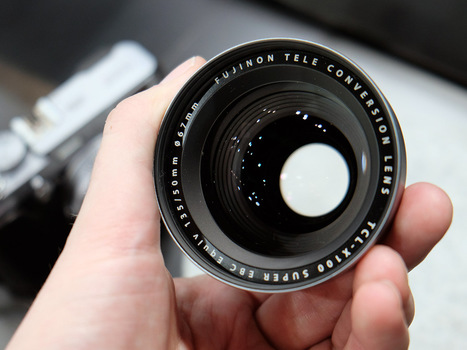
So of the four cameras that remain, Fuji's X-E2 and X-M1, Panasonic GX7 and Sony A7, I have to decide what to keep and what have to find new homes on ebay. I may of course keep all of them or sell all of them. At this moment in time all options are on the table. I don’t purchase cameras very often, but when I do I have good reasons why. At the most I purchase one per year and then not every year. So why did I purchase the Fuji X100s? Meet the new Tele Conversion Lens for the X100/X100S that turns the fixed 23mm into 35mm (50mm equiv) pic.twitter.com/fqcOuCbjfl
hpc's insight:
Not often a scoop is on a tweet but this one is interesting: a teleconverter for the X100(s) has been waited by some users, the orgigin of the tweet gives it high credibility. I was able to have a very brief hands-on (10-15 mins) with a Fujifilm X-T1 during Photoworld Asia 2014 in Glorietta Mall, Metro Manila. So all of the images you see from this post are from the X-T1, most likely a pre-production unit since according to the Fujifilm guys, X-T1′s will reach our shore end of February or early March. Quite a few (20ish if I remember correctly) already signed up to reserve a unit that’s how good and enticing it is – if money/price weren’t a part of the equation I would have gladly placed my name, number and email address. We all know the Fuji XP1 is an amazing camera. Ahhh, it’s a gimme. Ya know…I get hit with emails, pm’s on forums, text messages etc about how I’m not getting the most from my camera because I’m using the weakest link in the Fuji lens lineup, the 18mm.
hpc's insight:
Nice The Fujifilm X-T1 is a compact system camera, but unlike models such as the Fuji X-E2 and Fuji X-Pro1, it has an SLR-like design. In essence this means that ... When I first went freelance I treated myself to some new gear. I bought a laptop – a necessary business expense – and a new camera, the Fuji X-Pro1, which at the time was on a special deal whereby you bought the body and an 18mm F2 lens for £999, and got a free lens from a choice of 27mm, 35mm or 60mm by redemption. I went for the 35mm F1.4. There are lots of benefits of using the tiny and silent Fuji X100S to photograph a wedding. Although I mainly use Canon cameras through the wedding day, there are many great opportunities when this little camera is a better option for me. That's usually when I want to get in close to my subjects without affecting their behaviour. Its small size, and silence is what's most important here. But there have been small and quiet compact cameras around for a while now - what makes the Fuji different is the amazing clarity and image quality. These images fit in perfectly with those shot on the larger Canon SLR's, and it's pretty hard to distinguish between them in the finished set. With his photographs of the Spanish Civil War and the Normandy invasion, the photojournalist Robert Capa has always been considered a giant of black-and-white photo reportage. But how much do we really know of his work in color? That’s the question posed by the groundbreaking exhibition Capa in Color at the International Center of Photography, perhaps its greatest in the past five years.
hpc's insight:
Not directly linked with FujiX but interesting nevertheless. |
Your new post is loading...