 Your new post is loading...

|
Scooped by
Gilbert C FAURE
September 19, 2025 3:23 AM
|
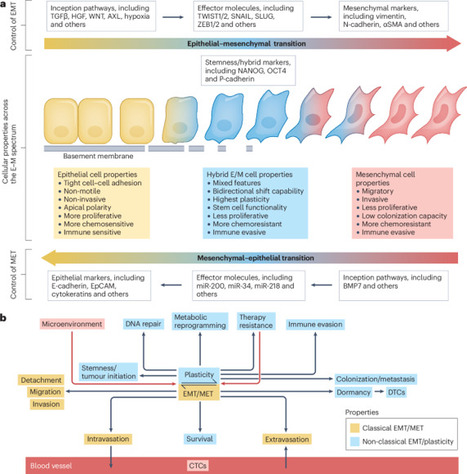
Cell plasticity is a crucial trait for cancer progression towards metastasis and treatment resistance. Research efforts from the past 20–30 years have revealed that the dynamic flux of the epithelial–mesenchymal transition (EMT) programme is one of the major underlying processes enabling cancer cell plasticity and greatly facilitates these major causes of cancer mortality. The spectrum of evidence ranges from extensive data from cell line and animal model studies across multiple cancer types through a rapidly expanding body of work demonstrating associations between EMT biomarkers and disease progression and mortality in patients. EMT is also implicated in resistance to most of the major treatment modalities, yet our efforts to harness this knowledge to improve therapeutic outcomes are currently in their early stages. In this Review, we describe clinical evidence supporting a role of EMT and the associated epithelial–mesenchymal plasticity in various stages of cancer in patients and discuss the subsequent clinical opportunities and challenges associated with attempts to implement this knowledge as novel therapies or clinical management approaches. Despite several decades of research that has revealed roles in the development and progression of many solid tumours, clinical translation of research targeting epithelial–mesenchymal transition (EMT) has thus far been limited. In this Review, the authors provide a summary of the role of EMT in cancer development and progression in the context of this lack of clinical translation, summarize the current status of direct or indirect EMT-modulating agents in clinical development, and highlight the major barriers to the development of EMT-related clinical interventions.
|
|
Scooped by
Gilbert C FAURE
November 8, 2019 1:02 PM
|
Background: The prognosis of early stage non-small cell lung cancer (NSCLC) is quite disappointing and the benefits of adjuvant therapy are relatively small. Thus, there is an urgent need to identify novel prognostic and predictive biomarkers. Lung adenocarcinoma has distinct clinical–pathological characteristics and novel therapeutic strategies are under active evaluation in the adjuvant setting. Here, we investigated the prognostic impact of circulating tumor cells (CTCs) and gene and miRNA tissue expression in resectable NSCLC. Patients and methods: We assessed the association between CTC subpopulations and the outcome of resected early stage lung adenocarcinoma (ADC) patients at three different time-points (CTC1-3) (before surgery, after one month, and after six months) in comparison to squamous cell carcinoma (SCC). Furthermore, gene and miRNA tissue expression, immunoprofiling, and epithelial-to-mesenchymal transition (EMT) markers were correlated with outcome. Results: ADC (n = 47) and SCC (n = 50) revealed different tissue expression profiles, resulting in the presence of different CTC subpopulations. In ADC, miR-155 correlated with AXL and IL6R expression, which were related to the presence of EMT CTC1 (p = 0.014 and p = 0.004). In the multivariate analysis, CTC2 was an independent prognostic factor for relapse-free survival, and CTC3 and AXL were independent prognostic for overall survival only in ADC. Neither the surgery nor the adjuvant treatment influenced the prognosis of these patients. Conclusions: Our study elucidate the prognostic impact of tissue AXL expression and the presence of CTCs after surgery in adenocarcinoma patients. Tissue AXL expression and CTC EMT activation could potentially represent biomarkers for the stratification of ADC patients that might benefit from new adjuvant therapies.
|
|
Scooped by
Gilbert C FAURE
November 2, 2018 10:08 AM
|
The presence of circulating tumor cells (CTCs) in the peripheral blood is a prerequisite for progression, invasion and metastatic spread of cancer. Consequently, the enumeration and molecular characterization of CTCs from the peripheral blood of patients with solid tumors before, during and after treatment serves as a valuable tool for categorizing disease, evaluating prognosis and for predicting and monitoring therapeutic responsiveness. Many of the techniques for isolating CTCs are based on the expression of epithelial cell surface adhesion molecule (EpCAM, CD326) on tumor cells. However, the transition of adherent epithelial cells to migratory mesenchymal cells (epithelial-to-mesenchymal transition, EMT) - an essential element of the metastatic process - is frequently associated with a loss of expression of epithelial cell markers, including EpCAM. A highly relevant proportion of mesenchymal CTCs cannot therefore be isolated using techniques that are based on the ‘capture’ of cells expressing EpCAM. Herein, we provide evidence that a monoclonal antibody (mAb) directed against a membrane-bound form of Hsp70 (mHsp70) - cmHsp70.1 - can be used for the isolation of viable CTCs from peripheral blood of tumor patients of different entities in a more quantitative manner. In contrast to EpCAM, the expression of mHsp70 remains stably upregulated on migratory, mesenchymal CTCs, metastases and cells that have been triggered to undergo EMT. Therefore, we propose that approache
|
|
Scooped by
Gilbert C FAURE
April 11, 2017 12:26 PM
|
|
|
Scooped by
Gilbert C FAURE
June 12, 2016 2:06 PM
|
Cancer stem cells (CSCs) constitute a small subpopulation of cancer cells with stem-like properties that are able to self-renew, generate differentiated daughter cells, and give rise to heterogeneous tumor tissue.
|
|
Scooped by
Gilbert C FAURE
December 18, 2015 3:47 AM
|
The adaptor protein ShcA protects epithelial cells from transitioning toward a mesenchymal phenotype by controlling partitioning of the TGF-β receptor and repressing downstream Smad2/3 activation.
|
|
Scooped by
Gilbert C FAURE
August 20, 2015 8:25 AM
|
by Yidan Zhi, Zhirong Mou, Jun Chen, Yujun He, Hui Dong, Xiaolan Fu, Yuzhang Wu
Cancer stem cells (CSCs) can invade and metastasize by epithelial-to-mesenchymal transition (EMT). However, how they escape immune surveillance is unclear.
|
|
Scooped by
Gilbert C FAURE
April 24, 2015 11:25 AM
|
Fluxion Biosciences Introduces the IsoFlux™ EMT Enrichment Kit for More Comprehensive Circulating Tumor Cell Analysis read Fluxion Biosciences news in the SelectScience scientific news archive
|
|
Scooped by
Gilbert C FAURE
August 19, 2014 2:16 PM
|
Phys.Org Microchip reveals how tumor cells transition to invasion Phys.Org The epithelial-mesenchymal transition (EMT) is a process in which epithelial cells, which tend to stick together within a tissue, change into mesenchymal cells, which can...
|
|
Scooped by
Gilbert C FAURE
November 24, 2013 1:31 PM
|
Emerging evidence indicates that breast cancer stem cells (CSCs) and the epithelial-to-mesenchymal transition (EMT) cooperate to produce circulating tumor cells (CTCs) that are highly competent for metastasis.
|
|
Scooped by
Gilbert C FAURE
November 29, 2012 3:03 PM
|
Study helps resolve debate about how tumors spreadMedical Xpress"Since reversion of EMT promotes colonization and growth of metastases, this study actually cautions that therapies inhibiting EMT could be counterproductive in preventing distant metastases...
|
|
Scooped by
Gilbert C FAURE
November 21, 2011 4:33 AM
|
This time I'll be writing about a paper that recently appeared in the journal Cancer Cell. The paper is something of a landmark because it has showed how the mere interaction of platelets with cancer cells is sufficient to induce ...
|
|
|
Scooped by
Gilbert C FAURE
February 27, 2021 1:02 PM
|
Epithelial stem cells serve critical physiological functions in the generation, maintenance and repair of diverse tissues through their ability to self-renew and spawn more specialized, differentiated cell types. In an analogous fashion, cancer stem cells have been proposed to fuel the growth, progression and recurrence of many carcinomas. Activation of an epithelial–mesenchymal transition (EMT), a latent cell-biological programme involved in development and wound healing, has been linked to the formation of both normal and neoplastic stem cells, but the mechanistic basis underlying this connection remains unclear. In this Perspective, we outline the instances where aspects of an EMT have been implicated in normal and neoplastic epithelial stem cells and consider the involvement of this programme during tissue regeneration and repair. We also discuss emerging concepts and evidence related to the heterogeneous and plastic cell states generated by EMT programmes and how these bear on our understanding of cancer stem cell biology and cancer metastasis. A more comprehensive accounting of the still-elusive links between EMT programmes and the stem cell state will surely advance our understanding of both normal stem cell biology and cancer pathogenesis. This Perspective outlines the connections of epithelial–mesenchymal transition programmes to the stem cell state in both normal and cancer stem cells and discusses emerging concepts related to the heterogeneous and plastic cell states generated by an epithelial–mesenchymal transition that influence our understanding of cancer stem cell biology and cancer metastasis.
|
|
Scooped by
Gilbert C FAURE
November 21, 2018 8:04 AM
|
Epithelial–mesenchymal transition (EMT) is crucial for embryogenesis, wound healing and cancer development, and confers greater resistance to cancer therapies. This Review discusses the mechanisms of EMT and its roles in normal and neoplastic tissues, the contribution of cell-intrinsic signals and the microenvironment to inducing EMT, and its effects on the immunobiology of carcinomas.
In cancer, the epithelial-to-mesenchymal transition (EMT) is associated with tumour stemness, metastasis and resistance to therapy. It has recently been proposed that, rather than being a binary process, EMT occurs through distinct intermediate states. However, there is no direct in vivo evidence for this idea. Here we screen a large panel of cell surface markers in skin and mammary primary tumours, and identify the existence of multiple tumour subpopulations associated with different EMT stages: from epithelial to completely mesenchymal states, passing through intermediate hybrid states. Although all EMT subpopulations presented similar tumour-propagating cell capacity, they displayed differences in cellular plasticity, invasiveness and metastatic potential. Their transcriptional and epigenetic landscapes identify the underlying gene regulatory networks, transcription factors and signalling pathways that control these different EMT transition states. Finally, these tumour subpopulations are localized in different niches that differentially regulate EMT transition states.
Via Krishan Maggon
|
|
Scooped by
Gilbert C FAURE
July 23, 2016 3:30 AM
|
Epithelial–mesenchymal transition (EMT) is prominent in circulating tumor cells (CTC), but how it influences metastatic spread in this setting is obscure.
|
|
Scooped by
Gilbert C FAURE
January 28, 2016 3:51 PM
|
Epithelial–mesenchymal transition (EMT) is a complex molecular program that regulates changes in cell morphology and function during embryogenesis and tissue development. EMT also contributes to tumor progression and metastasis.
|
|
Scooped by
Gilbert C FAURE
September 26, 2015 3:11 AM
|
by Michaël Ruff, Anthony Leyme, Fabienne Le Cann, Dominique Bonnier, Jacques Le Seyec, Franck Chesnel, Laurent Fattet, Ruth Rimokh, Georges Baffet, Nathalie Théret The increased expression of the Disintegrin and Metalloprotease ADAM12 has been...
|
|
Scooped by
Gilbert C FAURE
July 3, 2015 4:48 AM
|
Network biology approach to EMT in cancer metastasis: three stage theoryの 文がJ Mol Cell Biolからpublishしました. co-firstです. http://t.co/siY03ldF2i
|
|
Scooped by
Gilbert C FAURE
November 17, 2014 2:09 PM
|
Scientists at the Cancer Science Institute of Singapore (CSI Singapore) at the National University of Singapore (NUS) and their collaborators have developed a scoring scheme that predicts the ability of cancer cells to spread to other parts of the...
|
|
Scooped by
Gilbert C FAURE
March 14, 2014 8:36 PM
|
Epithelial-to-mesenchymal transition (EMT) and its reverse process, mesenchymal-to-epithelial transition (MET), play important roles in embryogenesis, stem cell biology, and cancer progression. EMT can be regulated by ...
|
|
Scooped by
Gilbert C FAURE
January 12, 2013 1:45 PM
|
Good work showing that #CTCs can be hard to find due to EMT, that is unless you have the right platform- http://t.co/Ruj9gOb6
|
|
Scooped by
Gilbert C FAURE
May 30, 2012 10:07 AM
|
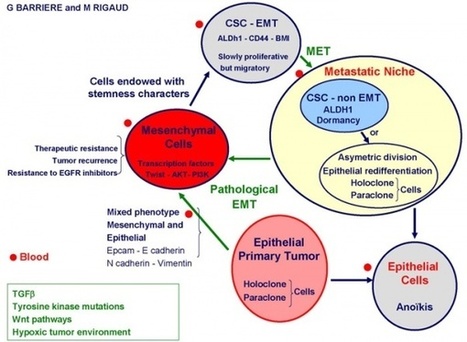
Epithelial mesenchymal transition (EMT) is a crucial event likely involved in dissemination of epithelial cancer cells. This process enables them to acquire migratory/invasive properties, contributing to tumor and metastatic spread.
|















https://www.scoop.it/topic/from-flow-cytometry-to-cytomics?q=emt
bibliographie archivée sur