


If you are serious about marketing your business, you need to tap into the hidden power of stories. Here are the four top stories you need to grow your business.
Via Kathy Hansen
Get Started for FREE
Sign up with Facebook Sign up with X
I don't have a Facebook or a X account


 Your new post is loading...
 Your new post is loading...
Your new post is loading...
 Scoop.it!
If you are serious about marketing your business, you need to tap into the hidden power of stories. Here are the four top stories you need to grow your business. Via Kathy Hansen 
No comment yet.
Sign up to comment
Scoop.it!

Successful marketers tell a compelling story, and that story creates word-of-mouth. They don’t talk about features or even benefits. They tell a story that we intuitively embrace, buy into, then pass on to other people, writes Robert Clay of Marketing Wizdom.
Companies go from start-up to market leadership through the correct use of stories. By articulating everything you do in a compelling manner in the form of a story, you bring everything alive, you make the invisible visible, you enable everyone in your team to rapidly understand exactly what you’re about, and deliver your product, service or expertise in a better and more consistent manner.
Present your story to the right people in the right way, and they will intuitively embrace it, buy into it, develop a passion for what you do and pass your story on for you. And this will happen in a fraction of the time it would take to get your message across by any other means.
Scoop.it!

There are eight million stories in the naked city, but the tales are truly stripped at “Bare.”
That’s the name of a monthly storytelling night at Brooklyn’s Union Hall, where guests — some of them comedians or radio hosts, but many of them non-entertainers — gather to hear the strangest and most satisfying moments of each other’s sex lives.
It’s just one such evening in the city’s vast and varied storytelling scene. More heartfelt than stand-up comedy, more impromptu than any reading series, storytelling is about sharing things that have happened in real life.
Scoop.it!
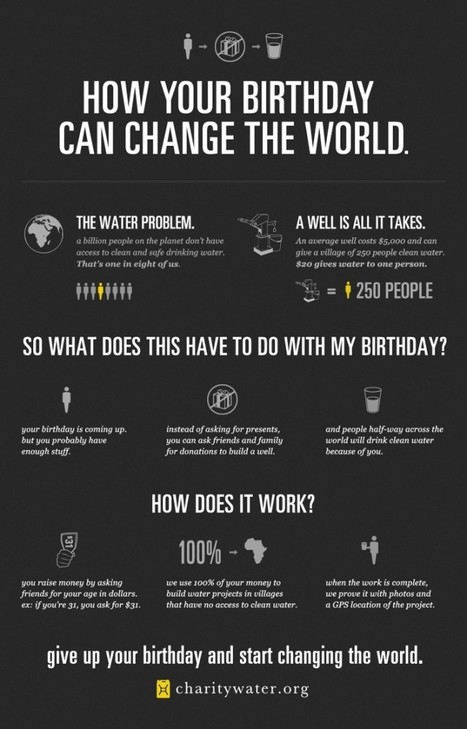
What are the story elements an infographic can use to be more effective? It needs to be emotionally engaging in ways that offer people a way to make a difference Metphor A beginning, middle & end with a story arc Statement of a problem and ways for resolution Story triggers -- graphics and words that trigger stories within the minds of viewers A point, a key message Suggested actions to take
Not all infographics need to tell a story. Before embarking on creating an infographic, ask yourself the following strategic questions: Who is my target audience? What important information does my target audience need or want to hear? Is the purpose of the infographic to share information, educate people, or create a context for understanding an issue? Is the purpose of the infographic to spark action -- either donations, support, or advocacy? What is my key message? What do I want my viewers to take away from the experience?
If you answered YES to #4, then you need your infographic to tell a story. If you answered YES to #3, then your infographic only needs to convey information.
Go read the article for more great infographic insights.
Scoop.it!

People asked me to explain how the Digital First approach might change the work of a business reporter, investigative reporter, lifestyle reporter and a reporter covering multiple beats. I'm not spelling out here how anyone should work. I’m suggesting things to consider as you decide how to work. Instead of going through each of the beats I was asked to address, as I’ve done with some of the others, I’ll list some questions and tasks any reporter should consider in working on any beat. I’ll answer them for some of the examples I was asked about, but the answers may be different for your beat.
For example, use a beatblog. You want to engage with two segments of the public: those with casual or occasional interest and those with intense and continuing interest. Your stories meet the first need. Your beatblog meets the second need. Your beatblog is a place to interact with people who care the most about the community or topic you cover: Ask for story ideas or angles, seek sources, seek feedback.
Scoop.it!

[Found via http://www.fastcodesign.com/1664000/app-turns-your-facebook-page-into-an-art-show] App turns your Facebook page into an Art Show.
This web app creates a retrospective of the most important figure of the era: you. Your Facebook page is already something of a minor art show, highlighting your little place in the cultural firmament through photographs and likes and cheerful cartoon chickens. Well now, you can turn it into a full-blown museum exhibit.
Intel’s Museum of Me draws info from your Facebook profile and sprinkles it throughout a virtual art gallery that looks and feels precisely like a real art gallery, right down to the pretentious signage and the solemn visitors pretending to think deep thoughts about the crap on the walls.
Scoop.it!

That’s right, ds106 is running again in the Spring of 2012 (starting January 16). One major change for this semester is there will be no predefined assignments, everyone will simply pick the assignments they want to do based on a rating system.
This course will require you to both design and build an online identity and narrate your process throughout the fifteen week semester. Given this, you will be expected to openly frame this process and interact with one another throughout that course as well as engage and interact with the world beyond as a necessary part of such a development.
In many ways this course will be part storytelling workshop, part technology training and, most importantly, critical interrogation of the digital landscape all around us that is ever increasingly defining the the way we communicate with one another.
For more information on ds106 and the course calendar & syllabus http://ds106.us/wiki/index.php?title=Main_Page
Scoop.it!

How to create a polished, powerful digital story for yourself or your nonprofit.
Digital storytelling is a craft that uses the tools of digital technology to tell stories about our lives. Done properly, storytelling can be a powerful, evocative way of communicating themes and stories, often touching us in deeper ways than one-dimensional videos that rarely probe beneath the surface of people’s lives. Nonprofits, especially, can use this technique to convey powerful, emotion-filled messages — by letting the people you’re helping tell their own stories.
Scoop.it!

In school, teachers ask us to imagine that electricity is both a wave passing through material such as a copper wire, and the agitation of static copper particles within the wire.
When it comes to understanding the function of storytelling inside organisations, the same teaching could be helpful. No story works without a narrative, or basic carrier wave holding its sense. But as that story passes from mouth to mouth, so individuals become excited, just like those charged copper particles. And just like electricity, the dual nature of storytelling can lead to shocks for those who misunderstand its power, or try to short-circuit one or other of its characteristics.
Inside large organisations, there’s plenty of confusion about labels. Is storytelling really a corporate communications discipline? Is it really about people management skills rather than content? Or does it fit best in the leadership development space inhabited by business coaches?
Scoop.it!

The key to telling a good story, whether it’s in front of a campfire or on screen, is drawing your audience into the story. When your audience is fully involved in the story, they’re giving life to your characters. They’re filling in everything that happens between the moments you’re showing on screen. They’re anticipating what will happen next. They’re rooting for what they hope will happen, or rooting against what they fear will happen.
Pushing is giving the audience more story than they can absorb. If you’re pushing story at them, you’re not pulling them into the story. You pull them in by giving them reasons to want more story than you’ve given them so far.
Scoop.it!

We’ve all heard that everyone has a story to tell. And from what I’ve learned over the past two years of studying the art and craft of writing, it needs to be universal so that others can relate while highlighting our own uniqueness so the story only we can tell can be told.
We all have a treasure chest inside of us just waiting to be opened…
Given that we move past that pesky inner critic who tries to convince us that our story is boring, sappy, not believable or whatever else it needs to convince us not to move forward, let’s talk about how we do find our story. Here are some gold nuggets of advice from a sampling of writers, memoir teachers and Top Ten Bloggers I have discovered while digging for my own treasures...
Scoop.it!

Here’s one of the most important tips in Bringing Your Message to Life: People deeply relate to characters in the stories they love. If they see you as part of a story that really matters, they’ll relate to you, too. So take a look at the eBook if you’d like to know more about how to cast your organization, your business (or yourself) as the central character in a story that moves your audiences.
Scoop.it!

The cultural narrative is broken. Most of us are acutely aware of this current state of affairs, especially in the broader context of systemic change. We see that our institutions (education, finance, politics, economy) are not equipped to serve us any longer, and we’re clawing around for a story (or stories) to describe the “new way of doing things” that can be agreed upon by society so we can move forward.
People are disillusioned and lacking trust, and a new story infused with simplicity, aesthetics, beauty and grace will go far. I think many of us are looking for something resonant to believe in and stand behind, something that is in alignment with our deep desires, passions, values and principles.
|
Scoop.it!

The definitive guide to keeping a journal, including the tools to use, writing prompts for beginners, and an explanation of why journaling is important. Via Kathy Hansen
Scoop.it!

A new study by a professor at Franklin W. Olin College of Engineering suggests that the stories we tell ourselves when we reflect on the challenges in our lives can play a major role in improving our mental health, particularly when we interpret our life as the product of our own actions.
“The big take away message of this study is that you are not only the main character in your story, but also the narrator,” said Jonathan M. Adler, assistant professor of psychology at Olin College and author of the study. “Even though you don’t get to dictate everything that happens to you, you do get to determine how you make sense of your life, and that process can have enormous impact on your mental health.”
Scoop.it!

We are a new sister site of The Digichick, a digital scrapbooking community whose main goal is to help you "Capture, Record and Preserve Your Life's Story."
The key thing we have forgotten is that the goal of scrapbooking is to be recording our most precious memories, telling our stories, writing it all down while these things are still fresh in our minds! Pictures are beautiful things. Scrapbookers love the art of photography. But, I’m sorry, most photos are not worth 1,000 words—photographs cannot speak for themselves. If you were given a photograph of your great-grandmother as a child, what would you know about it by just looking at it? Where was it taken? Why was it taken? Is there a story behind this or that little detail? Wouldn’t you want someone there to tell you all about it?
As a memory keeper, this is where YOU come in. That is your role!
Scoop.it!

Piles of credit card debt. Sleeping in parents' basements. David-and-Goliath showdowns. These are just some of the popular elements of startup mythology that show up on the "About Us" pages of company websites--and with good reason.
There was a time when a company's "About Us" page didn't matter quite so much: A short bio, a mission statement and boom, done. These days, corporate-weary consumers care more and more about buying locally, supporting independent businesses and owning products that are made sustainably and responsibly. They want to know the story of what they're buying, who is selling it and what causes it may support. In a business landscape where success hinges on establishing a personal connection with customers and investors, the "About Us" page has become prime real estate.
Michael Antonorsi, co-founder and master chef of Carlsbad, Calif.-based Chuao Chocolatier, knows this firsthand. "Storytelling is huge for business," he says.
Scoop.it!
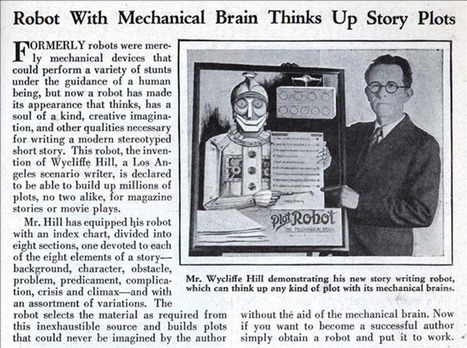
In 1894, French critic Georges Polti recognized thirty-six possible plots, which included conflicts such as Supplication, Pursuit, Self-sacrifice, Adultery, Revolt, the Enigma, Abduction, and Disaster. In 1928, dime novelist William Wallace Cook, author of Plotto: The Master Book of All Plots, did him one better, cataloging every narrative he could think of through a method that bordered on madness. His final plot count? 1,462.
Plotto, reissued last month by Tin House, was a manual that aimed to mechanize the entire narrative trade. In his introduction, Paul Collins recognizes that Cook was something of a plot machine himself, once writing fifty-four novels in a year, more than one a week. Cook’s methods were developed into a Plotto Studio of Authorship in New York City, his book hailed as “an invention which reduces literature to an exact science.”
Scoop.it!

Great presenters are storytellers. And because audiences need more than slides, they tell stories with powerful interpersonal communication tools, like gestures, posture, and facial expressions. Great presenters know we’re wired for body language.
Scoop.it!

Social marketing used to be just that thing you did; like politicians, business owners would scout the neighborhood, introduce their services, shake hands and kiss babies. You’d talk to people and get to know them; you’d share stories and maybe a cup of coffee.
Fast forward. Today, all of the above is called social networking and social marketing. The difference is that your neighborhood, thanks to the Internet, has billions of people in it. You have a wider reach, and there’s a lot more hands to shake. - But, you still have to be actively involved.
You have to interact for social marketing to work at all. You have to be involved. Normally, you’re using social media to connect with your customers and build your reputation, right? So you pour out all this good stuff and you wonder… are people really listening? Is this making any difference? Am I wasting my time? Let’s address these things one at a time...
Scoop.it!
When you hear, "tell me a story," does your mind suddenly go blank? Don't panic. Do you know that the best corporate leaders liven a business presentation with a story, but you don't know how? Don't worry.
The good news is you're already a natural storyteller! Surprised? You shouldn't be. It's built right into our genetic code.
How do you go from being a "natural" storyteller to being a good one? Here are ten tips to get you started...
Scoop.it!

Digital Storytelling takes a plot, event or idea and enriches it with engaging media and interaction. A tool that has recently become a lot easier for students to integrate into their digital storytelling is Twitter.
One new feature that we are thrilled to see is the ability to take Tweets and embed them anywhere. This has a number of really useful applications and lets conversations travel much further than Twitter.com. As each Tweet is an individual thought, reaction or opinion, it a fascinating experience for students to pull together Tweets to tell real life, digital stories.
Scoop.it!

Good storytelling lies at the very heart of good litigation. Neither the information revolutions of the digital age, nor the dizzying advances of technology have changed that.
The challenge lawyers face is that of adapting the storytelling art to the requirements and capacities of our day. Discovery and review must articulate the client’s most compelling story. It must disable the counter-story told by the other side. Story-centric reviews serve as powerful levers for the other assets – both human and hard – committed to the work of review excellence. This is important work. Justice depends on a compelling story and injustices arise when we forget that.
Scoop.it!

The Professional Values & Story Index (PVSI) from the Storybranding Group is an assessment based on a model created by Dr. Carol S. Pearson, who specializes in story archetypes. The site describes the index as a “story typing instrument for individuals that illuminates professional assets, values, and gifts through a story-based lens.”Unlike the assessments in my 5-part series on Life-Story Interventions that Guide Career Choice, the PVSI doesn’t use storied techniques to arrive at self-actualization or help users come up with a preferred career/life story. Instead, it looks at story type, resulting in one of 12 story types.
Check out the PVSI at http://www.storybranding.com/site/take-the-pvsi-survey.php
Scoop.it!

[while every country has their own copyright laws, this is a good example of the terms, timeframes & complexities]
A resource published by Cornell University http://copyright.cornell.edu/ as of January 1, 2012.
|




