 Your new post is loading...
"If you want to separate your content from your competitors, storytelling is a great tactic to add to your content marketing strategy. Several interesting case studies have shown how the implementation of storytelling can triple sales within one year. The best part is that any business can use storytelling in their content marketing strategy by following these five best practices."
Read the full article to find out more about these best practices and see examples: - Know your ideal audience
- Tell stories that your ideal audience can relate to
- Use stories in various aspects of your content
- Listen to your ideal audience
- Create a series
Via Kamal Bennani

|
Scooped by
Kim Zinke (aka Gimli Goose)
February 3, 2015 12:17 AM
|
"Research on storytelling in executive development found storytelling outperformed many other development initiatives in creating leadership skills. When leaders learn storytelling it “builds strategic competence and strengthens organizational character.” This is not about learning how to give a quick pep talk, but embedding storytelling into the organization as cultural and leadership norms.
In my work coaching executives, clients frequently voice uncertainty about when to tell a story, what kind, and in what situation. To that end, I’ve developed a list of common leadership stories to use as a guide. While there’s overlap between these at times, in general, leaders should have stories in each of these buckets to draw from when needed."
Read the full article to find out more about this list of leadership stories and examples of each: - challenge stories
- relating stories
- metaphoric stories
- vision stories
- potential stories
- cautionary tales
- humorous stories
|
|
Scooped by
Kim Zinke (aka Gimli Goose)
January 31, 2015 11:17 PM
|
National Storytelling Week (Sat 31 Jan to Sun 8 Feb) was set up by the Society for Storytelling 15 years ago and aims to promote the oral tradition of storytelling; celebrating our most ancient art form.
"We have sourced some sound advice from two of our directory storytellers who give simple tips for getting to grips with learning a story and top tips for telling a tale."
Read the full article to find out more about: - Ewan McVicar’s top 10 handy hints for storytelling. How to choose and tell a tell a story.
- Judy Paterson's step-by-step guide to learning a story. This is not as difficult as you might think. Once you have used this technique with simple and short stories you will find it easy to learn longer and more involved stories.
|
|
Scooped by
Kim Zinke (aka Gimli Goose)
January 27, 2015 2:21 AM
|
"Your business story matters, people want to know how you got here and what you can do to positively impact them and/or their business. The audience could be just one person or thousands, it doesn’t really matter, what does is that your story is true, engaging and relevant."
Read the full article to find out more about coach, entrepreneur and storytelling expert Madeline McQueen's top 10 techniques for mastering the art of telling a great story and captivating your audience: - Everyone has a story to tell so don’t be afraid to tell yours
- People buy people so make your business story personal
- Share information your audience can relate to
- Order your information
- Every story needs to have a point and must come to a conclusion
- If you are not sure about your story no one else will be
- Remember that storytelling in business is also a form of selling
- Know which story to choose
- Practice, practice, practice
- Time is precious so keep to it
|
|
Scooped by
Kim Zinke (aka Gimli Goose)
January 24, 2015 8:12 PM
|
"Storytelling is an art that takes planning, research, and skill; the storytellers make decisions along the way that drive their stories forward, engage their audience, and impart information vital to the telling of their story. The best content agencies understand this craft and can produce timely stories about a brand, product, or company.
By following these five rules, you too can tell an interesting, captivating story that will enchant your audience, share important information, and engage from beginning to end."
View the SlideShare to see more about these 5 rules of storytelling: - Understand your brand and audience, speak in an authentic voice
- Get your facts straight, use the 5 Ws
- The power of specifics, details, and imagery
- Show, don't tell
- Know the end at the beginning
|
|
Scooped by
Kim Zinke (aka Gimli Goose)
January 21, 2015 1:41 AM
|
"Martin Luther King and the legacy he left behind has transformed America over the last 50 years. He taught us poignant lessons about equality, strength of character and passion; but there’s a less obvious lesson he taught us in the way he inspired people with his words: By telling a great story."
Read the full article to find out about these key elements of the strikingly inspirational “I Have a Dream” speech and how to apply them to your story: - Structuring the Story with a Beginning, Middle and End
- Inciting Incident
- Using Imagery
- Using Analogies and Metaphors
- No Slides
|
|
Scooped by
Kim Zinke (aka Gimli Goose)
January 19, 2015 2:17 AM
|
"Have you heard that including numbers in your media pitch will attract journalist attention? Apparently, so has everyone else.
Knowing what makes a good story and how to find that story within your organization can help you refine your media pitches and engage customers more successfully."
Read the full article to find out more about these tips that can help brands uncover the stories within their business that connect to customers: - Answer the “so what?”
- Use nut grafs
- Incorporate figurative language
- Visualize your story
|
|
Scooped by
Kim Zinke (aka Gimli Goose)
January 12, 2015 8:15 PM
|
"So it should be natural that we tell others our stories as a means to influence them on the job. When tragedy strikes, the media doesn’t just report how many people died, the impact on the Richter scale or the economy, and the inches of snow, rain, or flooding. Instead, reporters find the people stories. They put a face to the tragedy by telling you of the single guy who jumped from the safety of his boat to save a drowning two-year-old whose parents, unable to swim, stood on the swollen river’s shore screaming for help.
But storytelling is not just about sensationalism. Storytelling makes leadership possible. A leader without the ability to tell a great story has lost the platform and power to persuade."
Read the full article to find out more about these 7 tips as you start to build your personal or business stories: - Show, don't tell
- Start with a hero
- Manage your ego
- Add some twists
- Make it interesting
- Create a callback line
- Challenge your listeners
|
|
Scooped by
Kim Zinke (aka Gimli Goose)
January 8, 2015 8:00 PM
|
#RIPRobinWilliams tweets show how to serialize your story
"What can you learn from Norm MacDonald’s Twitter tribute (would that be twibute?) to Robin Williams? What can’t you learn?! MacDonald shows us how to serialize our stories, how to get the word out in 144 characters or less — and when to stop typing."
Read the full article to view the six tips to take from MacDonald's tribute: - Tell a story
- Serialize your story
- Start strong
- Keep it short
- But don't compress the life out of it
- Know when to quit
|
|
Scooped by
Kim Zinke (aka Gimli Goose)
January 7, 2015 12:49 AM
|
"No matter the medium with which we work, we storytellers share a mission, and there’s much we can learn from those of other trades and backgrounds.
With the internet breaking down barriers between cultures and making more information instantly available, it is much easier for us to connect, collaborate and learn about the craft of storytelling from others. But the internet can also make things noisier—sometimes it’s hard to know where to look to be inspired and stay challenged."
Read the full article to find out more about these nine blogs that refresh an understanding of technique, inspire creativity, and expand storytelling consciousness: - Jonathan Gottschall
- Stillmotion
- McKee Story
- Medium
- Hurlbut Visuals
- TED Blog
- Longform
- Go Into the Story
- Song Exploder
|
|
Scooped by
Kim Zinke (aka Gimli Goose)
January 2, 2015 2:11 AM
|
"So, how do you go about constructing a story? There are some easy steps to follow to get started. First, establish your starting point by asking yourself these basic questions: Who is the audience? What is your goal in telling your story? Are you persuading someone to invest in your company? Are you trying to gain buy-in for an idea among your co-workers? Are you trying to inspire people to support a cause, an individual, or save someone’s life?
If you’re trying to do any of these, consider the below guideposts for good storytelling."
Read the full article to find out more about these seven storytelling tips: - Stories are about people
- Let your characters speak for themselves
- Audiences bore easily
- Stories stir up emotions
- Stories don’t tell: they show
- Stories have at least one “moment of truth”
- Stories have a clear meaning
|
|
Scooped by
Kim Zinke (aka Gimli Goose)
December 28, 2014 2:11 AM
|
"It doesn’t matter whether you write about the economy or something commonly considered “buzzworthy” like entertainment. Everyone has an interesting story waiting to be uncovered.
The challenge is finding the best way to tell that story so your audience wakes up and listens."
Read the full article to find out more about these six storytelling tips gleaned from an expert panel on digital storytelling: - Basics first: Get your audience to care.
- What’s your story in a nutshell?
- Show and (sparingly) tell.
- Visuals can help — and if you’re not careful, harm — your credibility.
- Video is the future.
- Finally, you gotta have faith.
|
|
Scooped by
Kim Zinke (aka Gimli Goose)
December 14, 2014 11:11 PM
|
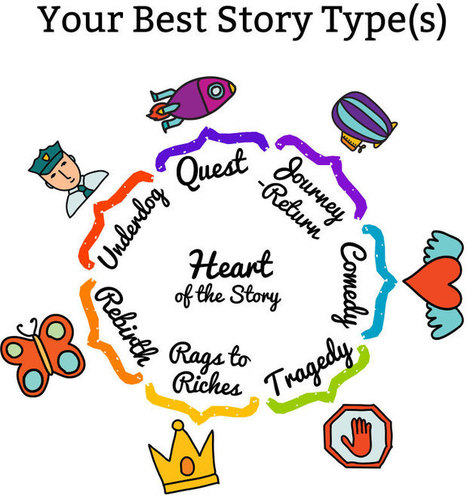
"According to experts, 99% of all stories ever told can be categorized into seven basic plots: Underdog, Quest, Journey/Return, Rags to Riches, Comedy, Tragedy, and Rebirth.
Understanding which plot your business/brand story falls into can help you focus your marketing messages and storytelling efforts into a more cohesive whole."
Take the quiz in this article to find out which of the seven major story plots best fits your needs.
|
Be it a feature film, a 30-second commercial or a tweet, there's no denying the impact of content that captures audience attention and genuinely engages them.
Read the full article to find out more about these three storytelling tips that will elevate your content marketing from textbook to must-read: - Introduce us to a hero
- Set the stakes
- Pay off
Via José Carlos
|
|
Scooped by
Kim Zinke (aka Gimli Goose)
February 1, 2015 6:42 PM
|
"Everyone knows that if you want people to support your cause you must tell stories. But if you really want to succeed, you have to tell the RIGHT STORY -- the story that pulls donors in, makes them hunger to donate to you. Here's how to tell that story."
View the full Slideshare to find out more about the three ways to tell a story in fundraising (one wrong, one correct, one half-right) and these 5 hints for donor-focused fundraising stories: - say "you" a lot
- put the donor in the story
- write like your Aunt Ruth
- keep your heart on your sleeve
- avoid statistics
|
|
Scooped by
Kim Zinke (aka Gimli Goose)
January 29, 2015 2:13 AM
|
"So you are a film student or filmmaker and you’re interested in telling a story that will stay with your audience beyond the “fade out.” Let’s say you want a webisode to go viral. Or, a couple of years ago, you heard Disney and Fox talking about transmedia. Now you’re wondering how to stay on trend with these big distribution companies. How would you even begin to write, shoot and produce a story that is “transmedia” ready?
Read the full article to find out more about these four key elements you can pay attention to when creating your work that makes it easier to transition into something interactive and cross-platform: - create a story world
- create mystery boxes within that world
- master the anatomy of the viral video
- shift your emphasis from storytelling to story making
|
|
Scooped by
Kim Zinke (aka Gimli Goose)
January 26, 2015 1:12 AM
|
"We’d like to introduce you to the newest member of our team. No, scratch that, we’d like to introduce you to the newest member of your team… The Solutions Journalism Toolkit!
Or at least that’s what we hope. We’ve spent months working on this comprehensive toolkit on everything solutions journalism in hopes that it can be your trusty guide as you practice this thrilling, and sometimes challenging, craft. You’ll find a wide range of information, including what kinds of data you might dig into, how to write about failure in an instructive way, how to paint a picture of compelling, complex characters, and much more."
Read the full article to download the free 48-page toolkit which is meant to be a practical guide for journalists and editors who are interested in incorporating solutions journalism into their work, and covers: - the basics of solutions journalism: what is it? What is it not? What impact can it have?
- how to find, vet, conduct interviews for, pitch, craft, and promote solutions journalism stories.
- four different solutions story structures and show you what they did right (positive deviant, big new idea, experiment in progress, location transformation).
- answers some of the most common questions about solutions journalism.
- tips from esteemed journalists on how to best practice solutions journalism.
|
|
Scooped by
Kim Zinke (aka Gimli Goose)
January 22, 2015 2:55 AM
|
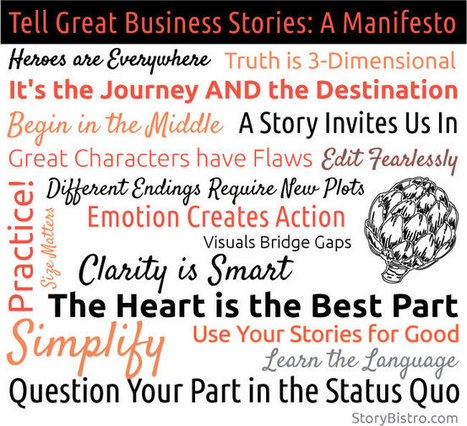
"Content marketing is the solution! You’ve got to tell more and better stories! Right. But how?
This isn’t just another bandwagon. This is truly important stuff. So, how do you — the micro biz owner — learn to tell an engaging story? Something that will move your clients to action?"
Read the full article to find out more about these tips from the business storytelling manifesto: - Truth is three-dimensional
- Edit fearlessly
- It’s the journey AND the destination
- Size matters
- Heroes are everywhere
- A story is an invitation
- Different endings require new plots
- Question your part in the status quo
- To join the tribe, learn its culture, its language
- Don’t begin at the beginning
- Great characters have flaws
- Bridge gaps with visuals
- Practice
- Simplify. Clarity is Smart.
- Emotion moves us to act
- Use your stories for good
- The Heart is the Best Part
|
|
Scooped by
Kim Zinke (aka Gimli Goose)
January 19, 2015 5:00 PM
|
"In the past, everything about case studies has probably made you run far away. They are often dry, generic, or pretty much just a high school pep rally (minus the cool letterman jackets) cheering on a company, product, or solution. But they don't have to be.
Good case studies can help to subtly yet persuasively show off products or services. They tell the story of a business problem that your customer had and what you did to help overcome it. Statistics offer tangibility, and quotes from the customer give credibility."
It's time to take a different approach to writing case studies so that they're read and shared—and result in more leads. Read the full article to find out more about these five things you should keep in mind to create case studies that are less boring and more effective: - Build suspense
- What's in it for them?
- Testimonials are everything
- Make it visual
- Don't lie
|
|
Scooped by
Kim Zinke (aka Gimli Goose)
January 16, 2015 1:00 AM
|
"This video illustrates a simple method I’ve developed that not only helps you remember the story, but it also helps you associate the story with things that are meaningful and relevant so it pops to mind when you most need it. And as an added bonus making the connection to meaning reinforces your ability to remember."
|
|
Scooped by
Kim Zinke (aka Gimli Goose)
January 11, 2015 6:09 PM
|
"Take two minutes to watch this advert from IKEA. Those two minutes are guaranteed to change how you think about marketing your business. This video is more than just advertising designed to sell something, it’s a home run in brand storytelling."
Read the full article to find out more about these 10 things that Ikea did to make their story great:
- Understood their customer’s worldview.
- Made the customer the hero.
- Started with his story.
- Changed how the customer felt and acted in the presence of their product.
- Understood what they are really selling.
- Helped us to see reflections of ourselves in the hero.
- Tapped into our emotions, creating a visceral connection with the brand.
- Created advertising that aligns with the company’s vision and brand personality.
- Backed up the story with the experience delivered in store and across all touchpoints with the brand.
- Gave potential customers something to believe in.
|
|
Scooped by
Kim Zinke (aka Gimli Goose)
January 8, 2015 1:58 AM
|
"What exactly is a story?
Let me give you a hint: a quote from Steve Jobs is not a story. A customer testimonial is not necessarily a story. A picture of a dog in the rain may or may not be a story.
A true story — one that carries the full impact a story promises — contains certain fundamental elements."
Read the full article to find out more about these fundamental building blocks for crafting a simple, effective story: - Story at work
- Characters count
- Emotion fuels stories
- Focus is essential
- Everybody can tell a story
|
|
Scooped by
Kim Zinke (aka Gimli Goose)
January 2, 2015 2:00 PM
|
"At the end of every year, we tell ourselves a story. We piece together the narrative of our much kinder, much healthier and much more successful selves. We pack it into an unrealistic yet hopeful wish that we send out into space on December 31st.
So we make New Year’s resolutions, only to break them on January 1st. And that’s ok. We are no more than human. But a resolution that can help us on all levels is rather simple (this is not a self-help book). It’s all about finding your existing strengths and quirky, cool sides, not about reinventing yourself within a year.
It’s all about finding your own narrative and, yeah, embracing it. And this concerns both yourself and your brand. And if you want to make a few more meaningful resolutions for your business, let’s go with storytelling ones."
Read the full article to find out more about these storytelling resolutions that will help you find and tell your story this year: - Dig in your own past to find your brand’s story
- Start thinking in stories
- Do visual storytelling
- And do video storytelling. A lot of it
- Find the right channels and the right people
- Then let your customers continue the story
|
|
Scooped by
Kim Zinke (aka Gimli Goose)
December 31, 2014 12:38 AM
|
By ascribing a story to your company, you provide an illustrated example of how, why and what you do, while assigning an emotional weight to your company’s journey. The result is the creation of a brand. How can you harness that emotional response to better communicate your company’s mission and overall goals? Let’s examine some of the tenets of storytelling for business and how they can be applied to your organization."
Read the full article to find out more about these elements of a brand story and where companies can typically find them: - Inciting incident
- Rising action
- Turning point (climax)
- Falling action
- Denouement
|
|
Scooped by
Kim Zinke (aka Gimli Goose)
December 27, 2014 1:48 AM
|
"Storytelling has been one of our defining human characteristic, even before we developed oral languages. Signs, marks on the skin, drawings on the sand, were common ways to communicate achievements, the location of water, or the whereabouts of dangerous enemies waiting to ambush their prey. With time, we have developed sophisticated ways of transforming information into narratives, relaying messages, and conveying images."
Read the full article to see examples and find out how to make stories memorable using these 5 storytelling lessons from history: - The Lascaux & Chauvet caves in France - the caveman lesson: Use familiar images. Pick visuals that your audience can relate to, and pair them with your message. Your audience will understand it and remember it vividly.
Hieroglyphics... Infographics? - the mummy lesson: Present your hard data using infographics while threading a compelling story. Combine this with the Caveman Lesson: use familiar images and your audience will understand and relate to your message, and most importantly, remember it. The Bible, Coran, Talmud, Vedas - the God almighty lesson: Build narratives around things that you know and use shared and common examples so your audience can relate. Use repetition when you cannot use images and do so in subtle ways, introducing slight variations each time. Then re-write, re-write, and re-write once again… Aesop's Fables and the moral of the story - the fabulist lesson: Be concise. Make your story self-explanatory, and don’t give all the answers. Never underestimate your audience’s intelligence: provide value, guide them, and let them come to their own conclusions.
Reason & emotion: The stories of William Shakespeare - the bard's lesson: Plan your story and give it a clear plot with a well defined arc — it will keep your audience engaged. Know your audience and make sure your story uses the right voice, style and language.
|























add your insight...
307Another great article about the power of storytelling, to create interesting content and ideas, such as case studies, about how to pu together stories to tell.
245