


Hirschman made his arguments without mathematical formulas or complex models. His subject was economics, but his spirit was literary.


|
Scooped by
Beth Kanter
onto Failure and Learning June 20, 2013 8:57 AM
|
 Scoop.it!
Hirschman made his arguments without mathematical formulas or complex models. His subject was economics, but his spirit was literary.

 Your new post is loading...
 Your new post is loading...
Your new post is loading...
Scoop.it!
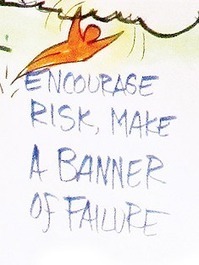
Some thoughts on the Innovation and Nonprofits Plenary panel ... including a renewed sense to curate and write about failure

Beth Kanter's comment,
December 13, 2013 8:49 AM
I was thinking about you yesterday - I'm taking a workshop with Lisa Heft on facilitating emergent experiences.

june holley's comment,
December 13, 2013 8:52 AM
I'm doing a research project on network leadership - have 30 minutes to talk - need your help!!! I'll email
Beth Kanter's comment,
December 13, 2013 9:03 AM
into next week, would love to catch up and hear what you're doing.
Scoop.it!
Beth Kanter's insight:
This article includes 10 skills to learn to be successful. I'm focusing on the asking good questions: "Good questions are ships that sail us into discovering lands and that can open up the opportunity to uncover things we would have never imagined... unless we asked." Source: Robin Good Why
How: Learn and practice the use of the 5 Ws. These are questions whose answers are considered basic in information-gathering. They are often mentioned in journalism (cf. news style), research, and police investigations. They constitute a formula for getting the complete story on a subject.
a) Factual b) Interpretive c) Evaluative Source: Asking Questions - The Key to Engaging Students in Learning - LessonPaths
Scoop.it!
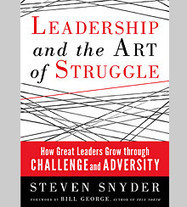
Judith E. Glaser, author of Creating WE: Change I-Thinking to We-Thinking and Build a Healthy Thriving Organization, introduces a passage illuminating the drivers of success from Leadership and the Art of Struggle: How Great Leaders Grow through...
Beth Kanter's insight:
Summarizes the research on growth vs fixed mindsets from Carol Dweck and others. "The real secret of success resides in people’s mind-set. He shows how a “fixed” mind-set that ascribes success to innate qualities is less resilient and adaptable than a “growth” mind-set that connects achievement to continuous learning and persistence
Beth Kanter's curator insight,
April 2, 2013 11:32 AM
Summarizes the research on growth vs fixed mindsets from Carol Dweck and others. "The real secret of success resides in people’s mind-set. He shows how a “fixed” mind-set that ascribes success to innate qualities is less resilient and adaptable than a “growth” mind-set that connects achievement to continuous learning and persistence."
Scoop.it!
These failures, in no particular order, were found through research in the print media and on the web and from the contents of our brains.
Scoop.it!
Posts about Fail Forward written by jewishedproject
Beth Kanter's insight:
Looks like Lisa is looking at failure!
Scoop.it!
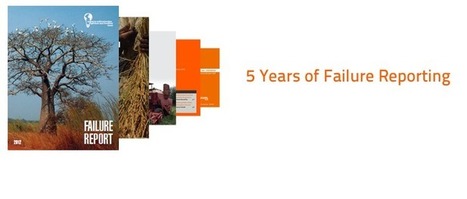
Failure Reports: A How-To Guide is intended to support organizations who are interested in documenting and learning from their failures, and using the process as a launch point for organizational c...
Scoop.it!

FailCon 2013 FailCon has traveled around the world, visiting over a dozen countries since its inception in 2009. Now we're back in our home city of San Francisco to teach new lessons, focus on the best stories of the...
Beth Kanter's insight:
"Fail fast, fail often." Learn what these words mean at #FailCon next month. Save $50 off tkts w/code "50smc" http://bit.ly/15ZTl8A
Scoop.it!

Focus on the recipient's perspective, not yours.
Beth Kanter's insight:
This is a different spin on the failure topic - how to apologize. You have to keep in mind who you are talking to, what they need, and above all empathy.
Scoop.it!
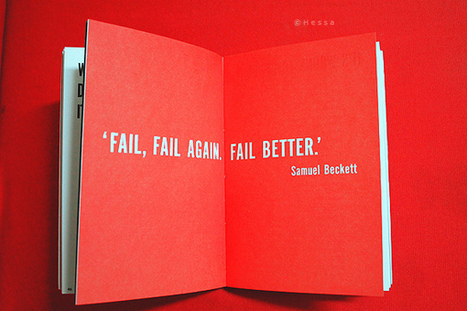
Photo credit: Flickr user Hessa. Grantmakers across the country raised a glass to failure at the 2013 Grantmakers for Effective ...
Scoop.it!
Beth Kanter's insight:
Don't let failure be the final step
Scoop.it!
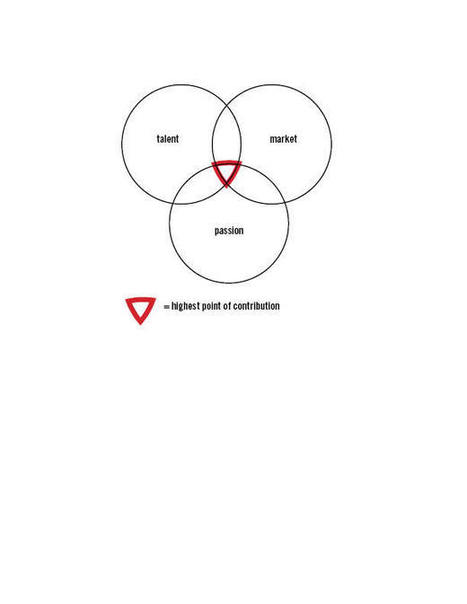
Why don't successful people and organizations automatically become very successful?
Beth Kanter's insight:
If success is a catalyst for failure because it leads to the "undisciplined pursuit of more," then one simple antidote is the disciplined pursuit of less. Not just haphazardly saying no, but purposefully, deliberately, and strategically eliminating the nonessentials. Not just once a year as part of a planning meeting, but constantly reducing, focusing and simplifying. Not just getting rid of the obvious time wasters, but being willing to cut out really terrific opportunities as well. Few appear to have the courage to live this principle, which may be why it differentiates successful people and organizations from the very successful ones.
|
Scoop.it!

Several years ago, Millman described these sentiments in an essay for Steven Heller’s book, Design Disasters:
Scoop.it!

Asking One of your direct reports walks into your office looking for help: the rollout of the new line of Web-based products she is managing is falling behind schedule. All the prototypes have been create...
Beth Kanter's insight:
Asking good questions Framework. The most effective and empowering questions create value in one or more of the following ways:
What not to ask Questions focused on why a person did not or cannot succeed force subordinates to take a defensive or reactive stance and strip them of their power. Such questions shut down opportunities for success and do not allow people to clarify misunderstandings or achieve goals. These questions include:
Scoop.it!

Rosemary Tyrrell, Ed.D.'s curator insight,
February 18, 2014 12:56 PM
Carol Dwek's Mindset is based on a lot of research she has done over the years. It has applications throughout higher education. 
Parent Cortical Mass's curator insight,
February 19, 2014 8:19 AM
nice set of links about Carol Dweck's Mindset Theory. Every parent needs to know what Carol Dweck discovered in her research. 
Jaimee's curator insight,
March 5, 2014 10:09 AM
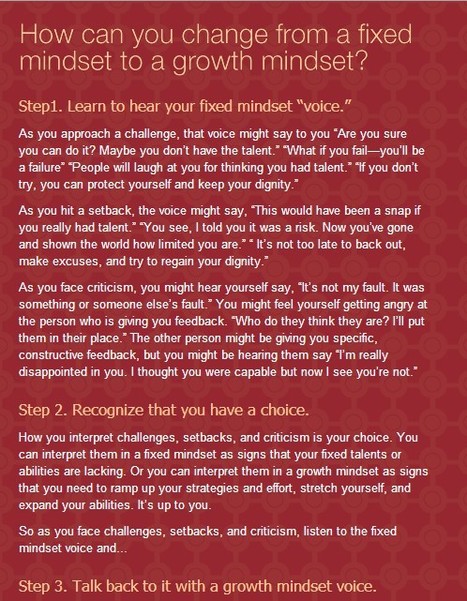
So one who wants to make a change must have a positive outlook on new situations or task that they are not used to?
This article is about how one can gain or become a part of the group that is a growth mind set. You gain success or become a better person by following these changes.
Scoop.it!
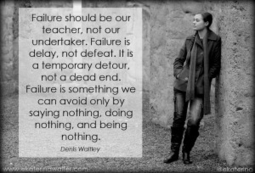
Our definition of failure, and our path in life, is shaped by three things: Passion, Purpose, and Attitude. We need to re-define what failure means to us.
Beth Kanter's insight:
Doubts kill more dreams that failure ever will.

Dean J. Fusto's curator insight,
August 4, 2015 8:28 PM
Doubts kill more dreams that failure ever will.
Scoop.it!

Too often we get hung up on THE NEXT GREAT IDEA that will save or transform the Jewish community. Following stark headlines birthed by the recent Pew study, I suspect the urgency around this may e...
Beth Kanter's insight:
Great to see nonprofit folks take up the mantra to learn from failure after the plenary session at NTC last year.
Scoop.it!

Not many people would call themselves failure experts with a sense of pride and purpose. I do. If you are interested in having me speak to failure, learning, innovation or resilience at your event,...
Scoop.it!

Social entrepreneurs talk about the importance of getting back up when something goes wrong.
Beth Kanter's insight:
"Failure is a weird word. I don't see it as failure. I see it as a natural evolution of a solution to a problem."
Dean J. Fusto's curator insight,
August 4, 2015 8:28 PM
"Failure is a weird word. I don't see it as failure. I see it as a natural evolution of a solution to a problem."
Scoop.it!

Diana Athill, Margaret Atwood, Julian Barnes, Anne Enright, Howard Jacobson, Will Self and Lionel Shriver reflect on their own disappointments in life, love and work
Scoop.it!
Hirschman made his arguments without mathematical formulas or complex models. His subject was economics, but his spirit was literary.
Beth Kanter's insight:
Albert O. HIrschman was a economist. This essay by Malcolm Gladwell shares stories of his life and philosophy about doubt, creativity, and failure. Great storytelling, but some juicy bits about failure. Creativity always comes as a surprise to us; therefore we can never count on it and we dare not believe in it until it has happened. In other words, we would not consciously engage upon tasks whose success clearly requires that creativity be forthcoming. Hence, the only way in which we can bring our creative resources fully into play is by misjudging the nature of the task, by presenting it to ourselves as more routine, simple, undemanding of genuine creativity than it will turn out to be. While we are rather willing and even eager and relieved to agree with a historian’s finding that we stumbled into the more shameful events of history, such as war, we are correspondingly unwilling to concede—in fact we find it intolerable to imagine—that our more lofty achievements, such as economic, social or political progress, could have come about by stumbling rather than through careful planning. . . . Language itself conspires toward this sort of asymmetry: we fall into error, but do not usually speak of falling into truth.
Scoop.it!
Beth Kanter's insight:
One way to avoid failure is really understanding what to say yes and what to say no to ...
Scoop.it!

Why are flaws in our own decision-making invisible to us? Learn four surprisingly simple ways to make better nonprofit decisions.
|













Albert O. HIrschman was a economist. This essay by Malcolm Gladwell shares stories of his life and philosophy about doubt, creativity, and failure.
Great storytelling, but some juicy bits about failure.
Creativity always comes as a surprise to us; therefore we can never count on it and we dare not believe in it until it has happened. In other words, we would not consciously engage upon tasks whose success clearly requires that creativity be forthcoming. Hence, the only way in which we can bring our creative resources fully into play is by misjudging the nature of the task, by presenting it to ourselves as more routine, simple, undemanding of genuine creativity than it will turn out to be.
While we are rather willing and even eager and relieved to agree with a historian’s finding that we stumbled into the more shameful events of history, such as war, we are correspondingly unwilling to concede—in fact we find it intolerable to imagine—that our more lofty achievements, such as economic, social or political progress, could have come about by stumbling rather than through careful planning. . . . Language itself conspires toward this sort of asymmetry: we fall into error, but do not usually speak of falling into truth.