EntomoNews
480.5K views | +22 today
EntomoNews
Dernières nouvelles des insectes, collemboles, myriapodes et autres arthropodes...
Your new post is loading...
Scooped by Bernadette Cassel
January 5, 2017 6:37 AM
Scoop.it!

L’étonnant dimorphisme des mantes-orchidées

L’étonnant dimorphisme des mantes-orchidées | EntomoNews | Scoop.it
Chez les mantes orchidées, les femelles sont bien plus grandes que les mâles. Ce gigantisme aurait facilité la prédation, tandis qu’une petite taille aurait permis aux mâles d’éviter les prédateurs.


[L'étude] Selection for predation, not female fecundity, explains sexual size dimorphism in the orchid mantises : Scientific Reports, 01.12.2016 http://www.nature.com/articles/srep37753


Bernadette Cassel's insight:


→ Une nouvelle explication du dimorphisme sexuel chez la mante-orchidée / Predation on pollinating insects shaped the evolution of the orchid mantis - From www.eurekalert.org - December 26, 2016 6:56 PM


No comment yet.
Scooped by Bernadette Cassel
March 10, 2015 3:28 AM
Scoop.it!

Le secret de la mante-orchidée — qui ne ressemble pas vraiment à une orchidée

Le secret de la mante-orchidée — qui ne ressemble pas vraiment à une orchidée | EntomoNews | Scoop.it

Par James Gilbert. The Conversation, 27.01.2015. "Secrets of the orchid mantis revealed – it doesn’t mimic an orchid after all"


"The orchid mantis is something of a poster child for such cryptic mimicry. So obviously true is this evolutionary story that it is often discussed today as established fact.


No one seemed to have noticed that there has been no evidence to support this hypothesis. Orchid mantises are actually very rare in the field, so their behaviour is hardly known about, except in captivity. For example, nobody knows exactly which flower the mantis is supposed to mimic.


Now a set of newstudies by James O'Hanlon and colleagues shows quite clearly that we’ve been getting it wrong all this time. While it is indeed a flower mimic – the first known animal to do this – the orchid mantis doesn’t hide in an orchid. It doesn’t hide at all. And to an insect, it doesn’t even look particularly like an orchid."


[...]


"This phenomenon, known as aggressive mimicry, occurs in other animals. [...] Surprisingly mantises did not choose to hide among the flowers. They chose leaves just as often. Sitting near flowers did bring benefits, though, because insects were attracted to the general vicinity – the “magnet effect”.


[...]


[L'étude] Habitat selection in a deceptive predator: maximizing resource availability and signal efficacy - Behavioral Ecology, 10.10.2014 (The most recent version of this article was published on 2015-01-29)

http://beheco.oxfordjournals.org/content/early/2014/10/10/beheco.aru179.short


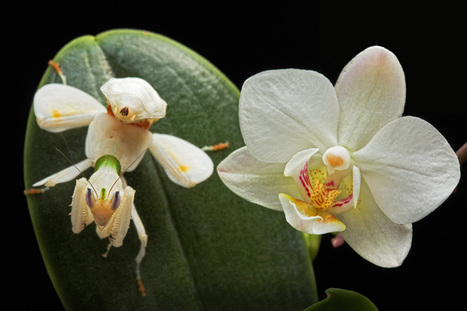
[Image] Orchid mantis, Hymenopus coronatus. Igor Siwanowicz


___________________________________________________________________


SUR LE MÊME SUJET (en français) :

→ La mante se "déguise" en orchidée pour chasser - Sciencesetavenir.fr, 05.03.2015
http://www.sciencesetavenir.fr/animaux/20150302.OBS3681/la-mante-se-deguise-en-orchidee-pour-chasser.html
                              
Bernadette Cassel's insight:


→ La mante-orchidée, redoutable piège ambulant pour pollinisateurs - From www.futura-sciences.com - December 3, 2013 5:59 PM


No comment yet.
Scooped by Bernadette Cassel
December 26, 2016 12:56 PM
Scoop.it!

Une nouvelle explication du dimorphisme sexuel chez la mante-orchidée / Predation on pollinating insects shaped the evolution of the orchid mantis

Une nouvelle explication du dimorphisme sexuel chez la mante-orchidée / Predation on pollinating insects shaped the evolution of the orchid mantis | EntomoNews | Scoop.it
... A team of scientists at The Cleveland Museum of Natural History, Australia, and Germany discovered that the orchid mantis looks like a flower due to the exploitation of pollinating insects as prey by its praying mantis ancestors. By studying the evolutionary relationships of the orchid mantis and its distant relatives, the team discovered that females in the orchid mantis lineage increased in size and changed color over their evolutionary history to gain advantage over large pollinating insects, such as bees, as well as the ability to attract them for predation. However, the morphologically dissimilar males are small and camouflaged, enabling them to live a life of predator avoidance and mate finding. The team found that this difference in males and females, termed sexual dimorphism, was likely the result of female predatory success that favored larger and more conspicuously colored individuals. This result challenges the traditional explanation for sexual dimorphism in arthropods as an increase in female egg production and suggests female predation strategy led to the differing male and female ecologies in the orchid mantises. The research was published online in the journal Scientific Reports.


Research challenges traditional views in insect evolution. Cleveland Museum of Natural History, EurekAlert! Science News, 01.12.2016
 

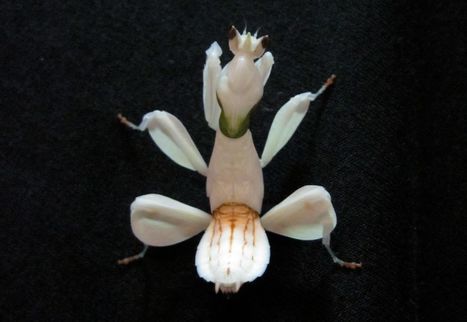
[Image] A mating pair of the orchid mantis, Hymenopus coronatus, shows extreme size difference between the male and female. Credit Jason Zhu


[L'étude] Selection for predation, not female fecundity, explains sexual size dimorphism in the orchid mantises : Scientific Reports, 01.12.2016 http://www.nature.com/articles/srep37753


Bernadette Cassel's insight:


→ 'mante-orchidée' in EntomoNews | Scoop.it
http://www.scoop.it/t/entomonews/?tag=mante-orchid%C3%A9e


No comment yet.
Scooped by Bernadette Cassel
December 3, 2013 11:59 AM
Scoop.it!

La mante-orchidée, redoutable piège ambulant pour pollinisateurs

La mante-orchidée, redoutable piège ambulant pour pollinisateurs | EntomoNews | Scoop.it

Futura-Sciences, par Quentin Mauguit. « Pour attirer des proies à elle, la mante-orchidée Hymenopus coronatus dispose d’une arme redoutable : elle se transforme en une fleur appétissante. Les insectes pollinisateurs malaisiens et indonésiens n’y voient que du feu. Enfin confirmé, cet exemple de mimétisme agressif serait unique en son genre. »


[...]


« Au cours de l’évolution, cet insecte prédateur a acquis une morphologie pour le moins atypique. En effet, ses quatre pattes locomotrices ont l’apparence de pétales blancs et roses. Or, l’animal peut les agencer de manière à ressembler à une orchidée à tout moment, que ce soit sur une feuille ou une branche. Voici donc la question : ce comportement est-il utilisé pour se rendre invisible des prédateurs tels que les lézards et les oiseaux, pour attirer d’appétissants insectes pollinisateurs, ou pour les deux à la fois ? »


« Pour le déterminer, James O'Hanlon s’est rendu en janvier 2011 en Malaisie en espérant rencontrer cet insecte rare dans son milieu sauvage, bien loin de l’université Macquarie (Sydney, Australie) où il officie habituellement. Si nous parlons de lui, c’est bien évidemment qu’il y est parvenu, mais aussi qu’il a apporté des éléments de réponse. Oui, ce camouflage est bien utilisé pour chasser. D’ailleurs, selon l’article paru dans la revue American Naturalist, il attire plus d’abeilles et de papillons qu'une des fleurs imitées ! »


[...]


[L'étude] Pollinator Deception in the Orchid Mantis

James C. O’Hanlon, Gregory I. Holwell and Marie E. Herberstein, The American Naturalist, 23.09.2013     
                        
[Lien] JSTOR: The American Naturalist, Vol. 183, No. 1 (January 2014), pp. 126-132http://www.jstor.org/stable/10.1086/673858
                          
No comment yet.