


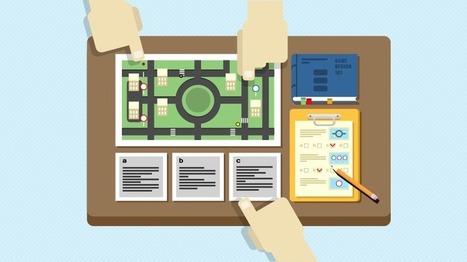
Want to know what Learning Game Design Mistakes Instructional Designers make? Check 4 Learning Game Design Mistakes IDs make.
Get Started for FREE
Sign up with Facebook Sign up with X
I don't have a Facebook or a X account


 Your new post is loading...
 Your new post is loading...
Your new post is loading...
 Scoop.it!
Want to know what Learning Game Design Mistakes Instructional Designers make? Check 4 Learning Game Design Mistakes IDs make. 
Scoop.it!

Need a little inspiration? Find out what kind of learning games Pokémon Go can open your eyes to creating; the possibilities are endless.
Scoop.it!

A platform that teaches coding through gamification makes it easy for teachers with no computer science background to teach coding.
Scoop.it!
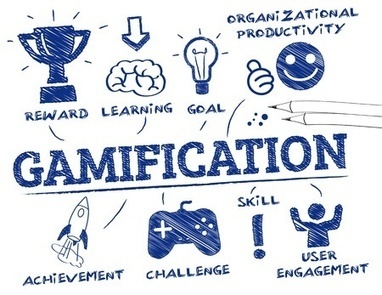
Today, both large and small companies have various options when it comes to corporate training programs and training their staff. From using innovative tec

Jasmine Villarreal's curator insight,
July 19, 2016 4:23 PM
This article gives myths about what Gamification is thought to be. It takes those myths and gives the truth or a different way to look at it. For example, people think Gamification is just to gain points, badges, etc. In reality, Gamification helps a student by mastering the subject like a normal game, to gain points. Link to full story: http://blog.insynctraining.com/learning-through-gamification-myth-versus-fact 
caseytburns@gmail.com's curator insight,
September 6, 7:38 PM
Within discourse around Gamification exists challenges several prevalent misconceptions while underscoring the nuanced role gamification can play in educational contexts. One common myth, that gamification is suitable for all content, is refuted by research showing that its effectiveness depends on how well game mechanics align with learning goals and subject matter; complex or abstract topics may not benefit without thoughtful adaptation. Another misconception equates gamification with game-based learning, but in reality they differ significantly. Gamification overlays game elements onto existing content, whereas game-based learning embeds instruction within the game itself. Critics also caution that poor implementation can lead to distraction or superficial engagement, turning gamified elements into empty gimmicks rather than meaningful learning tools. Conversely, evidence indicates that gamification, when designed with purpose, can motivate sustained engagement and support cognitive objectives, particularly through mechanisms that go beyond mere points and badges to evoke dynamics like narrative and autonomy. The key insight is clear: gamification must be driven by pedagogical alignment and intentional design and not treated as a quick-fix. When grounded in theory and tailored to learner needs, gamified learning can transcend novelty to become a meaningful scaffold for motivation and mastery.
Scoop.it!
Are you looking for interactive ways to enhance your online training modules? Give Gamification a try! Watch the video to know more.
Jasmine Villarreal's curator insight,
July 19, 2016 4:55 PM
This is a video that talks about why teachers should start using Gamification in their classrooms (includes statistics).
Scoop.it!

From
www

This infographic illustrates eight elements that make games for fun and engaging for learners.

elearning at eCampus ULg's curator insight,
May 29, 2016 3:28 AM
Gamification is always one step away ...
Scoop.it!
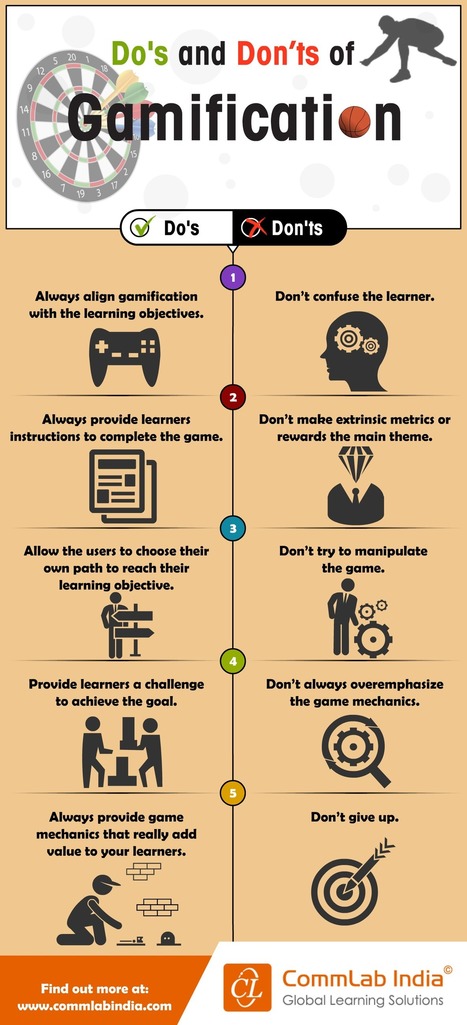
"For the successful implementation of gamification, it is important to know its dos and don’ts. Here is an infographic which highlights the dos and don’ts of gasification."

Sergio Melendez's curator insight,
September 16, 2024 3:10 PM
The dos and don'ts of gamification set a clear expectation of what it is needed in order to have a clear and organized gamification platform where there is a real learning objective and establishes a line of information for a complete and thorough implementation.
caseytburns@gmail.com's curator insight,
September 4, 10:57 PM
Nice article here and it does an excellent job of underscoring the importance of designing gamified learning experiences with intentionality and learner focus. Key recommendations like aligning gamification with learning objectives, providing clear instructions, and allowing learners to choose their own progression paths, highlight how thoughtfully integrated game elements can enhance engagement and autonomy. Conversely, common pitfalls warning against implementing gamification merely for novelty or overwhelming learners with complex gameplay mechanics remind us that without clear purpose and simplicity, gamification risks becoming confusing rather than motivational. This kind of guidance reinforces a fundamental principle: gamification is most effective when it’s a purposeful instructional scaffold, not just a decorative add-on. When thoughtfully applied, it enriches learning by making it interactive and enjoyable, but when misapplied, it distracts and frustrates. The infographic’s balanced approach encourages designers to deploy gameful strategies that genuinely support learning goals and learner experience. It's rpovides a helpful visual of methodology in application.
Scoop.it!

Digital learning is an imperative. Our learners live increasingly digital lives, working and learning wherever they are which means they need access to content at the point of need. Given all of the trends and technologies — how do you know where to begin? Whether you’re just getting started or ready to up your game, join …
|
Scoop.it!

"Gamification has gained a lot of attention in the areas of development and training within larger business environments. It has reshaped how corporate training programs are delivered by finding methods to increase interest, maintain engagement, and make the information more accessible. But do the benefits of gamification end with these large-scale implementations? Can the principles be used to change how we design our own personal learning experiences, and, if so, to what benefit?
The answers are “no” and “yes,” respectively. And here’s how it works."
caseytburns@gmail.com's curator insight,
September 6, 6:54 PM
This article challenges the notion that gamification is reserved for corporate or large-scale training, making a compelling case that these principles can be applied to individual learning journeys as well. It asserts that game-inspired design like setting personal goals as “quests,” using self-made achievements, or tracking progress with points can transform self-directed learning into a more engaging, structured, and self-motivating. It democratizes gamification by suggesting learners become their own designers, therefore boosting autonomy, metacognition, and motivation. While it lacks empirical data to measure impact, the core insight, that individuals can harness gamification to enhance personal learning resilience and curiosity, is powerful and empowering. It resonates with theories of self-determination and highlights how even informal learning can benefit from intentional, playful design scaffolding. The real pedagogical value lies in learners adopting gameful mindsets to scaffold their own growth, rather than relying solely on institutional tools or platforms.
Scoop.it!

Gaming has traditionally belonged to the K-12 sphere, but in recent years higher education has taken a vested interest in this learning approach.
Scoop.it!

Want to know whether Digital Game-Based Learning is here to stay? Check the advantages of and criticisms on Digital Game-Based Learning.

Lon Woodbury's curator insight,
August 3, 2016 5:42 PM
Since Digital Games are so common and instilled in our culture, it makes sense for educators to master it and provide learning games that are equally challenging and motivational. "If you can't beat them, join them." -Lon 
Matt Adcock's curator insight,
December 6, 2017 7:31 AM
Another look at the for and against debate on game based learning
Scoop.it!

One of the first things you may think of when you think about a game is competition. Traditionally most games engage players in some way with a competitive aesthetic, the aim being to win or beat other players. However, more games are starting to use fellowship to engage players. Scriptwriter Taryn Stack looks at the rise of Massively Multiplayer Online Role-playing Games (MMORPGs) and cooperative board games which demonstrate that fellowship and co-operation are just as valid as competition when it comes to creating engagement.
Scoop.it!

This year’s toy fairs again showed an industry in hot pursuit of products that adeptly transcend digital and physical play, and whilst high profile failu
Scoop.it!

"A common argument among proponents of game-based learning has been the need to engage students raised with the instant feedback and gratification of modern technology like video games and text messaging. Game-based learning, then, ideally meets that generation where they are. Of course, you can't just throw together a game and call it educational, either. The real challenge comes in striking a balance between learning and fun in the overall experience."
Scoop.it!

People learn by sitting still, keeping quiet and paying attention to the lesson, right? That's not how gamers learn!
Scoop.it!
"Taking the first step to gamified learning can seem overwhelming, especially if you are the type of teacher who likes to create everything from scratch. There are a number of apps and online platforms that already exist as gamified learning environments and others that are not designed as games but lend themselves well to gamification."
|





Atenção designers instrucionais: 4 Possíveis enganos no desenho de games! #avancee