South Africa often feels two different countries chaffing up against each other—one for the rich and one for the poor. This separation was legislated under apartheid, but post-apartheid South Africa has struggled to bridge the divide. Today, the disparity in education, skills and income continues. Two recently released World Bank reports further show tha
"More than half of the populationalready lives in poverty, and a further 27% of the population live in a state of susceptibility to poverty. These 27% are referred to as the transient poor by the World Bank in it’s report “Overcoming poverty and inequality in South Africa.” On the other hand 20% of the country can be considered middle class, while only 4% of the country is considered elite. In comparison, Mauritius’ middle class is nearly 80% of the population."
What I Hear When You Say is a video series that explores how words can both unite and divide us depending our own perspective, experience, and interpretation.
Nonprofits are generally viewed as entities that primarily respond to government or market failure. But nonprofits are well-situated to shape—rather than just respond to—the process of governance, and local organizations are becoming more and more central to promoting neighborhood democracy.
Note the connection between photography and sociology according to the prominent sociologist Howard Becker: "At first, some photographers used the camera to record far-off societies that their contemporaries would otherwise never see and, later, aspects of their own society their contemporaries had no wish to see. Sometimes they even conceived of what they were doing as sociology, especially around the turn of the century when sociologists and photographers agreed on the necessity of exposing the evils of society through words and pictures."
Here is a quote from the chapter titled Confronting Class in the Classroom from bell hook: "Bourgeois values in the classroom create a barrier, blocking the possibility of confrontation and conflict, warding off dissent. Students are often silenced by means of their acceptance of class values that teach them to maintain order at all costs. When the obsession with maintaining order is coupled with the fear of losing face, of not being thought well of by one's professor and peers, all possibility of constructive dialogue is undermined." Very powerful... Laura
Extract from an Open University program shown on BBC2 in the early 90s. Ed Soja discusses the postmodern nature of the Bonaventure Hotel I have now uploaded ...
This is an excellent documentary narrated by Ed Soja. It is very important to understand how space is socially constructed. Here in the Bonaventure lies hidden messages of control and entrappment.. Excellent presentation.Laura
This is an excellent documentary narrated by Ed Soja. It is very important to understand how space is socially constructed. Here in the Bonaventure lies hidden messages of control and entrappment.. Excellent presentation.Laura
For the first time we find villagers rebelling against the urbanists and against urbanization: how successful would such a social movement be if all the rural areas and its peoples do that?
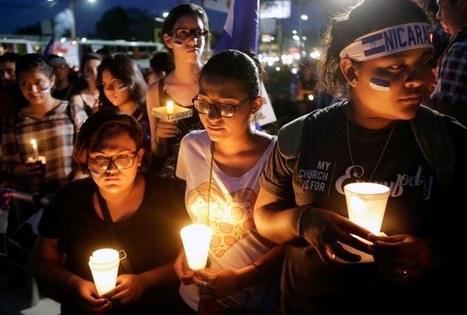
Jon Lee Anderson on protests in Nicaragua over proposed social-security reforms that are threatening the stability of the government of President Daniel Ortega.
Nicaragua's present situation is an example of how out-of-touch leaders can ruin a country The president-dictator, Ortega, and his co-dictator wife, Murillo, have been in power since 2007 ruling with deaf ears and black hearts. Due to their recent decision to raise the cost of social security while reducing its benefits (something truly bizarre), civil unrest has spilled into the streets permeating throughout the whole country. To quell the anger, Ortega had his soldiers open fire on protesters (another bizarre decision). Average Nicaraguan citizens are enraged and ready for a change of power.
Ortega first took power in 1979 when his socialist "junta" overthrew an oppressive right-wing regime. Essentially one group of extremists replaced another. The situation only worsened with the involvement of the U.S. Seeing the pro-Soviet Marxist takeover in its geographic backyard, Ronald Reagan authorized military support for a group of right-wing counter-revolutionaries (known in Spanish as 'Contras') who used terrorism to retake the government. Ortega was removed from power in 1990. The article points out that the C.I.A. backed Contras led to the destruction of the Nicaraguan economy. The United States is a paradox as it raves about democracy at home but goes out of its way to support extremist regimes with little regard to human rights abroad. This self-serving "my interests above all" attitude will only come back to haunt the U.S. as chronic instability in its backyard can spill over to other countries and slither its way to the U.S. border.
A salient feature of dictatorships, like Ortega's regime, is that they control the media and the news. Only two newspaper outlets, La Prensa and Confidencial, stand independently to oppose the government's "official narrative." Interestingly enough, Ortega and Murillo's children run the pro-government media outlets - illustrating how close family connections between business and government are unhealthy for society. These kindred relations weaken checks and balances because of conflicts of interest.
Two things to take away from this article: One is that the U.S. needs to either cease meddling in foreign affairs or be much more careful. The second is that this scenario serves as a reason why the world needs transparent democratic societies. This latter form of governance ensures that no single group can hold onto power for so long, becoming insensitive to the needs of the people, and continuing to rule simply to hold onto power.
My late friend Hans Rosling called the labels “outdated” and “meaningless.” Any categorization that lumps together China and the Democratic Republic of Congo is too broad to be useful. But I’ve continued to use “developed” and “developing” in public (and on this blog) because there wasn’t a more accurate, easily understandable alternative—until now.
The solidarity economy is a global movement to build a just and sustainable economy. It is not a blueprint theorized by academics in ivory towers. Rather, it is an ecosystem of practices that already exist—some old, some new, some still emergent—that are aligned with solidarity economy values. There is already a huge foundation upon which to build.
A California charity is helping to educate youngsters in conflict zones, especially the strife-torn eastern section of the Democratic Republic of Congo. As VOA's Mike O’Sullivan reports, the group Justice Rising is attempting to meet a need that is largely unmet in trouble spots worldwide.
"Was 9/11 the opening salvo in a new age of terrorism? Some argue that this act ushered in a more chaotic world. Others contend an increased focus on terrorism in the past 15 years is the result of conflating terrorist activity with insurgency. We shed light on these claims by analyzing data on domestic and transnational terrorist incidence from 1989 to 2014. The evidence suggests that the years since 9/11 have been different from those preceding them. Once the prevalence of conflicts is accounted for, the post-9/11 era is a significantly less terror prone period than the years before it. A country not suffering civil conflict was upwards of 60 percent more likely to experience terrorism prior to or during the year 2001 than since. However, the opposite trend holds for those countries with a higher proportion of Muslims. Prior to 2001, countries with higher Muslim populations experienced less domestic terrorism. Since 9/11, these countries have experienced significantly more terrorism – both domestic and international – than they had previously."
Schools can be extremely orderly and run with precision and under the surface have a character deficit. I'm all for discipline, but I want to see that students are taking ownership for their behavior and can self-manage in positive ways. I want to see students empowered to do good and make a difference in the world. That won't happen in a culture of compliance. It will only happen in a culture of character.
The first thing a sociologist must do is use his sociological imagination (Mills coined this concept). Looking at this urban photographer image should say it all... look how powerful photography is when looking at a peripheral area in a country and see where the discarded, unemployed and marginalized live and the open sewage outdoors... Laura
let-me-bleed: “ In my Sociology class, we had to write every hurtful word we’ve ever been called on a sticky note and then stick it to our body. We then went around and took them off of each other....
If your students think a photo can’t change history, have them think again, drawing on this resource-rich article from media literacy expert Frank W. Baker.
Photos do change history, as much as our civil rights movement changed our pictures... It goes both ways. How can a photo change history? Find out. Laura
You think a photo does not change history... History changes photo but then in a virtual age it is the picture that shapes history... The Civil Rights Movement remains the most important and radical change of the 20th century in the Western world... LK
Indigenous Peoples Assistance Facility's (IPAF) 2018 Call for Proposals provides small grants of US$ 20,000 to US$ 50,000 and provides funding focused on indigenous youth and prioritize projects as a viable and attractive economic activity for youth.
Özlem Sensoy and Robin DiAngelo take on an important yet challenging task in Is Everyone Really Equal?: An Introduction to Key Concepts in Social Justice Education (2nd edition): providing a primer that strives to balance complexity and accessibility in critical social justice education for a broad audience. Part of James A. Banks’ Multicultural Education Series, the book’s foreword, preface, prologue, twelve chapters, and glossary cover a great deal of ground in promoting “social justice literacy” with chapters combining theoretical explanations of and practical engagement with concepts ranging from culture and socialization to oppression and power to racism, classism, and ableism. Consequently, faculty who teach undergraduate courses related to social justice, multicultural education, and educational foundations in particular will find 'Is Everyone Really Equal?' relevant to their work.
Over 150 experts in AI, robotics, commerce, law, and ethics from 14 countries have signed an open letter denouncing the European Parliament’s proposal to grant personhood status to intelligent machines. The EU says the measure will make it easier to figure out who’s liable when robots screw up or go rogue, but critics say it’s too early to consider robots as persons—and that the law will let manufacturers off the liability hook.
In addition to being delicious, chocolate has many other positive attributes. Just this week, researchers at Loma Linda University found that chocolate reduces stress levels and inflammation and improves mood, memory, and immunity.
This may be the reason why scientists at University of California, Berkeley (UC Berkeley) have joined forces with food and candy firm Mars to try and save cacao crops from an extinction feared to happen by 2050 as a result of climate change. Together, they are experimenting with a gene-editing technology called CRISPR to make cacao crops more resilient.
To get content containing either thought or leadership enter:
To get content containing both thought and leadership enter:
To get content containing the expression thought leadership enter:
You can enter several keywords and you can refine them whenever you want. Our suggestion engine uses more signals but entering a few keywords here will rapidly give you great content to curate.


 Your new post is loading...









"More than half of the population already lives in poverty, and a further 27% of the population live in a state of susceptibility to poverty. These 27% are referred to as the transient poor by the World Bank in it’s report “Overcoming poverty and inequality in South Africa.” On the other hand 20% of the country can be considered middle class, while only 4% of the country is considered elite. In comparison, Mauritius’ middle class is nearly 80% of the population."