Your new post is loading...

|
Scooped by
Beth Dichter
April 1, 2012 7:32 PM
|
Teachers differentiate to three major considerations: readiness, interest, and learning profile. Matching instruction to students' readiness correlates strongest with academic growth, according to research. "Learning profile is a fluid concept that includes how culture, gender, intelligence preference, and learning style might influence how a student approaches learning. Carol Tomlinson is quick to clarify that learning profile is not a synonym for learning style. The "learning styles" approach to teaching has received a lot of criticism of late – particularly from three groups, Tomlinson told attendees at her ASCD Annual Conference session on the controversial topic." You may find the slides that go with this article on her website: http://www.caroltomlinson.com/Presentations/2012ASCD_LearningStyleControversy.pdf ; (The image is the first slide.)
|
|
Scooped by
Beth Dichter
April 1, 2012 4:03 PM
|
"This article presents 10 research-based principles of instruction, along with suggestions for classroom practice. These principles come from three sources: (a) research in cognitive science, (b) research on master teachers, and (c) research on cognitive supports…The fact that the instructional ideas from three different sources supplement and complement each others gives us faith in the validity of these findings." Although these ideas may not be new they are discussed in detail, potentially providing some new insights: * Begin each lesson with a short review of previous learning,
* Present new material in small steps with student practice after each step,
* Ask a large number of questions and check the response of all students,
* Provide models,
* Guide student practice,
* Check for student understanding,
* Obtain a high success rate,
* Provide scaffolds for difficult tasks,
* Require and monitor independent practice,
* Engage students in weekly and monthly review.
|
|
Scooped by
Beth Dichter
April 1, 2012 12:42 PM
|
Get lesson plans and student handouts to offer lessons that help students learn how to apply critical thinking skills when doing research online.
|
|
Scooped by
Beth Dichter
April 1, 2012 8:01 AM
|
"e-Learning has been using this ‘show, don’t tell’ approach for a long time. However, although scenarios and interactions go a long way to involving the learner in the course, I think we need to pay greater attention to the different styles of learning. You’re probably familiar with Fleming’s VAK/VARK model of three ‘types’ of learners: visual, auditory and kinaesthetic. He makes the argument that some learn best through visual aids such as diagrams, others through discussion, and other by physically carrying out tasks. Although I think this is too ‘neat’ a categorisation of learners, as a mixture of learning types is more stimulating than a single format, I find this model useful for considering all the different elements that make up a good course."
|
|
Scooped by
Beth Dichter
March 31, 2012 9:41 PM
|
|
|
Scooped by
Beth Dichter
March 31, 2012 9:21 PM
|
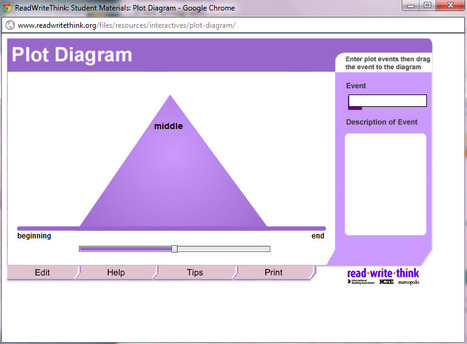
The Plot Diagram is an organizational tool focusing on a pyramid or triangular shape, which is used to map the events in a story. This mapping of plot structure allows readers and writers to visualize the key features of stories.
|
|
Scooped by
Beth Dichter
March 31, 2012 7:48 PM
|
I felt it was worthwhile to update the Top Post (over 25,000 views) on Langwitches: Bloom’s Taxonomy for iPads I have added links to each app represented on the visual.
|
|
Scooped by
Beth Dichter
March 30, 2012 10:06 PM
|
Visually see the differences between asynchronous e-learning and synchronous e-learning practices.
|
|
Scooped by
Beth Dichter
March 30, 2012 8:44 PM
|
Just a few years ago, the idea of using a mobile phone as a legitimate learning tool in school seemed far-fetched, if not downright blasphemous. Kids were either prohibited from bringing their phones to school, or at the very least told to shut it off during school hours. But these days, it’s not unusual to hear a teacher say, “Class, turn on your cell. It’s time to work.”
|
|
Scooped by
Beth Dichter
March 30, 2012 3:11 PM
|
Business leaders should follow Bob the Builder's example and ask themselves if they can achieve their goals – research shows it will increase the chances of success. In a nifty set of experiments, three social scientists explored the differences between what they call "declarative" self-talk (I will fix it!) and "interrogative" self-talk (Can I fix it?). They began by presenting a group of participants with some anagrams to solve (for example, rearranging the letters in "sauce" to spell "cause".) But before the participants tackled the problem, the researchers asked one half of them to take a minute to ask themselves whether they would complete the task – and the other half to tell themselves that they would complete the task.
The results? Read on to find out!
|
|
Scooped by
Beth Dichter
March 30, 2012 6:18 AM
|
When students create a movie or interactive slide show to tell their story, learning becomes personal.
|
|
Scooped by
Beth Dichter
March 29, 2012 9:11 PM
|
In his new book, Imagine, Jonah Lehrer explores the art and science of original thinking — from Shakespearean tragedies to the invention of masking tape to Nike's "Just Do It" campaign. And when you get stuck?
|
|
Scooped by
Beth Dichter
March 29, 2012 8:03 PM
|
You might think that in the second decade of the twenty first century, high school educators would no longer show evidence of silly old-school biases – but, regrettably, you’d be wrong. In fact, they seem to be persisting in their bias even when...
|
|
|
Scooped by
Beth Dichter
April 1, 2012 4:31 PM
|
Screenleap makes it really easy to share your computer screen. You can share your screen with as many people as you like with no downloads, account setup, or cost required. Friends, family, and colleagues can view your computer from their laptops, desktops, or mobile devices without having to install anything.
|
|
Scooped by
Beth Dichter
April 1, 2012 1:05 PM
|
We say information is free, but does that mean it's all easy to learn? How can you become a free-range learner? The rough talk that goes with this presentation can be found here: http://bit.ly/nFKWrO
|
|
Scooped by
Beth Dichter
April 1, 2012 12:31 PM
|
Many consider Thomas Edison a genius, and he left behind 3500 notebooks. "The pages read like a turbulent brainstorm and present a verbal and visual biography of Edison's mind at work." This article provides some of the tools Edison used, "creativity lessons that emerge..." The key concepts are: * Challenge all assumptions * Quantity * Nothing is wasted * Constantly improve your ideas and products and the ideas and products of others * Turn deficiencies to your advantage * Record your ideas and thoughts Check out this article for additional detail!
|
|
Scooped by
Beth Dichter
March 31, 2012 9:57 PM
|
"Last year, when we began contemplating our Beg, Borrow or Steal issue, we thought our survey of the lived economy deserved an ambitious graphical exploration. After brainstorming meetings ("Can we do, like, the whole thing?") long hours logged on FRED, and a few all-nighters, we came up with a package of data visualization and explanation that we hope will give you an idea of the big picture. The economy is complicated. Let us walk you through it." This econographic looks at the US economy with a brief look at the past (beginning 1917) and then moves from the 1970s into the "Great Recession" while exploring the the US and the world economies.
|
|
Scooped by
Beth Dichter
March 31, 2012 9:30 PM
|
"It will take classroom teachers, who understand that '21st Century Learning' cannot be equaled to 'using computers, iPads, web 2.0 tools or other technology gadgets and tools' at a set time during their schedule, to make the shift how we think about learning."
|
|
Scooped by
Beth Dichter
March 31, 2012 9:04 PM
|
In One Minute, Facebook Logs 6 Million Pages Views, Google Handles 2 Million-Plus Search Queries, Twitter Adds More Than 320 Accounts and the Data Deluge Threatens to Overwhelm Network Infrastructure Network infrastructure as a topic lacks the sex...
|
|
Scooped by
Beth Dichter
March 31, 2012 8:23 AM
|
This infographic takes a look at the amount of tax payer money that goes into funding specific military equipment ranging from the 'small' items to the truly gargantuan in price.
|
|
Scooped by
Beth Dichter
March 30, 2012 9:10 PM
|
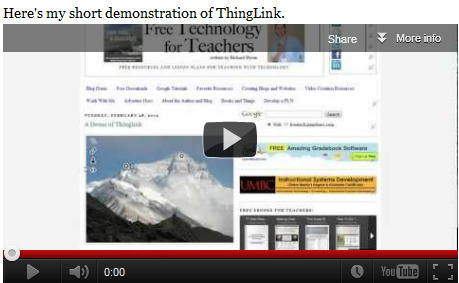
Richard Byrne shares a short tutorial on using ThingLink to create interactive images. ThingLink is now offering educators and students free accounts (create up to 50 images for free) or a paid plan with 500 images at a discounted price. How might you use ThingLink. He suggests that it "could be used by art students to identify and tag important elements of a picture, drawing, or photography...could also be used in history classes to have students identify important places in a battlefield like Gettysburg." What ideas do you have for using this tool?
|
|
Scooped by
Beth Dichter
March 30, 2012 3:35 PM
|
"Video games have very real benefits but too much of the same thing, day in, day out, actually ends up hurting you...Check out the inforgraphic and see what good gaming can do for you."
|
|
Scooped by
Beth Dichter
March 30, 2012 6:30 AM
|
Google has so many tools available that we often are now aware of all the resources at out finger tips. This eBook provides a guide to many features. Remember Google allows you to not only do search queries, but it acts as a dictionary, unit/currency converter, calcuator...this eBook helps to organize many of the tools in one location.
|
|
Scooped by
Beth Dichter
March 29, 2012 9:17 PM
|
Flash Rosenberg imagines how the ideas in IMAGINE are tackled, tickled and teased-out by the author Jonah Lehrer.
|
|
Scooped by
Beth Dichter
March 29, 2012 9:07 PM
|
Ever since video games found their way into arcades and homes across the country, the debate over whether they hold any educational merit or learning opportunity has been a fervent one. Today – with approximately 56 percent of households owning at least one gaming console – it has become more essential to assess what and how kids learn while playing video games, and if these tactics can be applied to other areas of education.
|