



Eclectic Technology
230.9K views |
+0 today
Filter by date
Tags
Tech tools that assist all students to be independent learners & teachers to become better teachers
Curated by
Beth Dichter
 Your new post is loading...
 Scoop.it! 
"In children with math anxiety, seeing numbers on a page stimulates the same part of the brain that would respond if they spotted a slithering snake or a creeping spider—math is that scary. Brain scans of these children also show that when they’re in the grip of math anxiety, activity is reduced in the information-processing and reasoning areas of their brains—exactly the regions that should be working hard to figure out the problems in front of them..." 
Jennifer Lynn's curator insight,
January 11, 2016 6:18 AM
Math anxiety is a serious problem that is noticed among many children now-a-days. This problem can lead to issues like losing self-worth and affecting the values of relationships among friends and family. So, you need to take care of your kids' mental and emotional health. Here are some of the tips that will help you to handle such anxiety in a better manner: http://bit.ly/22V4Q23
Scoop.it!
"We all have memories of the great teachers who shaped our childhood. They found ways to make the lightbulb go off in our heads, instilled in us a passion for learning and helped us realize our potential. The very best teachers were creative with the tools at their disposal, whether it was teaching the fundamentals of addition with Cheerios or the properties of carbon dioxide with baking soda and vinegar. As the Internet has developed, so too have the resources available for teachers to educate their students." A great example of using technology to facilitate student learning!
Scoop.it!
From
trello

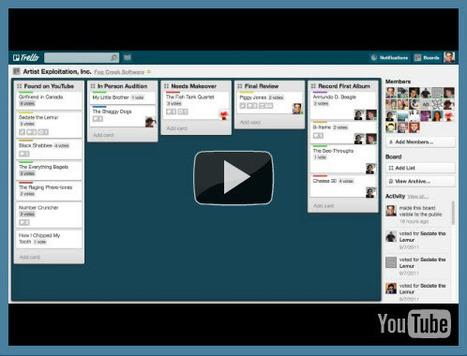
Organize anything, together. Trello is a collaboration tool that organizes your projects into boards. In one glance, know what's being worked on, who's working on what, and where something is in a process. 
Stephanie Sapp's curator insight,
February 6, 2015 9:27 AM
A great way to help your students stay on task while working on your PBL projects!
Scoop.it!

Technology can help make your education environment more accessible to those with special needs. This guide includes: * an overview of accessibility and its effect in the classroom; * definitions of impairment types and tech solutions for each; * an assistive tech overview and decision tree; * links and references for more information. It is available to download in English and Spanish.
Scoop.it!

From
edreach
Is learning required in your school? Most of us would emphatically answer "yes" to that question. But do your practices require students to learn? Have you established routines in your school that create learning opportunities for all students?
Scoop.it!

"Learning happens. Everyone picks up information at their own individual pace, yet myths painting different demographics and techniques with a broad brush still creep their way into classrooms and the public consciousness alike. Feeding into them, however, proves exceptionally problematic to child and adult students hoping to eke through life with the skills they need to accomplish their goals. Parents, administrators, faculty, and even the students themselves might want to start chipping away at the following misconceptions first."
Scoop.it!

Asking questions is a great way to enhance the learning process both in school and later on in life. Unfortunately the human fallacy here is that we sometimes don't feel the need to truly think before we ask these questions, which can lead to frustration, disappointment, and resentment—everything except learning the knowledge we seek—when we don't get the answer we were expecting. There is definitely a science behind asking smart questions, and this article lays it out rather nicely.
PLEASE NOTE, THIS LINK IS NOT WORKING. WAS RESCOOPED ON MARCH 28TH WITH NEW LINK THAT WORKS. Or click on this link: http://faculty.gvc.edu/ssnyder/121/Goodquestions.html
Scoop.it!

Parents pay top dollar for private school tuition, but the posh existence they're buying may actually hurt American ingenuity.
Scoop.it!

"What is the future of teaching? What about education in general? Many schools and universities around the world are playing a risky game right now that could make them irrelevant in the future. They’re simply holding onto past practices and not adapting to the changing world." A short article with a Slideshare presentation that has some wonderful quotes (such as "Professors today teach exactly the same way they taught a thousand years ago." Sebastian Thrun, Stanford University), six key drivers of education to watch, five challenges higher education institutions need to face, two technologies to watch in the near term, and two conclusions.
Scoop.it!

The American Heritage® Dictionary invites you to create a self-portrait using your words.
Scoop.it!

Are you loooking to create a social media policy for your school or district? Or to update your current policy? Or perhaps consider guidelines for best practices? Check out this presentation from the ASCD annual conference in March 2012. You can access the presentation (with lots of resources), a resource document and a video created to help educators understand the importance of the use of social media in education.
Scoop.it!

My Web My Way explains the many ways you can change your browser, computer, keyboard and mouse settings to make the web more accessible to you... |
Scoop.it!

"Just 44 percent of American teachers say they're satisfied with their jobs, the lowest number in two decades and an 18-point drop since 2008. A growing number of teachers are deciding to leave the profession altogether in favor of a new career path. What's behind the unhappiness?"
Scoop.it!

NBC News, Steve Wozniak, Sarah Palin – all victims of social media hacks. It goes without saying that the ubiquity of social media apps is creating concern amongst enterprise infosec organizations. This Veracode infographic presents common social media hacks and explores ...
Scoop.it!

"One of my favorite books on leadership is The Future of Management by Gary Hamel. If you haven’t read it, I encourage you to do so...the essential premise is that current management models, which are centered on control and efficiency, are extremely ill-suited for an era in which adaptability and creativity drive organizational success. This has major ramifications for how we think about leading schools and preparing school administrators, of course."
Scoop.it!

"I tweeted yesterday an interesting news item in Erik Robelen’s blog in Education Week that a few states (Oklahoma, California, Massachusetts) are seriously looking into some sort of assessment of creative thinking as part of the whole 21st century skills/entrepreneurship movement. I think it is a great idea, with a lot of potential for leveraging change. Now, of course, the naysayers are quick to say that you cannot measure creative thinking. This is silly: here is a rubric for doing so..."
Scoop.it!

"Not only can Google Voice become a repository for oral reports, assignments, or sound bites, but teachers can also write notes on each clip, share, and post them. Not only is this an effective tool for use with auditory learners and a way to practice language skills, but English as a Second Language and Foreign Language teachers will also want to listen up too!" 
Jéssica Cristiny Campos's curator insight,
November 19, 2014 9:44 AM
What about using student's cell phones to make them improve language skills?
Scoop.it!

Asking questions is a great way to enhance the learning process both in school and later on in life. Unfortunately the human fallacy here is that we sometimes don't feel the need to truly think before we ask these questions, which can lead to frustration, disappointment, and resentment—everything except learning the knowledge we seek—when we don't get the answer we were expecting. There is definitely a science behind asking smart questions, and this article lays it out rather nicely.
Please note, I scooped this last night but was told the link is not working. This time I am going to the original site, although I located it via the Committed Sardine but out through the 21st Century Fluency Project and the image is from their post.
Scoop.it!

"Learning happens. Everyone picks up information at their own individual pace, yet myths painting different demographics and techniques with a broad brush still creep their way into classrooms and the public consciousness alike. Feeding into them, however, proves exceptionally problematic to child and adult students hoping to eke through life with the skills they need to accomplish their goals. Parents, administrators, faculty, and even the students themselves might want to start chipping away at the following misconceptions first."
Scoop.it!

"It’s not a new question, but it’s certainly a divisive one — how to best measure student learning. As the Department of Education works toward finding a way to assess student learning beyond what most agree are sub-par standardized tests, and movement for opting out of assessments grows, educators and those who work in the education system are attempting to define the criteria for themselves."
Scoop.it!
Internet learning is becoming quite popular. Distance education allows students a chance to learn their subjects at their leisure. Convenience is another of the benefits that is found with internet educational institutions. Adaptive learning is an essential component of distance learning. 
Angela C. Dowd's comment,
February 25, 2013 11:53 AM
Interesting...I have been aware of the idea of cognitive modeling but wasn't aware of how it is being used in software design...interpreting the cognitive abilities of students and delivering a "tailored" learning experience.
Scoop.it!

"Welcome to the Nelson Mandela Digital Archive Project. Our aim is to locate, document, digitise, and provide access to all archival materials related to Nelson Mandela." Currently there are six sections available: My Moment with a Legend, Early Life, Prison Years, Presidential Years, Retirement, Books for Mandela and Young People. A source rich with materials.
Scoop.it!

Storytelling Timeline built in Javascript. This new tool allows you to pull in media from different sources. You can create a Timeline by filling in a Google spreadsheet, or use JSON (which provides a more detailed timeline). It is an open source project, free to download, and provides best practice to use (as in keep it short, pick stories with a strong chronological narrative, and include events that build up to major occurences). There are also many examples to view.
Scoop.it!

"Questioning everything is idiotic and a waste of time. Teach them to question wisely." appeared in my Twitter stream. It was a response to my statement, "The future comes from questioning everything." As always, Ira David Socol has written a post that will make you ask questions, helping you to "create a next generation unwilling to accept the mistakes of the past and present." |





