Call it the "learning paradox": the more you struggle and even fail while you're trying to master new information, the better you're likely to recall and apply that information later.
Providing too much scaffolding, guidance, structure - call it what you will - "early on, until the students or workers show that they can do it on their own — makes intuitive sense, it may not be the best way to promote learning. Rather, it’s better to let the neophytes wrestle with the material on their own for a while, refraining from giving them any assistance at the start."
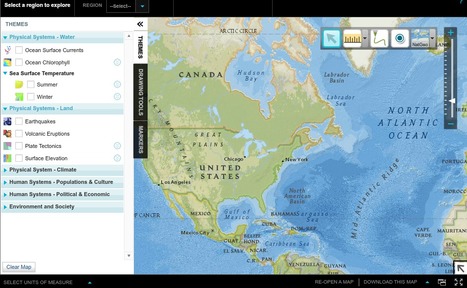
National Geographic Education beta has a new tool, MapMaker Interactive, that allows you to explore your world with maps. Select the region you want to map. There are options for themes, data and tools that allow for customization. Themes include Physical Systems: Water, Land and Climate; Human Systems: Population & Culture and Political and Economic; and Environment and Society. There are drawing tools and markers and you may download maps that you create. There is also a version that is black and white that has basic map elements as well as borders and names and other features. These maps may be printed out. The link to this is http://education.nationalgeographic.com/education/mapping/outline-map/?map=USA&ar_a=1.
Socol begins this essay suggesting that there are many words that he would like to "toss out of our educational vocabulary"...including rigor, flipped classroom, special education...and evidence-based practice.
Perhaps a question that we need to ask (and answer) is why are schools using the term evidence-based practice. It turns out that the term comes from the medical profession, as in evidence-based medicine...but is it possible to transfer what works in the field of medicine to education?
As always Socol provides links to many resources and a look at where he thinks we need to be in the future...an article worth reading and sharing.
"Khan Academy and the new Ted-Ed website are being touted to create an educational revolution. What I am concerned about is the underlying pedagogy of Ted-Ed and Khan Academy. I love listening to a good talk and talking about it afterwards, but does it change my thoughts and/or behavior? Typically not. Grant Wiggins’ recent post, 'Everything you know about curriculum may be wrong. Really' discusses this point:
The point of learning is not just to know things but to be a different person – more mature, more wise, more self-disciplined, more effective, and more productive in the broadest sense."
So one question to consider, are the videos the core of instruction, or are teachers (live and in person) the core? Gernstein provides many resources in this article and raises many interesting points as this question is explored.
"...all technologies are eventually overcome by new innovations. In the business world this kind of tech is known as “disruptive technology.” Our latest infographic covers many of the crucial disruptions that have brought us to today’s tech. Such disruptions can be so radical that they dramatically alter a culture or society, even our everyday lives...What technology has forever changed the way you go about things?"
NewsJack is a product of MIT's Center for Civic Education. It is built on Mozilla's Hackasaurus and allows users to remix and edit news websites, thus their tag line "All the news you'd love to see." You have the option of choosing CNN, Fox News or the NY Times as sites to remix, or you may enter your own URL.
"At this critical juncture in the history of American journalism, as the news media and the nature and extent of original reporting itself undergo a very difficult transformation, we must reflect on the inherent, incalculable value of original, independent reporting in our nation and in the world. Facts are and must be the coin of the realm in a democracy, for government “of the people, by the people and for the people,” to quote President Abraham Lincoln in his Gettysburg Address, requires and assumes to some extent an informed citizenry."
A new website, with the goal to be a comprehensive visual history of America's independent journalism. With interview, timelines, documentaries and more this site is rich with resources and more will be added over time.
"Chocolate-covered broccoli.That’s what designers of educational games call digital products that drape dull academic instruction in the superficially appealing disguise of a game...
But what happens if "scientists design two different variants of the game: an 'intrinsic' version, in which mastery of mathematical challenges produced rewards within the game, and an 'extrinsic” version', in which a period of play was followed by an online math quiz."
Graduation time is just around the corner, and the local news is rampant with stories about college graduates who do not have a job.
This infographic provides "the essential parts & pieces to impress your future employer." My personal suggestion is to consider alternative ways to present your resume. Using some of the newer tools that allow you to create a more visual resume should be considered.
"Ever wonder if gaming can be used as a therapy for young people with depression? Find out how University of Auckland researcher, Dr Sally Merry, and her team of researchers and games developers have created a video game to treat youth depression. Sally hopes the therapy will reach out to depressed youth, 75% of whom would normally receive no treatment."
The British Medical Journal has just published an article about this at
Depression is a common thing to happen and you don't even know you have depression until you don't know what the symptoms are. This trailer of depression is for young adults and adults who go through depression and they produced a video game to treat people who go through depression. It involves critical thinking and helps you to overcome depression by playing the game regularly and you will know that this video game is helping you to overcome depression in different situations.
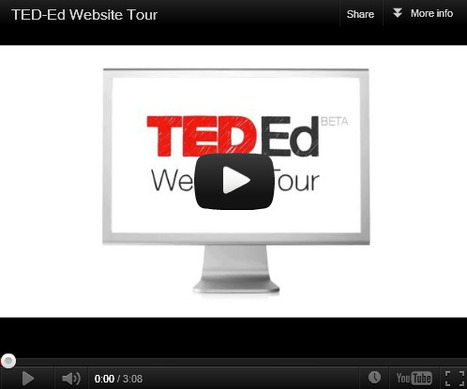
There are so many articles and posts today on the new open platform TED-Ed...and with good reason. They state "the goal is to allow any teacher to take a video of their choice (yes, any video on YouTube, not just ours) and make it the heart of a 'lesson' that can easily be assigne din class or as homework, complete with context, follow-up questions and further resources."
This scoop will send you to a page that has a video TED-Ed Website tour; a sample of a lesson where the teacher and the animator worked together; and tools that allow you to edit headlines, introductions, questions and follow-up links.
Take the time to look at these new offerings, and realize that this is the beginning of a resource that become a key component of your tool box.
"It’s clear that children from poverty are often at a disadvantage in school, and educators can find it challenging to help such students become positively engaged in their own learning. In a recent webinar for Scientific Learning, author and educator Eric Jensen (Teaching with Poverty in Mind), provides invaluable guidance for teachers who work with at-risk and low-income youth."
As well as providing some suggestions there is also a link to a webinar and links to additional readings.
As I study to become a high school teacher in a metropolitan area, this article is pertinent to both my effectiveness in that position, as well as my current research. The methods that the article highlights regarding how to engage students who live in poverty and how to be a support for them speak directly to my question of how a teacher can influence poverty.
What happens when you take data calculated from over an app called Eatery (for the iPhone) over 5 months and from over 50 countries, and use this crowd-sourced data to create a series of infographics? You get one infographic that looks at what has been eaten over the past 24 hours which provides a health rating of good, medium or poor (a global image) and an additional five infographics titled (Perception, When, Where, Who, What):
* We Eat Less Health Than We Think
* When We Eat Matters
* Where We Eat Matters
* Who Eats What
* Eating Habits Are Contagious
You might also want to read the Methodology section to have a better understanding of the data and what it shows for cities in the U.S.
"By now most people understand that standardized tests are not only harmful, but often they are also poorly constructed. But is there such thing as a good test? I was having a conversation with Cathy Earle about the subject and wondered if there is such thing as a good test. During that conversation she explained the reality is that in many cases the problem is how tests are used i.e. to assess students rather than help them learn. I asked her to say more and provide and example. Here it is and I have to admit...I rather like this kind of test."
Read on to learn about a test that is not quite the norm, but definitely engages the student as well as others!
What happens when you spend summer designing a course as a video game? In this TEDxBozeman Paul Andersen describes his experience along with lessons learned, lessons that apply to flipped classrooms. The video is about 11 minutes in length and worth watching.
"Twitter may have started off as a fun social media site for keeping up with friends and sharing updates about daily life, but it’s become much more than that for many users over the past few years as the site has evolved and grown...Whether you’re an academic or just interested in building your Twitter profile, keep reading to learn some tips and tricks that can help you take the first steps towards using Twitter for coursework, research, building a professional network, and beyond."
Worldreader gives Kindles to students in sub-Saharan Africa. The nonprofit's new report, funded by USAID, shows that access to e-readers improved primary school students' reading skills significantly.
How do you train an innovator? Which schools are doing it better than others? Are teachers equipped with the new skills required to educate students in this decade?
This post explores these questions and offers five "essential education and parenting practices that develop young people's capacities to innovate." The first one is "Learning to work collaboratively (innovation is a team sport!)."
The concepts of information and knowledge are also explored, beginning with the statement "Information may be free but knowledge also includes understanding, problem solving, communication, and collaboration, none of which is free." Are we addressing these 21st century skills as our students move from elementary school through high school, or our teachers "...compelled to teach to the tests for accountability purposes..."?
Additional topics are also explored, including AP testing (and the move to have students "demonstrate that they can apply knowledge learned and not merely regurgitate it" to the fact that many when you look at CEO's of most major companies "the majority did not go to an Ivy League school for undergraduate..."
Paul Andersen is a science teacher and a technology specialist in Montana, and has this great video on Metacognition. In this video he provides ten tips on increasing comprehension.
He also has an amazing number of other resources available on his website http://www.bozemanscience.com/ including science videos, other educational videos, and a journal. He recently presented a TEDx talk about how to use game design to improve student learning. Great resources and food for thought.
"Mapping a Personalized Learning Journey – K-12 Students and Parents Connects the Dots with Digital Learning focuses on how today's students are personalizing their own learning, and how their parents are supporting this effort."
Today many students are personalizing their learning with the support of their parents. This report looks at "how students seek out resources that are digitally-rich, untethered and socially-based." Questions addressed include:
* What are the digitally-rich, untethered and socially based learning strategies that facilitate this process?
* How can education stakeholders support students as they seek to personalize their learning?
"At some point in your life you've won a game you've never played before or witnessed a young child say or create something with worldly depth."
How about this quote from Shunryu Suzuki (a Buddhist monk) "In the beginner's mind there are many possibilities, but in the expert's there are few."
Perhaps we need to try to see the world through the eyes of a child, be more open to trying ideas that we think are completely off the wall, to think like a child. Much more information is found in this article.
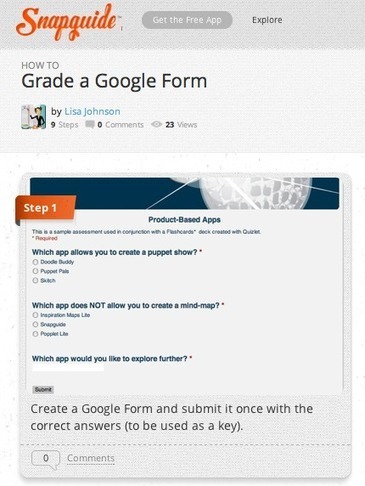
So take Google, combine it with Flubaroo (a tool that works with Google Forms and allows them to be graded) and add in Snapguide (presenting a tutorial to walk you through setting up the Flubaroo script) and you have a home run! Great set of tools that work together.
What can we do in the classroom to help our students to become engaged in their work, to be fully involved? This post is a follow-up to one written in June 2011, and provides a "variety of strategies and approaches" you may try to help move students from being on-task to being engaged. To whet your appetite, here are the first two.
* Ask questions that don't have right or wrong answers. Seek student opinions, allow argumentation, encourage persuasion, and teach students how to disagree and debate in a positive way.
* Strike a balance between praise and feedback. Grant Wiggins, co-author of Understanding by Design points out that praise, "Keeps me in the game, but doesn't help me get any better." While praise may encourage effort, specific feedback is necessary in order to truly learn and grow.
To get content containing either thought or leadership enter:
To get content containing both thought and leadership enter:
To get content containing the expression thought leadership enter:
You can enter several keywords and you can refine them whenever you want. Our suggestion engine uses more signals but entering a few keywords here will rapidly give you great content to curate.


 Your new post is loading...