Your new post is loading...

|
Scooped by
Beth Dichter
May 7, 2012 2:44 PM
|
“My students regularly ask, "What’s the Cloud?" And I never have a really good answer for them. "It’s saving and doing stuff online," seems completely inadequate… I generally end up describing a few resources that I think would be useful to that particular student…The Cloud is actually an umbrella concept covering any service or tool that is housed on the Internet…here are some of the things that you can find in the Cloud that will help you in your quest for success in higher education.” Many of these resources are also good for primary and secondary education.
|
|
Scooped by
Beth Dichter
May 6, 2012 8:47 PM
|
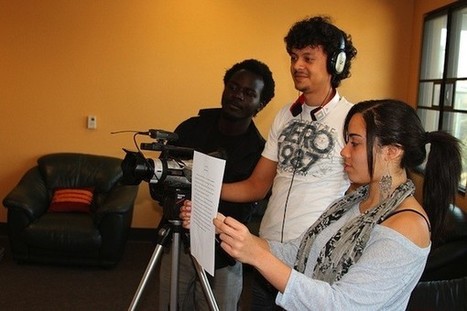
"Cell phones are a terrific tool to support student engagement and achievement in speaking and listening. Here are some ways that teachers are using cell phones to do just that by using tools like Google Voice and Voki and functions like video."
|
|
Scooped by
Beth Dichter
May 6, 2012 2:40 PM
|
"College students today are more tech savvy than ever before. Just how important is technology to their academic lives? Presta used material from the Pew Research Center, Chronicle of Higher Education, Mashable and other sources to put together in this infographic. Check it out for the full picture of how technology is changing college students’ lives."
|
|
Scooped by
Beth Dichter
May 5, 2012 10:44 PM
|
"Politics is about what happens rightnow, but education policy is about what happens five or 10 years from now. And it’s the second part of that phrase that explains a sometimes uncomfortable truth about policy and policymaking — in education, we really cannot say with certainty exactly how things will turn out in a decade, as the results based on student performance must be judged by longitudinal surveys for about a decade before judgment is passed." This article explores "this long-term vs. right now view of education" looking at two survesys of teachers, and provides a list of what factors teachers believe "have the greatest impact on improving academic achievement" and which teachers believe "are the least important for improving academic achievement."
|
|
Scooped by
Beth Dichter
May 5, 2012 8:05 PM
|
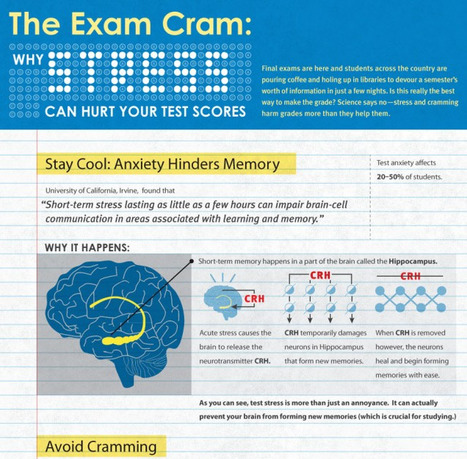
"It’s exam time, and most students go through the same panicked routine semester after semester. While you may think caffeine IVs and all-nighters are the only way to tackle exam week, studies show that this kind of study pattern may harm your GPA more than it helps–YIKES! Fortunately, our latest infographic outlines some some sweet tips on how to make your study sessions less stressful and more efficient so you can rock those final exams this semester."
|
|
Scooped by
Beth Dichter
May 5, 2012 8:32 AM
|
“Workplace technology has evolved dramatically since the first stone tools were used 2.6 million years ago. Back then the amount of information our brains had to process was minimal...as workplace technology advanced through the ages this data increased dramatically, culminating in the digital age & information overload we are faced with today…Can new technology which visualizes information provide a solution…?”
From a Data Digest Report published by Mindjet:
The initial study included 2,000 office workers. A “scientific sample of 12 participants that took part in the study over 4 days were fully conversant with all tested software…the research investigated differences in individual & team performance using visual mapping software compared to traditional office software.”
The experiment results of the individual tasks found:
* On an individual level, workers using visual mapping techniques used on average nearly 20% less cognitive resources compared to when using equivalent traditional software…
* Participants using visual mapping software were 17% more productive...and able to recall 4.5 per cent more details…
Group results
* Groups collaborating on a project used on average 10% less cognitive resources…
* By using visual mapping software, groups were 8% more productive…
* Participants working in groups were able to recall 6.5% more data when using visual mapping compared with traditional techniques…
The study may be accessed through a link on the infographic page.
|
|
Scooped by
Beth Dichter
May 4, 2012 10:48 PM
|
So what is critical design literacy and why is it needed? This article states "Critical design literacy applies the protocols of design thinking to practice social innovations that lead to social transformation. In the learning environments that we will pilot we want students to become literate in critical thinking and critical designing. The former encourages students to look at their community through an inquisitive lens while the latter encourages students to design for community impact." Points on how to practice digital literacy, a look at how to redesign K-12 environments and designing for equity are also discussed.
|
|
Scooped by
Beth Dichter
May 4, 2012 8:50 PM
|
As you read this, students all over the country are sitting for state standardized exams. Schools spend up to 40% of the year on test prep, so that, shall we say, no child is left behind.
|
|
Scooped by
Beth Dichter
May 4, 2012 8:15 PM
|
From scytales in the year 700 BC to the first password, CAPTCHAs and literally unbreakable 258-bit encryption, take a walk with us through the history...
|
|
Scooped by
Beth Dichter
May 3, 2012 9:14 PM
|
"It has been said that imagination is more important than knowledge, and for any experienced classroom teacher it is easy to see daily evidence of this... Dr. Murray Hunter of the University of Malaysia Perlis has listed the 8 types of imagination we use on a daily basis, with explanations for each." His definition "Imagination is a manifestation of our memory and enables us to scrutinize our past and construct hypothetical future scenarios that do not yet, but could exist. Imagination also gives us the ability to see things from other points of view and empathize with others." Read on to learn the 8 types of imagination and links to additional resources.
|
|
Scooped by
Beth Dichter
May 3, 2012 8:25 PM
|
It's hard to pay attention to the business of journalism without hearing about data journalism or data-driven journalism. The Data Journalism Handbook is the 'work of an internation, collaborative effort involving dozens of data journalism's leading advocates and best practitioners.' Now available online in beta (at http://datajournalismhandbook.org/1.0/en/) Although geared to journalists the book provides insights into data literacy, visualizing data, open data and more...and given that schools are data driven this may be an excellent resource for a wider audience.
|
|
Scooped by
Beth Dichter
May 3, 2012 7:54 PM
|
"Students sit in the test-taking room, with full access to computers and wireless connections. As they work on national exams, they can be seen accessing the internet from time to time. Are the results from this testing going to be corrupted because these test-takers are not isolated from global information resources?" We use the term 21st century skills today, and we discuss the need to have our students understand how to collaborate, be critical thinkers, be problem solvers...the list goes on and these skills, ones that are defined as necessary often rely on the use of technology...but what happens when we give a test that is online?
|
|
Scooped by
Beth Dichter
May 2, 2012 10:55 PM
|
"Using games for purposes other than entertainment is nothing new. There are war games, educational games, throne games. But a new class of games has sprung up in recent years, designed to create awareness and raise support for a variety of global issues. Such serious games seek to harness the power of competition and/or novelty to attract players and get the word out for a good cause. Here are 15 games you can play and be a better person for it."
|
|
|
Scooped by
Beth Dichter
May 7, 2012 6:25 AM
|
"Oh Noah!, (formerly known as Noah Comprende) is designed to teach Spanish to children ages six to eight through animated videos with embedded games that help build vocabulary. In each three-minute video, a misunderstanding launches a comic misadventure. Kids learn language better when they can put it into meaningful context. Although – like Noah – they may not understand all the Spanish dialogue, kids can comprehend the story told through rich visual storytelling, much like a silent movie."
|
|
Scooped by
Beth Dichter
May 6, 2012 7:52 PM
|
“Value-added Models (VAM) of accountability are now the rage. And it is understandable why this is so. They involve predictions about “appropriate” student gains of performance. If results – almost always measured via state standardized test scores – fall within or above the “expected” gains, then you are a “good” school or teacher. If the gains fall below the expected gains that you are a “bad” school or teacher."
Yet there are also many questions about the way VAM is being implemented. Grant Wiggins explains why Value Added Models are good in theory and also discusses many of the issues around the implementation of VAM (and includes many references).
|
|
Scooped by
Beth Dichter
May 6, 2012 8:30 AM
|
"I’ve been completely obsessed with Google’s new mini-site devoted to finding better ways to incorporate proper web searches into the classroom. Dubbed ‘Search Education,’Google’s new site has an array of lesson plans, videos (check a sample out below), concept maps, and other tools designed to help any educator properly integrate Google... As part of Search Education, Google has shared a bunch of lesson plans that are organized by degree of difficulty. So, if you consider yourself and / or your students Google experts, you should try out the more advanced plans. If you don’t know what ‘boolean’ means, then you probably should start with the more basic stuff. The following are just some of the many lesson plans brought to you by Google. Check out the site for more info!"
|
|
Scooped by
Beth Dichter
May 5, 2012 10:39 PM
|
"What is learning analytics – as a field of study, as a practice, as a set of tools, as a way to collect and analyze educational data? What are we tracking, and to what end? This article provides a working definition and then explores a number of questions, raising the importation notion that learning analytics should be used to help us support "student learning." A number of issues are also raised such as "Do we tell students what data we collect and how we are going to use it? Do students dontrol and do they own their learning data?"
|
|
Scooped by
Beth Dichter
May 5, 2012 1:32 PM
|
"When used effectively, technology plays an important role in enhancing the learning process. Teachers can use digital devices to present supplemental material for lessons or to encourage students to take a more hands-on role in their education." The question is how do we keep students engaged and focused on the lesson...knowing how many distractions exist once a student is sitting at a computer.
Suggestions include: * Encourage direct engagement * Use real-world problems Read on for additional ways to use technology to enhance your lessons and support student learning.
|
|
Scooped by
Beth Dichter
May 5, 2012 7:32 AM
|
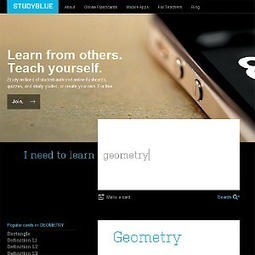
"Students like to study together... Peek down the hallways of your own school, or in the cafeteria or library around final exam time, and you’ll probably see students quizzing one another over the content they anticipate encountering on the test. Thanks to the Web, they don’t have to be in the same room to work together.
Let’s take a look at some platforms that help students connect for online study sessions."
|
|
Scooped by
Beth Dichter
May 4, 2012 9:26 PM
|
"Do you think you’re creative?” Ask this question of a group of second-graders, and about 95 percent of them will answer “Yes.” Three years later, when the kids are in fifth grade, that proportion will drop to 50 percent—and by the time they’re seniors in high school, it’s down to 5 percent.
|
|
Scooped by
Beth Dichter
May 4, 2012 8:45 PM
|
"When we ask students to work with and learn from primary sources, we transform them into historians. Rather than passively receiving information from a teacher or textbook, students engage in the activities of historians — making sense of the stories, events and ideas of the past through document analysis. Use DocsTeach activities for classroom demonstration, as full-class activities, as small-group activities, or as individual in-class or homework assignments. Manage activities in your account. Share both activities you find and those you create with your students on DocsTeach." With many ready-to-use tools for teaching with documents and thousands of primary documents from the National Archives this site is rich with resources... Now available for the iPad - to download free app: http://itunes.apple.com/us/app/national-archives-docsteach/id513465174?mt=8
|
|
Scooped by
Beth Dichter
May 4, 2012 2:31 PM
|
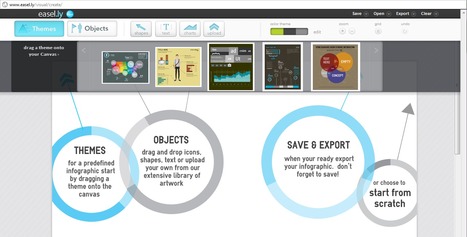
Create infographics online...easel.ly defines itself as "a theme-based web-app for creating infographics and data visualization." easel.ly is in beta and provides drag and drop pre-designed themes (currently five choices) and the ability to customize objects (as in people, animals, backgrounds, maps and more), creating rich infographics. easel.ly supports Firefox, Chrome and Safari.
If you are interested in having students create infographics this is definitely worth checking out!
|
|
Scooped by
Beth Dichter
May 3, 2012 8:57 PM
|
"It’s all about teaching digital literacy and citizenship: the knowledge and skills necessary to think critically, behave safely, and interact responsibly in a digital world..." Three reasons why digital citizenship matters: * Kids need guidance in this area as they need guidance in many areas; * Who knows what's coming...we do not know the future, but we need to have skills that help us; * The genie is out of the bottle and to be a citizen in the 21st century requires skills, such as how to find and evaluate information online... Tips for teaching digital literacy and citizenship are also posted as are links to resources.
|
|
Scooped by
Beth Dichter
May 3, 2012 8:00 PM
|
Unfortunately, many college students cheat, whether it's because of laziness or desperation. But how do they do it, and what can educators do to stop it? And the techniques used in college are also used in secondary education...
|
|
Scooped by
Beth Dichter
May 3, 2012 3:10 PM
|
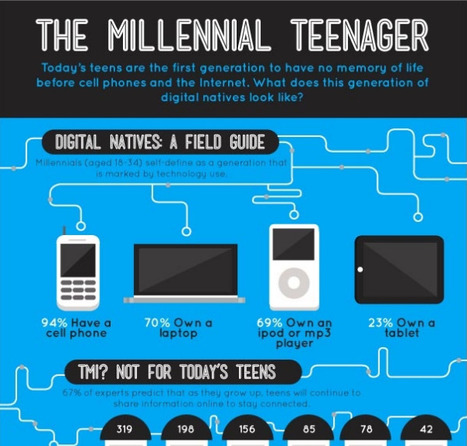
Teenagers today have so much exposure to technology. Check out this infographic for a more detailed look at the tech-savvy world of these teens.
|