Your new post is loading...

|
Scooped by
Beth Dichter
June 8, 2012 9:10 PM
|
"What your kids look for in a snack might be different than what you look for as a parent. While they focus on taste, you focus on nutrition. Same goes for games. Glitzy, big-name games can be enticing, just like junk food. Some are flashy and addictive but do little to feed kids' curiosity or help them develop. But truly great video games can help your kids grow in ways you never thought possible -- just like delicious, healthful food. So how can you avoid the sugar-cereal equivalents in the game world? Read these 10 tips to find out." The first tip, draw your kids in, is followed by a brief explanation and two video games that would tend to draw your kids in. In this case the games are for ages 10+ and 12+, but other tips have suggestions for younger and/or older kids.
|
|
Scooped by
Beth Dichter
June 7, 2012 10:17 PM
|
On May 16, 2012 Dr. Thomas Brush, Professor and Associate Dean for Teacher Education at Indiana University and my dissertation director, posted the following exclamation of surprise and alarm on FaceBook. "His message was in response a White House reply to a long letter he had written about the ways in which education policy, particularly testing and unrealistic expectations for teacher candidates, are creating a roadblock to getting America’s best and brightest college graduates into public school classrooms. What has gotten this seasoned teacher educator so riled up, and is there truth to his claim that government policy is preventing some excellent potential teachers from entering the profession?" You may read the full text of Dr. Brush's letter as well as the reply from the White House, or see a summary of the points Dr. Brush made...and determine where you stand with these issues. Are new regulations "discouraging to potential teachers?" Will "the successful completion of a series of test" make better teachers? There are many questions to ponder.
|
|
Scooped by
Beth Dichter
June 7, 2012 4:09 PM
|
"Do you know how to read? More precisely, do you know how to read to kids?...research shows that subtle features of the way adults act during story-time make a big difference in children’s literacy—and that most grownups aren’t using these simple but effective techniques." Read this article to learn simple tips which result in positive results!
|
|
Scooped by
Beth Dichter
June 6, 2012 9:23 PM
|
One public school in Boston is focused on building students' collaborative—rather than competitive—abilities. Watch the video (~6 minutes) and learn about a school in the Boston area that might be called a "transformational school," a school where "students start their lessons without prodding fromtheir teachers..." They also speak talk about the Habits of Mind the use as a conceptual framework: * Evidence - How do you know?
* Conjecture - What if things were different?
* Connections - What does it remind you of?
* Relevance - Is it important? Does it matter?
* Viewpoint - What would someone else say? How would someone else feel? Watch and listen and ask yourself, would your school make this type of transition?
|
|
Scooped by
Beth Dichter
June 6, 2012 8:11 PM
|
"Learnist, as many have already pointed out, works much like Pinterest — a way to catalog online resources on a topic and share them with the user’s social network. And like Pinterest, it looks like a digital bulletin board with pictures and messages, and connects with Facebook accounts. In fact, the site’s “learning boards” look quite a bit like Facebook’s timeline feature, and Facebook membership is required to use Learnist at this point." Currently in beta you may find that if you request membership you will receive an invitation. In the meantime you may explore some of the information that has been posted by others.
|
|
Scooped by
Beth Dichter
June 6, 2012 3:03 PM
|
This is the 3rd post in a series that is looking at Word Cloud Generators. Nine word cloud generators are shared, and they are quite different. The first two posts are in this Scoop.it also. One covered 12 Tips in Using Worlde and the other was on 108 Ways for Eductors to use Word Clouds in the Classroom. Check this post out for information on ABC Ya, Tagul, Word It Out, Tag Crowd, Wordsift (one of my favorites), Make Word Mosiac, VocabGrabber, TagCloudGenerator and You Are Your Words (another favorite of mine).
|
|
Scooped by
Beth Dichter
June 5, 2012 8:57 PM
|
|
|
Scooped by
Beth Dichter
June 5, 2012 7:53 PM
|
This webinar explored four key elements of DBQ instruction using images, video and web-based audience responders. Download my slidedeck. DBQ stands for document based questions. If you teach history, or any course that uses documents (which may be visuals) then there are an amazing number of resources included in the SlideShare embedded in the post. You will walk in your students' shoes as you learn "four key components" to document-based instruction: 1. The right documents. 2. Knowing how to look at them. 3. Letting students disover their own patterns, then ask students to describe, compare and defend what they found. 4. Basing the task on enduring questions, the kind that students might actually want to answer.
|
|
Scooped by
Beth Dichter
June 5, 2012 6:40 AM
|
"When e-textbooks were first introduced, they were supposed to be the wave of the future, and experts thought we’d see e-reader-toting students littering college campuses, and of course being adopted in droves by online university students. But they haven’t taken off quite as expected..."
|
|
Scooped by
Beth Dichter
June 4, 2012 9:00 PM
|
"The National Center for Education Statistics just released its 2012 Condition of Higher Education report, and for those who follow higher education, its findings are not surprising. Higher education is booming, with a 37% increase in enrollment from 2000-2010...There is a wealth of data in the report, but here are four of the research results that may go a long way toward explaining some of the recent challenges in higher education, including declining retention and graduation rates." A brief explanation of the results are below. The article provides additional detail as well as an analysis. * Students accepted thru open admission are less likely to complete degrees. * More students are working part time or full time. * "Students seem to get less for their money at private for-profit colleges." * "The achievement gap between white and other races/ethnicities is increasing."
|
|
Scooped by
Beth Dichter
June 4, 2012 8:41 PM
|
"As mobile devices become more and more popular the demand for easy access to wi-fi increases as well. It is already pretty easy to access wi-fi in most places including coffee shops, restaurants, the mechanics, etc. Access to wifi will only become wider spread and easier to access especially when it is predicted 1 in 4 users will have more than one connected device by 2016...While free wi-fi is great it does not necessarily protect you the same way a secure network may. Today’s infographic 'Free Wi-fi, Friend or Foe?' gives us some examples of ways hackers can hijack your accounts and how to ensure your safety when browsing on an open network."
|
|
Scooped by
Beth Dichter
June 4, 2012 2:09 PM
|
Discovering the brain's power to change may be neuroscience's biggest—and most promising—contribution to education. "What we find is people really do change their brain functions in response to experience," said Kurt W. Fischer, the director of Harvard University's Mind, Brain, and Education Program. "It's just amazing how flexible the brain is. That plasticity has been a huge surprise to a whole lot of people."
|
|
Scooped by
Beth Dichter
June 3, 2012 10:23 PM
|
Discover how a pinch of curiosity can improve your cooking! Explore recipes, activities, and Webcasts that will enhance your understanding of the science behind food and cooking. Check out science experiments and learn more about the science of "cooking" eggs, pickles, candy, bread, seasoning and meat.
|
|
|
Scooped by
Beth Dichter
June 7, 2012 10:29 PM
|
"Summer is around the corner. The kids will be out and family vacations will be underway soon. However, it's also important to view this as a time to get your child ready for the new school year ahead." A look at the history of summer break, great book suggestions for summer reading (Kindergarten thru 3rd grade), the loss of learning in math, what happens with social studies, phys ed and more!
|
|
Scooped by
Beth Dichter
June 7, 2012 8:31 PM
|
"Blended learning is a disruptive innovation in education that can take many forms. Here, we look at what blended learning is, why it’s spreading, and how it works in real and virtual classrooms. Join the conversation on blended learning below."
|
|
Scooped by
Beth Dichter
June 6, 2012 10:02 PM
|
"From ways of measuring it to knowing what it really means, there are a lot of myths and misunderstandings about intelligence. After decades of research (or perhaps centuries, if you count pre-Scientific Revolution work), we still don’t know everything there is to know about intelligence, but in many areas we’re getting a whole lot closer to having a complete understanding. Here, we chronicle some of the more recent findings in intelligence research..."
|
|
Scooped by
Beth Dichter
June 6, 2012 8:38 PM
|
Qwiki has launched a new site, which is a "presentation platform" and it appeared that the material from the original Qwiki was gone...but it is available under this new URL.
For those of you who have not tried Qwiki it is worth checking out. Type in your search term and it is transformed into a visual presentation, with real-time audio narration and other data including maps, movies, images, animations and more.
|
|
Scooped by
Beth Dichter
June 6, 2012 7:59 PM
|
"InstaGrok is an intelligent visual search engine and interactive learning tool that collects educational content and displays it in the form of a cloud of related words." Along with multimedia features, there is a visual map; content is displayed in multipe formats (think Universal Design for Learning); and students may choose a level of difficulty. Additional images are available in this post or head over to to InstaGrok at http://www.instagrok.com/.
|
|
Scooped by
Beth Dichter
June 5, 2012 9:13 PM
|
"Studying abroad is a great way to find growth, career inspiration, and great experiences, but so many students today don’t get to experience this type of learning. In fact, only 1% of all students enrolled in higher education institutions today choose to study abroad...Read on to learn why studying abroad is such an important experience, and why many believe that study abroad programs should be required for higher education studen."
|
|
Scooped by
Beth Dichter
June 5, 2012 8:53 PM
|
Every year a few wise commencement speakers rise above the cliches and deliver a truly important message. Ten speakers, ten memorable speeches addressing a range of topics...with a short description and a video of the speech. Key ideas include: * Doing it for money is never worth it * Questioning everything is normal * Be a passionate, engaged citizen * Serve a purpose larger than yourself And some of the speakers are playwright Tony Kushner, host of 'American Life' Ira Glass, Bob Woodruff, and veteran journalist Jim Lehrer.
These Commencement Addresses have the potential to inspire each of us.
|
|
Scooped by
Beth Dichter
June 5, 2012 7:43 PM
|
"A few weeks ago fellow Voices blogger Shelley Wright wrote a provocative blog on flipping Bloom’s Taxonomy and beginning the learning experience with Creativity...Ongoing education for teachers in all of Bloom’s Taxonomy except for Creativity is relatively straightforward...Encouraging teachers to teach creativity requires a different approach." The post goes on to explore * Why teachers who create do Creativity so well * Teaching creativity is messy * Assessing efforts to teach Creativity * We will get what we assess
|
|
Scooped by
Beth Dichter
June 4, 2012 9:05 PM
|
"There are roughly 7,000 languages currently spoken around the planet today. As the world continues to become more interconnected, due in large part to the ever-increasing use of the internet, language use will undoubtedly evolve, as well. Check out our "Speaking of Languages..." infographic below to learn more about the future of the world's many languages."
|
|
Scooped by
Beth Dichter
June 4, 2012 8:49 PM
|
This post looks at underachievers, with a focus on "undiscovered weaknesses or uneven learning skills." Specifically it provides information on weak visual learners, weak verbal learners, graphomotor weaknesses, attention weaknesses, and social factors. In each section there is an explanation followed by suggestions or "possible paths of action." Although written with the parent in mind this is also a great resource for teachers.
|
|
Scooped by
Beth Dichter
June 4, 2012 6:32 PM
|
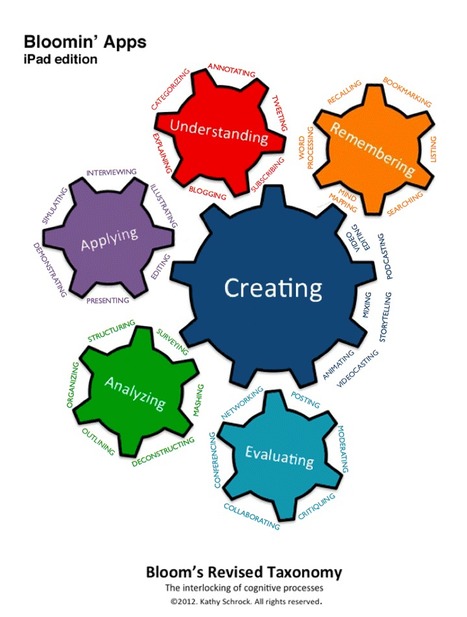
Includes all the Bloomin' versions in one place! One link for Kathy Schrock's Guides - check out Bloom's Revised Taxonomy the iPad edition, Google Apps to Support Bloom's Android Apps to Support Bloom's and Web 2.0 Apps to Support Bloom's.
|
|
Scooped by
Beth Dichter
June 4, 2012 6:23 AM
|
"Schools have found an alternative way to equip children with flexible and adaptive skills by allowing them to learn through playing video games." Did you now that video games help students develop skills in problem solving and negotiation; judgement, analysis and stategic planning; communication; narrative and transmedia navigation and more? As well as showing skills this infographic also provides names of eduational games as well as facts and statistics, how video games are used at school and skills video games help you hone. If you are interested in gamification check out this infographic.
|