Your new post is loading...

|
Scooped by
Beth Dichter
June 13, 2012 10:06 PM
|
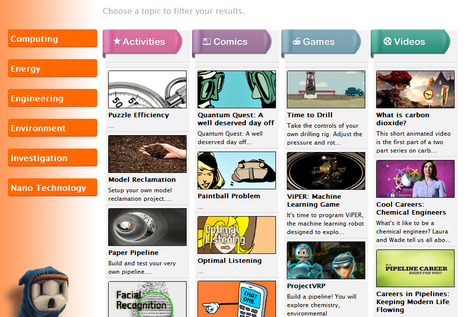
"School's out for the summer! Whether your kids are at home, at the pool, or working summer jobs, they probably have less structure than they're used to. What can you do to help? How about sending them to summer camp? Well…virtually. Using our new Learning Ratings, it's easy to pick apps, games, and websites that let kids have fun while keeping up their existing skills and building new ones." You may search by age levels (2 - 6, 7 - 11, and 12 - 17). Each tool is rated for educational value. The image above shows the learning activities.
|
|
Scooped by
Beth Dichter
June 13, 2012 9:07 PM
|
Do you wan to “master the art of Googling”? Check out this interactive infographic that provides 20 search tips to help you get your “PhD” in Googling.
|
|
Scooped by
Beth Dichter
June 12, 2012 9:18 PM
|
How different are the brains of boys and girls? What do educators and parents need to know about gender and the brain, and how can we best help students learn?
|
|
Scooped by
Beth Dichter
June 11, 2012 8:35 PM
|
"Paul Barnwell’s article “Why Twitter and Facebook aren’t Good Instructional Tools” is a ruse…in a good sense. I think it’s a brilliant way to get a whole load of readers coming to the defense of social media tools in the classroom. But take a minute to read what he’s written and you’ll see it’s not an attack, it’s a call to action.
Done well, social media and technology integrated into the classroom feels like a familiar old softball glove. It becomes an extension of your hand and you almost forget that it’s there. Done badly, it’s a waste of time and the return on your investment is nil."
|
|
Scooped by
Beth Dichter
June 11, 2012 8:11 PM
|
Who are our digital natives? And what are their skills? Through a combination of video clips, text and links this post defines "digitals", and explores their impact on educators. Clearly technology is here, and it is impacting education and how teachers teach. Is technology being used effectively in schools? Are we making assumptions in terms of what it means to be a "digital native" or a digital immigrant"? This article explores these issues providing much food for thought.
|
|
Scooped by
Beth Dichter
June 10, 2012 10:34 PM
|
"Raise the bar. Set new goals. Ask your students to do things they might not think they can do at first. Give them the freedom to get creative. To design. To solve problems. To justify their opinions. Then, they’ll turn around and out-think you. They’ll come up with ideas and solutions that you hadn’t even considered. They’ll lead you in a new direction. They’ll make you want to replan, revise, and reflect. Then you’ll feel like you are struggling. That’s when you know you’ll be growing, too. That’s called being a teacher."
|
|
Scooped by
Beth Dichter
June 10, 2012 9:03 PM
|
What often causes more anxiety for a college student than studying for a test? It’s being given a written assignment to complete. The strategies provides work well for students in primary and secondary education: Develop a Strategy; Write with a Purpose; Master the Mechanics; Practice Makes Perfect; and Find and Use Resources. Within each section there are links to additional resources.
|
|
Scooped by
Beth Dichter
June 10, 2012 8:22 PM
|
Yippy (a search engine) now has a cloud creator (in beta). Type in your word or phrase, select a border style and link style as well as width and prview your cloud. You may also get the code and add it to your website.
|
|
Scooped by
Beth Dichter
June 10, 2012 7:28 PM
|
|
|
Scooped by
Beth Dichter
June 9, 2012 11:42 PM
|
"As technology becomes more entwined with curriculum and instruction, school districts are looking to each other for models that work. For their technology and learning initiatives, three school districts were recognized as first-place winners in their respective student population categories in the 2012 Digital School Districts Survey from the Center for Digital Education."
|
|
Scooped by
Beth Dichter
June 9, 2012 7:01 PM
|
Wonderville, brought to you by the Science Alberata Foundation, is an interactive destination for kids to discover and explore the world of science. The site encourages students to explore and discover that science if fun! There are many adventure games (over 30) which build science knowledge. There is an activities section, with science crosswords, word search puzzles and printable activity sheets. Find video that explore real-life application of science concepts. And check out the comics to learn and laugh
|
|
Scooped by
Beth Dichter
June 8, 2012 10:18 PM
|
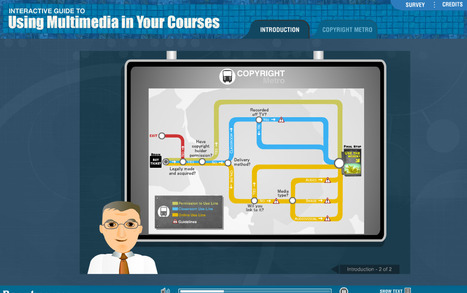
Do you have questions about using copyright media in your classroom, specifically copyrighted audio, images, and audiovisuals? This is an interactive tool, where you "board the subway" and explore a number of stops.
|
|
Scooped by
Beth Dichter
June 8, 2012 9:54 PM
|
"The crowd-sourced site Wikipedia has long been bemoaned by the academic community as an unreliable source for student research. Some educators, however, have embraced the site—not only for pointing students in the direction of quality information, but also for teaching information literacy skills." This article recommends you discuss/define terms such as crowd-sourced, open source, citation, plagiarism and more (and provides a link to an article '7 Things You Should Know About Wikis.' The article then recommends steps students should take as they explore Wikipedia for articles, in other words, use media literacy/information literacy skills as you would with any website when using Wikipedia. This is a great source to help you think about how to teach skills to your students.
|
|
|
Scooped by
Beth Dichter
June 13, 2012 9:11 PM
|
"Overall, educators need to understand some basics about technology and that it is not a be-all-end-all solution to everything in a classroom. Technology can help teachers differentiate and provide new experiences for their students. Technology can also help students better understand a concept and provide extra help for them. Educators need to start with good pedagogy and lesson objectives and activities and then look for technology that can enhance those lessons, improve teaching and learning, and help students learn."
So what do you need? As well as listing ten specific skills links are included to help you learn/refresh the skills as well as a link to an article published earlier this year on "The How's, Why's and Value of Educational Technology. Below are three of the items listed...check out the article for the complete list.
* Internet Search and Research
* Hardware Basics and Troubleshooting
* Finding Apps and Software
|
|
Scooped by
Beth Dichter
June 12, 2012 9:29 PM
|
Thanks to Larry Ferlazzo for sharing this!
|
|
Scooped by
Beth Dichter
June 12, 2012 8:46 PM
|
...an infographic that highlights the progress made within AP curricula over the past decade. Our graphic, “The Rise of the AP,” shares information and statistics from theCollege Board’s 8th Annual “AP Report to the Nation.”
|
|
Scooped by
Beth Dichter
June 11, 2012 8:20 PM
|
"A May 29, 2012 post in Education Week’s Transforming Learning blog, Urgency and Complacency in Public Schooling recapped a conversation between Learning First Alliance’s Executive Director Cheryl Williams and U.S. Secretary of Education Arne Duncan in which Duncan stated that the biggest challenge facing public education today is complacency. Is public education complacent? If so, what are the causes, and if education has grown complacent, what can we do about it?" Justin Marquis explores this issue, suggesting that "teachers are suffering from a severe case of learned helplessness." He looks at collective bargaining, communication (or lack of), standardized testing and funding cuts, and proposes a solution. You may find yourself agreeing with sections and disagreeing with others, but I suspect you will be pushed to look at a variety of issues, and possibly follow some of the links within the article.
|
|
Scooped by
Beth Dichter
June 11, 2012 7:41 PM
|
"During the past two days, our list of Free Online Movies has been getting some good exposure. And we've got no complaints. But while assembling the movie list, we were also busy putting together a list of 500 Free Online Courses from top universities. Here’s the lowdown: This master list lets you download free courses from schools like Stanford, Yale, MIT, Oxford, Harvard and UC Berkeley." They list 55 courses in Philosophy, 50 in History, 50 in Computer Science and many more. You may see highlights from the list, or access the complete list on their website.
|
|
Scooped by
Beth Dichter
June 10, 2012 9:46 PM
|
As mobile devices become more popular, education leaders differ on when and if devices like iPads should be integrated into K-12 curricula.
|
|
Scooped by
Beth Dichter
June 10, 2012 8:44 PM
|
Have you asked yourself what skills a 21st century teacher needs to have today? In this post a list of 33 skills every teacher should have is provided, as well as links to resources to help you learn the skills. The list ranges from create and edit digital audio to exploit digital images for classroom use to compile a digital e-portfolio. The list is extensive as are the resources. Consider exploring this post over the summer and return to your classroom with new ways to address 21st century skills!
|
|
Scooped by
Beth Dichter
June 10, 2012 7:58 PM
|
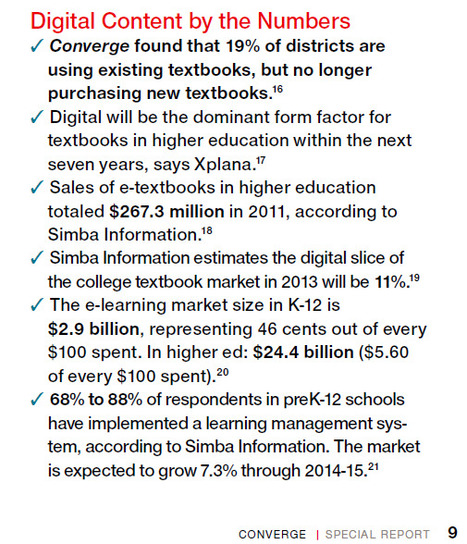
Converge has published a special report that “examines…education transformation in all its facets: from curriculum acquisition to best practices for a successful transition to key governmental policies.” The report discusses a wide range of subjects. After an Introduction and The Big Idea (as in textbook reformation) the sections are So You Want to go Digital – Now What? (with 7 articles); Policy and Legislation: Where Has It Been and What’s Coming?; Barriers to Success – And How To Hurdle Them (3 articles); What The Future Holds; and The Reformation in Action. Technology concerns, plagiarism and copyright, professional development tips, digital content by the numbers and much more is covered.
|
|
Scooped by
Beth Dichter
June 10, 2012 7:09 PM
|
A recent research paper sheds light on several ways in which educational games can facilitate the learning experience and benefit the student. The article states "if gamification is to be of use to schools, we must better understand what gamification is, how it functions, and why it might be useful. This article addresses all three questions – what,how, and why bother? – while exploring both the potential benefits and pitfalls of gamification." To go directly to the article: http://www.gamifyingeducation.org/files/Lee-Hammer-AEQ-2011.pdf.
|
|
Scooped by
Beth Dichter
June 9, 2012 11:15 PM
|
Are you looking for a large display interactive calcuator to use with your students with an interactive whiteboard? If so, check out this site. Two versions of the calucator are available - one is 800x600 and the other 1024x768. Although the site says it works with IE 5 or 6 I tested it with Chrome and Firefox. Both may be downloaded and used off-line.
|
|
Scooped by
Beth Dichter
June 8, 2012 10:32 PM
|
Powerful Learning Practice has just released a free 13-page Twitter Guide for Teachers. "This guide is for educators who are new to Twitter, or veterans to the social media platform who want to bring Twitter into their classrooms or grow their network." The sections include: * Growing your personal network with Twitter * How to leverage your personal learning network with hashtags * Twitter in the classroom
|
|
Scooped by
Beth Dichter
June 8, 2012 9:59 PM
|
Are you thinking of flipping your classroom? Do you see a flipped classroom as watching videos? Think again. Peter Pappas suggests that a flipped classroom is "really about creating more time for in-class student collaboration, inquiry, and interaction. It's also is a powerful catalyst for transforming the teacher from content transmission to instructional designer and changing students from passive consumers of information into active learners taking a more collaborative and self-directed role in their learning." He provides a "slide deck" that has strategies, resources, lesson and more to help you make this transition.
|