


Today's feature is all about using various web tools and resources to have the tough talk - to find better ways for teaching about controversy.

 Your new post is loading...
 Scoop.it! Today's feature is all about using various web tools and resources to have the tough talk - to find better ways for teaching about controversy. No comment yet.
Sign up to comment
Scoop.it!
Check out YouTube's top trending educational videos in 2013.
Beth Dichter's insight:
It appears that science is trending in educational videos on YouTube. Other videos in this list (and embedded in the post) include: * Immovable Object vs Unstoppable Force * Why Do We Kiss? * Is Your Red the Same as My Red? * How Old Are Your Ears? (Hearing Test) * Amazing Facts to Blow Your Mind (Part 2) * What if the Sun Disappeared? * What Your Body Does in 30 Seconds * Canada & the United States: Bizarre Borders (Part 2) * The True Science of Parallel Universes
Scoop.it!

"I’ve been doing some thinking about how to best define innovation in education. I’ve been reading a lot of mission statements lately for schools and districts and keep finding the word “innovative” used, yet little sign of practices in the objectives, tactics and goals to back this up. The tactics and action plan seem to be oriented towards producing test scores and the practices seem 20th century at best."
Beth Dichter's insight:
Nancy White looks at definitions that businesses use to define innovative and then looks at how education defines innovation. Here is one of her statements: "In education, innovation often results when ideas are applied to satisfy the needs and expectations of the students." Take the time to click through to the post and read her other statements and then ask yourself 'Am I innovative? Is my classroom innovative? My school?" or "What changes need to be made to make my teaching, my classroom or my school innovative?"
Scoop.it!

"One of the components of Close Reading is annotation, in which the students read short, complex text adding annotations as they read. Students might circle words or phrases that are powerful, underline those that are confusing, indicate big events or when a character shows strong emotion, and write questions or thoughts. They use metacognitive markers or “Thinking Notes” as a means to move beyond just highlighting..."
Beth Dichter's insight:
Close Reading covers a wide range of materials: poems, news articles, short stories, plays, photos, paintings, videos and more. This post provides five tools to help students annotate a wide variety of media. They are listed below, More detailed explanations are found in the post. * Doctopus - this program is great if you use Google Apps (and therefore Google Drive). * Diigo is a great tool for annoting text and images found online. Drawing tools are also available. * Markup does not require an account. "It provides tools for drawing, highlighting, adding text, and sharing via a link. It does require the installation of a bookmarklet or the Chrome extension." * PDFzen is a free tool that works with Google Drive. It will open the following types of files: pdf, doc, docx, xls, xlx, odt and rtf. * VideoAnt allows you to annotate videos hosted on YouTube as well as HTML5 and flash videos and works in a number of browsers. As we begin to prepare our students for new testing the ability to annotate is critical. These tools provide a variety of options that you may want to explore and use in your classroom.
Scoop.it!

Learning to focus on one task while tuning out the many distractions vying for attention is a crucial life skill that some students are missing.
Beth Dichter's insight:
We live in age with many distractions. What happens to students when they are constantly being interrupted by one digital device or another? What impact might this have on their ability to cultivate "skills of attention...if students don’t learn how to concentrate and shut out distractions, research shows they’ll have a much harder time succeeding in almost every area." What should we do to help students learn to focus? Should learning to focus become a part of the curriculum? Learn more about this topic by clicking through to the post.
Scoop.it!
"From reminding us of what to pack for a trip to helping doctors perform surgery, checklists are crucial for projects that require sequential steps or a series of tasks. As Atul Gawande points out in his book “Checklist Manifesto,” checklists break down complex tasks and also ensure consistency and efficiency if more than one person is working on a project."
Beth Dichter's insight:
How can check lists help students? Below are a few of the ways suggested by this post. Click through to read all of them. * A task-based checklists allow students to follow steps providing guidance to successful completion of complex tasks. * Checklists help with metacognition. They help students "become aware of their learning process." The post also provides five resources to use checklists in your course. * Wunderlist * List Weaver * TeacherVision.com * ReadWriteThink.org Remember that your check lists may change as students use them...and to ask students for their feedback as they may have ideas that you have not considered. 
Gary Harwell's curator insight,
December 9, 2013 11:54 PM
Why don't we get our students into the habit of making a list?
Scoop.it!
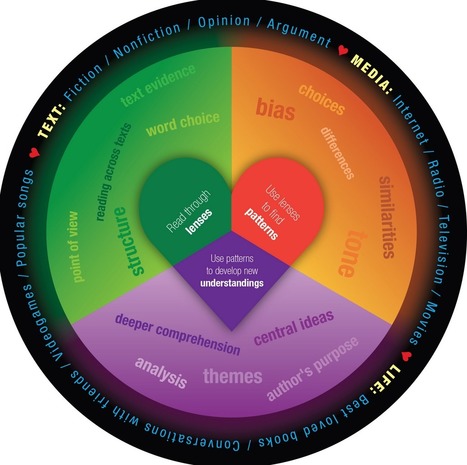
To meet the Common Core ELA Standards students must "readily undertake the close, attentive reading that is at the heart of understanding and enjoying complex works or literature." The purpose of c...
Beth Dichter's insight:
With Common Core testing approaching close reading in an area that we know students will need to know well. This post provides many resources. Are you looking for resources on the basic components of close reading? Find links to information on complex short text, pre-reading activities, re-reading of text, annotations, text-dependent questions, peer collaboration and response to text. Check out a visual on text complexity, one on annotation techniques and one on text-dependent questions. Additional materials are also available. 
Intriguing Networks's curator insight,
December 7, 2013 9:05 AM
Thik this is a very interesting dilemma long form read alongside skimmers, wasn't scanr eading always part of a good student's skill set. Will need to read this carefully. 
David Baker's curator insight,
December 8, 2013 12:33 AM
Just went to the blog post and it is a rich resource. I will be adding it to my seminar follow up.
Scoop.it!

Finding an extensive list of webtools that do not require registration is not always easy to do, but this list by Nathan Hall fits the bill.
Beth Dichter's insight:
Are you looking for a list of webtools that do not require registration? If you make a point to check out this list, which has at least 25 categories ranging from QR codes to Surveys and Polls, Charts/Graphs to Word Clouds, Maps to Calculators and so many more. As you scroll down this lengthy list you may find something that meets your needs in an area you had not yet considered!
Gary Harwell's curator insight,
December 8, 2013 6:07 AM
No Registration huh......that means FREE and comes in under our budget of $0.23.
Scoop.it!
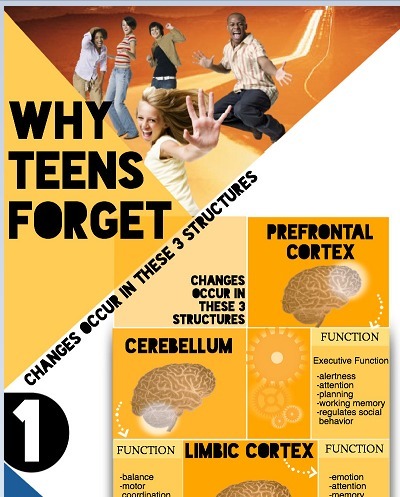
David Wilcox, of Musings on the Middle Years of Education, and I have worked together to create an infographic about the teen brain. It is based on a blog post he wrote over a year ago (Click here ...
Beth Dichter's insight:
Do you understand the teen brain? This infographic explains how "teens forgetfulness may be due to major changes in their brain. These changes can last into the college years." This is a long infographic with three sections. Section 2 looks at the question "Why is my teen so forgetful?" and Section 3 will provide ideas on how you may help your teen. Although designed for parents this is a great infographic for teachers to gain a better understanding of the current research on teens and their brains. The final section of the infographic provides references. You may download this as a single file or download each section independently. 
Audrey's curator insight,
December 5, 2013 3:24 PM
Thanks for this Beth. I will add this to my tutorials for students. It is very helpful, Audrey. Also have a look at www.hotmoodle.com.
David Baker's curator insight,
December 8, 2013 1:01 AM
I plan to share this at the School Accountability meeting I am chairing next week. We have a standing agenda item - the middle school student. This is a great resource and in a great format to start conversations at school and home.
Scoop.it!

"There are those times when a student wants to use and cite an image, but the original creator of the image and other important details are not exactly easy to identify. Google’s reverse image search is a wonderful tool, but it’s a two-step process, requiring you to open Google and drag the image, or copy its URL into the search box with the little camera. (You could use the browser extension.) Now, Google’s reverse image search feature is a bit more convenient."
Beth Dichter's insight:
Google has made it much easier to search for images now IF you are using Chrome as a browser. You can simply right-click on an image (or hold down control on a Mac) and wait for a box to come up and click search Google. Quick and easy....if you have the right browser!
Scoop.it!
Beth Dichter's insight:
This chart looks at the difference between a fixed mindset and a growth mindset by looking at eight areas: * Desire * Evaluation of situations * Dealing with setbacks * Challenges * Effort * Criticism * Success of others * Result... You may want to share this with students or other teachers at your school.
Intriguing Networks's curator insight,
December 1, 2013 10:55 AM
Mindset can we use DH to shift user mindsets? 
Phil Turner's curator insight,
December 1, 2013 5:50 PM
Learning experientially can be more or less painful ... depending on your mindset. You can pick your mindset, and this checklist helps you reflect on what mode you are operating in.
Scoop.it!

"Good teaching is a major undertaking. Make no mistake–teaching has never been easy. But as we come upon 2014, as a profession teaching is increasingly characterized by its possibility, accountability, and persistent mutation. Which makes it a challenge to do at all, much do well. The response to these challenges is a mix of building-level professional development, self-directed teacher improvement, and a troubling amount of teacher burnout. So how can you teacher smarter rather than simply grunting harder?"
Beth Dichter's insight:
Here are seven strategies you might choose to use to make your teacher smarter. They are explained in the post (and listed in the image above). For those whom may see this without the image: * Place the big rocks first * Use technology to automate (with suggestions on what you might do) * Know yourself * Teach in the moment * Advocate for yourself * Find new measures of success * Open your classroom doors wide You may find some new ideas to try out in your classroom!
Audrey's curator insight,
December 9, 2013 4:34 PM
How about asking the student to teach you? They nearly always come up with something different, which you can add to your own notes. Students are also great at acting out scenes, particularly when they are organising other students. Give them a mark for it. Then test their knowledge a few days later with a 30 minute test. curating for www.homeschoolsource.co.uk. Also have a look at www.hotmoodle.com.
Scoop.it!
Beth Dichter's insight:
What are the top ten skills that are needed in the workplace today? The University of Phoenix has published this infographic that provides a look at the top ten skills as well as information on how to acquire the skills. Are you providing your students the opportunity to learn and/or practice these skills?
Audrey's curator insight,
November 29, 2013 2:26 PM
These skills make a lot of sense and all tend to be included in education, right now. In addition to learning the standard topics, most educational establishments incude socio-cultural, moral and practical lessons for students to be able to cope with life in the 21st century.
audrey@homeschoolsource for http://www.homeschoolsource.co.uk |
Scoop.it!

"The model for the webquest (inquiry oriented activity done online) was created in 1995 by Bernie Dodge at San Diego University. Since its inception, thousands of webquests have been created, covering all school subjects, including social studies, science, language arts and much more. Whether you choose to design your own or use one created by another teacher, I hope this list with have what you are looking for."
Beth Dichter's insight:
Webquests are a great way to have students participate in inquiry based learning. If you have never had students complete a webquest then you are in luck because this post provides access to webquest in the following curriculum areas: * Language Arts * Mathematics * Science * Social Studies/History * Technology * Miscellaneous There are also links to some collections of webquests as well as a rubric for evaluating webquests and a short slideshow on Teaching with Webquests.
Gary Harwell's curator insight,
December 18, 2013 2:19 AM
Lots and Lots of Webquests for our students.
Gary Harwell's curator insight,
December 18, 2013 2:19 AM
Lots and Lots of Webquests for our students. 
Aaron Prentice's curator insight,
November 3, 2015 5:27 AM
Webquest
Webquest is a fantastic digital tool for teachers as it often contains relevant units of work developed by other educators. It affords students the opportunity to have fun whilst involved in inquiry based learning.
Scoop.it!
"Google Tips is collection of Google product use examples and tips. You can select a specific product to learn about or scroll through the whole gallery of tips for all products."
Beth Dichter's insight:
Check out Google Tips to learn more about the many products that Google offers. One you find a tip that interests you and click on it you will find a short description, "stuff you need" (typically a Google account and perhaps a short amount of time based on what I viewed) and a presentation that walks you through steps. This is geared more to beginners and may be a great tool for students whom may be trying new tools. 
Steve Vaitl's curator insight,
December 16, 2013 12:07 PM
Tips for use of Google+ features. Great for inspiring your own use for them!!
Scoop.it!
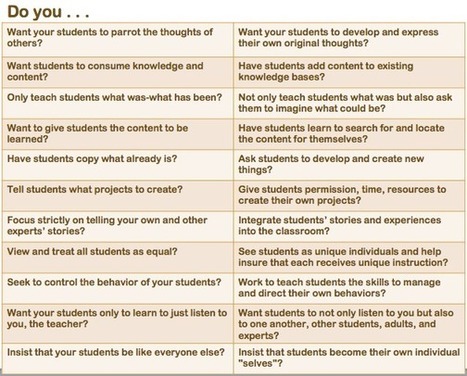
I have discussed and promoted the need for educators to reflect deeply on their beliefs, processes, and practices in several of my posts: Where is Reflection in the Learning Process and Teacher Ag...
Beth Dichter's insight:
What questions can we ask ourselves to assess our "pedagogical principles and instructional preferences"? Jackie Gerstein provides a list (and the list as a table as shown above) to help you reflect on your practice. As she states the process may be "simple but not easy." You may answer the question but how do you change your practice so that you may implement it in your classroom? 
Kirsten Macaulay's curator insight,
December 22, 2013 5:28 AM
This title of this post states “simple but not easy” because to answer the questions is simple. I know that every good teacher would answer these questions in the direction of student-centric education; one that is in the best interests of the student. But implementation is another thing. To implement the non-maintstream alternative is not easy given the accountability systems, one’s own training and background, and mandated school initiatives. It takes a strong, self-directed and courageous educator to do so.
Scoop.it!

"Educators are increasingly focusing on the ninth grade as the year that determines whether a young person will move on or drop out of school. According to research published in the journal Education, ninth graders have the lowest grade point average, the most missed classes, the majority of failing grades, and more misbehavior referrals than any other high-school grade level. Ninth grade has increasingly become a “bottleneck” for students..."
Beth Dichter's insight:
Research shows that 9th grade is a pivotal year for high school students. Some define it as a "make or break year for many 14- and 15-year-olds." Why? They are entering a new school, having more autonomy and more homework, and they are an adolescents, with brains that may not be making the best decisions. 
Mary Lambert Belechak's curator insight,
October 10, 2014 6:19 PM
Knowing 9th grade year is so pivotal and important and getting 9th graders to know it are two different things. Attendance, behavior, and grades. Attendance in first 30 days.
Scoop.it!

"Talking to our learners about digital citizenship requires us continually to revise and update our messages. We tell our students constantly that we are not cops here at school to block their access online, but rather we are here to educate them about using it."
Beth Dichter's insight:
Teaching digital citizenship is not as simple as we think. This year with information being released about the NSA and their actions a new layer was added. Several weeks ago The Guardian released a short video, The NSA and Surveillance Made Simple, that helps to explain what it means when metadata is collected (and explains what the metadata is) and how this may impact privacy.
Scoop.it!

Preventing weak passwords by reading your mind/
Beth Dichter's insight:
Here is a tool that will help you learn how secure your password is. Type in one letter and wait a second or two and you will see three possibilties that they believe will be the next character. A check means they did not guess your character, an x means they did. Students often believe that there passwords are secure and this tool may help them learn that they may not be as secure as they thought. 
Nancy Jones's curator insight,
December 8, 2013 2:20 PM
This is really very clever and a great way to get anyone, student or else, to consider password safety. Thanks for sharing. 
Miro Svetlik's curator insight,
December 9, 2013 3:06 AM
A really cute password tester for non-geek users. Try it for yourself.
Scoop.it!
"Some teachers are a little torn over the use of animation in the classroom – lots love it but sometimes people feel it can be a time-consuming waste of precious classroom hours, with students spending a long time perfecting something that they don’t believe has huge educational value. In fact, there are fantastic concrete reasons to take advantage of the massive range of animation tools out there specifically for use in a teaching environment. Here are just some of them!"
Beth Dichter's insight:
I watch students go the library and many immediately head towards graphic novels. Have you considered letting students use tools that allow them to create animated characters with the caveat that they must also write a story (perhaps informational text). This post looks at five online tools you might use as well as five reasons to use the tools. The tools include Domo, Kerpoof, Anim8tor (a tool that "allows students to use algebraic and calculus functions to create 3D animations"), Zimmer Twins and Go Animate 4 Schools. Think about how these tools will assist students with communication skills, building bridges, self-expression, technical skills and presentation skills. For more information click through to the post.
Scoop.it!

Encouraging kids to think in pictures and words can free up their creativity and language skills as they write.
Beth Dichter's insight:
What would happen if you encouraged students "to think in pictures" as well as words? This post explores what happened in one classroom where the teacher decided to have students write in Lifebook Journals daily. Learn more about this activity by clicking through to the post. 
Mary Lou Buell's curator insight,
December 6, 2013 5:30 PM
This makes so much sense to me--we have done a little of this with the cartoon and graph assignments. Thinking I should plan more.
Gary Harwell's curator insight,
December 8, 2013 6:09 AM
Most of our students are probably visual learners....... this explains a lot. 
Open Doors's curator insight,
January 12, 2014 5:59 PM
Helping children think in both pictures and words can help with language fluency and development of creative skills.
Scoop.it!
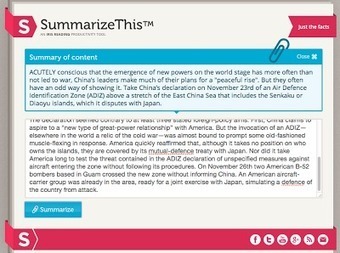
"SummarizeThis is a free tool that summarizes the main point(s) of long articles that you find on the web. To use SummarizeThis you just copy and paste text into the summary box and click "summarize." A summary of the text then appears above the original text that you copied."
Beth Dichter's insight:
This tool look interesting and you might have students use it when they are doing research. We know how hard it can be to get students to read longer articles. This has the potential to let them see if his article is important to their topic. Will it help them answer their questions?
Intriguing Networks's curator insight,
December 3, 2013 3:35 AM
B Possibly not just for teachers, but if it works so well then maybe the authors might need to think again, 'brevity the soul of wit'
Phil Turner's curator insight,
December 3, 2013 6:03 PM
This looks surprisingly effective (in my test of one article) ... and could be a useful first order tool for scanning large amounts of work. Students might learn to summarise/paraphrase by looking carefully at how the results relate to the original text (if they can resist just cutting and pasting the new words). 
Tracy Shaw's curator insight,
December 10, 2013 6:58 PM
Here's a cool tool for teachers! Time saver.
Scoop.it!

''I recently had the opportunity to talk with the technology journalist Clive Thompson, author of Smarter Than You Think. You can read the full conversation here. From that chat, I distilled nine lessons from Clive on how we can improve our thinking, with and without technology." I recently had the opportunity to talk with the technology journalist Clive Thompson, author of Smarter Than You Think. You can read the full conversation here. From that chat, I distilled nine lessons from Clive on how we can improve our thinking, with and without technology."
Beth Dichter's insight:
Are you interested in learning some lessons on how to become more creative? This post provides nine lessons. Below are three of the lessons. Click through to learn more about what they entail as well as learn six more. * Spend significant chunks of time offline * Engage in "Cognitive Diversity": Do Something Mentally Different * Don't Isolate Yourself: Learn Social Thinking 
Progressive training's curator insight,
December 2, 2013 1:29 PM
9 Ways To Be More Creative
#business #training http://goo.gl/ivsB2S
Scoop.it!

In the age of the Common Core and its emphasis upon having students take on more challenging text, independent reading and student choice can easily take a back seat to the demands of increased rigor.
Beth Dichter's insight:
How many ways can you come up with to support reading in school? This post provides 25 ways to support independent reading. Chances are you already know some of these but you will probably find one or two new ideas in the lengthy list. Below are five. Click view to read the complete list. * Create a “Caught Reading” Campaign that features Teachers as Readers. * Host Book Clubs for Students and Parents. * Sponsor a Young Author Conference. * Encourage Students & Teachers to Write Book Reviews. * Host a Mystery Check-Out Day.
Audrey's curator insight,
December 2, 2013 6:12 PM
In addition schools can encourage story writing. Have a look at storgy featured on www.hotmoodle.com
Scoop.it!

"Rethinking Innovation. Does it just come or can we inspire it?"
Beth Dichter's insight:
Does innovation come from within, or are there ways we can help inspire our students? This infographic provides 27 suggestions that you might try in your classroom. Do you have anything that works well for you that is not included? If so please share it! 
Leslie Minton's curator insight,
November 30, 2013 5:35 PM
Really gets you thinking about how to inspire greater innovation 
Drora Arussy's curator insight,
December 1, 2013 8:23 AM
Interesting that this inforgraphic chose to put thinking "outside of the box" inside boxes, but in general the idea is important for us to remember. When facilitating a class encourage buy in from the students, encourage them to exercise their minds and be creative! |







Students often like to study controversial topics. The level of discourse may rise when these types of conversations take place. To be successful with these types of topics it is necessary to have "a classroom community, must set up an atmosphere of respect, tolerance, and understanding."
This post provides ten resources that provide resources for 10 controversial subjects. The list is below and more information is available by clicking through to the post.
* Reclaim the Swatika Day - Did you know that the Swatika is an ancient symbol for peace?
* Morris Dees and the Southern Poverty Law Center
* The Ethics of Force Feeding Inmates
* El Salvador Refused to Allow Abortion that would save a Mother's Life
* Teen Pregnancy - How Does Having a Child Change your Life?
* Really Awful Court Cases
* LGBT Teens and Homelessness
* Life on Death Row
* Dating and Domestic Violence
* Driving Men Crazy in Saudi Arabia: Women's Rights