Eclectic Technology
230.9K views | +6 today
Eclectic Technology
Tech tools that assist all students to be independent learners & teachers to become better teachers
Curated by Beth Dichter
Your new post is loading...
Scooped by Beth Dichter
January 14, 2014 10:44 PM
Scoop.it!

What Are the 7 Mind Frames of Learning?

What Are the 7 Mind Frames of Learning? | Eclectic Technology | Scoop.it

'Learning thrives on error'

"Among all the influences that can make a profound difference in student learning is how we think about our role!  So, start with looking inward and ask about the mind frames you have as an educator. 

It is through these mind frames that we make decisions in the classroom and school, and it is argued that educators highly imbued with these mind frames are among the high impact educators."


Beth Dichter's insight:

These 7 mind sets of learning come from John Hattie, Professor of Education and Director of Research at the University of Melbourne. The first three are below (and quoted from the post):

* Teachers/leaders believe that their fundamental task is to evaluate the effect of their teaching on students' learning and achievement (Know thy Impact)

* Teachers/leaders believe that success and failure in student learning is about what they, as teachers or leaders, did or did not do. We are change agents!  (e.g., Growth vs. fixed: High expectations for all)

* Teachers/leaders need to talk more about the learning than the teaching (Focus on learning)

This post will help raise questions that may help you improve your teaching. What mind frames to you have as an educator? Are there areas where you think you could improve? Read through the post to learn more about the three areas listed above (with a more in-depth look at them and read about four additional mind frames).

Rosemary Tyrrell, Ed.D.'s curator insight, January 15, 2014 2:30 PM

This is a great article and seems to be based on the same ideas that Carol Dwek's Mindset relies on. Worth a read. 

Armando's curator insight, January 19, 2014 8:21 AM
What Are the 7 Mind Frames of Learning?
Terry Doherty's curator insight, January 27, 2014 5:48 PM

I like the approach of "walking in their shoes" to describe how educators effect an interest in learning.

Scooped by Beth Dichter
January 12, 2014 8:39 PM
Scoop.it!

Three Good Tools for Building Flipped Lessons That Include Assessment Tools

Three Good Tools for Building Flipped Lessons That Include Assessment Tools | Eclectic Technology | Scoop.it
Beth Dichter's insight:

Are you interested in flipping part of your class and would like to know some tools that would also allow you to add assessments to videos. Richard Byrne has three suggestions and all are free!

*eduCanon - Quoting from the post "eduCanon allows teachers to build flipped lessons using YouTube and Vimeo videos, create questions about the videos, then assign lessons to their students."

*Teachem uses the TED-Ed model. Choose videos that are hosted on YouTube. Add questions and comments. Videos may be public or private.

*Knowmia is a website and iPad app and their website has over 17,000 videos that you may use. You may also create your own. Knowmia has been designed for teachers and students and provides an Assignmen Wizard and is adding additional  features.

If you looking for a tool that allows you to flip a lesson and also include an assessment these three provide a variety of options. Have fun exploring and finding the one that will work best for you.

The Rice Process's curator insight, January 12, 2014 8:53 PM

Very helpful.

Charlotte Lovie's curator insight, March 9, 2014 6:43 AM

Some more ways of adding learning content to video.

Константин's curator insight, March 12, 2014 12:09 PM

добавить понимание ...

Scooped by Beth Dichter
January 11, 2014 9:37 PM
Scoop.it!

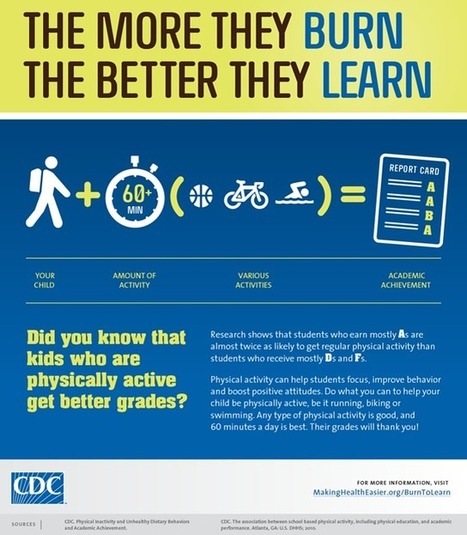
The More They Burn The More They Learn Infographic

The More They Burn The More They Learn Infographic | Eclectic Technology | Scoop.it
It's back to school time again and educators, parents and kids are focused on making this year as successful as possible. Did you know that teens who receive m…
Beth Dichter's insight:

Getting children to move, to be physically active, makes a difference in their grades. This infographic provides additional detail and if you click through to the link you can also get a print only version. Additional resources are also available on the websites including a CDC Physical Activity in School Factsheet and a CDC Physical Activity and Youth Factsheet.

No comment yet.
Scooped by Beth Dichter
January 11, 2014 7:40 PM
Scoop.it!

57 Free Digital Interactives For All Teachers... Plus 8 Free Mobile Apps

57 Free Digital  Interactives For All Teachers... Plus 8 Free Mobile Apps | Eclectic Technology | Scoop.it
Welcome to a post that examines an amazing free collections of educational digital interactive programs and apps. You are sure to find something that will fit your classroom in the very near future...
Beth Dichter's insight:

Michael Gorman shares 15 tools located at ReadWriteThink that work with Language Art classes, providing short descriptions. An additional 42 tools that are available on the website that focus on Language Arts (although some of them would work with other courses, such as the Timeline, Venn Diagram, K-W-L Chart, and ReadWriteThink Webbing Tool, so teachers across the curriculum may want to also check them out.

In addition ReadWriteThink has 8 mobile apps (and seven work on iOS and Android, 1 in iOS only). These apps include three focused on poetry: Acrostic, Diamante and Themes Poems as well as Alphabet Organizer, Trading Cards, Venn Diagram, Timeline and Word Mover.

If you have  not checked out ReadWriteThink is it worth checking it out. To go directly to ReadWriteThink: www.readwritethink.org

No comment yet.
Scooped by Beth Dichter
January 10, 2014 10:35 PM
Scoop.it!

BBC News - An animated journey through the Earth's climate history

BBC News - An animated journey through the Earth's climate history | Eclectic Technology | Scoop.it
How did the Earth's climate arrive at its current state and how do scientists delve into the secrets of our planet's past?
Beth Dichter's insight:

Thanks to Richard Byrne for sharing this website. This film provides a look at climate change over the last 800,000 years in 2.5 minutes! The movie has graphs, images and narration and there is a text version that you may access that provides information on the sources. If your class is looking into climate change this is a great resource to use.

No comment yet.
Scooped by Beth Dichter
January 8, 2014 10:26 PM
Scoop.it!

Inside your computer - A Lesson from Ted-Ed

Inside your computer - A Lesson from Ted-Ed | Eclectic Technology | Scoop.it
How does a computer work? The critical components of a computer are the peripherals (including the mouse), the input/output subsystem (which controls what and how much information comes in and out), and the central processing unit (the brains),...
Beth Dichter's insight:

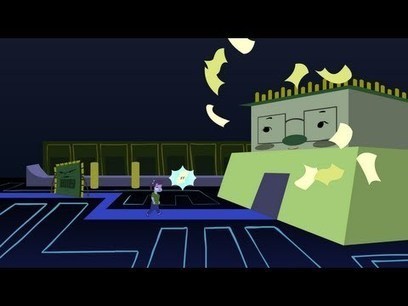
This TED-Ed video explains how a computer works in simple terms. I suspect that children in early elementary would learn from it as would many students in upper elementary and middle school. Although technology is prevalent in their lives many have no concept of what is happening inside a digital device. This video will help them learn, and since it is from TED-Ed there is a quiz and the ability to flip the video!

No comment yet.
Scooped by Beth Dichter
January 6, 2014 8:36 PM
Scoop.it!

Hope and Optimism: The Other 21st Century Skills

Hope and Optimism:  The Other 21st Century Skills | Eclectic Technology | Scoop.it
Due to the interest of my post The Other 21st Skills, I decided to individually discuss each of the skills or dispositions I proposed that are in addition to the seven survival skills as identified...
Beth Dichter's insight:

Jackie Gerstein returns with a post on Hope and Optimism, another 21st century skill. Why hope and optimism? There are important skills/characteristics in this area:

* Positive View About the Future

* Can Do Attitude

* Personal Agency

* Engage in Positive Self Talk

* Belief in Ability to Solve Problems

* Belief in One’s Ability to Impact Positively on One’s Situation.

* Maintaining Perspective

* Sense of Efficacy

She then provides information and links to articles that have researched how hope and optimism impact students' lives in many areas, research based guidelines on how to build skills of hope in students, and more. This post provides much food for thought.

No comment yet.
Scooped by Beth Dichter
January 5, 2014 6:52 PM
Scoop.it!

The Listening Teacher: Getting Feedback From Your Students

The Listening Teacher: Getting Feedback From Your Students | Eclectic Technology | Scoop.it

"Mid-year or more frequently, I ask students to complete an evaluation form. I craft the questions carefully so simple answers are hard to write. Instead, I try to create specific, complex questions that cover the material, the classroom activities and the students—peers and the individual.

Many teachers shake their heads and avoid these exercises. They scoff that students would actually take the forms seriously or that the students will say anything useful. But I find the nature of the questions often elicits a straight answer—short, but helpful."

Beth Dichter's insight:

This post provides a number of strategies that may help you receive better feedback from your students. The author, Jane Healey, suggests that you formulate "inquiries specific to a task." She has had students write an exemplary comment about another student (receiving "fabulous point-of-view descriptions") and then have the student write one for themselves.

Additional questions you might ask are also provided for research projects and class discussions.

Mary Cunningham's curator insight, January 5, 2014 7:35 PM

This is a great blog post on feedback and the importance of asking and listening to our students.

Darleana McHenry's curator insight, January 6, 2014 12:07 PM

Would you allow your students to evaluate you as a teacher? I think that you would learn a lot. 

macksayers's curator insight, January 6, 2014 1:07 PM

Listening to our students through asking thoughtful questions and providing descriptive feedback to their peer and self assessments. 

Scooped by Beth Dichter
January 3, 2014 10:23 PM
Scoop.it!

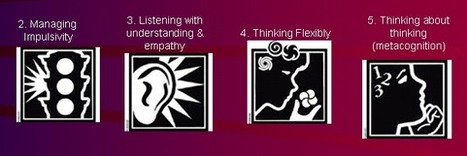
16 Strategies For Integrating The Habits of Mind In The Classroom

16 Strategies For Integrating The Habits of Mind In The Classroom | Eclectic Technology | Scoop.it

"In outcomes-based learning environments, we generally see three elements in play: 1) learning objectives or targets are created from given standards; 2) instruction of some kind is given; and then 3) learning results are assessed. These assessments offer data to inform the revision of further planned instruction. Rinse and repeat.

But lost in this clinical sequence are the Habits of Mind that (often predictably) lead to success or failure in the mastery of given standards. In fact, it is not in the standards or assessments, but rather these personal habits where success or failure — in academic terms — actually begin."

Beth Dichter's insight:

Many of us discuss Bloom's taxonomy with students (although we may not refer to it using that terminology) but how many of us talk about Habits of Mind with our students. This post explores how we can use habits of mind to help our students providing suggestions as to how you might help your students learn them.

To see the full poster of the Habits of Mind: http://indysintriguingideas.edublogs.org/files/2010/08/16HabitsofMind1.jpg

Bernard Guévorts Authentis's curator insight, January 5, 2014 5:14 AM

Pour une bonne reprise...

Kimberly House's curator insight, January 6, 2014 3:06 AM

I echo Beth Dichter's comments. This is vocabulary we should be using with our students. Identifying habits and ways if thinking that lead to learning. 

Scooped by Beth Dichter
January 2, 2014 7:00 PM
Scoop.it!

What is Performance Assessment?

What is Performance Assessment? | Eclectic Technology | Scoop.it
Performance assessments are real-world scenarios that reflect the ambiguity of real-world challenges. They require higher-order thinking and problem solving. They are concluded with authentic performance.
Beth Dichter's insight:

One key part of the Common Core is performance assessments. One question many may have is just what is performance assessment. This post provides a number of descriptions of performance assessments including ones from ETS, five criteria from Wiggins and McTighe based on Understanding by Design and ASCD.

Performance tasks may include project-based learning, drawings, videos, and more.

There is also a discussion on four reasons to use performance assessment. They are:

* Personalized Learing

* Formative Assessment

* Competency Education

* Standards-based Education

For more information click through to the post.

niftyjock's curator insight, January 8, 2014 4:18 PM

Would role-plays fit into Performance Assessment? 

Scooped by Beth Dichter
January 2, 2014 4:17 PM
Scoop.it!

Counting Down the Top S’Cool Tools for 2013: #1 - 10 (EdSurge News)

Counting Down the Top S’Cool Tools for 2013: #1 - 10 (EdSurge News) | Eclectic Technology | Scoop.it
Drumroll, please! The final S’Cool Tools countdown, based entirely on your clicks!
Beth Dichter's insight:

Here is the list of the top ten "S'cool Tools" for 2013 from EdSurge. Last week I scooped the tools from 11 - 20. Once again there is a range of tools and they are all free. Three are detailed below but you may view information on all ten in the post. Have fun exploring!

* Mathigon is an amazing math resource with videos, slideshows, e-books, apps and more. Resources are available for primary and secondary students.

* Google Treks - Are you looking for lesson plans based on Google Maps? If so check out Google Treks. Lesson plans are across the curriculum and all use Google Maps so the concept of geographic location is involved. If you want to create your own Trek there is a tutorial and a rubric to help you out.

* NuSkool uses "popular culture to enhance learning both inside and outside the classroom." Geared to students in grades 6 - 12 you may search for by grade, subject and genre. Genres include music, film, television, video games, sports, social networking and popular culture. Select your grade level, subject and genre and you will find a choice of lesson plans that include the media, a description of the lesson, procedures and assessments.

Sue Alexander's curator insight, January 3, 2014 12:05 PM

Fantastic list! Great Scoop, Beth.

niftyjock's curator insight, January 8, 2014 4:22 PM

I've used some of them. How many have you used?

Scooped by Beth Dichter
January 1, 2014 3:10 PM
Scoop.it!

Plagiarism vs. Collaboration on Education’s Digital Frontier

Plagiarism vs. Collaboration on Education’s Digital Frontier | Eclectic Technology | Scoop.it
Instead of focusing our concerns on technology as an aid to plagiarizers, we should focus on its ability to foster creativity and collaboration, says Jen Carey.
Beth Dichter's insight:

As teachers we know how easy it is for students to plagiarize today. We are asked to have students work collaboratively and use tools where students may see others thoughts. How to we deal with these issues, the need for collaboration and using tools which promote this and the issue of students plagiarizing? And when it comes to assessment how do we ask students to collaborate yet also demand that they not plagiarize?

This post explores these issues and discusses how to "transform cheating into collaboration"?  There is also a question that each of us might ask ourselves (and I suspect many of us have): If you can Google an answer is it a good question for an assessment?


No comment yet.
Scooped by Beth Dichter
December 31, 2013 10:53 AM
Scoop.it!

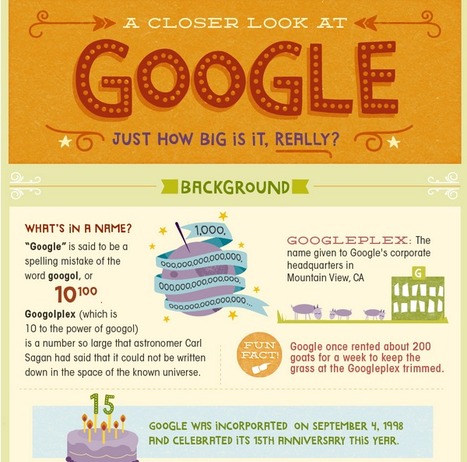
Google - Just How Big is it, Really? (Infographic)|

Google - Just How Big is it, Really? (Infographic)| | Eclectic Technology | Scoop.it
Here are some stats and facts that may give you an idea of how big Google really is.
Beth Dichter's insight:

Google is a company that many of us rely on for email, to search, for their free apps and more. Check out this infographic to learn more about Google's background, finances and the many services that it provides. This would be a good infographic to kick off a classroom discussion about what it means to be the company that holds so much of your information and what they have the potential to do with this information.

No comment yet.
Scooped by Beth Dichter
January 13, 2014 10:40 PM
Scoop.it!

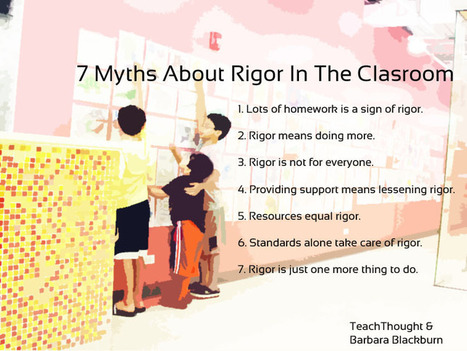
7 Myths About Rigor In The Classroom

7 Myths About Rigor In The Classroom | Eclectic Technology | Scoop.it
Beth Dichter's insight:

One of the buzzwords in education today is rigor, but what does that mean? This post shares seven myths about rigor, providing a deeper look at each one if you click through. What are these myths? Three are below.

* Is asking students to do a lot of homework a sign of rigor? Not if it is busy work, or if it leads to burnout. Although parents may define it as rigor what do you think?

* Rigor is not for everyone. How do we help students if we request less of them? Rigor may not be the same for each student but each student should be asked to reach their highest level.

* Standards alone take care of rigor. The Common Core Standards tell us they will increase rigor, but it is the instruction that will make this happen, not the standard.

Much more information on this issue is available in the post.

Kirsten Macaulay's curator insight, January 15, 2014 7:20 AM

Very true. A must read.

Scooped by Beth Dichter
January 12, 2014 1:56 PM
Scoop.it!

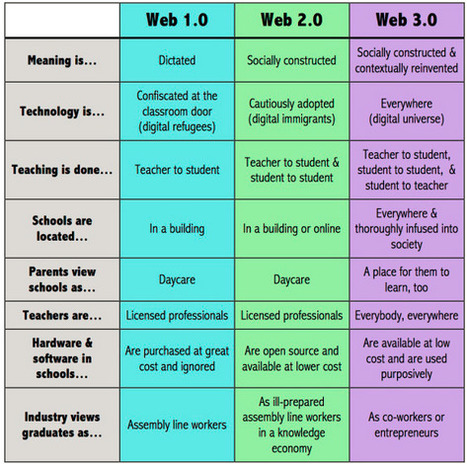
What Is Web 3.0 And How Will It Change Education?

What Is Web 3.0 And How Will It Change Education? | Eclectic Technology | Scoop.it
We'll reach a new state of web skills when we reinvent technology tools to better enhance our personal learning. We'll be at 3.0 when schools are everywhere and not viewed as daycare.
Beth Dichter's insight:

Web 3.0 has been shared on this Scoop.it and this table is a bit different from previous ones. What do you think? Is your school heading towards a Web 3.0 environment, where teachers will not only be those whom are licensed professionals but also those who are accesible on line from all parts of the worlld? Will schools graduate students whom view industrywill view as co-workers whom are prepared for a knowledge economy? This table presents what may be in the future. What do you think?

Lori Wilk's curator insight, January 12, 2014 2:55 PM

Great to have a chart for comparison

Julie Ekner Koch's curator insight, January 14, 2014 3:00 PM

Our learning experience is changing, both in the education system and in the workplace. This table provides an overview of the new web 3.0 and its implications

Scooped by Beth Dichter
January 11, 2014 9:10 PM
Scoop.it!

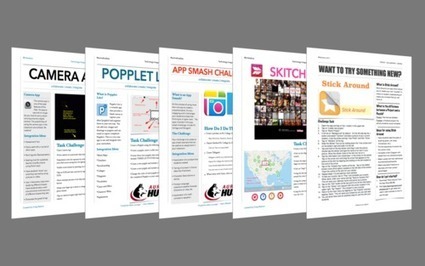
App Task Challenges for Teachers

App Task Challenges for Teachers | Eclectic Technology | Scoop.it

Craig Badura, a PK-12 Integration Specialist in Aurora, Nebraska, has
developed a series of App Task Challenges. Each Challenge is a an easy to follow guide that gives teachers the opportunity to create products with an app.

Beth Dichter's insight:

If you have iPads in your school and teachers need help with apps check out these "App Task Challenges" created by Craig Badura. Currently four are available and you may download them here. Learn about these apps for the iPad: Camera, Popplet and Skitch plus there is an App Smash Challenge you might undertaken. In addition Darin Spenser was inspired by Badura's work and has created on on Stick Around. These handouts could also be modified to use with students. All are available on this website.

Melissa Marshall's curator insight, January 12, 2014 2:08 AM

Inspiring - some great materials here, might use some of these ideas for 2014!

Scooped by Beth Dichter
January 11, 2014 7:08 PM
Scoop.it!

Digital Aristotle: Thoughts on the Future of Education

"Some thoughts on teachers, students and the Future of Education."

Beth Dichter's insight:

One point of view of how schools may change as we move from schools based on moving people from farms to factories and what may happen as digital technology continues to expand and the possibility of online learning where the computer would be the "personal tutor". The video is just under 6 minutes and will raise some questions. You might consider sharing it in faculty meeting (and if you do the discussion may be somewhat heated).

HUBMODE's curator insight, August 11, 2014 2:43 AM

Digital will disrupt Education as well.Let us build it with a huge human touch#HUBMODE

Scooped by Beth Dichter
January 9, 2014 9:56 PM
Scoop.it!

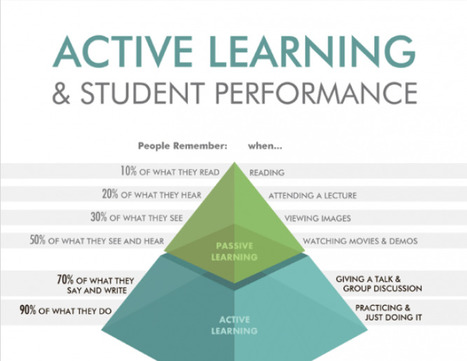
Active Learning and Student Performance Infographic

Active Learning and Student Performance Infographic | Eclectic Technology | Scoop.it

"The Active Learning and Student Performance Infographic presents how students in an active learning environment demonstrate better improvement in conceptual understanding than traditional lecture hall classes. Students ask more questions, better questions, and offer explanations about physical phenomena during discussions without being called upon."

Beth Dichter's insight:

This infographic includes information from an outside organization that looked at several classes at North Carolina State University that were redesigned for active learning.

Nicoletta Trentinaglia's curator insight, January 28, 2014 6:48 AM

it seems that students in flipped classroom approach demonstrate better performance compared to traditional classroom

Scooped by Beth Dichter
January 7, 2014 8:52 PM
Scoop.it!

A Comparison of Educational Blogging Platforms

A Comparison of Educational Blogging Platforms | Eclectic Technology | Scoop.it
Beth Dichter's insight:

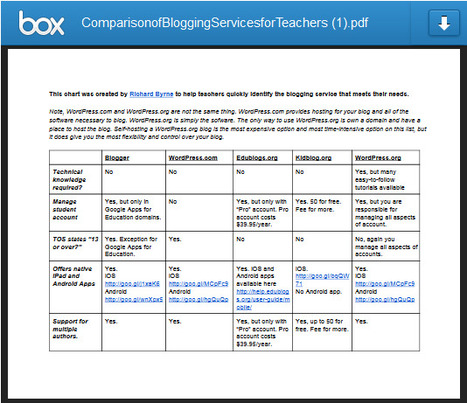
Richard Byrne provides a comparision chart comparing five blogging platforms in eight key elements in this post. If you are considering starting a blog for yourself or your students this post will provide information that may help you in making the best decision.

Rosemary Tyrrell, Ed.D.'s curator insight, January 10, 2014 1:35 PM

Useful comparison chart. 

Alfredo Corell's curator insight, January 11, 2014 2:15 PM

The chart compares eight key elements of five common blogging platforms.

You can download this chart as a PDF through this Box.com link or click here to see it as a Google Document.

carldowse's curator insight, January 25, 2014 5:23 AM

A useful guide for choosing the tool that fits your teaching context and learners' needs.

Scooped by Beth Dichter
January 6, 2014 7:27 PM
Scoop.it!

The Most Important Developments in Human History (Infographic)

The Most Important Developments in Human History (Infographic) | Eclectic Technology | Scoop.it
Beth Dichter's insight:

What do you think are the ten most important developments in human history? What do you think your students would think? This infographic is from Norwich University Online and provides their view but I would suspect that our students might come up with a different list (as would many teachers). This would be a great topic for students to research and create their own infographic...which would probably include items not included in this one!

No comment yet.
Scooped by Beth Dichter
January 5, 2014 4:54 PM
Scoop.it!

Competency Based Education... in 5 easy steps

Competency Based Education... in 5 easy steps | Eclectic Technology | Scoop.it
Beth Dichter's insight:

As the Common Core tests becomes more of a reality there is also conversation about competency based education. We know that not all students learn at the same pace of in the same way and competency based education would address these concerns. This infographic by Mia MacMeekin provides  a great overview of the five steps to move in this direction:

* Define and state the goal.

* Design the path.

* Design authentic assessments for each competency.

* Add an array of content and discovery resources.

* Gamify the course.
Some additional information is found in the infographic.

Gary Harwell's curator insight, January 6, 2014 12:08 AM

Competency based education is a great idea but can it be used in a traditional classroom setting?

Gary Harwell's curator insight, January 6, 2014 12:08 AM

Competency based education is a great idea but can it be used in a traditional classroom setting?

Scooped by Beth Dichter
January 3, 2014 9:49 PM
Scoop.it!

Mission 3: A Cheyenne Odyssey - Interactive History Game

Mission 3: A Cheyenne Odyssey - Interactive History Game | Eclectic Technology | Scoop.it

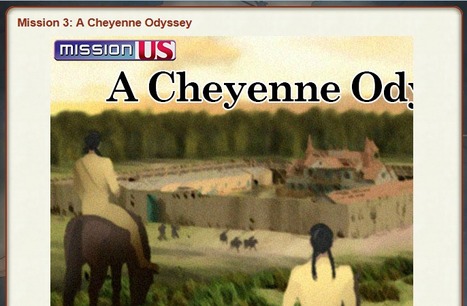
"Mission US is a multimedia project that immerses players in U.S. history content through free interactive games.

In Mission 3: “A Cheyenne Odyssey,” players become Little Fox, a Northern Cheyenne boy whose life is changed by the encroachment of white settlers, railroads, and U.S. military expeditions.  As buffalo diminish and the U.S. expands westward, players experience the Cheyenne's persistence through conflict and national transformation."

Beth Dichter's insight:

"A Cheyenne Odyssey" is the third mission from Mission U.S. This interactive game will teach students about the Cheyenne's experience. There is a teacher guide available for this game (as well as the first two: Mission 1 - For Crown or Colony? and Mission 2 - Flight to Freedom). Each guide provides an overview, background information, standards alignments, activites, primary sources and there are videos to help provide guidance for teachers.Two additional games are set to be released in 2014 and 2015. The games are geared to students in Grades 5 - 8.

No comment yet.
Scooped by Beth Dichter
January 2, 2014 5:19 PM
Scoop.it!

5 Powerful Questions Teachers Can Ask Students

5 Powerful Questions Teachers Can Ask Students | Eclectic Technology | Scoop.it
Beth Dichter's insight:

Here is a visual that may help your students with critical thinking skills. The post in Edutopia provides addtional information on this and the image came via twitter and that link is at the end of this post.

As you read the five questions you may find that might change a few. For example, if you are working with younger students you might want to change the first question to "What do you think you know?" and you might also want to change the fourth question to "What more can you tell me?"

Do you have other ideas? Share them by adding a comment.

The link to the visual is at https://twitter.com/shannonclark7/status/404336242625892354/photo/1/large

No comment yet.
Scooped by Beth Dichter
January 1, 2014 4:52 PM
Scoop.it!

Alphablocks - 26 Strategies to Improve your Learning (Visual)

Alphablocks - 26 Strategies to Improve your Learning (Visual) | Eclectic Technology | Scoop.it
Beth Dichter's insight:

How about starting a New Year by sharing learning strategies? Here is an infographic that provides 26 learning strategies. Consider sharing one a day for the next 26 days, or print out a copy and share it with your students. A few of the ideas included are:

* Connect the Dots

* Hypothesize, Test, Adjust

* Listen More

* Question Assumptions

Scooped by Beth Dichter
December 31, 2013 9:56 PM
Scoop.it!

5 Better Ways To Say 'I Don't Know' In The Classroom

5 Better Ways To Say 'I Don't Know' In The Classroom | Eclectic Technology | Scoop.it
Do you allow students to answer a question with the response "I don't know" in the classroom? Perhaps you should consider no longer allowing that phrase and instead offering up these five other ways that might get students thinking a bit more.
Beth Dichter's insight:

How often do you hear a student say "I don't know." Here are five alternative suggestions that you might offer up to your students. Why? If we want our students to become critical thinkers they need to be able to ask questions. Rather than accepting the answer "I don't know" have the student think a bit more and come up with a better question. Click through to the post to see three additional questions and share your own if you have other suggestions.

Kirsten Macaulay's curator insight, January 1, 2014 5:10 AM

5 Better Ways To Say 'I Don't Know' In The Classroom

1. May I please have more information?

2. May I have some time to think?

3. Would you please repeat the question?

4. Where could I find more information about the?

5. May I ask a friend for help? Good ideas!

R. Alisha J. Hill's curator insight, January 3, 2014 2:12 AM

How do you engage the student when he/she says "I don't know"?