

Follow, research and publish the best content
Get Started for FREE
Sign up with Facebook Sign up with X
I don't have a Facebook or a X account
Already have an account: Login

E-Learning-Inclusivo (Mashup)
1.1M views |
+2 today

 Your new post is loading...
 Your new post is loading...
Your new post is loading...
 Scoop.it!

Best strategies that helps administrators understand each and every part of the education system is to connect and collaborate with other administrators and education leaders. Via Pippa Davies @PippaDavies 
Scoop.it!
Une séance d'apprentissage collaboratif appuyée sur le web2.0 : déroulement, préparation, bonnes pratiques. Présentation en 40 diapos Il s'agit du contenu Via Gilles Le Page, xavier suñé

Matthieu CLEMENT's comment,
December 27, 2013 9:19 AM
Bonjour Gilles. Dans ta présentation des murs collaboratifs, tu pourrais mettre la bonne source, pour le mur que j'ai fait réalisé par mes élèves de Terminale... http://padlet.com/wall/mondialisationTS Merci pour eux et le respect de leur travail. Autrement, belle synthèse !

Gilles Le Page's comment,
December 28, 2013 4:52 AM
Bonjour Matthieu, désolé pour la bourde ! Je corrige aussitôt et je rends à César ce qui est à César :-) Meilleurs voeux !
Gilles Le Page's comment,
December 28, 2013 4:52 AM
Bonjour Matthieu, désolé pour la bourde ! Je corrige aussitôt et je rends à César ce qui est à César :-) Meilleurs voeux !
Scoop.it!

Shekema Silveri:
When considering connectivity inside the classroom, it is important to begin by determining what it means to be a connected learner in the 21st century. Specifically, each of us (adults included) must ask ourselves the following questions: What are the benefits of connecting with others? What opportunity costs are associated with becoming/remaining connected? How do we successfully determine which communities to which we should connect/ belong? - See more at: http://blog.successatthecore.com/an-issue-of-connectivity/#sthash.kkv4qbcn.dpuf ;
Scoop.it!

One of the strategies I’ll be writing about is cooperative learning. In the course of my research, I’ve found some pretty good sites that I thought readers might find useful.
I’ve divided them into two sections — one sharing sites that provide research results on its use and the second section with sites offering more practical ideas on how to implement cooperative learning in the classroom.
Here are my choices for The Best Sites For Cooperative Learning Ideas: Via Jim Lerman, Ana Rodera
Scoop.it!
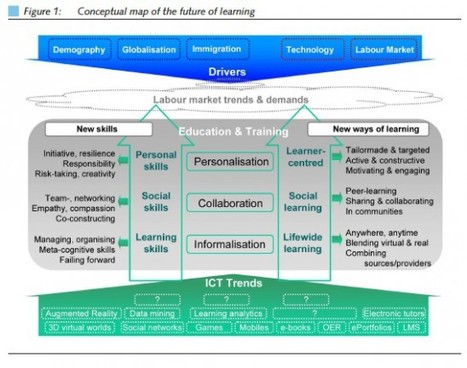
The Vision From the executive summary:
Redecker, C. et al. (2011) The Future of Learning: Preparing for Change Seville Spain: Institute for Prospective Technological Studies, JRC, European Commission Via Kathleen McClaskey
|
Scoop.it!

luiy's curator insight,
February 20, 2014 5:51 AM
The byproduct of use is a Conucopia of the Commons -- the act of using the database adds value to it. As users engage in low threshold participation (read, favorite, tag and link) we gain a form of collective intelligence. But it is important to distinguish the value of collective intelligence and collaborative intelligence, as first pointed out by Mitch Kapor:
When users participate in high enagement activities, connecting with one another, a different kind of value is being created. But my core point isn't just the difference between these forms of group intelligence -- but actually how the co-exist in the best communities.
Scoop.it!

Ken Morrison's curator insight,
December 31, 2013 9:18 PM
Howard Rheingold releases "Peerogogy 2.0" it is a collection of techniques of collaborative work and techniques. It is about how to help people learn together.
Scoop.it!
Scoop.it!

In today’s connected world, students are increasingly comfortable using video to communicate in their personal lives. From using Facetime to keep in contact with families at home to connecting via Google Hangout with friends studying abroad, students are coming into the classroom with a rich skill set of video collaboration methods, often without knowing it. Video has become second-nature to so many students. For effective learning, incorporating real-time video is increasingly important and can truly enhance student outcomes. Designing video into traditional, online, and hybrid classes is surprisingly easy. Via Edumorfosis, Mercedes Kamijo
Scoop.it!

From
www

A different kind of massive open online course (Mooc) platform, launched today, will provide students with the small collaborative learning groups that have so far been hard to find in the Mooc format. Via Ana Cristina Pratas
Scoop.it!
![Curating Information & Making Sense of Data Is a Key Skill for the Future [Research] | E-Learning-Inclusivo (Mashup) | Scoop.it](https://img.scoop.it/KrkxRVnH-00QDsqHCUKTTTl72eJkfbmt4t8yenImKBVvK0kTmF0xjctABnaLJIm9)
Robin Good: The Institute for the Future and the University of Phoenix have teamed up to produce, this past spring, an interesting report entitled Future Work Skills 2020.
By looking at the set of emerging skills that this research identifies as vital for future workers, I can't avoid but recognize the very skillset needed by any professional curator or newsmaster.
It should only come as a limited surprise to realize that in an information economy, the most valuable skills are those that can harness that primary resource, "information", in new, and immediately useful ways.
And being the nature of information like water, which can adapt and flow depending on context, the task of the curator is one of seeing beyond the water, to the unique rare fish swimming through it.
The curator's key talent being the one of recognizing that depending on who you are fishing for, the kind of fish you and other curators could see within the same water pool, may be very different.
Here the skills that information-fishermen of the future will need the most:
1) Sense-making: ability to determine the deeper meaning or significance of what is being expressed
2) Social intelligence: ability to connect to others in a deep and direct way, to sense and stimulate reactions and desired interactions
3) Novel and adaptive thinking: proficiency at thinking and coming up with solutions and responses beyond that which is rote or rule-based
4) Cross-cultural competency: ability to operate in different cultural settings
5) Computational thinking: ability to translate vast amounts of data into abstract concepts and to understand data-based reasoning
6) New media literacy: ability to critically assess and develop content that uses new media forms, and to leverage these media for persuasive communication
7) Transdisciplinarity: literacy in and ability to understand concepts across multiple disciplines
8) Design mindset: ability to represent and develop tasks and work processes for desired outcomes
9) Cognitive load management: ability to discriminate and filter information for importance, and to understand how to maximize cognitive functioning using a variety of tools and techniques
10) Virtual collaboration: ability to work productively, drive engagement, and demonstrate presence as a member of a virtual team
Critical to understand the future ahead. 9/10
Curated by Robin Good
Executive Summary of the Report: https://docs.google.com/viewer?url=http%3A%2F%2Fapolloresearchinstitute.com%2Fsites%2Fdefault%2Ffiles%2Ffuture-work-skills-executive-summary.pdf
Download a PDF copy of Future Work Skills 2020: https://docs.google.com/viewer?url=http%3A%2F%2Fapolloresearchinstitute.com%2Fsites%2Fdefault%2Ffiles%2Ffuture-skills-2020-research-report.pdf Via Robin Good, janlgordon

Beth Kanter's comment,
December 20, 2011 7:34 PM
Thanks for sharing this from Robin's stream. These skills sets could form the basis of a self-assessment for would-be curators, although they're more conceptual - than practical/tactical. Thanks for sharing and must go rescoop it with a credit you and Robin of course

janlgordon's comment,
December 20, 2011 7:56 PM
Beth Kanter
Agreed. It's also one of the articles I told you about....good info to build on:-)
Scoop.it!

If you are interested in cooperative studies or just want to build a more collaborative culture in your place of work, watch the below 20 minute talk by Martin Nowak. Via Dr. Susan Bainbridge
|










The suggestions offered hold great promise for unit entry events to intrigue students.