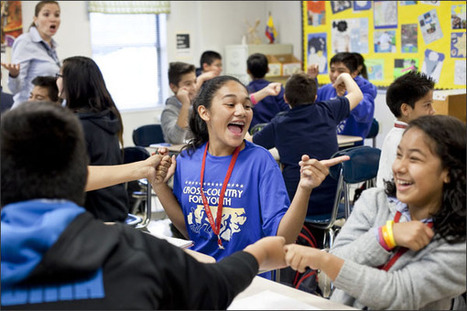
The goal of the Racine Unified dual-language programs is to prepare bilingual and biliterate students to achieve high levels of success academically, linguistically and socially. In RUSD, the program follows an 80/20 model in which kindergarten students receive 80 percent of their daily instruction in Spanish and 20 percent in English. By fifth grade, children spend half of the day learning in each language.
Elementary schools that offer the program: Dr. Jones, Fratt, Janes, Johnson, Julian Thomas, Mitchell, Racine Early Education Center and Wadewitz. Students who wish to continue in the dual-language program in middle school attend either Mitchell Middle School or Starbuck Middle School.
Published by Chalkbeat New York, November 10, 2014
Three years after being pressured to improve the education of English language learners, city officials under a new regime say they will tackle the problems without any arm-twisting.
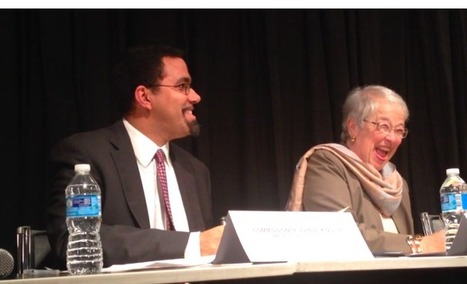
Chancellor Carmen Fariña and State Education Commissioner John King on Monday agreed to increase enrollment in bilingual programs, put more qualified teachers in their classrooms, better match newly-arrived students with language services, and hold principals accountable for implementing their plan. The agreement sets yearly targets but did not include details about how the city will meet those goals.
In other news, the school board voted to create a Spanish-English learning program at Landon Middle School.
USD 501 has a bilingual elementary — Scott Dual-Language Magnet — and a smaller bilingual program at Whitson Elementary. They follow a model in which half of the students are native Spanish speakers and half are native English speakers. The goal is fluency in both languages.
Next year the students to complete the elementary level will continue their bilingual journey at Landon.
Published by the Greenpoint News, November 6, 2014
Brooklyn Arbor is committed to meeting the needs of all students and providing them with a tailored educational experience, rich with hands-on learning and real-world connections.
The school is a big proponent of the “outdoor classroom.” Last year, the school went on over 175 field trips and neighborhood walks to destinations in and outside of NYC! These experiences build vocabulary, help youngsters engage with their community and primary sources, and make learning concrete.
The school has a thriving Spanish Dual Language program in grades K, 1 and 2 and a full time ESL teacher to support its English Language Learners.
The school offers a weekly after school program in partnership with Yogi Beans and another with the Williamsburg Art and Movement Center to help support students’ native language and increase their second language through movement.
To create inclusive environments for Students with Disabilities, the school offers flexible programs and an ICT class for every grade level. The school has a full time guidance counselor that provides both at-risk and mandated counseling to students.
The state of North Carolina is opening and expanding Dual Language Education programs after finding they produce better academic results for ALL children.
Six Philadelphia elementary schools — Southwark, Cayuga, Elkin, McClure, Muñoz-Marín, and Taylor —have successfully started popular dual-language programs. Families in North Philadelphia or South Philadelphia — whether Anglo or Latino, monolingual or bilingual — want their child to learn in both Spanish and English.
Published by the Statesville Record & Landmark, November 5,2014
Iredell-Statesville Schools is expanding the dual immersion language program at East Iredell Elementary School to the middle school level beginning next school year, continuing to grow one of the district’s most popular magnet programs.
I-SS’ Board of Education voted unanimously during Monday’s Committee of the Whole meeting to bring the Spanish language program into East Iredell Middle School for the 2015-16 school year.
This practice of sharing bilingual students is common for Bryan and College Station schools that serve English Language Learners, or children whose native language is something other than English, in dual language programs. Bryan serves 3,535 ELL students throughout the district, while the College Station district serves 772.
As the students progress through the grade levels, the curriculum shifts from the majority of their instruction given in Spanish to the majority given in English, said Marilyn Rosas, the director of bilingual education with the Bryan district. Down the hall in the fifth-grade bilingual classrooms at Crockett, the worksheets and posters on the walls are now largely in English. A word wall has terms such as the "White House" and "Mayflower Compact" described in English, and English-written essays are hung up in the hallway.
"In the earlier grades, they build their native language more than their English because we want them to get their basics in their native language, and then bring it over to English," Rosas said.
The districts serve these children through Spanish- and English-instructed programs that must be taught by a bilingual certified teacher, per state law. But if the district cannot provide enough bilingual educators, they must come up with an alternative way to serve the students and submit a waiver to the state education agency for approval.
In both districts, their alternative system includes sharing a bilingual and an English as a Second Language certified teacher. The bilingual teacher instructs students in mostly Spanish, while the ESL teacher instructs in English, though does have training to support students who are struggling in English, Ehrhardt said.
Published by the New Haven Independent, October 24, 2014
When Rocio Barahona told her students she would bring out the “caracoles,” a wave of excitement rolled through the first-grade classroom.
“Caracoles! Caracoles!” they loudly whispered to each other, as their teacher pulled out tanks of small aquatic snails—and charted a new approach to bilingual education.
Barahona’s class had become familiar with the Spanish vocabulary word in its second year of Clinton Avenue School’s “dual language” program, which alternates two groups weekly between classes held entirely in Spanish and entirely in English.
The students weren’t just learning about snails. They were continuing an experiment taking place at the heavily Latino K-8 school—an experiment in how best to conduct bilingual education. The experiment is drawing in not only Spanish-speakers but English-speaking children looking to add Spanish to their repertoire early on.
Published by the Los Angeles Wave, October 17, 2014
LYNWOOD — Bringing together both native English speakers and students still learning the English language, the Lynwood Unified School District this year kicked off its new dual immersion program, starting with kindergarteners at Will Rogers Elementary School.
The program will grow year by year, as students move through the sixth grade, ensuring students can read, write and effectively communicate in both English and Spanish, while achieving a high level of academic success.
Published by the Topeka Capital Journal, October 16, 2014
Meanwhile, USD 501 administrators are exploring options for a middle school dual-language site that will continue the bilingual education of students in the Spanish-English programs at Whitson and Scott elementaries.
Administrators have met with parents of the dual-language students and staff at a few middle schools to discuss the matter, and have recommended to the school board that the program be located at Landon Middle School.
Published/Broadcast by You Tube American Graduate, September 8, 2014.
The undaunted, charismatic, Gilberto Lobo and the innovative Dual Language Education Program have made a quality education possible for many young Hispanic students. They are transforming the classroom and an oftentimes stubborn educational system into a Dual language environment that champions bilingualism and bi-literacy, and enhances cultural diversity.
Broadcast by Time Warner Cable News, September 25, 2014
You may remember taking a foreign language class in school, but in Texas, many students are learning two languages at the same time. Our own Jennifer Borget shows us how a dual language program is working at one Texas school in this "Parenting Report."
“Because when children emigrate from other countries, they’ve already learned a lot of the basics—in their mother tongues,” explained Chiu.
The approach practiced in Shuang Wen and other bilingual schools is more of what New York City Chancellor Carmen Fariña wants to see.
Fariña and other school officials announced a new memorandum Monday to enhance the ELL experience in New York public schools.
She explained, “For me, this is not about an agreement to fill seats or to fill a legal requirement. This is something to give our kids hope, in college and beyond.”
Fariña recalled her teaching days in a Hispanic neighborhood where she was one of the only teachers who spoke Spanish.
The need for teachers to learn more languages was apparent to her from early on.
“If more teachers knew more languages, I think we’d be in a lot better place,” said Fariña.
Wisconsin school district makes classes available for "oldsters" as well as youngsters to become bilingual and bi-literate in both English and Spanish.
Published by the Beloit Daily News Connection, November 8, 2014
In addition to learning English, Laursen said one of the challenges for many Latino students and their families who are new to the district is knowing formal academic Spanish. Many of the Latinos who come to Beloit are from Mexico, some native to rural areas where there may not have been adequate educational opportunities. Most know conversational Spanish, but never learned about grammar or language construction.
To address the need for Spanish speakers to learn formal academic Spanish and to offer an opportunity for students who are native English speakers, the district started the Dual Language Immersion program in the 2012-2013 school year for 72 students in kindergarten classes at Hackett and Robinson elementary schools. Half of the students’ day is spent in Spanish instruction and half in English.
After the first year of the program, the kindergarten students moved into first grade where the program has continued and a new batch of kindergarten students entered Dual Language Immersion in the 2013-2014 school year which expanded to include Todd Elementary School. Students will continue on with the bilingual programming up through middle school, and then take some additional classes in high school.
Laursen said there are three decades of research supporting the program, noting it’s much easier for younger students to learn a second language. By fifth and sixth grades, students who know two languages typically outperform their one-language counterparts.
Laursen said the program has been a win-win for both English and Spanish speakers.
“Latinos learn to read and write in their native language they’ve been listening to and also get science and social studies in Spanish so they are understanding more of what is going on,” Laursen said.
In other efforts to help native Spanish speakers learn correct Spanish and English, in the last few years the district added Spanish for Spanish Speakers, a new class at the high school and middle schools for those who don’t know how to read or write it correctly. Prior to the class, Laursen said many Spanish speaking students would sign up for the traditional Spanish class and many times fail.
Laursen explained how many Latino students in the district are from families who came from rural parts of Mexico which may have not had educational opportunities much past the fourth or fifth grades. It’s resulted in the Latino students and their parents who arrive in Beloit sometimes not being able to read or write Spanish in a standard grammatically correct way.
“With our older students, because they didn’t have formal Spanish instruction, they don’t understand Spanish grammar and vocabulary. And a lot of times their Spanish language influences their English,” Laursen said.
Laursen went on to say the Spanish for Spanish speakers course can help Spanish speaking students understand grammar and language structure in both Spanish and English.
This year, after careful review of the community and parent voices, a new Dual Language Program was implemented. In addition to this newest program, ESL, ICT (Special Education), and Foreign Language (Spanish through Music for Pre-Kindergarten) are always available. Science, social studies, technology and physical education is alsooffered.
The state of North Carolina is opening and expanding Dual Language Education programs after finding they produce better academic results for ALL children.
The Topeka School Board voted unanimously Thursday night to select Landon Middle School to become the first in the state to offer a dual language school for students. The program will begin with the start of the 2014-15 school year.
Published by the Tarrytown Daily Voice, November 3, 2014
The Tarrytown dual language program provides students with the opportunity to learn a second language while continuing to develop their native language proficiency. Students are exposed to the same curriculum as their peers while also having the opportunity to learn a second language.
Dual language classes include a balance of students from Spanish-language and English-language backgrounds who participate together in instructional activities presented in two languages.
MINNEAPOLIS — On weekday mornings, a stream of orange buses and private cars from 75 Minnesota postal codes wrap around Yinghua Academy, the first publicly funded Chinese-immersion charter school in the United States, in the middle-class neighborhood of Northeast Minneapolis. Most pupils, from kindergarten to eighth grade, dash to bright-colored classrooms for the 8:45 a.m. bell, eager to begin “morning meeting,” a freewheeling conversation in colloquial Mandarin.
During a Wednesday morning tour of Prairie Elementary School and the Early Childhood Education School, state board members said the schools' offerings were on par with some of the most innovative in Illinois. Particularly the dual-language program at Prairie, where students in Vivian Presiado's kindergarten class greeted the group with a welcome song — performed in both Spanish and English.
"The dual-language program is brilliant," state board member Jim Baumann said. "It's unique for this area because we mostly see programs like this in Chicago. The impact of a bilingual program like this is really good for kids and culturally it breaks down a lot of barriers. It helps kids understand other cultures at a younger age."
The bilingual academic track has been offered at Urbana's Prairie and Leal elementary schools for three years. It gives students the opportunity to become proficient in both English and Spanish — from kindergarten onward.
Collinswood Language Academy's experiences with two-way language learning illustrates why North Carolina state education officials are sold on the idea.
Kindergartners and first grade students will not be allowed to speak English in half of their classes at a Wyoming elementary school this year. The reason, said officials at Park Elementary School in Casper, Wyoming, is the school is now offering dual-language education.
The 5- and 6-year-old students will speak Spanish for half the school day, and English for the other half. It is all part of a new program in the state designed to help students learn a second language more quickly.
WINDHAM — After expanding into pre-school and seventh grade, the Companeros program is getting another boost - students can enter the program after kindergarten.
The district has hosted several forums to offer information on the program and clarify how children who previously couldn’t get into the program can now earn a spot.
“This will strengthen the program,” said Amy Finsmith, dual language program specialist for the district.
To get content containing either thought or leadership enter:
To get content containing both thought and leadership enter:
To get content containing the expression thought leadership enter:
You can enter several keywords and you can refine them whenever you want. Our suggestion engine uses more signals but entering a few keywords here will rapidly give you great content to curate.


 Your new post is loading...