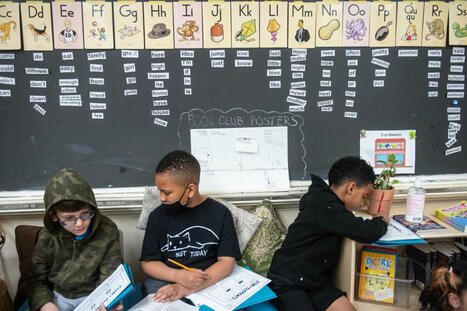
"What we hear is no dual language, English only,” said Tara Fortune, immersion project coordinator at the Center for Advanced Research on Language Acquisition at the University of Minnesota. “But what’s really happening is beneath the surface these programs are really growing. It’s become sexy.
“Immersion is a program that is about bilingualism, bi -literacy and multi-literacy."
Researchers have seen a growth in immersion education across the country. The Center for Applied Linguistics estimated there are about 1200 programs in schools across the nation. Most are Spanish and English programs, but a growing number include Mandarin Chinese, Korean and French. The instruction can be about improving English skills for the 21% of school-age children in the country who speak a language other than English at home, but also about encouraging bilingual skills for English speakers as well.
Utah, one of the most consistently conservative states in the nation, spearheaded two-way immersion programs over the past few years under Republican governor and former GOP presidential nominee hopeful Jon Huntsman.
Utah’s language instruction focuses on immersion learning. In Utah, students learn 50% of their subjects in English and 50% in a second language. Two-way immersion means some students speak English as their native languages at home, and some might not.
For the 2011-2012 school year, there are 57 immersion programs in Utah— 31 in Spanish, 17 in Mandarin Chinese and nine in French. Next year, the state expects to have 76 programs, said Gregg Roberts, world languages and dual immersion specialist for Utah’s Department of Education. All of the instruction starts in kindergarten or first grade, and the overarching plan for these programs was developed and supported at a state level.
Despite Administration’s desire to slash education spending, a final bicameral, bipartisan bill restores most funding, including English Learner, World Language, EdTech, and Professional Development With a January 30 deadline coming up, the House and Senate Appropriations Committees released a four bill FY26 “minibus” appropriations bill that contains final compromise funding levels for the Departments of Education, Defense, Labor, and HHS. Key K-12 programs that the Trump Administration proposed for elimination—including Title II-A (Professional Development), Title III (English Language Acquisition), Title IV-A (flexible block grant, often used for EdTech), Native Hawaiian Education and Alaska Native Education—are being retained at the same
Supported by a Teaching and Learning Grant, the By Learners For Learners project brings undergraduate-written children’s stories to life with the release of fully illustrated digital publications
An audit from city Comptroller Brad Lander found that the city Department of Education has not been providing legally-mandated services for English Language Learners, disproportionately impacting Spanish, Chinese, Russian, Bengali and Arabic-speaking communities.
The French American Academy, a private bilingual school with campuses in Englewood and Downtown Jersey City, has opened its first high school campus in the Jersey City Heights. The new high school …
Linguistic diversity among our multilingual students in grades pre-K–12 has been steadily increasing over the last 15 years, and with changing classroom dynamics, we need strong, intentional instruction to meet their unique needs. Yet, all too often, novice and experienced teachers may teach as if they are working with students who come from monolingual, English-speaking American backgrounds, despite today’s classrooms being far more culturally and linguistically diverse than ever before. To truly support every learner, start from an asset-based approach—recognizing and valuing the rich linguistic and cultural resources multilingual students bring to the classroom. How can educators create a support
State schools chief Tom Horne is making a last-ditch effort to force school districts to use only "structured English immersion'' to teach students who are not proficient.
In classrooms across Honolulu, bilingual education is reshaping how students learn, connect and see the world. Find out more here: https://tinyurl.com/mrw9d6d5
Latino students and families begin the new year still facing the Trump administration’s attacks on public education, which include the threat of indiscriminate immigration raids, federal funding disruptions and the dismantling of the U.S. Department of Education. What can advocates and educators do to support students, including Latinos, in 2026?
A New York City’s Department of Education audit report found thousands of immigrant students were left without proper English instruction or certified teachers.
As a reading interventionist and Haitian immigrant, Websder Corneille supports Haitian students who are learning English, but said his role is more than serving the students or school —he serves the community.
Moving Beyond Binary Thinking about Language in the Classroom The concept of academic language is most widely attributed to Jim Cummins, who introduced the distinction between Basic Interpersonal Communication Skills (BICS) and Cognitive Academic Language Proficiency (CALP) in the late 1970s and early 1980s (Cummins, 1979). BICS and CALP have been canon in ESL teacher education during the four decades that followed. Amidst a global pandemic and the death of a black man under the knee of a white police officer, academic language was challenged by a new generation of scholars in 2020. A committee dedicated to Anti-Black Racism and
The Trump administration has rescinded guidelines on how schools should teach English learners, which has caused concern for administrators and families.
To get content containing either thought or leadership enter:
To get content containing both thought and leadership enter:
To get content containing the expression thought leadership enter:
You can enter several keywords and you can refine them whenever you want. Our suggestion engine uses more signals but entering a few keywords here will rapidly give you great content to curate.


 Your new post is loading...