Your new post is loading...
Published by Capitol New York, January 15, 2015
On Wednesday, city schools chancellor Carmen Fariña announced that the Department of Education will create forty new dual language programs.
Fariña, who has made foreign language instruction a top priority of her tenure, originally announced her plans to open the dual language programs in September, after a school visit with Queen Letizia of Spain.
The programs will be partially funded by $1 million from federal Title III funds, and each school will receive a $25,000 planning grant. The programs are slated to open this September.
Twenty-five of the programs are entirely new, and the remaining 15 are expansions of existing dual language programs. The programs will be offered ten schools in the Bronx, 11 in Brooklyn, nine in Manhattan, eight in Queens, and two on Staten Island. The programs are mostly held at elementary schools: 23 K-5 schools will offer dual language programs, along with 13 middle schools, three high schools, and one K-12 schools.
Hebrew, Japanese, French, Haitian Creole, Spanish and Mandarin Chinese programs will be offered.
Published by the Austin American Statesman, January 15, 2015
Since 2010, the Austin Independent School District, like many school districts across the nation, has offered dual-language programs at the elementary school level. Now, at the request of parents, the district will expand the popular program into middle school classrooms, a move this board fully supports.
It makes sense to provide a bilingual education to all Texas children. As local businesses partner with international companies, and as our communities become more diverse, the ability to adequately communicate in more than one language is vital. To truly master more than one language, however, bilingual education needs to starts at an early age. Experts agree that a dual-language education in the classroom is one of the best ways to teach young minds two languages simultaneously.
The Austin district currently offers dual-language programs in more than 50 of its elementary school campuses. Next year, it will expand the program — where students learn in English and a foreign language, like Spanish or Vietnamese — into Burnet and Fulmore middle schools. The program expansion will start in sixth grade and will add a grade level each year. While this is an important first step, expanding into other middle schools and high schools will better serve current and future dual-language students.
Three middle schools requested funding for dual-language programs, but only Fulmore and Burnet met the board’s expansion criteria, including ensuring a sufficient number of students participating in the program.
Most of Europe and other parts of the world encourage children to learn at least one foreign language. The practice has been the opposite historically in the United States, which is a huge disservice to the children of this country. Evidence shows that children who are bilingual are cognitively, academically, intellectually, socially and verbally more advantaged than their monolingual peers, according to several studies.
It’s no wonder dual-language programs have surged in popularity in the past decade as American schools look to compete and provide strong academic options to public school students.
In 2000, there were only about 260 dual-language programs operating in U.S. schools. Over the past decade, however, dual-language programs have grown tenfold, with an estimated 2,000 now operating, according to the Harvard Graduate School of Education.
Locally, dual-language programs gained traction during the tenure of former Superintendent Meria Carstarphen. In the two-way dual-language program, English is taught for about half the day, and the other language — Spanish, Mandarin or Vietnamese — is taught for the other half. In many schools, the method replaces familiar transitional bilingual education. The transitional model, designed for non-English speakers only, teaches limited amounts in their native tongues, eventually transferring students to English-only instruction, sometimes into English as a Second Language programs, in which students are immersed in English and get extra help with grammar and expanding their vocabulary.
Currently, the district still uses English as a Second Language programs in middle and high schools. But, with research pointing to dual-language programs as a better way to engage a diverse student body, adopting a dual-language program in secondary schools on a wider scale should be considered. Given the Austin district is 60 percent Latino, with more than a quarter speaking little to no English, the program could close gaps between English and non-English speaking students, as research suggests.
Open to all students, dual-language programs provide an environment in which everyone is learning a new language and help ethnic boundaries disappear. In this setting, students become less fearful of making mistakes speaking a new language because everyone around them also is acquiring a new language . In the end, all participating students grasp concepts better and achieve higher academic success.
If the Austin district is to be fully committed to the success of the program, the district must ensure that dual-language programs are adequately staffed and teachers property trained.
Additionally, to maximize the benefits of the program, it is important that the district expand to more middle schools and high schools. Investing money and energy into the program, only to drop off in middle school, makes no sense. Continuing the investment through the end of high school is only logical.
Though dual-language programs can be cost-effective, with some dual-language schools able to address the literacy needs of English learners within the confines of the regular classroom, the Austin district’s dual-language program expansions, including the new programs at the middle schools, are estimated to cost $576,000 in 2015-16.
We understand that the new school board will have a tough job of trying to balance the district’s financial ledger this next school year, but we urge members to look at preserving and funding quality programs like dual language. The return on the investment of growing a workforce that is literate in two languages is a wise investment that benefits Austin and all of Texas. Linda Pantoja teaches a dual language Pre-K class at the Anita Uphaus Early Childhood Center in Southeast Austin. The Austin Independent School District will expand its program next year, adding two middle schools to 50 elementary schools. RALPH BARRERA/ AMERICAN-STATESMAN 2014

|
Scooped by
Dual Language Education of New Mexico
December 27, 2014 3:58 PM
|
Published by UMUK, December 15, 2014
This is the first in a three-part series about the bilingual experience at El Sol.
Most of the students at El Sol Elementary in Kalamazoo are learning a second language. That’s because the school teaches half of its lessons in English and the other half in Spanish.
The goal is for kids to graduate knowing both. It’s also to show them, as one parent puts it, that “the world is not all English.” And it gives those whose native language is Spanish the chance to study it.
In the first of a three-part series, WMUK reports on how El Sol came to exist six years ago, and what it means to the students and parents it serves.
|
|
Scooped by
Dual Language Education of New Mexico
December 27, 2014 3:41 PM
|
Published by WMUK, December 17, 2014
Students at Kalamazoo’s El Sol Elementary learn in both English and Spanish. But they don’t use their knowledge just to complete their homework.
Instead, they find a variety of ways to use their dual-language skills to their social advantage. That’s what a Western Michigan University anthropologist – who’s also an El Sol parent – is finding in her research at the school.
In the last of a three-part series, WMUK reports on some of the unexpected benefits of bilingualism.
|
|
Scooped by
Dual Language Education of New Mexico
December 25, 2014 10:32 PM
|
Published by the Provo City School District, December, 2014
The Dual Language Immersion Program offered in Provo School District is available in Mandarin Chinese, French, Portuguese and Spanish. Students begin in first grade; each year the next grade will be added so students will have the opportunity to participate through sixth grade.
Students will spend one-half of their school day learning in the target language and the other half learning in English. Integrated thematic instruction will be provided in all subjects – math, science, social studies, music, physical education and art. Why Immersion? More than 40 years of research consistently documents the power of immersion programs to help students attain high levels of second language proficiency. No other type of instruction, short of living in a second-language environment, is as successful. Young children especially thrive in this type of instructional environment.
Studies consistently show that exposing a student to another language early in his or her education increases memory and concentration, problem solving skills, and provides a greater understanding of their primary language. Fortunately, language immersion is also the least expensive way to deliver second language instruction.
|
|
Scooped by
Dual Language Education of New Mexico
December 10, 2014 7:31 PM
|
Published by PRI, December 10, 2014
Just head to Hillsboro High School, near Portland, Oregeon, and step into the Algebra 2 class. The concepts — open intervals, integers, logarithm rules — are already challenging for most students. Now learn them in Spanish.
From start to finish, teacher Moises Curiel instructs in that language, and the students plug away, asking questions and working through problems in groups.
Learning in another language isn’t a problem, because the students have two things in common: They all know English, and they’ve studied in Spanish for years. Many of the students here either grew up speaking Spanish with their families, or want to speak Spanish themsevles, like Peter Kuskie. He's a sophomore who grew up speaking only English.
Published by Education Week, December 9, 2014
The benefits of bilingual K-12 schooling drive Annalisa Nash Fernandez to go to great lengths for her children.
|
|
Scooped by
Dual Language Education of New Mexico
November 29, 2014 10:47 PM
|
Despite the fact almost one in five young people have a first language other than English, research reveals their skills go unsupported and unrecognised by exam system
|
|
Scooped by
Dual Language Education of New Mexico
November 18, 2014 10:05 PM
|
Published by the National Journal, November 18, 2014"Given the profound changing demographics of California, it is really incumbent on us as policymakers at the federal, but especially more so at the state level, to make the human capital investments for higher education, for education, and especially for economic development," said state Sen. Kevin de Leon, president pro tempore of the California State Senate, on Tuesday at a National Journal event in San Francisco that was underwritten by MasterCard. "We don't have to be bilingual. We have got to be trilingual, quadrilingual," de Leon said. "We have to learn more languages."
|
|
Scooped by
Dual Language Education of New Mexico
November 17, 2014 9:16 AM
|
Published by DNAinfo New York, November 17, 2014
There are 110 dual language programs in elementary schools and a handful more in middle and high schools across the five boroughs. Most are in Spanish, but there are also programs in Chinese, French, Arabic, Bengali, Korean, Russian and Haitian Creole.
Next fall, the city will open about 40 more dual language programs. Creating more dual language programs is part of the DOE's pledge to meet state-mandated goals to improve education for non-English-speaking students.
|
|
Scooped by
Dual Language Education of New Mexico
November 12, 2014 6:31 AM
|
Published by the Epoch Times, Novembe 10, 2014
“Because when children emigrate from other countries, they’ve already learned a lot of the basics—in their mother tongues,” explained Chiu.
The approach practiced in Shuang Wen and other bilingual schools is more of what New York City Chancellor Carmen Fariña wants to see.
Fariña and other school officials announced a new memorandum Monday to enhance the ELL experience in New York public schools.
She explained, “For me, this is not about an agreement to fill seats or to fill a legal requirement. This is something to give our kids hope, in college and beyond.”
Fariña recalled her teaching days in a Hispanic neighborhood where she was one of the only teachers who spoke Spanish.
The need for teachers to learn more languages was apparent to her from early on.
“If more teachers knew more languages, I think we’d be in a lot better place,” said Fariña.
|
|
Scooped by
Dual Language Education of New Mexico
November 10, 2014 12:46 PM
|
Published by the Walworth County Gazette, November 6, 2014
|
|
Scooped by
Dual Language Education of New Mexico
November 10, 2014 12:26 PM
|
Published by the Beloit Daily News Connection, November 8, 2014
In addition to learning English, Laursen said one of the challenges for many Latino students and their families who are new to the district is knowing formal academic Spanish. Many of the Latinos who come to Beloit are from Mexico, some native to rural areas where there may not have been adequate educational opportunities. Most know conversational Spanish, but never learned about grammar or language construction.
To address the need for Spanish speakers to learn formal academic Spanish and to offer an opportunity for students who are native English speakers, the district started the Dual Language Immersion program in the 2012-2013 school year for 72 students in kindergarten classes at Hackett and Robinson elementary schools. Half of the students’ day is spent in Spanish instruction and half in English.
After the first year of the program, the kindergarten students moved into first grade where the program has continued and a new batch of kindergarten students entered Dual Language Immersion in the 2013-2014 school year which expanded to include Todd Elementary School. Students will continue on with the bilingual programming up through middle school, and then take some additional classes in high school.
Laursen said there are three decades of research supporting the program, noting it’s much easier for younger students to learn a second language. By fifth and sixth grades, students who know two languages typically outperform their one-language counterparts.
Laursen said the program has been a win-win for both English and Spanish speakers.
“Latinos learn to read and write in their native language they’ve been listening to and also get science and social studies in Spanish so they are understanding more of what is going on,” Laursen said.
In other efforts to help native Spanish speakers learn correct Spanish and English, in the last few years the district added Spanish for Spanish Speakers, a new class at the high school and middle schools for those who don’t know how to read or write it correctly. Prior to the class, Laursen said many Spanish speaking students would sign up for the traditional Spanish class and many times fail.
Laursen explained how many Latino students in the district are from families who came from rural parts of Mexico which may have not had educational opportunities much past the fourth or fifth grades. It’s resulted in the Latino students and their parents who arrive in Beloit sometimes not being able to read or write Spanish in a standard grammatically correct way.
“With our older students, because they didn’t have formal Spanish instruction, they don’t understand Spanish grammar and vocabulary. And a lot of times their Spanish language influences their English,” Laursen said.
Laursen went on to say the Spanish for Spanish speakers course can help Spanish speaking students understand grammar and language structure in both Spanish and English.
|
Published by The Hour, January 10, 2014
NORWALK -- To support the growing number of Haitian English Language Learners at Brien McMahon High School, the school established a Bilingual Education program to help Creole-speaking students adapt to their new school environment.
Published by Slate, January 5, 2014
With the passage of the Bilingual Education Act in 1968 and other developments during that decade, Spanish speakers were, for the most part, no longer punished. But many bilingual programs still aimed to teach students English as quickly as possible, with too little priority on maintaining Hispanics’ native language. Truly “bilingual education”—which aims to help students become, and stay, fluent in multiple languages—was too often perceived as a luxury only privileged native English speakers could afford.
Sensing this prejudice and the obstacles their children faced without a working knowledge of English, many Hispanic families preferred bilingual programs that prioritized English instruction above all else. And some remained skeptical of dual language programs’ emphasis on Spanish, which middle-class, English-speaking parents began to embrace in the 1980s.
Hispanic parents haven’t lost sight of the stigma and obstacles faced by non-English speakers, but they may feel more confident embracing their native language for a few reasons. The American population has become more diverse and multilingual, making it harder to justify English dominance from a pragmatic and political standpoint. For the first time this year, the country’s public schools enroll more “minority” students than non-Hispanic white ones. Also, a growing number of middle- and upper-income families recognize the economic advantages to mastering multiple languages in an era of globalization; many have clamored for more dual language schools and programs as a result, helping to legitimize and popularize the approach. And a growing body of research suggests that dual language education does not hinder a non-native speaker’s progress in English and may actually accelerate it over time if the programs are designed well.
|
|
Scooped by
Dual Language Education of New Mexico
December 27, 2014 3:47 PM
|
Published by MMUK, December 16, 2014
How do you teach students in two languages? The answer might seem obvious. Instruct them in one, then the other.
Students at Kalamazoo’s El Sol Elementary do spend part of their day immersed in Spanish and part of it in English. But the educators say there’s more to a good bilingual experience than talking at students and expecting them to keep up.
In the second of a three-part series, WMUK reports on what goes into making a dual language program effective
|
|
Scooped by
Dual Language Education of New Mexico
December 25, 2014 10:37 PM
|
Published by WAMU Public Radio, December 12, 2014
Demand For Dual-Language Programs In D.C. Public Schools Skyrockets
By: Kavitha Cardoza
Most students in the U.S. learn a foreign language at some point in their academic careers, but in several D.C. public schools, learning a foreign language is more than just another elective. In fact, there are long waiting lists at schools that fully immerse students in two different languages.
Welcome to the Washington Yu Ying Public Charter School in Northeast D.C. The school offers a dual-language immersion program, meaning students learn in Chinese for half of their time spent in class. Yu Ying’s approximately 500 students start learning Chinese when they’re in pre-K.
“It’s fun to learn Chinese and that’s one of the things Barack Obama regrets,” says fifth-grader Aidan Elliott. “It’s from a book I read. He said he regrets not learning a language and playing an instrument.”
Yu Ying isn't the only dual-language school in the area. D.C. has 13 dual-language public schools that offer programs in Spanish, French and Hebrew, among other languages.
Demand on the rise throughout D.C.
Demand for these language programs is on the rise as research shows students who study more than one language do better academically, particularly African-American children and those who aren’t fluent in English.
“Last year we had about 1,100 applicants for 20 spots,” says Marquita Alexander, Yu Ying’s Head of School.
Ten years ago, D.C.’s traditional public schools had one immersion school with 450 children. Now it has eight schools with more than 3,000 students. There are plans to expand in the coming years because of long waiting lists.
Despite this expansion, dual-language programs have been criticized for the fact that none are located east of the Anacostia River.
“The elementary programs we have are clustered in areas, which have traditionally had students who didn’t speak English,” says Katarina Britto, head of bilingual education for D.C. Public Schools.
But given the success of dual-language programs, Britto is confident that programs will develop at more schools.
|
|
Scooped by
Dual Language Education of New Mexico
December 16, 2014 12:35 PM
|
Published by District Administration, December, 2014
Next fall, Houston ISD students will be the first in the nation with the opportunity to immerse themselves in the Arabic language.
In November, the Houston board of education unanimously voted to open the Arabic Language Immersion Magnet School in fall 2015, with two pre-K and two kindergarten classes. A new grade level will be added each year as students progress through grade 5. ... Houston ISD is also home to two districtwide Spanish language schools, and the Mandarin Chinese Language Immersion Magnet School, which opened in 2012 for grades pre-K through 5. The Mandarin school has four student applicants for every available spot. The district’s long-term goal is to open a dual-language program in every elementary school....
|
|
Scooped by
Dual Language Education of New Mexico
December 10, 2014 8:53 AM
|
Published by La Prensa, December 5, 2014
When Toledo’s Natalie Hess learned that a new bilingual public charter school named Toledo SMART Elementary was opening this past fall she didn’t hesitate to enroll her 6-year-old daughter Ester Hess.
That’s because Mrs. Hess realized that being bilingual in today’s world is important and being able to acclimate in a diversity society would give her daughter an advantage over many other students.
|
|
Scooped by
Dual Language Education of New Mexico
December 7, 2014 11:20 AM
|
Published by the WK Kellogg Foundation, December, 2014
In New Mexico, with the nation’s highest percentage of Hispanic residents the sudden loss of Spanish and indigenous languages might seem surprising.
|
|
Scooped by
Dual Language Education of New Mexico
November 19, 2014 5:56 PM
|
Detroit Public Schools will further expand offerings to bilingual students and families.
|
|
Scooped by
Dual Language Education of New Mexico
November 17, 2014 9:23 AM
|
Published by Lohud, November 16, 2014
Infante-Green has been visiting dual-language programs across the state, hoping to find programs that offer a rigorous curriculum along with needed supports. She liked what she saw in the Tarrytowns, one of six districts in the Lower Hudson Valley that offer dual-language programs.
"This is what it's meant to be, but not everyone is able to carry it out," said Infante-Green, associate commissioner of the Office of Bilingual Education and Foreign Language Studies. "Our direction is toward bilingual for everyone. These are the first steps in that direction. Hopefully, we can share some of the exemplary practices here. People always like to see it. It's very difficult to imagine it."
Tarrytowns, White Plains, New Rochelle, Port Chester, Ossining and
Elmsford offer dual languages classes in their elementary grades. Many have been in place for more than five years. Dual language classes are designed to have about half the students native Spanish speakers and half native English speakers. The students learn reading, math, science and social studies in both languages.
The classes are popular; all six districts have waiting lists. Parents who met with Infante-Green during her Tarrytowns tour said they liked to see their children learn another language and become comfortable with children from other cultures. They said their children did not get watered-down curriculum, which some had worried about. Younger siblings, often given preference in dual-language enrollment, pick up words and attitudes from older siblings that makes a second go-round a breeze, they said.
The native Spanish-speaking parents said the only downside was within their own communities, where parents worry that their children won't learn English if they have the option to learn in Spanish.
|
|
Scooped by
Dual Language Education of New Mexico
November 16, 2014 8:09 AM
|
Published by the Journal Times, November 16, 2014
The goal of the Racine Unified dual-language programs is to prepare bilingual and biliterate students to achieve high levels of success academically, linguistically and socially. In RUSD, the program follows an 80/20 model in which kindergarten students receive 80 percent of their daily instruction in Spanish and 20 percent in English. By fifth grade, children spend half of the day learning in each language.
Elementary schools that offer the program: Dr. Jones, Fratt, Janes, Johnson, Julian Thomas, Mitchell, Racine Early Education Center and Wadewitz. Students who wish to continue in the dual-language program in middle school attend either Mitchell Middle School or Starbuck Middle School.
|
|
Scooped by
Dual Language Education of New Mexico
November 12, 2014 6:24 AM
|
Published by Chalkbeat New York, November 10, 2014
Three years after being pressured to improve the education of English language learners, city officials under a new regime say they will tackle the problems without any arm-twisting.
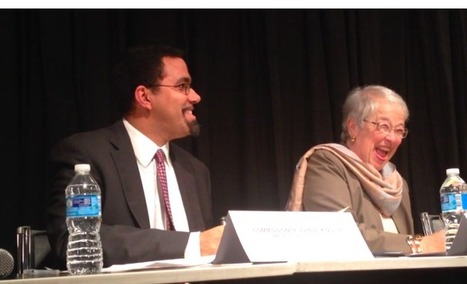
Chancellor Carmen Fariña and State Education Commissioner John King on Monday agreed to increase enrollment in bilingual programs, put more qualified teachers in their classrooms, better match newly-arrived students with language services, and hold principals accountable for implementing their plan. The agreement sets yearly targets but did not include details about how the city will meet those goals.
|
|
Scooped by
Dual Language Education of New Mexico
November 10, 2014 12:31 PM
|
The Topeka Capitol-Journal, Novbember 6, 2014
In other news, the school board voted to create a Spanish-English learning program at Landon Middle School.
USD 501 has a bilingual elementary — Scott Dual-Language Magnet — and a smaller bilingual program at Whitson Elementary. They follow a model in which half of the students are native Spanish speakers and half are native English speakers. The goal is fluency in both languages.
Next year the students to complete the elementary level will continue their bilingual journey at Landon.
|