Your new post is loading...
San Francisco is home to a large Cantonese-speaking population, with over 75% of Chinese speakers in the San Francisco Unified School district using Cantonese at home. There’s demand but no supply, with the Cantonese learning pipeline being cut off after K-8 despite a need for translated public services.
Each year, about 160,000 new California students are identified as English Learners. How and when these students are reclassified as English proficient is a key factor in their academic progress, yet many have likely been held back due to criteria that are overly subjective and onerous. We offer five recommendations to improve reclassification for this large population of students.
The Education Department notified Congress in February of its plans to dismantle OELA.
María Jesús Abilleira discusses what the changes mean and why the instructional approach matters Starting in fall of 2026, the AP® World Language and Culture exams are changing in ways that go well beyond format adjustments. Across Spanish, French, German, Italian, Chinese, and Japanese, the College Board is introducing a Project component that accounts for 35% of each student’s total score. Students must research a topic announced in January of the exam year, deliver a structured oral presentation, and respond on the spot to four questions from a recorded interlocutor. There is no script, no previewed question set, and no
Hearing and practicing language leads to stronger literacy skills.
Millions of families across the United States are navigating one of the most complex systems in public education the special education process without the tools they need to do it effectively For Spanish speaking families the challenge is even greate
Kate Kinsella provides proven practices for ensuring all students are prepared to contribute and listen actively within bilingual, ELD, and content-area coursework The Need for Re-engaging Language Learners Socially and Academically Since the pandemic, K-12 educators have made earnest efforts to provide safe and supportive havens for re-engaging young scholars who suffered tremendous learning loss and social isolation. English learners enrolled in diverse programs, whether bilingual or general education, count among the youths who were most victimized by distance education. The prolonged social isolation they experienced interrupted their development of English language, foundational literacy skills, and subject matter knowledge (Sugarman
Williams: Congressional Republicans challenging students’ right to a free public education regardless of immigration status conflate the cost factors.
The political climate in Arizona has stifled bilingual education. One student is trying to change that.
A push by Stephen Miller and GOP lawmakers to challenge a landmark Supreme Court ruling would strip undocumented children of access to public education.
Language barriers in the classroom can present complex challenges. Instead of placing the burden on multilingual learners, let’s commit to an institution-wide approach to support them
When a friend came to him and confided she was failing her high school classes, Emilio Saenz listened. She was falling behind, she said. Spanish is Andrea Valenzuela’s native language and the barriers to learning math, science and navigating high-school life only in English were tough. “When I arrived in the United States, one of […]
A new brief identifies key barriers preventing Title III from fulfilling its goals, making the case for continual federal involvement.
|
Learning English is always difficult. But current aggressive approaches to immigration policy are creating more barriers for learners and the programs that serve them than ever before in Appalachia and beyond.
Experts examine what research tells us about advancing literacy for students who are learning in more than one language
The state has laid out a vision for supporting students through the English Learner Roadmap but too many teachers are left without enough training or support to turn this policy into practice.
When oracy is embedded, students move from answering to reasoning, from participation to contribution, and from silence to voice.
It’s been over a decade since parents and school districts sued New Mexico for failing to provide a sufficient education to Native American students, low-income students, students with disabilities, and English language learners
After seeing his son thrive in Willard Elementary’s Two-Way Immersion program, Marc Zarefsky wanted Evanston/Skokie School District 65 to expand bilingual education programs, not scale them back. For Zarefsky, the district’s decision to close two bilingual programs was a step in the wrong direction, he said. At the end of the academic year, Distric
Daniel Ward sets Multilingual Learners at the center of efforts to improve reading scores Despite the administration’s arguments to the contrary, ensuring that multilingual learners (MLs) are central to the success of national literacy efforts may become more difficult now that the controversial structural changes to the Department of Education are set for implementation next month. The most obvious change is that the Office of English Language Acquisition (OELA) will be dissolved and its functions will be redistributed across the Office of Elementary and Secondary Education (OESE), already undermined by mass firings last October in the midst of a government
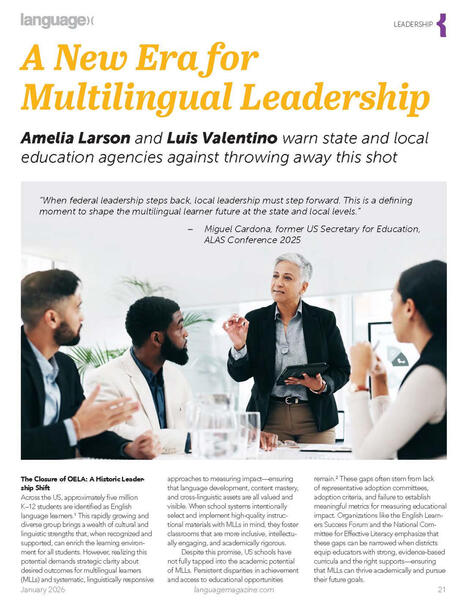
Amelia Larson and Luis Valentino warn state and Local Education Agencies against throwing away this shot The Closure of OELA: A Historic Leadership Shift Across the United States, approximately five million K–12 students are identified as English languagelearners.¹ This rapidly growing and diverse group brings a wealth of cultural and linguistic strengths that, when recognized and supported, can enrich the learning environment for all students. However, realizing this potential demands strategic clarity about desired outcomes for multilingual learners (MLLs) and systematic, linguistically responsive approaches to measuring impact—ensuring that language development, content mastery, and cross-linguistic assets are all valued and visible.
Sanchez: Language access, cultural understanding and parent partnership are foundational, not supplemental, for special education systems.
Beyond providing cross-cultural education to young people from all backgrounds, ICAGeorgia, now approaching 330 students, is a welcome sales tool for Japanese expatriates bringing their families to the state.
Overall, public schools across Massachusetts — which has become a target of President Trump’s crackdown on immigration — lost over 15,000 students from fall 2024 to fall 2025, according to state data released in January. That brings total enrollment in the state to its lowest level in over three decades.
|


 Scoop.it!