Your new post is loading...

|
Scooped by
Beeyond
Today, 9:20 AM
|
To appreciate the significance of this development, it is helpful to look back at the previous defining era of telecommunications. In the early 2010s, as smartphones became ubiquitous and app economies exploded, the metric of value for both carriers and consumers shifted dramatically. This was the era of the gigabyte. Subscriptions, usage caps, and pricing tiers were all defined by data consumption. Telcos established the price per gigabyte as their primary billing KPI, monetizing the massive demand for mobile internet, video streaming, and app-based services. For a decade, the “GB per month” was the yardstick of digital life.
|
|
Scooped by
Beeyond
May 19, 10:19 AM
|
Look at the image above. On the left is your current human subscriber. For the last two decades, you have sold them GBs per month, fought over marginal ARPU increases, and watched every single app try to commoditize your network. That race to the bottom didn’t end up really well.
On the right is your brand-new customer.
Figure just ran a live drill in which a human intern competed against its Figure 03 humanoid, “Bob,” to see who could sort and categorize more packages. The result? The human lost the moment they had to step away to go to the bathroom. F.03 just kept working.
|
|
Scooped by
Beeyond
May 18, 10:12 AM
|
As I have consistently discussed, the sudden explosion of thousands of autonomous, AI-powered voice applications has pushed Twilio’s orchestration platform into the center stage of the Inference Economy.
Honestly, it feels almost stupid that a historically high-latency, expensive, frequently untested, and spam-ridden legacy voice channel like Twilio VOIP is fundamentally beating the global telecom operators who have literally owned and operated this infrastructure for 150 years.
Unfortunately, this is just a damning reflection of how little the telecom establishment understands about AI economics. How many times can a single industry lose its core service to outsiders?"
|
|
Scooped by
Beeyond
May 17, 11:09 AM
|
The military is moving from communications as a support function to communications as an operating layer. In the older model, networks connected headquarters, bases, command rooms, ships, vehicles, and troops. In the new model, networks connect drones, sensors, logistics systems, cyber platforms, autonomous vehicles, cloud environments, AI models, identity systems, command software, and industrial supply chains. The network is no longer outside the mission; it is now inside the mission.
|
|
Scooped by
Beeyond
May 15, 5:03 AM
|
La 125e édition du concours Lépine vient de s'achever, récompensant des inventions toujours plus ingénieuses. Nous avons réalisé une sélection des plus originales d'entre elles. Que diriez-vous de vendre (on peut aussi le donner) votre accès Internet inutilisé ? Le système DotDot permet de partager ses Gigas à travers un petit boîtier coloré intelligent qui crée « un réseau WiFi dans les 100 m autour de soi ». « C’est un partage de connexion anonyme sous stéroïdes », résumait Christophe Bureau, le fondateur, auprès d’actu Grenoble en mai 2025, après avoir remporté une médaille d’or.
|
|
Scooped by
Beeyond
May 11, 2:12 PM
|
For a decade, “Becoming a Utility” was the ultimate slur in the telecom boardroom. If you wanted to offend a Telco C-suite, you just needed to say: “You are nothing more than a Utility”.
But in 2026, the irony is really sad as Telcos should be begging for that utility status. While global operators grind out a stagnant 4% revenue growth, power utilities have positioned themselves as the AI revolution’s feedstock, surging at 8% their revenues in 2025 or double the pace of the so-called “TechCos.”
The industry remains stuck in an echo chamber of Haters dismissing leadership as incompetent, Vendors selling silver-bullet products to fix structural rot, and Denialists claiming tech agility on 2% revenue growth. To find the exit, we must stop the noise and address the five-dimensional trap: Regulatory, Technological, Market, Consumer, and Cultural, that keeps 300 intelligent Telco´s management teams producing identical mediocre results.
|
|
Scooped by
Beeyond
May 10, 5:32 AM
|
The transition to an AI-native network is a transition from a syntactic stack to a semantic stack. If intelligence is to flow efficiently, the network must adopt biological “attention.” It must become a refinery that tokenizes reality at the source, transmitting only the relevant 50 bits of meaning. The future of the network is about how much you can afford to forget. This is a statement of architectural efficiency, not a fluffy marketing phrase. By understanding that biological intelligence thrives on the ruthless disposal of irrelevant data, it becomes clear why the next generation of infrastructure will not be measured by how many “packets” it can move, but by how effectively it can route “intent.”
|
|
Scooped by
Beeyond
May 8, 10:12 AM
|
SuperBroadband combines T-Mobile’s 5G FWA network with access to Starlink’s broadband satellite constellation. The service is aimed at businesses like hospitality, retail and oil/gas. Plans start at $250. “We’ve made it quite configurable and customizable,” T-Mobile’s Mo Katibeh told Fierce
|
|
Scooped by
Beeyond
May 8, 10:08 AM
|
How AI for telecommunications is reshaping operators: mature tech, documented ROI, and a 90-day roadmap to drive measurable opex and customer wins.
|
|
Scooped by
Beeyond
May 8, 10:00 AM
|
With 5G, IoT, edge computing, and AI-native architectures all converging at once, the sheer volume of decisions your network demands every second has outpaced what any team of engineers can manually manage. In broader terms, this is a scale problem that you can solve with automation in telecom.
|
|
Scooped by
Beeyond
May 7, 2:48 PM
|
Traditionally, the network operates with default configurations and relies on manual monitoring of system logs and performance counters, which limits system performance. By the same token, traditional ticketing systems are built for manual network operations.
The shift to virtualized RAN (vRAN) started a decade ago, pioneered by Samsung and leading operators. vRAN disaggregated network functions from dependency on custom hardware platforms and offered operators the flexibility to select best-in-class telco-grade servers from multiple vendors combined with container as a service (CaaS) providers to offer deployment and planning flexibility. As part of this shift to cloud-native modern architectures, operations must move to more proactive methodologies using AI/ML technology.
|
|
Scooped by
Beeyond
May 7, 12:47 PM
|
The telecommunications deficit in Europe is evident in the severe, compounding capital shortfall. In 2024, capital expenditure per mobile connection in Europe stood at €35, exactly half of the €70 invested by operators in leading global markets.
This disparity is driven by a systemic financial squeeze, with the average Return on Capital Employed for European operator groups falling from approximately 10% in 2015 to less than 7% in 2024. Operating in highly fragmented markets and burdened by 34 overlapping sets of regulatory and security obligations, European operators lack the free cash flow required to absorb the massive upfront costs of modernizing their physical infrastructure.
|
|
Scooped by
Beeyond
May 5, 8:40 AM
|
In the early 1990s, the telecommunications industry was built on the logic of continuity. The dominant architecture was circuit switching, a system in which a physical, dedicated path, a “solid line” of copper, was required for the entire duration of a communication. To the executives of that era, business was a series of analog fixtures: a phone call was an open circuit, a memo was a physical object in a mailbag, and a movie was a continuous strip of celluloid.
When pioneers like Donald Davies and Paul Baran proposed breaking information into discrete “packets” that could find their own path across a network, the reaction was often dismissive. Legacy carriers viewed discretization as an invitation to chaos. They argued that “chopping up” a voice call into tiny fragments and hoping they would reassemble on the other end would compromise the system's reliability. In their view, reality had mass, and information could not be divorced from its physical medium without catastrophic failure.
|
|
|
Scooped by
Beeyond
May 20, 9:18 AM
|
This week at the J.P. Morgan Global Technology, Media and Communications Conference, executive leadership from the major U.S. wireless carriers and AST SpaceMobile presented their outlooks on the direct-to-device satellite market. The public consensus among the telecom CEOs framed orbital connectivity as a strictly complementary technology rather than a disruptive threat.
Verizon CEO Dan Schulman stated that for the foreseeable future, satellite will remain a complementary service to the carriers. He noted that terrestrial capacity is 100 to 1,000 times more efficient than satellite in urban and suburban areas. T-Mobile CEO Srinivasan Gopalan doubled down on this view, noting that satellite traffic currently accounts for just 0.0002% of T-Mobile’s total network usage. Gopalan also dismissed the potential threat of a D2D provider launching an MVNO to compete directly with carriers, arguing that it would not add incremental total addressable market. AT&T CEO John Stankey similarly described satellite as a natural extension of the network, acknowledging it currently handles a small percentage of total network traffic.
|
|
Scooped by
Beeyond
May 18, 10:15 AM
|
All ESP32 (and some ESP8266) devices can make use of at least one type of mesh network to communicate, peer-to-peer, without the need for a centralized “router.” Others can be used to interface with existing smart homes, communicate over long distances, or take advantage of low-latency data transfer in useful projects that are fun to make.
|
|
Scooped by
Beeyond
May 17, 11:17 AM
|
If I were a Tier-1 Telco executive today, I would be deeply concerned about the long-term revenue damage Starlink will inflict. And yes, it will inflict damage, because you don’t plan for tens of thousands of satellites in orbit just to rescue a few stranded hikers on Mount Everest. That is the truth, whether the industry admits it out loud or not.
But trying to block Musk, or believing he will passively accept his fate as a submissive 3GPP radio vendor, is an absolute delusion. Forming a defensive cartel to isolate SpaceX does two highly dangerous things for legacy carriers. First, it moves the attention from the Real Problem, which is Earthbound CapEx and Flat Revenue, and secondly, It Wakes a Dragon and Triggers Asymmetric Retaliation.
|
|
Scooped by
Beeyond
May 15, 10:11 AM
|
On May 14, 2026, the three largest U.S. carriers announced a joint venture to pool spectrum for a unified direct-to-device (D2D) satellite platform. While the public narrative centers on rural coverage, this is a defensive restructuring of telecom power.
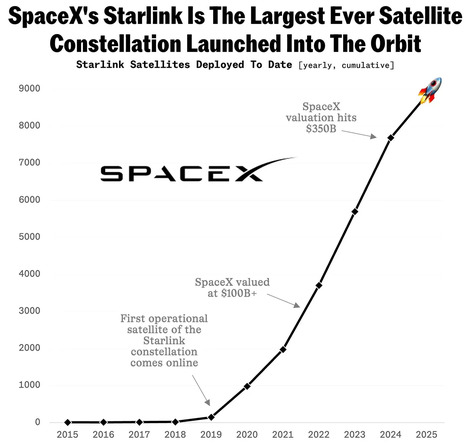
Satellite connectivity is scaling aggressively. SpaceX’s V3 satellites and Starship launches will soon drive a 10x capacity increase, while recent regulatory shifts have elevated Starlink from a vendor to a sovereign spectrum holder. Concurrently, Amazon’s acquisition of Globalstar gives the hyperscaler direct access to Apple’s D2D consumer market. Far beyond eliminating dead zones, this JV marks a high-stakes power struggle between legacy Tier-1 operators and vertically integrated space titans for the control of next-generation communications.
|
|
Scooped by
Beeyond
May 14, 9:37 AM
|
A Tier One telco threw me an “acid test” question today. The question was much sharper: “With around 10,000 satellites in orbit today, how many fixed broadband households can Starlink actually support? 20 million, 30 million, 100 million?” That question is important because it is not about coverage but about damage. Fixed and cable players do not lose sleep because Starlink can draw a coverage map over the planet; they lose sleep if Starlink can take paying broadband households at scale without destroying its own quality.
|
|
Scooped by
Beeyond
May 10, 5:34 AM
|
For over a decade, the telecommunications industry has been running away from its own identity. We were told that being a “pipe” was a death sentence, leading many Telcos to pursue other ventures rather than remain Telcos, while neglecting the engineering masterpiece beneath their feet. But as Kim Krogh Andersen (Product and technology from Telstra) recently highlighted at TM Forum, the tides are shifting. His message was a refreshing wake-up call for the industry: The network is not a commodity to be hidden; it is the product itself.
Switching our mindset from “providing access” to “selling a programmable product” is the most significant architectural and cultural pivot of this generation. It’s an admission that our 99.999 % reliability is not just a utility but a high-performance engine that, if properly exposed, can power the next era of the Inference Economy. Based on Andersen’s insights and the emerging shift toward AI-native architectures, I have identified 10 concrete aspects that define what it truly means to treat your network as a product.
|
|
Scooped by
Beeyond
May 8, 1:41 PM
|
The Telecom Operations Management Market is projected to grow from USD 9.8 billion in 2024 to USD 32.6 billion by 2035 at a 12.8% CAGR, driven by the mass-market adoption of AI-powered OSS across telecom network operations, the expansion of 5G service assurance into real-time performance monitoring, and the proliferation of cloud-native operations platforms that directly reduce network downtime and improve customer experience.
|
|
Scooped by
Beeyond
May 8, 10:09 AM
|
Telecom operators are under pressure from rising costs, customers who expect instant digital service, and competitors that can launch faster. Many operators assume they must finish large-scale modernization before AI can deliver value. In practice, that sequence is too slow. The same legacy complexity that blocks transformation is also where AI can help first.
A better approach runs AI and modernization in parallel. Well-scoped AI agents can take on targeted work—like confirming orders or triaging tickets—while highlighting the exact bottlenecks to fix next. When agents repeatedly stall or escalate, it often points to broken handoffs, conflicting rules, missing data, or fragile integrations.
|
|
Scooped by
Beeyond
May 8, 10:07 AM
|
After more than a decade of accelerated deployment, fibre is no longer a growth-at-any-cost infrastructure story. Returns are now determined by monetisation, capital discipline and the ability to generate contracted cash flows. This represents a shift in the investment thesis, which is playing out in different ways for fibre-to-the-home (“FTTH”) and B2B fibre.
|
|
Scooped by
Beeyond
May 7, 2:49 PM
|
Direct-to-cell works by turning Starlink’s low Earth orbit satellites into something that behaves, from your phone’s perspective, exactly like a terrestrial cell tower. No special hardware. No firmware update. No new SIM card. Your existing LTE smartphone connects to a satellite orbiting roughly 340 miles overhead as if it were pinging a tower down the street.
The implications are profound. The entire value chain of terrestrial telecom — land acquisition, tower construction, power systems, ground maintenance, spectrum auctions — gets replaced by a constellation that scales globally from a single launch facility. There is no permitting fight. There is no easement negotiation with a reluctant landowner. There is no multi-year deployment timeline.
|
|
Scooped by
Beeyond
May 7, 2:46 PM
|
5G is the future of connectivity, but it comes at a massive cost. Telecom operators worldwide are spending billions to roll out this new network, and the price tag is staggering. From upgrading existing sites to buying spectrum, every step requires careful financial planning. In this article, we break down the real costs behind 5G infrastructure and what telcos are paying. If you are an investor, business owner, or simply curious about 5G economics, this guide will give you a clear picture of what’s happening.
|
|
Scooped by
Beeyond
May 7, 3:21 AM
|
By May 2026, SpaceX will have 10,000 satellites in orbit and filings for a million more, yet Newtonian physics remains a total buzzkill. Satellites simply can’t punch through concrete or match the dense urban capacity of a 5G small cell, making “pure” satellite-to-phone a high-end emergency backup rather than a primary mobile service.
So, why the interest in Starlink becoming an MVNO?
Direct-to-Device capacity alone won’t satisfy mobile consumers or enterprises, suggesting Musk has a much larger play in motion. While he isn’t showing his full hand, specific shifts in technology and business roadmaps shed light on Elon’s real endgame for telecommunications. Let’s explore.
|