Did You Know.....The Art Institutes offer degree programs in animation, graphic design, game art & design, game programing and others at dozens of campuses across the US.
So, you’re interested in animation programs in the charming American south? Lucky for you, the region offers a wide range of educational opportunities for future animators, but you might have to look a bit harder at times. That’s why we’ve compiled our own list of 20 southern schools worthy of your attention.
Comparing programs can be akin to comparing apples to oranges, but we’ve tried to provide you with a solid list of programs that touch every area of animation. Mind you, when it comes to landing your first- or fifth- industry job, studios will first and foremost look at the applicant’s portfolio and personality. An education should provide you with the foundation you need to thrive.
Click headline to read more and access hot links--
It’s YouTube’s fault, the $7.99 I just sent to England. There I was, minding my own business, just looking for a clip from Doctor Who to send to a friend, when I noticed the sponsored video results at the top of the search page:
Screen Cap of YouTube page--
The reason that top result popped up on my Doctor Who search is that the named Much Ado stars, David Tennant and Catherine Tate, had previously worked together on Who. As a fan of both actors, I’d heard about the production, but as I tragically do not live in London, I didn’t think I’d ever get to see it. That was because, until this week, I had never heard of Digital Theatre, which makes “the best of British theatre” (according to its tagline) available to the rest of the world for digital rental or download.
Founded in 2009, Digital Theatre currently hosts 13 full-length filmed productions (plus educational resources) that represent a range of contemporary and classic works, including Into the Woods, The Royal Shakespeare Company’s Comedy of Errors, and The Container, a play performed inside a shipping container .
The default pricing is for British pounds, though a pull-down menu switches that to American dollars or Euros; streaming rental prices range from $3.49 to $7.99, while HD downloads are available for $10-$17.99 — essentially comparable to the same rates Apple charges for films on iTunes.
(Pro-tip: Even if you’re in the UK, try to buy with American dollars — for some reason the British pricing, by current conversion rates, is a bit more expensive.)
Once I’d signed up for a Digital Theatre account, paying for a 48-hour rental of Much Ado was relatively simple, though the actual technology was rather disappointing: The stream was only available via a crude browser-based Flash player, meaning that I couldn’t stream using iPad or iPhone, and the Adobe Air desktop player was a clunky experience, especially when trying to skip forward or backwards. This is what happens when you spend Apple-level dollars — you expect an Apple-level experience.
Our understanding of what constitutes "a new culture of learning" requires us to share several basic assumptions about the world and how learning occurs.
First and foremost is the realization that,
The world is changing faster than ever and our skill sets have a shorter and shorter life.
Strategies which resist or even adapt to a constantly changing world are insufficient to keep up. We need ways to embrace change and even enjoy making sense out of a constantly changing work.. Denying change has become a losing strategy.
We need to fundamentally rethink learning and strive for ways to amplify learning and make it scalable.
Understanding play is critical to understanding learning.
Beginning this fall, The Wharton School at the University of Pennsylvania will host the first ever MBA-course on gamification as it applies to business. The class will be taught by Kevin Werbach, a professor of Legal Studies at the Wharton School, and Dan Hunter, a professor at New York Law School.
They are supporting the course with an invite-only symposium, “For the Win“, which kicks off today and is bringing together many top experts in order to discuss the shape of the field as it stands and where gamification will be heading in the future.
In the next stages, the organizers hope that “For the Win will become a valuable resource for information and discussion about gamification,” and the website will host content from the symposium as well as from the fall course. To have Wharton–which consistently ranks in the top-3 business schools in the country–backing gamification and considering its implications in business and beyond demonstrates the disruptive shift caused by game thinking and game mechanics.
Be sure to check back for more on the symposium as well as other cutting edge developments in gamification.
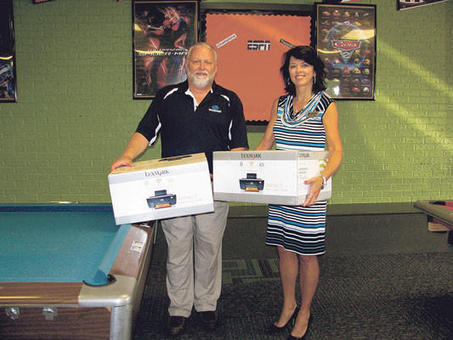
Connected Tennessee recently donated four new printers to the Rutherford and Bedford County Boys Girls Clubs. Two printers were presented Friday to each club as a part of a donation made by Lexmark International to the Computers 4 Kids (C4K) program. Kentucky-based Lexmark provided a total of 250 printers to the C4K program that will be distributed to Boys Girls Clubs across the state over the coming weeks.
Connected Tennessee has partnered with the Boys Girls Clubs in Tennessee since 2010 as a part of the Computers 4 Kids: Preparing Tennessee’s Next Generation for Success project. The C4K program deploys computers, academic support programs, and workforce training to two disparate, but especially at-risk, populations: those in the state’s foster care system who are “aging out” as they turn 18, and youth who are active in the state’s 76 Boys Girls Clubs.
The American Recovery and Reinvestment Act-funded program will impact the lives of nearly 60,000 youth across the state throughout the life of the grant — providing a helping hand to youth that are working hard to attain a better life for themselves.
Earlier this year I wrote a post about Hackerspaces and Makerspaces, after attending the Computers in Libraries conference in Washington. I met up with Buffy Hamilton for lunch, and as ever was inspired with the responsive way she grabs an initiative and runs with it.
So I wasn’t surprised to find Buffy writing Makerspaces, Participatory Learning, and Libraries where she ‘nailed’ the opportunity.
Now here she is, putting forward the New Chapter for 2012-2013 proposal for A Makerspace Culture of Learning at the Unquiet Library. Love it!
In a sense, this is not a new concept at all, particularly for primary schools, as kids are hands-on and experimental in their classroom experiences. What I particularly find attractive about makerspace culture is that it responds to, and perhaps acts as a counterfoil to the gamification/gaming momentum that is somehow almost seen as the only response to innovation and change in schools.
Hackerspaces and makerspaces provide outstanding opportunities for synergy in our new learning environments.
Click headline to read more and watch slide show presentation--
Yesterday HTINK opened the doors to a brand new pop-up makerspace for kids: The NYC Makery. As a group of makers and educators who are passionate about spreading the joy of making, we have been itching to open a makerspace for kids for the past few years.
Finding an affordable space in New York City has proven to be our biggest hurdle. So a few months ago we decided to start with a pop-up model as a way to begin sooner, build a community, and figure out what works, and what doesn’t, in a makerspace for kids. Our hope is that through setting up a series of temporary makerspaces and holding making workshops in different communities all around New York City, we will learn through an iterative process and discover the best practices for setting up a makerspace geared especially towards young people.
Increasingly, the school library/media/information specialist has become an important key player in helping students understand the limitations of the Internet and sites such as Wikipedia. Unsuspecting students believe Google, the web, and Wikipedia are THE encyclopedias with ALL of the answers. As we all know, nothing could be further from the truth. (In 2009, a student posted a fake quote on the Wikipedia site of music composer Maurie Jarre, and several news organizations mistakenly used the quote in Jarre’s obituary.) “The flaws in Wikipedia, and other kinds of media” says Dan Gillmor, director of the Center for Citizen Media, ”demonstrate how much we need to update our media literacy in a digital…era.” (Source)
Several studies have revealed that many of today’s youth don’t question what they find online. In their searching, they often don’t bother to consider anything other than the top (first) result, assuming Google has done their vetting for them. And if it’s a dot com, they’ve reasoned, then it’s unreliable. One recent study finds that most of us distrust the Internet. A UK survey found that one in three 12-15 year olds believe that information on a website listed by a search engine must be truthful. A 2011 report from the University of Southern California’s Center for the Digital Future said while most people rely on the Internet, most still don’t deem the content they see online reliable.
But I am here to suggest that there is another literacy that is just as important, if not more so than information literacy. It is media literacy, and it has been identified as one of the 21st century skills all students need to succeed. Groups like the Partnership for 21st Century Skills, Future Work Skills 2020, and the 2012 Horizon K-12 Report all point to media literacy as a necessary skill to be taught.
Smart Planet has covered the use of 3D printers for everything from new arms for a little girl to real guns. And these are amazing achievements. So it’s only natural that scientists are looking for even bigger things to print.A professor from the University of Southern California has developed a system to print out entire houses with all the fixings including concrete foundation, plumbing and electrical wiring.
Engineering professor Behrokh Khoshnevis scaled up 3D printing so that it can be used to construct buildings by using a process called Contour Crafting.
Contour Crafting is a layered fabrication technology that uses a moveable gantry taller than the house to be built. Walls are built up layer by layer using concrete with automatic reinforcement or plumbing added in the process.
Khoshnevis says current construction methods are slow, labor intensive and costly. With Contour Crafting, houses could be built for a fraction of the cost and in less time. Khoshnevis says that a 2500-square-foot house can be built in approximately 20 hours.
He says the method could be used to construct emergency or low-income housing.
You can listen to Khoshnevis talk about his idea at a recent TEDx event:
Maker spaces —workshop areas that encourage tinkering and creating—and other interactive community spaces have been popping up in unexpected places.
One of the newest homes for these collaborative environments has been in public libraries. Many of these spaces expose young learners to STEM skills, and help kids make the connection between what they learn in classrooms and real-world applications.
The Idea Box, a 9’ by 13’ glass-enclosed space in the Oak Park (Ill.) Public Library, inspires visitors to participate in its rotating installations. According to the library website, changing the Idea Box provides a fresh way to keep visitors engaged.
“Installations vary to reflect the diverse interests in our community. One installation may feature participatory art and culture; another may solicit opinions on an upcoming initiative or library service, or be hands-on, demonstrating new technology,” the site reads.
Past installations have included an exhibition of visitor-created poetry using magnetic words in honor of National Poetry Month, and an open working studio for visual artists. The box has also invited visitors to create their own constellations out of LED touch lights, and contribute to its ever-growing “Post-It Wall.” The library space holds special events, as well, like a photo shoot complete with various backdrops and accessories for visitors to use while taking photos with their library cards.
“It’s like a pop-up shop of creative surprises,” wrote Zachary Slobig in a recent write-up in Good Magazine.
Slobig also discussed the maker space at the Westport Public Library in Connecticut. Inspired by a local maker faire, the space has its very own Maker-Bot Replication—a 3-D printer library-goers can use to “print” the tools used within the space. Patrons can also help the library’s resident maker, Joseph Schott, build two airplanes that will hang from the library ceiling.
Click headline to read more and watch the video clip--
When was the last time you went to the library looking for a book? How about a 3D printer? The Fayetteville Free Library, a public library in upstate New York, plans to offer its community both options: A traditional, book-filled library, and a Fab Lab to learn new technologies and build new projects.
In recent years, the FFL’s Executive Director Susan Considine has been pushing for a reinterpretation of libraries’ role.
“Libraries exist to provide access to opportunities for people to come together to learn, discuss, discover, test, create. Transformation happens when people have free access to powerful information, and new and advanced technology."
This forward-thinking attitude has helped the FFL continue to grow, adding an AV-enabled meeting room, tutoring spaces and even a coffee shop. In 2003, the FFL moved its expanding facilities into a disused furniture factory. Soon, the east wing of that building will become one of America’s first free, public-access maker spaces.
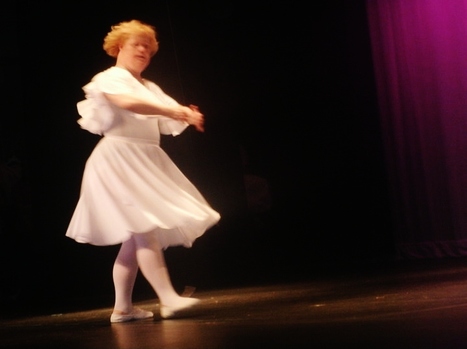
For many years, Delight Lester, her teaching staff and the students of Arts In Motion Studio have been a unique and inspiring part of the East Hills/Eastown arts community and beyond, performing at festivals and community and private events all over West Michigan.
You may have seen them at the Grand Rapids Festival for the Arts, in years past, the Arts in Ada Festival, the St. Patrick's Day Pet Parade and Street Party in East Hills, or the ArtPeers Fall Festival of 2011. You also may have seen them taking a walk in the East Hills area some afternoon when the weather's nice.
They are a group of students with physical, mental, and emotional disabilities who learn and practice dance, visual arts, drama, and music in classes that emphasis the inherent creative talent of everyone who participates.
Facilitated by AIM staff, the students are encouraged to participate in the design, organization, and presentation of everything they do on whatever level they are able.
Access Humboldt hosting Mozilla Ignite event - "Eureka Idea Jam!"
On Monday August 20, 2012 from 4:30pm to 6:00pm, Access Humboldt is hosting "Eureka Idea Jam" a local event that is part of a national project called Mozilla Ignite. https://mozillaignite.org/
"Mozilla Ignite is an open innovation challenge hosted by Mozilla and the National Science Foundation as part of the US Ignite initiative. The goal: imagine and build apps that show the full potential of next-generation networks, in areas that matter -- like healthcare, education, energy, manufacturing and public safety."
The "Eureka Idea Jam" will be an informal brainstorm session - gathering ideas about future possibilities. We'll consider some big fun questions:
What would you do with an Internet without limits?
How can next-generation apps change the world?
Come to Access Humboldt's "Eureka Idea Jam" and share your ideas!
There are plenty of different 3D printers to choose from these days, from the popular Makerbot Thing-O-Matic to the budget-priced Solidoodle. These all have one drawback however in that they aren't exactly portable. Most need to be disassembled to be moved and even the fully-assembled Cubify printer isn't really built for travel. But now, two MIT students have developed the PopFab, a machine that does 3D printing and more, all while fitting inside a small suitcase.
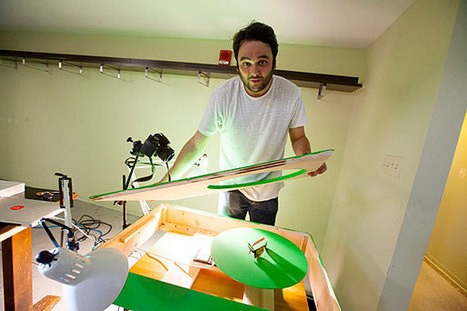
The PopFab was developed by students Ilan Moyer and Nadya Peek, from the MIT CADLab and MIT Center for Bits and Atoms respectively. Billed as a "portable fabrication multi-tool," the machine was revealed through an online video showing the whole device folding out from a metal briefcase and almost immediately printing a small object after a bit of setup. All it takes is to attach the printing head to the fold-out arm, feed in some printing material, and connect a computer to transmit a design.
Earlier this year, here, I wrote about the possibilities of school-based digital learning and the challenges that inequitable access to technological resources and skills pose to those possibilities.
Since then, the Broadband Rhode Island Digital Literacy program has gotten off the ground. Found online at http://literacy.broadband.ri.gov/, the BBRI Digital Literacy program aims to educate Rhode Islanders who lack access to and information about technology through a freely available curriculum, volunteer instructors, and face-to-face classes based in communities and locations where the need for digital literacy education is highest.
You may want to take a class, become an instructor, or connect an organization that you’re a part of with BBRI‘s work. I am not currently involved personally, but think that the initiative is a great addition to our state’s education resources. Check it out and help spread the word.
The course "Gamification" by Associate Professor Kevin Werbach from the University of Pennsylvania, will be offered free of charge to everyone on the Course platform.
Click headline to watch the YouTube video and sign up for the online course--
As part of our makerspace initiative this year (please see this blog post and this slidedeck here) and inspired by the work of the Sacramento Public Library, one of my focal points is thinking about ways the library can support creating communities of readers and writers who are crafting and composing texts (and I use the term text rather liberally).
The Sacramento Public Library Winter 2012 "Write at iStreet Press" writing and publishing catalog offers a model of what the library as a makerspace for constructing texts looks like in a community through the public library. Possible topics I’m interested in offering as “lunch and learn” sessions or after-school sessions could include (but are not limited to!):
--Creative writing (memoirs, poetry, short stories, novels) and writer’s craft
--Self publishing options (print as well as eBook/eInk)
--Academic writing
--Digital and/or multimodal composition
--Multigenre writing
--Storytelling
Click headline to read more and access hot links--
The concept of libraries as makerspaces first hit my radar last November when I read about the Fayetteville Free Library’s FabLab. As I began hearing more buzz about libraries and makerspaces the first few months of this year, I decided that learning more about this concept and exploring how I might apply the elements of makerspaces to my library program would be a personal learning project for the summer.
So what is a makerspace? Makerspace defines it as:
'Modeled after hackerspaces, a makerspace is a place where young people have an opportunity to explore their own interests, learn to use tools and materials, and develop creative projects. It could be embedded inside an existing organization or standalone on its own. It could be a simple room in a building or an outbuilding that’s closer to a shed. The key is that it can adapt to a wide variety of uses and can be shaped by educational purposes as well as the students’ creative goals.'
The Library as Incubator Project describes makerspaces as:
'Makerspaces are collaborative learning environments where people come together to share materials and learn new skills… makerspaces are not necessarily born out of a specific set of materials or spaces, but rather a mindset of community partnership, collaboration, and creation.'
During a crowded reception at Harvard’s Arts @ 29 Garden, Travis K. Bost, M.Des.S. ’12, reached toward a small shelf of books and removed a green volume.
Choosing a book happens all the time at a University with more than 70 libraries, 17 million volumes, and miles of shelves. But it was also a larger act: Bost had designed the shelf, which was fitted with a microcontroller and photocells, to show information about the book being removed. When he picked out William Cronon’s “Nature’s Metropolis,” a computer screen flashed related information, including naming books by the same author.
Bost’s invention, which is still in the “proof of concept” stage, was on display at openLAB_Summer, an Aug. 9 showcase sponsored by metaLAB (at) Harvard, a Kirkland Street collaborative research laboratory under the umbrella of the Berkman Center for Internet & Society. Organizers called the dozen offerings on display “summer projects and propositions, experiments and explorations.”
Click headline to read more and access hot links--
One of the most striking quotes that came out of this year’s Professional Colleges and Universities Summit came from Frank Mulgrew, the President of the Online Education Institute at Post University. During his presentation on the next generation of online learning environments, Mulgrew stated that “the lecture does not work”at professional colleges and universities.
Though we often take lectures for granted, it’s important to remember how commonplace they are in higher ed, to recognize the implications of Mulgrew’s bold statement. If lectures “do not work,” then every day, thousands of professors in lecture halls across the country are ineffectively educating their students. With that in mind, how did Mulgrew come to this thought-provoking conclusion?
He began by explaining the difference between passive and active learning. Face-to-face lectures are considered passive because the learner simply sits and listens to the instructor without actively participating in the learning and teaching process. Mulgrew went on to argue that the part of our brain used to receive information in lectures – and to retrieve that information later – is weaker than the part of our brain that participates in more active learning. Examples of active learning include group discussions or experienced-based learning that allows students to take ownership of their education and actively participate in the classroom.
Over a dozen teams of entrepreneurs and students worked feverishly all summer in Chattanooga, Tenn.’s GigTank startup accelerator to develop gigabit apps that showcase the power and practical value of the country’s largest gigabit network. On Thursday, more than 500 techies, financiers and business mavens gathered to see the fruits of this year’s “summer camp for geeks.”
The premise was simple. Recruit nationally and internationally to select eight two-to-four-person teams of entrepreneurs and 11 students who formed their own teams. Offer $150,000 in cash prizes as the reward. Turn the teams loose in two- and three-month pressure cookers of accelerated application development.
In a process one participant described as a cross between Survivor and American Idol, we saw two primary outcomes. GigTank unleashed great creativity tempered by a real-world gigabit environment, and it’s helping people understand that apps don’t have to require a gig to benefit from a gig network.
It’s been a hit at the Harold Washington Library in Chicago, and now it’s spreading.
YOUmedia are learning spaces where kids explore, express and create using digital media, and then hook what they learn there back into the classroom. Expanded learning, experiential learning, student-centered learning—whatever the term, YOUmedia’s core philosophy is that youth are best engaged when they’re following their passions, collaborating with others, and creating instead of passively consuming culture.
YOUmedia is the brainchild of researchers in the MacArthur Foundation’s Digital Media and Learning initiative. The idea was to create a public space where teens and pre-teens could come and learn about digital media from practitioner/mentors via a process that involves “hanging out,” “messing around,” and “geeking out.”
In other words, kids come into the space to play video games with their friends, move on to, say, borrowing a podcasting microphone, and end up learning how to do sound engineering. They then use those skills to re-imagine and remix “Neverwhere,” a book by Neil Gaiman, or remix a jazz classic. In doing so, they gain a new appreciation for literature or music that may engage them in new ways in the classroom.
The design of the space is deliberate. It’s grounded in the experiences of an innovative afterschool project, Digital Youth Network, that Nichole Pinkard, associate professor in the College of Computing and Digital Media at DePaul University, had designed in Chicago, as well as the work of Mizuko (Mimi) Ito, a cultural anthropologist at University of California, Irvine, whose study of 700 youth uncovered the “hanging out,” “messing around” and “geeking out” process of learning and engagement.
When it debuted at the Harold Washington Library in July 2009, YOUmedia was a radical idea—a library space that wasn’t only about books, that was rambunctious, that embraced social networks and video games. Three years later, there’s a new wave of similar ventures springing up at community centers and museums as well as libraries.
Hackerspaces are place-based collectives where individuals learn through socialization, tinker with technology, develop skills and pool technical resources.
But what’s holding them together and moving them forward?
Here are a few central themes drawn from my research in a western context that I am exploring, and would be particularly curious to explore internationally:
IAE is working in an emerging market. Our focus on developing one’s motivation, curiosity, optimism and the thinking skills needed to (for ever more) live life as a self-sustaining creative, as well as be able to teach others how to use our skills to fuel economic growth and innovation across sectors, is still a pretty novel idea.
While nationally there are 904,581 businesses in the U.S. involved in the creation or distribution of the arts that employ 3.34 million people, we need more of them who can help others (re)fuel our economy. As a result of our own fragmentation and inability to sustain ourselves, as a collective group, the creative sector has had trouble articulating our value proposition to others. While nationally the nonprofit arts and culture industry generates $166.2 billion in economic activity annually—a 24 percent increase in just the past five year, ( Americans for the Arts: Arts and Economic Prosperity Study III) artists continue to struggle to find the space, grants and income they need to become more visible in other sectors and valued. (LINC:Artists and the Economic Recession)
So how do we bridge this gap?
A friend of mine, Benjamin Sugar, helped me realize that a bridge to fill this gap exists in Maker Spaces- or what some refer to as hackerspaces. Both hackerspaces and Maker Spaces are community-operated physical places where people can meet and work on their projects. The run often like clubs or gyms with memberships from $70 to 125 dollars per month. “Each has a unique flavor of their neighborhood and reflect members needs and interests” Benjamin told me. Profits are reinvested into the maker space through the purchase of new tools, supplies, machinery or equipment for each area of member interest.
To get content containing either thought or leadership enter:
To get content containing both thought and leadership enter:
To get content containing the expression thought leadership enter:
You can enter several keywords and you can refine them whenever you want. Our suggestion engine uses more signals but entering a few keywords here will rapidly give you great content to curate.


 Your new post is loading...