Your new post is loading...
Between now and the end of the century, climate change will trigger a cascade of rapid, irreversible environmental changes that will make it impossible for people to establish a sense of place, writes Frederick Hewett.
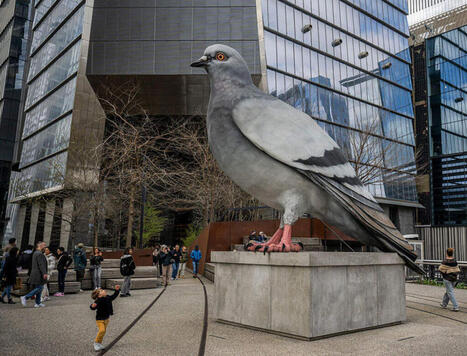
"Pigeons are having a moment,” I tell my friend. “Tove,” she kindly says, “I think that’s just your algorithm.” When I scroll through my Instagram feed, I see a video of someone putting makeup on to look like a pigeon. Then there’s a pigeon using a water bottle refilling station to take a nice little bath. An illustrated ode to pigeons. Someone dresses up like a pigeon and visits New York City’s “pigeon house.” There’s a gigantic pigeon sculpture on display at The High Line through spring 2026. PBS just aired a new documentary called "The Pigeon Hustle,” which reveals the secret world of urban pigeons. I heard about the documentary on social media, too. And, yes, it does appear that over half of the pigeon videos I’ve been watching were “suggested posts” — not content from people I follow. The algorithm has correctly deduced that I will stop scrolling to watch if there’s a pigeon on the screen. Yet I also wonder if the algorithm itself is behind my love of pigeons.
Legal challenges put SAVE borrowers in limbo for months, a time during which they were not required to make payments on their loans. That would change if the proposed settlement is approved.
This year's federal aid form is new and improved. But it came three months later than normal, and in its first week, online access has been unpredictable.
What is at stake is far more than a rejection of gangster capitalism and the global misery it produces. The deeper danger lies in recognizing that education has become the primary battlefield in the cultural and ideological wars waged by authoritarianism. Neoliberal capitalism, in its fascist mutation, does not simply impoverish; it seeks to colonize consciousness, to erode the capacity for critical thought, and to replace democratic imagination with the deadening certainties of hierarchy and fear. Universities now sit at a dangerous crossroad where truth is contested, civic memory is either erased or preserved, and the formative conditions for democratic life are nourished, or systematically destroyed. To defend higher education, then, is to reclaim its power to cultivate the forms of agency, solidarity, and critical awareness necessary to challenge the lies, brutalities, racism, corruption, and manufactured ignorance that sustain authoritarian rule.
My work connects to the concept of cultural war primarily as a cultural critic and academic who writes about representation, identity, and the role of art and technology in challenging the status quo. For Art21 I examined the “American Culture Wars” of the 1980s and 1990s, which were fought over issues of identity politics and the exclusion of underrepresented minorities in the arts: "[C]ulture wars are intellectual, political, religious, and/or social conflicts over cultural pluralism in Western societies. Culture wars have polarized Americans over social issues such as race and representation, education..." The theme of my essay was multiculturalism that offered a distinct culture war fought over issues of exclusion and identity politics. By the 1990s, multiculturalism had become an all-purpose word that evoked a range of meanings and implications. However, with the back-to-back elections of President Barack Obama, the U.S. entered an illusory period of “post-racialism” when the decades-old fight for inclusion and racial equity was side-lined. Many people bought into the idea that racial prejudice no longer existed or was no longer seen as a major social problem. In reality, there was a movement growing in power to dismantle civil rights legislation and affirmative action through litigation and policy changes. Some might say that post-racial backlash led to the election and re-election of Trump.
In American high schools, many teenagers are assigned few full books to read from beginning to end — often just one or two per year, according to researchers and thousands of responses to an informal reader survey by The New York Times.
GAZA CITY—On December 1, Mohammed Hossam Ashour stood inside one of the two remaining buildings of Islamic University in Gaza City. A 19-year-old information technology major, he was attending in-person lectures for the first time in two years after the university resumed classes in late-November. “We are happy to be beginning our return to something of a normal life, even if in a small way, to be returning to in-person learning after having been absent for more than two years because of the war the Israeli occupation waged against us,” Ashour told Drop Site News. “Despite the challenges, and despite the fact that more than 90 percent of the buildings at the Islamic University have been destroyed, the university still repaired and restored the buildings that could be used for teaching and made them available for the students so they could attend their lectures and come regularly to Islamic University.” Like every other university in Gaza, Islamic University was targeted by the Israeli military during its genocidal assault. Once one of the largest universities in Gaza, with about 17,000 students before the war—60 percent of them women—nearly every building on the campus is now a bombed-out, hollow shell. Many of the roofs are pancaked in and the auditoriums have been gutted and burned. Hundreds of displaced families have set up tents in the rubble-filled courtyard and sought shelter in lecture halls and classrooms.
The Geminids are particularly spectacular because of the amount of meteors people can see. When stargazing from a dark location, sky gazers can expect to see a meteor every minute or so during the peak.
I learned about this on an online forum, but I found it interesting. Here’s a description from the YouTube description… Recorded on September 24, 2025. NCompass Live - https://nlc.nebraska.gov/ncompasslive/ Special monthly episodes of NCompass Live! Join the NLC’s Technology Innovation Librarian, Amanda Sweet, as she guides us through the world of library-related 'Pretty Sweet Tech'.…
From 400-year-old globes to cosmic funeral shrouds, how the Osher Map Library in Maine shows people that maps aren't just for navigation — but windows into history, culture, and how we see the world.
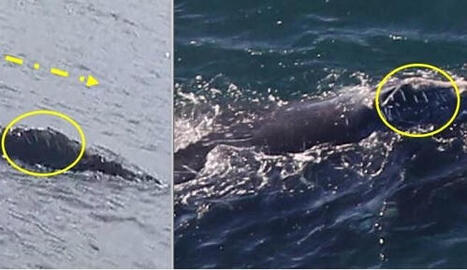
BOSTON – The New England Aquarium says researchers have discovered that a North Atlantic right whale recently sighted in Massachusetts waters is the same individual reported off Ireland last year, …
Education program sponsored by Shell’s Queensland Gas Company is ‘climate obstruction dressed up as education’, advocacy group says
|
Recently, for reasons both generational and chronological, I find myself looking back at people who have helped shape my life, writes David Tanklefsky. Some of them know their impact, but not all.
Students are using AI tools more than ever. An Angelo State University professor designed a way to figure out if his students were using artificial intelligence on a recent paper. We speak with Will Teague, who says students are sacrificing their own agency to artificial intelligence.
The department said recalling these fired staffers would "bolster and refocus" civil rights enforcement "in a way that serves and benefits parents, students, and families."
In both parties, the share that say the higher education system is going in the wrong direction has gone up by at least 10 percentage points since 2020.
Only five of the agency’s civil rights offices remain nationwide. Those who are still with the department say it will now be “virtually impossible” to resolve discrimination complaints.
The artwork had been hanging at San Francisco International Airport for months, largely unnoticed by the crowds streaming through Harvey Milk Terminal 1. But a social media post this week changed everything. A digital portrait series by Boston-based artist and educator Nettrice Gaskins, featured in SFO Museum’s “Women of Afrofuturism” exhibition, has unexpectedly become the latest flashpoint in an intensifying debate over artificial intelligence and the future of creative work. Though the show opened in May, it only recently came under scrutiny after a video uploaded to the Bay Area subreddit circulated widely, drawing thousands of comments — many sharply critical of the airport’s decision to display AI-generated art. The controversy comes at a moment of broader unease across the creative economy.
French marine archaeologists have discovered a massive undersea wall off the coast of Brittany, dating from around 5,000 BC. They think it could be from a stone age society whose disappearance under rising seas was the origin of a local sunken city myth. The 120-metre (394ft) wall – the biggest underwater construction ever found in France – was either a fish-trap or a dyke for protection against rising sea-levels, the archaeologists believe. When it was built on the Ile de Sein at Brittany's western tip, the wall would have been on the shore-line – between the high and low tide marks. Today it is under nine metres of water as the island has shrunk to a fraction of its former size.
Between September and November, 2.41 inches of rain fell -- more than what typically falls in the desert landscape in one year. An ancient lake that once existed at Death Valley National Park has reemerged after record rainfall in the region. Several inches of water have formed in Badwater Basin, which lies at 282 feet below sea level, the lowest point in North America, according to a press release from the National Park Service. During the Ice Ages, the basin -- colloquially known as Lake Manly -- was once a lake with depths of up to 700 feet.
To see the works by one of the top virtuoso portraitists of the 20th century, drop into the home that Nicolai Fechin designed and built for his family in Taos, New Mexico. Masterful oil and charcoal portraits created throughout his life are hung in quiet, contemplative corners of his spectacular 1920s home as part of Masterful Expression: Nicolai Fechin’s Portraiture, on view at the Taos Art Museum at Fechin House through December 31, 2025. The house itself is a masterwork with all the doors, railings, and embellishments carved by Fechin’s own hand, but the portraits and small, carved wooden busts show why he is considered one of the greatest Russian artists ever to take up residency in the United States.
GOP funding cuts mean that more children will grow up with the lifelong implications of untreated illnesses.
Frank Gehry, the world-famous architect, has died at 96 years old. The designer of the Guggenheim Museum Bilbao in Spain and the Walt Disney Concert Hall in Los Angeles also left his mark on the Massachusetts architecture scene with two recognizable buildings in the Boston area. Gehry designed the Ray and Maria Stata Center, a quirky looking building on the MIT campus in Cambridge that opened in 2004.
Poverty Point, a 3,500-year-old earthen mound located in Louisiana, continues to puzzle archaeologists and historians.
|