Your new post is loading...
University tells philosophy professor to ditch Plato How do you teach a philosophy course on "Contemporary Moral Issues" without talking about race or sex? It's a question that Texas A&M University is forcing philosophy professor Martin Peterson to answer.
Astronomers using Nasa’s Hubble Space Telescope have discovered a new type of cosmic object that is believed to be a “failed galaxy”. Dubbed ‘Cloud-9’, the astronomical curiosity is a cloud of dark matter 14 million light-years from Earth that contains no stars. It is the first time that such an object has ever been detected, and could improve scientists’ understanding of the early universe and the nature of dark matter. “This is a tale of a failed galaxy,” said Alejandro Benitez-Llambay from the Milano-Bicocca University in Italy, who is the program’s principal investigator.
Dorota Skowronska-Krawczyk sits in her office, eyes fixed on the computer monitor in front of her. "You see it move its eye," says the UC Irvine associate professor of physiology and biophysics, pointing to an image of a Greenland shark slowly drifting through the murky Arctic Ocean. "The shark is tracking the light—it's fascinating."
A recent DNA analysis on 777 ancient genomes from across the so-called Southern Arc, namely Southern Europe and West Asia, redirects the cradle of Indo-Europeans and sheds light on the Proto-Greek prehistoric past. As is well known, the Greek language belongs to the Indo-European language family, and, as far as the latest genetic analysis shows, the area of Greece is highly significant in terms of this language family’s origin and its dispersal throughout other areas—yet, what does new DNA research say about Proto-Greek speakers and the first Indo-Europeans?
Most of the exoplanets we’ve discovered have been in relatively tight orbits around their host stars, allowing us to track them as they repeatedly loop around them. But we’ve also discovered a handful of planets through a phenomenon that’s called microlensing. This occurs when a planet passes between the line of sight between Earth and another star, creating a gravitational lens that distorts the star, causing it to briefly brighten. The key thing about microlensing compared to other methods of finding planets is that the lensing planet can be nearly anywhere on the line between the star and Earth. So, in many cases, these events are driven by what are called rogue planets: those that aren’t part of any exosolar system at all, but they drift through interstellar space.
Some 9,500 years ago, a community of hunter-gatherers assembled to cremate a small woman in a ceremonial pyre at a rock shelter near Mount Hora in Malawi. Millennia passed. Many things happened. And now, at the dawn of the year 2026, scientists report the unearthing of the ashy remains of this ritual at a site, called HOR-1, which is "the oldest known cremation in Africa” and “one of the oldest in the world,” according to their study. “Archaeological evidence for cremation amongst African hunter-gatherers is extremely rare, with no reported cases south of the Sahara,” said researchers led by Jessica I. Cerezo-Román of the University of Oklahoma. “Open pyre cremations such as that at HOR-1 demand substantial social and labor-intensive investment on behalf of the deceased. Thus, cremation is rarely practiced amongst small-scale hunter-gatherer societies.”
A friend of mine, Frederick Pilot, recently asked me an interesting question. Is digital literacy that comes from using a smartphone the same as digital literacy from using a computer? It’s a great question, because the majority of Internet users in the world only have broadband access through a smartphone. In developing nations, 90% of broadband users only have access to a smartphone. In the U.S., 16% of adults only use a smartphone to reach the Internet.
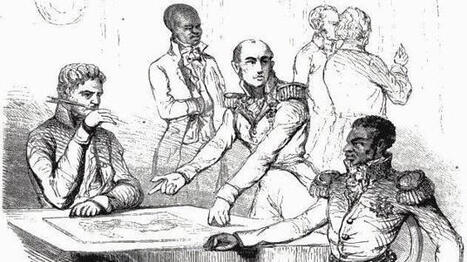
Haiti is one of the poorest nations in the world, and rich countries have their fingerprints all over the nation's stunted development.
WASHINGTON, Dec. 30, 2025 – Library and education advocates urged the Federal Communications Commission Tuesday to reconsider its rollback of federal support for off-campus Wi-Fi hotspots and school bus connectivity. The filings respond to petitions for reconsideration of the FCC’s Sept. 30 order rescinding earlier decisions that had allowed schools and libraries to use E-Rate funds for hotspot lending and Wi-Fi on school buses.
Ashlie Crosson was named the 2025 National Teacher of the Year for the Council of Chief State School Officers. A first-generation college student, she teaches English and journalism in rural Mifflin County, Pennsylvania, where she also grew up. Our conversation below covers the importance of a global education in rural schools, the value of school journalism programs, and the pleasures of returning home.
The Supreme Court’s inaction hands governments new power to pull titles, and puts Americans’ First Amendment rights at risk. Imagine that you decided to go to your local library to check out a book but you couldn’t find it on the shelf. You ask the librarian for help locating it, but they inform you it’s not available—not because someone else has checked it out, but because the government has physically removed it after deciding they don’t want you to read it. This isn’t the plot of a dystopian novel, it’s the reality that the U.S. Supreme Court has allowed in its recent decision to not hear arguments in the book ban case: Leila Green Little et al. v. Llano County. In leaving the Fifth Circuit ruling in place, SCOTUS effectively granted state and local governments in Louisiana, Mississippi, and Texas the authority to determine what materials you can and cannot read. This means people in these states do not have the same First Amendment rights as the rest of the country. And that should raise alarm for everyone.
The story of the Jutes in Britain is an often overlooked chapter in the island’s early Dark Age history. While the Angles and Saxons tend to dominate narratives of post-Roman Britain, the Jutes played a significant role in shaping the cultural and political landscape of what would eventually become England. Origins and Migration The Jutes were one of the Germanic tribes that settled in Britain after the departure of the Romans in the 5th century CE. According to the Venerable Bede, an 8th-century English monk and historian, the Jutes were one of the three most powerful Germanic nations to settle in Britain, alongside the Angles and Saxons. Traditionally, the Jutes were believed to have originated from the Jutland peninsula in modern-day Denmark. However, recent archaeological evidence has cast doubt on this assumption. Analysis of grave goods from the period shows strong links between East Kent, southern Hampshire, and the Isle of Wight, but little connection to Jutland. Some historians now suggest that the Jutes who migrated to Britain may have come from northern Francia or Frisia (now the Netherlands) instead.
The Coming of the Saxons Traditional accounts, such as those provided by the 8th-century monk Bede, paint a dramatic picture of the Saxon arrival. According to Bede, the first significant influx occurred in 449 AD, when a British king (possibly named Vortigern) invited Germanic mercenaries to help defend against the Picts and Scots. However, modern historians and archaeologists paint a more complex picture. Evidence suggests that Germanic peoples had been settling in Britain since at least the 3rd century AD, often as Roman auxiliaries. The “invasion” was likely a gradual process of migration and settlement rather than a single, dramatic event. The Saxons, originating from what is now northern Germany and the Netherlands, were one of the main groups of these Germanic settlers. They were joined by the Angles from southern Denmark and the Jutes from Jutland. Together, these groups would come to be known as the Anglo-Saxons, though the term “Saxon” was often used more broadly to refer to all these Germanic settlers.
|
The long read: The president has vowed to kill off ‘woke’ in his second term in office, and the venerable cultural institution a few blocks from the White House is in his sights. On 30 May last year, Kim Sajet was working in her office in the grandly porticoed National Portrait Gallery in Washington DC. The gallery is one of the most important branches of the Smithsonian Institution, the complex of national museums that, for almost 200 years, has told the story of the nation. The director’s suite, large enough to host a small party, has a grandeur befitting the museum’s role as the keeper of portraits of the United States’ most significant historical figures. Sajet was working beneath the gaze of artworks from the collection, including a striking 1952 painting of Mary Mills, a military-uniformed, African American nurse, and a bronze head of jazz and blues singer Ethel Waters. It seemed like an ordinary Friday. Until, that is, an anxious colleague came in to tell Sajet that the president of the United States had personally denounced her on social media. “Upon the request and recommendation of many people I am herby [sic] terminating the employment of Kim Sajet as Director of the National Portrait Gallery,” Donald Trump had posted on Truth Social. According to the post, Sajet was “a highly partisan person” and a “strong supporter” of diversity and inclusion programmes, which by an executive order on his inauguration day, 20 January, he had eradicated from federal agencies. “Her replacement will be named shortly,” continued the message. “Thank you for your attention to this matter!” Sajet is a Dutch-born, Australian-raised art historian in her early 60s. She has platinum blond hair, and wears trouser suits in bright colours and statement spectacles. Her manner is warm and open, but she also projects an air of professional control. When we met in autumn 2025, she seemed so determined not to say anything controversial that I struggled to believe that anyone could consider her radical. She recalled that, after absorbing Trump’s post, she shot a look at her shaken colleague, and asked: “Are you OK?” “It honestly was another day in the office,” Sajet told me. “Truly, I don’t think people realise that as soon as you become a director at the Smithsonian, you are a public figure.” In the 12 years she had been running the museum, members of Congress were constantly questioning displays, she said. A disgruntled painter whose portrait of Trump she had refused to put on display – because, she said, the work was of insufficient quality – had pursued her through the courts for years. But surely, I asked, the president personally firing her on social media was something else? She shrugged, her tough outer coating intact. “I think we can all agree we live in unusual times,” she said.
The emerging field of queer ecology shows how animal behaviors and LGBTQ+ experiences illuminate the ways humans interact with the environment and confront environmental injustice.
Nature is astonishingly diverse. Across the planet’s oceans, forests, grasslands, and cities, living beings interact in ways that defy rigid expectations. Yet when it comes to discussing queer behaviors in the natural world, we often hear only a handful of familiar examples: same-sex penguin couples raising chicks, male seahorses giving birth, or dolphins engaging in nonreproductive sexual behaviors. These stories tend to be framed as quirky anomalies—curiosities that stand out against a supposedly “normal” background.
But nature has never operated according to the human categories of “normal” or “natural.” The emerging field of queer ecology challenges these assumptions and invites us to see the environment, human identity, and ecological justice through a more expansive lens.
The scale and scope of the contemporary art on display is tremendous, but how often do art-seekers also get an opportunity to travel across ancient streets and landscapes, to meet real and fictional historic characters, contemplate fables and real-life stories, and see art of the past and present side by side? It can take days…
Being a reader means cultivating a relationship with the world that, by most standards, can seem pointless and counterproductive. If you read a book in 2025—just one book—you belong to an endangered species. Like honeybees and red wolves, the population of American readers, Lector americanus, has been declining for decades. The most recent Survey of Public Participation in the Arts, from 2022, found that fewer than half of Americans had read a single book in the previous 12 months; only 38 percent had read a novel or short story. A recent study from the University of Florida and University College London found that the number of Americans who engage in daily reading for pleasure fell 3 percent each year from 2003 to 2023. This decline is only getting steeper. Over the past decade, American students’ reading abilities have plummeted, and their reading habits have followed suit. In 2023, just 14 percent of 13-year-olds read for fun almost every day, down from 27 percent a decade earlier. A growing share of high-school and even college students struggle to read a book cover to cover.
In the murky first chapters of the human story is an unknown ancestor that made the profound transition from walking on all fours to standing up tall, an act that came to define us. The odds of stumbling on the fossilised evidence of such an evolutionary prize are slim, but in new research, scientists argue that an ape-like animal that lived in Africa 7m years ago is the best contender yet. After a fresh analysis of bones belonging to a species called Sahelanthropus tchadensis, the researchers concluded that while it resembled an ape, its bones were adapted to walking upright, rather than moving around on all fours. It is considered the oldest known hominin, or member of the human lineage, since the evolutionary split with chimpanzees.
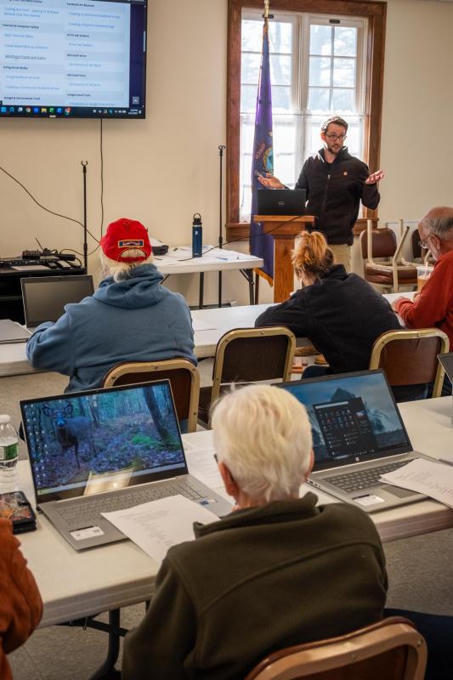
When her teenagers received their first computers in high school, Cindy Moeller joined them evenings and helped navigate homework assignments on the new devices. Later, working as a critical care nurse, she routinely carried a computer and entered codes and notes while working as a liaison between surgeons, hospital medical staff and patients before surgeries. Then the kids grew up and left home, she retired, and she and husband Allan often struggled with newer technology. “We were left floundering,” she says. “Things are changing all the time.”
Exploring ancient people’s shifting beliefs about rearing and eating pigs. Pork accounts for more than a third of the world’s meat, making pigs among the planet’s most widely consumed animals. They are also widely reviled: For about two billion people, eating pork is explicitly prohibited. The Hebrew Bible and the Islamic Koran both forbid adherents from eating pig flesh, and this ban is one of humanity’s most deeply entrenched dietary restrictions. For centuries, scholars have struggled to find a satisfying explanation for this widespread taboo. “There are an amazing number of misconceptions people continue to have about pigs,” says archaeologist Max Price of Durham University, who is among a small group of scholars scouring both modern excavation reports and ancient tablets for clues about the rise and fall of pork consumption in the ancient Near East. “That makes this research both frustrating and fascinating.” Among the most surprising finds is that the inhabitants of the earliest cities of the Bronze Age (3500–1200 BCE) were enthusiastic pig eaters, and that even later Iron Age (1200–586 BCE) residents of Jerusalem enjoyed the occasional pork feast. Yet despite a wealth of data and new techniques including ancient DNA analysis, archaeologists still wrestle with many porcine mysteries, including why the once plentiful animal gradually became scarce long before religious taboos were enacted.
WASHINGTON, Nov. 20, 2025 – A California regulator has formally challenged the Federal Communications Commission’s decision to eliminate E-Rate funding for off-campus Wi-Fi programs. FCC’s September rollback of hotspot and school bus Wi-Fi support is ‘abrupt and unfounded" and "is based on a faulty interpretation of Section 254 of the Communications Act", the CA Public Utility Commission says.
At 17 I was the Santa Claus for the Walkertown section of Hazard. Rick Rosanova, the news guy at Channel 4, was Santa at the new Sears in the old bowling alley in another part of town, Lothair. And Bill Douglas was the city’s main Santa from Backwoods to Big Bottom. He had a $1,000 velvet Santa outfit (in 1968 dollars) with black calfskin boots and jingle bells on a leather strap. His fake beard was combed human hair and in addition to that he could play the harmonica and jig dance. Value add-ons at anyone’s Christmas party. I worked at Palmer’s House of Toys, a more humble operation. I had a belly pillow and a stringy white beard-wig combination that I had to enhance by putting white shoe polish on my sideburns so my hair would not show through the gaps. The outfit was thin red corduroy, and instead of boots I had plastic covers to slip over my shoes to affect an illusion of boots.
Most fossil fans are familiar with the spectacular Jurassic marine reptiles found by Mary Anning along England’s Dorset Coast in the early 1800s, but few are aware that their predecessors – gigantic Triassic ichthyosaurs (250-201 mya)– have been emerging from the central mountains of Nevada’s Great Basin for the last 125 years. A beautiful exhibition – Deep Time: Sea Dragons in Nevada – shines a spotlight on these magnificent extinct creatures, brings them to life through life-size animations, and tells stories of scientific discoveries at the Nevada Museum of Art in Reno through January 11, 2026 The art museum reunites the state’s stunning Triassic marine reptiles from museum collections across North America, and couples this with an engaging walk through 200 years of paleo-art history starring these enigmatic Mesozoic “sea dragons.”
Philosophy majors rank higher than all other majors on verbal and logical reasoning, according to our new study published in the Journal of the American Philosophical Association. They also tend to display more intellectual virtues such as curiosity and open-mindedness. Philosophers have long claimed that studying philosophy sharpens one’s mind. What sets philosophy apart from other fields is that it is not so much a body of knowledge as an activity – a form of inquiry. Doing philosophy involves trying to answer fundamental questions about humanity and the world we live in and subjecting proposed answers to critical scrutiny: constructing logical arguments, drawing subtle distinctions and following ideas to their ultimate – often surprising – conclusions. It makes sense, then, that studying philosophy might make people better thinkers. But as philosophers ourselves, we wondered whether there is strong evidence for that claim.
The story of the Angles and their invasion of Britain is a fascinating chapter in the history of England, marking the transition from post-Roman Britain to Anglo-Saxon England. This tale of migration, conquest, and cultural transformation would shape the destiny of the British Isles for centuries to come. Origins of the Angles The Angles were a Germanic tribe originating from the Angeln peninsula in modern-day Schleswig-Holstein, Germany. Along with their close relatives, the Saxons and Jutes, the Angles were part of the broader group of North Sea Germanic peoples. Archaeological evidence suggests that the Angles had a well-developed society in their homeland, with a mixed economy based on agriculture, animal husbandry, and trade. They were skilled metalworkers and boat builders, traits that would serve them well in their future adventures across the North Sea.
|