Your new post is loading...
The story of the Jutes in Britain is an often overlooked chapter in the island’s early Dark Age history. While the Angles and Saxons tend to dominate narratives of post-Roman Britain, the Jutes played a significant role in shaping the cultural and political landscape of what would eventually become England. Origins and Migration The Jutes were one of the Germanic tribes that settled in Britain after the departure of the Romans in the 5th century CE. According to the Venerable Bede, an 8th-century English monk and historian, the Jutes were one of the three most powerful Germanic nations to settle in Britain, alongside the Angles and Saxons. Traditionally, the Jutes were believed to have originated from the Jutland peninsula in modern-day Denmark. However, recent archaeological evidence has cast doubt on this assumption. Analysis of grave goods from the period shows strong links between East Kent, southern Hampshire, and the Isle of Wight, but little connection to Jutland. Some historians now suggest that the Jutes who migrated to Britain may have come from northern Francia or Frisia (now the Netherlands) instead.
The Coming of the Saxons Traditional accounts, such as those provided by the 8th-century monk Bede, paint a dramatic picture of the Saxon arrival. According to Bede, the first significant influx occurred in 449 AD, when a British king (possibly named Vortigern) invited Germanic mercenaries to help defend against the Picts and Scots. However, modern historians and archaeologists paint a more complex picture. Evidence suggests that Germanic peoples had been settling in Britain since at least the 3rd century AD, often as Roman auxiliaries. The “invasion” was likely a gradual process of migration and settlement rather than a single, dramatic event. The Saxons, originating from what is now northern Germany and the Netherlands, were one of the main groups of these Germanic settlers. They were joined by the Angles from southern Denmark and the Jutes from Jutland. Together, these groups would come to be known as the Anglo-Saxons, though the term “Saxon” was often used more broadly to refer to all these Germanic settlers.
Raise my hands to a fallen sky, I fantasize
Me jumpin’ planets immortalized, I correspond… …But I live in circadian rhythms of a shooting star — K. Lamar, “6:16 in LA” Zeitgeist refers to a defining spirit or mood of a particular period of history as shown by the ideas and beliefs of the time. It’s one of my favorite words and concepts. As a PhD student in 2011 my research investigated a broad, transnational movement of diasporic African people working to attend to the prevailing spirit of an age. Mark Dery coined the term “afrofuturism” to capture this movement in his 1994 essay titled “Black to the Future,” which explored why so few Black Americans wrote science fiction, a genre whose “close encounters with the Other — the stranger in a strange land” seem uniquely suited to the concerns of Black people around the world.
Christmas traditions like stockings and yule logs are beloved parts of the holiday season today, but they actually date back to pre-Christian Europe. Aside from Easter, Christmas is perhaps Christianity’s most sacred date. As a celebration of Christ’s birth, the holiday is often rife with nativity scenes and holy hymns. However, many of the most beloved Christmas traditions actually have pagan roots. Wreaths, mistletoe, holly, and yule logs all date back to pre-Christian times. Mistletoe was sacred to the Druids of the ancient Celtic world, and yule logs may have Baltic or Germanic origins. Even the day we celebrate Christmas, Dec. 25, has nothing to do with the birth of Christ. The Bible never says when Jesus was born — and it likely wasn’t even during the winter. Instead, Dec. 25 may have been selected as the official date for Christmas to coincide with the pagan Saturnalia celebrations of ancient Rome, making it easier for Romans to accept Christianity as it spread through the empire nearly 2,000 years ago.
The latest numbers from the 42nd annual loon count indicate the population is stable and healthy. And since this kind of waterfowl is an indicator species, that's good news all around, says Tracy Hart, a wildlife ecologist with Maine Audubon.
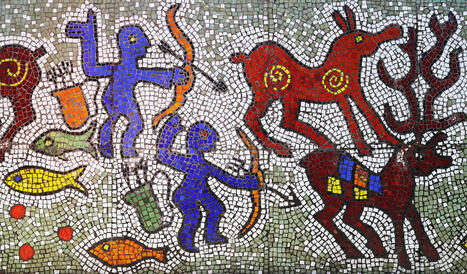
Today, people consider "Yule" synonymous with "Christmas." But centuries ago, Yule meant something different — a pagan mid-winter festival, dating back to pre-Christian Germanic people.
The action by county commissioners “shows a blatant disregard for the expertise of librarians,” one critic said.
The SAVE Plan is ending and repayment options will change dramatically in the new year.
If we want to get responsible media that does its job in reporting on the deeds and misdeeds of the rich and powerful, we need to look to fundamentally restructure the media.
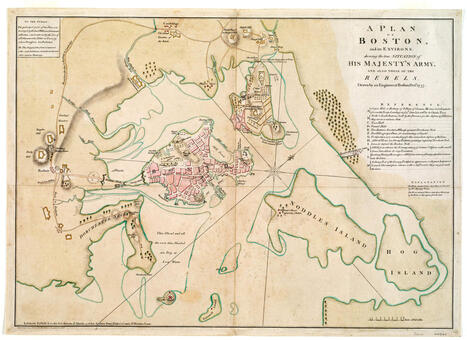
The exhibit features more than a dozen maps of Boston, New England and North America made before, during and after the American Revolution. They tell the story of how Boston and its landscape made the region a powder keg for revolutionary ideas. It’s hard to imagine, but less than 200 years ago, Boston was surrounded by water. The city was basically an island, connected to the rest of the state only through a tiny spit of land. Neighborhoods like Back Bay and parts of the South End didn’t exist until Bostonians dumped landfill into the water over the course of decades.
Following the removal of four dams from the Klamath River, which flows through California and Oregon, a group of young indigenous people are paddling from source to sea. (CNN) — Ruby Williams’ birthday was not your average 18th. She celebrated it on the Klamath River, with a group of young people making a historic journey paddling from the river’s headwaters in southern Oregon to its mouth in the Pacific Ocean, just south of Crescent City, California. It marked the first time in a century that the descent has been possible, after the recent removal of four dams allowed the river to flow freely. Williams, together with fellow paddler Keeya Wiki, 17, spoke to CNN on day 15 of their month-long journey, which they are due to complete on Friday. At this point, they had just 141 miles (227 kilometers) of the 310-mile (499 kilometer) journey left to go and had already passed through some of the most challenging rapids, such as those at the “Big Bend” and “Hell’s Corner” sections of the river. Both were exhausted and hadn’t showered in days — although they promised they “aren’t completely feral.” However, despite tired minds, they were steadfast in their commitment.
There’s plenty of dazzling eye candy tucked away in a corner of the Gems and Mineral Hall inside the American Museum of Natural History. Look at sparkly diamonds, rubies, emeralds, turquoise, and every other polished gem you can think of as you contemplate the mysteries of stars, planets, and distant galaxies in Cosmic Splendor: Jewelry from the Collections of Van Cleef & Arpels, on view through January 4, 2026.
Barbara Rose Johns was 16 when she led a walkout at her high school, credited with helping end school segregation. Her statue replaces Robert E. Lee's, which was removed in 2020.
|
The story of the Angles and their invasion of Britain is a fascinating chapter in the history of England, marking the transition from post-Roman Britain to Anglo-Saxon England. This tale of migration, conquest, and cultural transformation would shape the destiny of the British Isles for centuries to come. Origins of the Angles The Angles were a Germanic tribe originating from the Angeln peninsula in modern-day Schleswig-Holstein, Germany. Along with their close relatives, the Saxons and Jutes, the Angles were part of the broader group of North Sea Germanic peoples. Archaeological evidence suggests that the Angles had a well-developed society in their homeland, with a mixed economy based on agriculture, animal husbandry, and trade. They were skilled metalworkers and boat builders, traits that would serve them well in their future adventures across the North Sea.
The Brehon laws of ancient Ireland stand as a testament to the rich cultural and legal heritage of the Emerald Isle. This sophisticated system of jurisprudence governed Irish society for over a thousand years, from the Celtic era until the 17th century when it was finally supplanted by English common law. Far from being a primitive set of rules, the Brehon laws were a complex and nuanced legal code that addressed various aspects of Irish life, from property rights to social status, and even beekeeping.
Scientists using the James Webb telescope observed a distant exoplanet with an atmosphere of soot and diamonds, challenging all explanations. The Jupiter-size world, detected by the James Webb Space Telescope (JWST), doesn't have the familiar helium-hydrogen combination we are used to in atmospheres from our solar system, nor other common molecules, like water, methane or carbon dioxide.
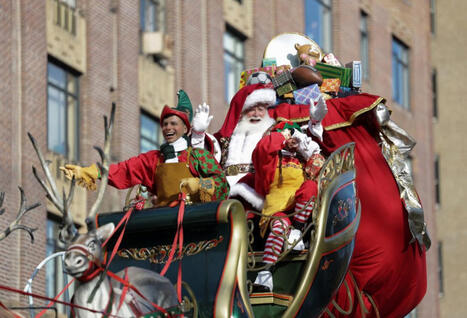
This Christmas, many children welcomed a familiar visitor – a jolly man in a red suit and a sleigh full of gifts. But the bearded figure Americans recognize today as Santa Claus is a relatively modern creation, shaped over centuries by folklore, art and evolving tradition. Stephanie Sy reports. And a warning for parents and younger viewers: this story contains some spoilers about Santa Claus.
In the aftermath of what remains a rare event — a shooting on a U.S. college campus — many are left scared, vulnerable and unsure of what's next.
From child labor to trafficking—and even foster care, sports, and detention—institutions meant to protect children often cause the greatest harm. There’s an invisible emergency in America: children toil in slaughterhouses, factories, and fields—night and day, unseen, unprotected, and endangered. A century ago, reforms such as compulsory schooling and restrictions on child labor marked a historic advance, shielding children from exploitation—a model still emulated worldwide. Yet today, austerity budgets, systemic neglect, and the ideology of “rugged individualism” are eroding those protections.
Child labor violations surged 31 percent between 2019 and 2024, according to the Department of Labor.
The largest WiFi network you may have never heard about is eduroam. This is a global WiFi roaming network operated by and for the educational community. The eduroam network is huge and is currently available at 38,000 locations in over 100 countries and territories. In 2024, the network logged 8.4 billion authentications of users joining…
Jay Caspian Kang on Australia’s social-media ban for young people under sixteen, on free speech, and on the U.S. movement to restrict kids’ access to technology. Free-speech norms and powerful tech companies make legal restrictions unlikely—but social changes are already taking place. et’s say, for the sake of the following discussion, that we agree on the following: - Teen-agers have First Amendment rights.
- Social media has become the place where people, especially young people, express their views.
- Social media is very bad for kids.
The question, given these facts, is: How much are we willing to restrict the free speech of teen-agers in order to protect them from the ills propagated by social-media companies?
One group noted "the irony of a billionaire being in charge of collecting pennies from debtors."
Bari Weiss blocked a critical story about the Trump administration — as CBS’s billionaire backers seek Trump’s help.
Billions of years ago, a day on Earth did not last 24 hours. New research suggests that for about one billion years, each day stayed fixed at roughly 19 hours because of a balance between the oceans, the atmosphere, and the pull of the Moon. Normally, Earth’s spin slows very gradually as tides raised by the Moon sap rotational energy, so day length creeps upward over time. A NASA overview estimates this process lengthens each day by roughly two thousandths of a second per century.
Ancient genetic data from central Argentina reveal a previously unknown human population that endured there for millennia before vanishing. The finding shows that one long-lasting group stayed rooted in its homeland while cultures, languages, and technologies shifted around it. Researchers read this story in DNA taken from human remains representing hunters, fishers, and farmers who once lived across the region. The study turns a blank spot on South America’s genetic map into one of its best documented chapters.
|