


Tama Kieves chose to move from a path that had gained her many rewards, but at great spiritual cost because she was denying her creative passions.

 Your new post is loading...
 Scoop.it! Tama Kieves chose to move from a path that had gained her many rewards, but at great spiritual cost because she was denying her creative passions. 
No comment yet.
Sign up to comment
Scoop.it!

By Sheri Plybon. Each week on the television show Shark Tank, several innovators bring their products to the “sharks” to ask for funding or other entrepreneurial assistance. Knowing oneself is key in this situation. It begins with resilience to get this far but then includes confidence to go further and let someone else who is more knowledgeable in business take the idea. We tend to hold our ideas so closely and identify with our inventions, and the key is “knowing” that if I did this before, I can do it again. Innovation is a learned process, but the drive and the passion are inherently personal.
Scoop.it!

Jessica Fournier has a job that makes poor use of her talents. She spends her days stocking sneakers at a warehouse outside Grand Rapids, Michigan. A decade ago she was an astrophysics student at Michigan State University, where she coauthored a paper on RR Lyrae, a low-mass star that pulsates light. But having failed to secure long-term employment in her arcane field, today she pays her bills by cataloging shoe sizes.
She may have given up astrophysics, but Fournier still has a deep love of science. As soon as she gets home from work each night, she boots up her Asus laptop and begins what she calls “my second job”: designing molecules of ribonucleic acid—RNA—that have the power to build proteins or regulate genes. It is a job that she happens to perform better than almost anyone else on earth.
Under the fitting nickname “starryjess,” Fournier is the world’s second-ranked player of EteRNA, an online game with more than 38,000 registered users.
Scoop.it!

French actress Bérénice Marlohe (Sévérine opposite Daniel Craig 's 007 in "Skyfall")... 'was told time and again [by casting agents, producers and directors in Europe] she didn't have what it takes to become a movie star. "They would tell me you are too tall compared to the actors or you have too much personality. The producers and director of a movie actually loved my work, but they told me it is not good to have too much presence compared to the main actress, so we will not hire you. I didn't agree with the system."'
'In a phone interview, Craig said Marlohe "brought a huge amount of depth to what is essentially a very small part. She gave her an awful lot of history in the way she played it. It makes it easy for me to act against and just much richer for an audience to watch."' ~~~ Related post: Creative People Shouldn’t ‘Tone It Down’ - By Cynthia Morris -- "It’s the job of the artist and writer to reflect what they see and feel. This expression of their art and talents must be larger than life." http://talentdevelop.com/4634/creative-people-shouldnt-tone-it-down/
Scoop.it!

Realizing the limited employment opportunities for his daughter, Shemanski recently founded Renewing the Renaissance, a for-profit company that employs artistically gifted, high-functioning adults with autism and other medical and executive functioning challenges.
Scoop.it!

John Gatins is the screenwriter of the movie "Flight." - "Gatins didn't start writing until he was 26 and newly sober. Years of slogging around Hollywood as a struggling actor had already taken their toll on the confident Vassar graduate. The answer to his boredom came from living fast and reckless." --- Part of this exciting, engaging movie is the story of main characters played by Denzel Washington and Kelly Reilly facing their addictions - which is so important for people to do, so they can really access their creative talents. The movie features the 12 Step/AA approach, which does not work for many people. See my article Gifted and Talented, Drugs and Alcohol http://talentdevelop.com/3212/ which has links to resources including Habit Doc - Psychologist Marc Kern provides an "Effective Alternative to AA."
Scoop.it!
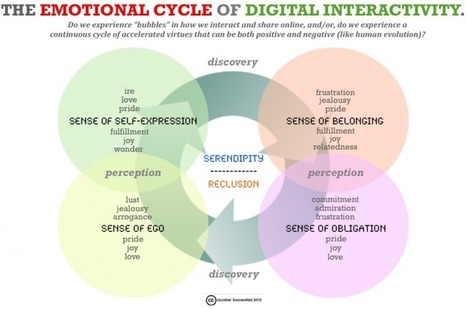
"Just as communications are multi-dimensional, interactions are as well, and they cross over into different emotional domains… Those places we all too often ignore or don’t even consider when we create things ... In this way, I believe that any great technology venture (any great company, really) must provide doors to perception and discovery that look well beyond transactional or even relationship benefits to some degree. We are evolutionary beings who use and build technologies as extensions of our biologies, genealogies and mythologies, and the complexities that arise can really only produce — rather, they must endeavor to produce — emotional benefits for end users and participants, as well as for creators and developers." Via Ana Cristina Pratas, Jack Patterson, Gust MEES, Louise Robinson-Lay, Rosário Durão, janlgordon, k3hamilton, molly mullee, Jimun Gimm
Scoop.it!

By Kate Stefans. "Everyone has self –doubt. It’s a matter of cultivating the confidence to grow beyond those voices of insecurity that sets us free. Unbound from the rational, and free to expand creatively." [On the fury of the hurricane in the Northeast:] "With so much energy swirling outside my window and in my mind, I found myself frantic to release it in some way."
Scoop.it!

The role gives D'Arcy, a retired nurse and midwife, the big break she has been working toward since leaving England for Los Angeles in 2002 — at the age of 69, and over the objections of her family. D'Arcy, now 79, said she was intrigued by the strength and humanity of the character. "She's this dippy, absent-minded woman who's really quite a child inside," said the actress with gray spiked hair and crystal blue eyes. "This little inoffensive woman, who's slightly lala, ends up becoming a formidable assassin." ~~~ My related post: Does Creativity Have An Expiration Date? http://thecreativemind.net/116/does-creativity-have-an-expiration-date/
Scoop.it!

"Multipotentialites have a number of often underestimated superpowers beyond skill. These qualities are the reason that so many innovators throughout history happen to have been oriented toward multiple disciplines. They predispose us to innovation."
From her blog post The 7 Multipotentialite Super Powers, by Emilie Wapnick. - Learn about her program Renaissance Business "for the Multi-Passionate Entrepreneur"
Scoop.it!

The idea of the daimonic has multiple meanings, from befitting a demon and fiendish, to motivated by a spiritual force or genius and inspired. “The presence of talent is not sufficient. Many people have more than one talent, and wonder what to do with them.”Jane Piirto, Ph.D. continues in her book Talented Children and Adults, “What is the impetus, what is the reason, for one talent taking over and capturing the passion and commitment of the person who has the talent?
Scoop.it!

It happens innocently enough: One minute you’re sitting at your desk, working on a report, and the next minute you’re thinking about how you probably need to do laundry and that you want to try the new restaurant down the street. Mind wandering is a frequent and common occurrence. And while mind wandering in certain situations – in class, for example – can be counterproductive, some research suggests that mind wandering isn’t necessarily a bad thing.
New research published in the journals of the Association for Psychological Science explores mind wandering in various contexts, examining how mind wandering is related to cognitive processes involved in working memory and executive control.
The Cognitive Processes Underlying Mind Wandering: Association for Psychological Science
Scoop.it!

Lena Dunham talks about being multitalented and using her neurotic qualities for writing, and performing what she writes, in her HBO show Girls.
|
Scoop.it!

A new approach to education using the arts’, is a European Union funded education project that is designing innovative methodologies to add creativity in to schools through the arts, as a key component of every school subject. European education has a critical need to find a way to weave creativity in to every aspect of the school curriculum, to not squeeze or under-utilize the arts as a key tool of nurturing creativity but to bring creativity through artistic expression in to every subject.
Scoop.it!

Students need opportunities to explore, discover, and use their imagination. Let's take a look at how creativity is being fostered in schools today.
Scoop.it!

I wanted to follow my heart and not be strategic and throw all preconceived ideas away, says Jonathan Adler in this talk about ignoring other people's opinions and charting your own path to creative fulfillment. From the video description: "Jonathan Adler is now synonymous with the irreverent designs -- pottery, housewares, furniture and beyond -- that he sells around the world...Adler preaches that we should keep other people's opinions out of our creative process and attributes his success to his disdain of focus groups and feedback." // One of my related posts: Toxic Criticism and Developing Creativity http://vsb.li/Pl3tbF
Scoop.it!

A number of people with exceptional abilities have used drugs, alcohol and other substances. Sometimes they risk addiction. Daniel Craig, currently playing James Bond again in “Skyfall,” thinks his character is “a borderline alcoholic, he always was!”He notes many of Bond’s traits are similar to those of Ian Fleming, who “fought a lot of pain through his life. He anaesthetised himself with alcohol and painkillers.”
Scoop.it!

Daniel Pink (in an interview with Seth Godin) commented about The Fountainhead by Ayn Rand: “Her iconic characters — for instance, Howard Roark — were motivated by internal desires like autonomy, mastery, and purpose.”
Scoop.it!

Creativity Expiration Date?; Pete Townshend on facing traumas; Responding Creatively to Turmoil and Disasters
Scoop.it!

A wonderful statement by Jennifer Connelly that can apply to other forms of creative expression we pursue: "Acting is great. When it works it is so fulfilling. You do the research and work with other talented people who are creative and compassionate and use all your faculties. The ability to express yourself completely is the most wonderful feeling in the world. Each film is a chapter in my life wherein I learn so much more about myself." [imdb.com]
Scoop.it!

:: “…the most beautiful thing a potter produces is…the potter.” ~Matthew Fox :: Sometimes I just get all hung up on what I’m creating…forgetting that if I really step into the destruction that must come before creation, what is transformed...
Scoop.it!

In an increasingly knowledge-based economy, where the daily tasks required in a large number of jobs require not repetitive button-pushing but independent and complex thinking, we are often exhorted to "be creative" or "use some creativity." Which would be fine, if creativity were a little dance one could do on command like a well-trained circus seal. But, for better or worse, the act of creation contains a certain morsel of irreducible mystery. It's intuitive and holistic, rather than analytical and linear (which is the gear we're usually in when we're struggling to get work done). It prospers under certain conditions and perishes under others. Here are 11 factors that often vaporize folks' creative juices:
Scoop.it!
"This lively RSA Animate, adapted from Dan Pink's talk at the RSA, illustrates the hidden truths behind what really motivates us at home and in the workplace..." Author Daniel Pink has said, “I find that question very daunting: What’s your passion? I find that almost paralyzing, in a way. I find it less paralyzing to say, What are you interested in doing next?” His book: Drive: The Surprising Truth About What Motivates Us. http://vsb.li/H04Xmd
Scoop.it!

Whether at work, school, or in everyday life, we often encounter situations where thinking outside-the-box is necessary. But, these sparks of insight can be somewhat hard to pin down. You just never know when creative thought will arise.
Scoop.it!

Based on informal discussions with aproximately "three-dozen artists a few general practices on how to lead a creative life emerged:
1) Live with awareness. 2) Make space for your unconscious mind. 3) Exercise the creative muscle
|





