Janet Atwood Describes How She Got Rid Of Her Fear Of Public Speaking In 30 Minutes With The Lefkoe Method...
Forms of anxiety such as this can hold many people back from expressing their creative abilities, and are often based on limiting beliefs. Eliminate a self-limiting belief free using the Lefkoe Method http://talentdevelop.com/ReCreateYourLife-free
As a child, you were gifted with imagination and creativity. Now grown up, you base your judgment on your knowledge and experience. How to think like a child?
"We have been constructed by schools and parents in such a way that for all problems we have a formula we can apply. This is what society provides us with in order to be efficient and independent.
Nine times out of ten, this is what gets us out of complicated situations.
But once in a while,if you could think differently, you might find some other solutions, easier and more effective."
~~~
Related: Overthinking, Worry and Creative Problem-solving
16 different ways to spark more creative and innovative thinking in your organization.
Simply put, the key to increasing creativity in any organization is to make it start acting like a creative organization. Suppose you wanted to be an artist: You would begin behaving like an artist by painting every day. You may not become another Vincent Van Gogh, but you'll become much more of an artist than someone who has never tried. Similarly, you and your organization will become more creative if you start acting the part. The following are 16 suggestions to encourage you and your colleagues to start becoming more creative today.
Book: Creative Thinkering: Putting Your Imagination to Work, by Michael Michalko. http://vsb.li/Wb5XxV
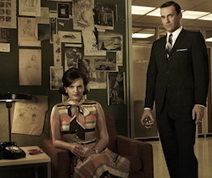
Jon Hamm (TV series 'Mad Men') talks about his life following the death of his father when he was 20, including his recovery from depression.
Hamm said, ‘I very much knew what the idea of permanence was by that point. I dropped out of school, moved into the basement of my older half-sister Julie’s house, enrolled in a local college and sank into depression.
Thumbnail descriptions of the thinking strategies commonly used by creative geniuses.
"How do creative geniuses generate so many alternatives and conjectures? Why are so many of their ideas so rich and varied? How do they produce the "blind" variations that lead to the original and novel? A growing cadre of scholars are offering evidence that one can characterize the way geniuses think. By studying the notebooks, correspondence, conversations and ideas of the world's greatest thinkers, they have teased out particular common thinking strategies and styles of thought that enabled geniuses to generate a prodigious variety of novel and original ideas."
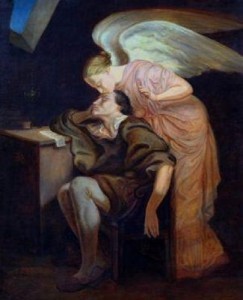
Many artists and other creators have the experience of being inspired by something outside themselves - or someone. What is this inspiration?
“Something really vital happens if we treat the things that give us the most joy and delight – like, say, our creative abilities – as gifts…” – Jericha Senyak
“Why don’t we get the best out of people? Sir Ken Robinson argues that it’s because we’ve been educated to become good workers, rather than creative thinkers. Students with restless minds and bodies — far from being cultivated for their energy and curiosity — are ignored or even stigmatized, with terrible consequences.”
The archetype of the shadow is depicted as: A shadowy figure, often the same sex as dreamer but inferior; a zombie or walking dead; a dark shape; an unseen ‘Thing’; someone or something we feel uneasy about or in some measure repelled by; drug addict; pervert; what is behind one in a dream; anything dark or threatening; sometimes a younger brother or sister; a junior colleague; a foreigner; a servant; a gypsy; a prostitute; a burglar; a sinister figure in the dark.
Often there is an air of disrepute about the person, or of danger, but that is not always so. Sometimes it appears as simply an indistinct figure, or someone difficult to really see...
************
As I note in my post "Developing creativity – using our bad thoughts and dark side,"
Our shadow side is the multitude of personality qualities, instincts, urges and thoughts we may be offended by and actively ignore, deny or try to cover up. But this secret or unexplored inner landscape can be a source of personal growth and creative expression.
Recent research solves longstanding madness/genius paradox By Scott Barry Kaufman, Ph.D....
"There is only one difference between a madman and me. I am not mad." — Salvador Dali
Must one risk getting lost in the sea of madness in order to reach the lone island of genius? While not necessarily mad, creative minds are often chaotic, untethered and unhinged. These thought processes enable a creative person to bring together lots of seemingly disparate streams of information in a unique way not immediately obvious to those grounded in "reality." Which creates an interesting paradox: How can creative geniuses simultaneously be mad and brilliant?
~~~
Related: Do We Need to be Crazy to be Creative? By Douglas Eby
Does creative inspiration come from our own teeming neurons, or is it a gift of a Muse?
A passion to create may feel like something from beyond us, or from a spirit being, but maybe that is what anything from the not quite known inner depths of our psyche feels like.
In his article The Creative Personality: Ten paradoxical traits of the creative personality (from his book Creativity: Flow and the Psychology of Discovery and Invention), Mihaly Csikszentmihalyi, PhD writes that “Creative people combine playfulness and discipline, or responsibility and irresponsibility” and that “Creative people tend to be smart yet naive at the same time.”
He says that “a core of general intelligence is high among people who make important creative contributions,” but according to the studies of Lewis Terman, “after a certain point IQ does not seem to be correlated with superior performance in real life” – including level of creativity.
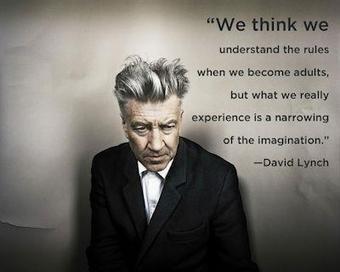
David Lynch on being a creative polymath: "I started out as a painter, and then painting led to cinema...Then cinema led to so many different areas—it led to still photography, music . . . Furniture is also a big love of mine. I started building these kind of sculptural lamps. Then I got into lithography...And I’ve always been painting along the way, as well as doing drawings and watercolors . . . There are just so many things out there for us to do." [From Interview magazine.] // From my post "An Intense Inner Pressure to Create" http://blogs.psychcentral.com/creative-mind/2012/02/an-intense-inner-pressure-to-create/ ~~~ Book: Catching the Big Fish: Meditation, Consciousness, and Creativity - by David Lynch. http://vsb.li/oCeztg
Creativity and Intelligence as opponent processes. By Sandeep Gautam...
Creativity and Intelligence are related, but also opposed to each other in a certain way. Traditional analysis of relations between intelligence and creativity have focussed on whether one is a subset of the other; whether they are correlated and found significantly more often together than by themselves; and whether one (high IQ) is a necessary condition or prerequisite for the other (creativity) - the threshold theory of creativity.
Noomi Rapace is the star of the new Ridley Scott film "Prometheus." Casting her as the lead character Elizabeth Shaw...
Rapace said that to make the character of Shaw believable, she felt the need to reconnect to her spiritual upbringing in Iceland, to a time when her belief system felt more certain. “I felt I had to face myself and find her in me,” Rapace said. “There’s a line in the movie, ‘That’s what I choose to believe,’ and I think that’s a key sentence in her life. She lost her dad when she was 9, her mother when she was a baby, and she’s been on her own. It’s like you have a choice: to either be destructive or to say everything happens for a reason and I just have to find the reason. She is driven by passion and an almost naive obsession to find out who made us.”
The Innovator's DNA book includes skills you can make use of being a disruptive innovator as an individual creator, as well as a business leader.
One of the skills: "Associating refers to your ability to make connections across seemingly unrelated questions, problems, fields of study, or ideas. Associational thinkers draw on knowledge acquired through questioning, observing, experimenting and networking to link together unexpected combinations of problems, ideas and observations to produce new business ideas."
In this article, Jill Burruss and Lisa Kaenzig define introversion and lists many of the characteristics of introverts. Suggestions are made on ways teachers can help introverts in the classroom and how families can help introverts at home.
~~~~
One of my related posts: Shyness, Introversion, Sensitivity – What’s the Difference?
New York Daily NewsGoogle boosts 'Genius U.'New York Daily NewsIN A MATCH made in high tech heaven, Google is donating $10 million worth of office space to students enrolling in Cornell's to-be-built “genius school” on Roosevelt Island.
Transmedia may have become an eyeroll-inducing buzzword in some circles but the ability to tell stories across platforms is a more relevant skill than ever. Writer and game designer Andrea Phillips takes us through some of the key lessons from her career in transmedia--lessons that are applicable to anyone with a story to tell.
Many multitalented people feel inspired to pursue multiple projects, often at the same time. One potential downside is physical and emotional burnout.
Jennifer Westfeldt wrote, produced and acted in her movie “Friends With Kids”...she also directed the “two-year, round-the-clock endeavor” - “I must have been crazy to have donned so many hats,” Westfeldt said. “It made good sense for me to direct it, since I was involved in every aspect anyway. But I’m not sure I’d ever do it again.”
Nope, even Michelangelo embraced constraints. But don't take it too far; process shouldn't be perfect. Here's why.
In the May issue of Inc., a reader, Elaine Ellis, poses a great question: Is creativity stifled by organization or is it easier to be creative at a company that is extremely well run?"
The way she phrases the question to some degree defines the answer. Of course it is easier to be creative in a "well run" company because it is easier to get things done and to experiment. Truly creative people don't baulk at every restraint; the best people I've ever worked with understood the necessity and found structure provoked them to do richer and more daring work.
In the early nineties a wide variety of arts-based approaches to creative problem solving and idea generation surfaced. One of the most popular forms that emerged was that of Improv Theatre. ... As leaders from all sectors today find themselves in uncharted waters, the demand for not only quantity, but quality of ideas is paramount. Just as potent as the many powerful techniques from the world of Improv Theatre, comes a more appropriate practice and inquiry tool for these times – Brain-calming.
... Brain-calming techniques are on the rise and can be seen routinely in many private and public organizations as meditation, learning partner walks, slow food dinners, conversation cafes, and journaling.
To get content containing either thought or leadership enter:
To get content containing both thought and leadership enter:
To get content containing the expression thought leadership enter:
You can enter several keywords and you can refine them whenever you want. Our suggestion engine uses more signals but entering a few keywords here will rapidly give you great content to curate.


 Your new post is loading...