


Developing Creativity newsletter: Information and inspiration to enhance creativity and personal development
Topics:
The Dyslexic and Creative Mind;
Innovation Excellence article;
Growing Up Gifted Is Not Easy By Elaine Aron

 Your new post is loading...
 Scoop.it! Developing Creativity newsletter: Information and inspiration to enhance creativity and personal development Topics: The Dyslexic and Creative Mind; Innovation Excellence article; Growing Up Gifted Is Not Easy By Elaine Aron 
No comment yet.
Sign up to comment
Scoop.it!
Douglas Eby's insight:
Natalie Portman: "I definitely thrive on discipline and extreme situations and a quest for perfection." -- But it was more than a driving professionalism that drove Portman to the Black Swan script, she says. "Something that was interesting to me was the need to become a woman, to become an adult, in order to be an artist."
Scoop.it!

Highly creative people often seem weirder than the rest of us. Now researchers know why
"Both creativity and eccentricity may be the result of genetic variations that increase cognitive disinhibition—the brain’s failure to filter out extraneous information."
Douglas Eby's insight:
“I hope I’m becoming more eccentric. More room in the brain.” Musician Tom Waits // Being eccentric – choosing not to be more safely mundane – can help our creative thinking and courage. As psychologist Robert Ornstein, PhD has noted, “If you spend too much time being like everybody else, you decrease your chances of coming up with something different.” From post: Being eccentric and creative
Scoop.it!

It's time for one of my very favorite creative thinking strategies: Think Like A Wise Fool Image from Wise Fool Carrying the strategy of "looking at things differently" to extremes brings us to the realm of the Wise Fool...
"The great benefit of the wise fool's antics and observations is that they stimulate our thinking. They jolt us in the same way that a splash of cold water awakens us when we are drowsy."
Douglas Eby's insight:
Roger von Oech is author of many books and products, such as A Whack on the Side of the Head
Scoop.it!

New German research finds a darkened room encourages freedom of thought and inspires innovation.

Denis Marsili's curator insight,
June 19, 2013 4:51 AM
WOW!! My lights are always dim, or I simply use my salt lamp :D
Scoop.it!

Collaborate by burning the midnight oil, like Edison Via Richard Reubenstone
Douglas Eby's insight:
Related post: Does Brainstorming Enhance Creative Thinking and Innovation?
Scoop.it!

Topics: Fighting Inner Battles To Be More Creative - Steven Pressfield; Eric Maisel Creative Catalysts by Gail McMeekin Scott Barry Kaufman on Creativity
Scoop.it!

“It’s not the writing part that’s hard. What’s hard is sitting down to write. What keeps us from sitting down is Resistance.”
Author Steven Pressfield goes on to describe in his book ‘The War of Art’ how this “Resistance” holds people back from being more creative. The book emphasizes that confronting creative blocks is an “Inner Creative Battle” against mental varieties of enemy, some of them very subtle, not so clear and definable as an outer foe.
Douglas Eby's insight:
Book: The War of Art: Break Through the Blocks and Win Your Inner Creative Battles, by Steven Pressfield.
Scoop.it!

"During your working lives, you will have to reinvent yourselves many times. Success and satisfaction will not come from mastering a fixed body of knowledge but from constant adaptation and creativity in a rapidly changing world."

Dave Rothacker's curator insight,
June 8, 2013 8:29 AM
This advice applies to all and to your businesses!
Scoop.it!
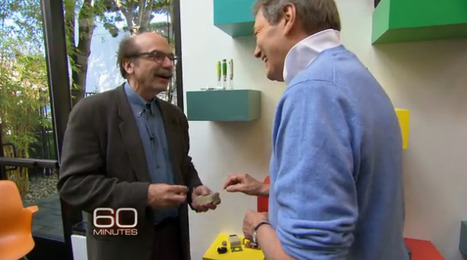
Global firm IDEO incorporates human behavior into product design -- an innovative approach being taught at Stanford. Charlie Rose profiles the company's founder, David Kelley.
Scoop.it!
Canon and Ron Howard present Project Imaginat10n, a film festival inspired by your photos. What will you inspire?
Scoop.it!

When do we lose the wonder and awe of childhood? How do we become so solemn and cynical? What happened to the simple sense of humour we used to have, when anything remotely silly could provoke giggles?
Scoop.it!

“Don’t compromise yourself. You’re all you’ve got.” That is great advice from Janis Joplin - but we may do just that: compromise, stifle ourselves, shut down what we are capable of, creatively and in other ways – often based on our self-limiting thinking.
|
Scoop.it!

"Since physical metaphors regarding creativity are so common and appear in several different languages, a group of researchers hypothesized that they may extend beyond mere clichés. But can acting out metaphors really affect how our minds work?"
Douglas Eby's insight:
Related: Creative Thinking: Imagine You Are Seven Again “All students answered the same question. But for one group, a single sentence was added to the instruction: You are seven years old…Those participants who were in the seven-year-old condition exhibited significantly higher levels of originality in thought." http://blogs.psychcentral.com/creative-mind/2012/10/creative-thinking-imagine-you-are-seven-again/
Scoop.it!

In this fascinating Scientific American article, the authors (Oren Shapira and Nira Liberman) tell us that creativity is not bound by the sole innate characteristics of an individual and can in fact be changed based on situation and context. Via stan stewart, Dina Gálvez
Scoop.it!

'Geniuses are not omnipotent. They are just very skilled at employing the creativity toolbox': 'Genius Unmasked' by Roberta Ness.
Douglas Eby's insight:
Related book: Innovation Generation: How to Produce Creative and Useful Scientific Ideas by Roberta B. Ness, M.D. http://buff.ly/1249bB0 // Review: "A thought-provoking dissertation on innovative thinking and how to circumvent the barriers that can inhibit our creativity." - Russell A. Hulse, Nobel Laureate in Physics.

MTD's curator insight,
June 21, 2013 4:15 AM
true innovators simply find new ways to twist the tools that everyone else has access
Scoop.it!

Creativity has two phases: generation and evaluation. You need to adopt a different mindset for each.
"In his wildly popular 2006 TED talk, Sir Ken Robinson defined creativity as “the process of having original ideas that have value.” Aside from being wonderfully succinct, this definition implies that any creative enterprise requires two key phases:
Douglas Eby's insight:
By Heidi Grant Halvorson Ph.D., author of Focus: Use Different Ways of Seeing the World for Success and Influence. http://shrd.by/Br5K1T
Scoop.it!

For businesses driven by creativity, hard work doesn't always result in success. In fact, it could hold you back. (The Key to Innovation? Stop Working So Hard!
Scoop.it!

“I didn’t speak the language and didn’t have any friends, [so] my parents bought a piano for me,” she wrote, hoping it would provide their daughter with a productive way to spend her free time. And, to put things mildly, the plan worked out: she earned the top prize at the International Steinway Piano Competition soon after her studies had commenced.
Scoop.it!

In terms of creativity and originality Deerhoof are true innovators in the music realm. The New York Times has even said “Deerhoof is one of the most original rock bands to have come along in the last decade.” I’ve been a fan for years and was stoked to be able to see them play at the San Francisco Museum of Modern Art last year when I coincidentally was in town for a conference. I had a hunch Think Jar Collective and its readers could learn from Deerhoof‘s creativity and was grateful to be able to chat with one of Deerhoof’s founders Greg Saunier
Scoop.it!

Have you ever spent an hour staring at a blank piece of paper, willing some new ideas to spill onto the page, only to feel disappointed and exhausted when nothing materializes?
"You might be going about brainstorming the wrong way. To generate new ideas, give your brain a break. Try starting with a clear mind, and avoid being so direct in your thinking.
"When Albert Einstein said, “Why is it I get my best ideas while shaving?” I think he was on to something with this observation."
Scoop.it!
"Amanda Palmer's keynote speech, delivered on May 4th, 2013 at Grub Street's Muse and Marketplace Conference (part of the NEA-funded Publish it Forward series), touches on what it means to be a writer -- or an artist of any kind -- in this new digital age where gatekeepers no longer control the means of distribution and it's just "your voice to the world." She poses the question: Without intermediaries, how can writers bridge the "noisy, crass" marketplace and their secluded, protected writing rooms or garrets which afford them the distance and silence to write their novels, poems and essays?"
Scoop.it!
Psychologist Scott Barry Kaufman says developing creative thinking involves moving back and forth from broad fields of attention, to more narrow ones.
He refers to research arguing that “mind wandering serves multiple adaptive functions, such as future planning, sorting out current concerns, cycling through different information streams, distributed learning (versus cramming), and creativity.”
Scoop.it!

Expectations are great when they help you think about what you want to accomplish. Expectations can also help you envision opportunities and problems you could face before they actually develop. Ex... Via stan stewart
Scoop.it!

Where creativity lies We want to believe that creativity is regularly awe-inspiring. It’s not though. As I was sitting in a bookstore the other day I noticed a woman commenting on a feature story of... Via stan stewart, Dário Viegas
|






