


By Michael Gill
So it seems that the BBC’s digital multimedia project had a few flaws, including this one noted by Price Waterhouse Coopers: “The focus and priorities of DMI were on technology build...


|
Decision Intelligence News
Decision Intelligence (DI) is the discipline concerned with how organizations and individuals design, support, and improve decision making at scale. It connects actions to outcomes in context by integrating human judgment, data, models, text, and AI into coherent decision systems. Decision Intelligence News curates developments across DI and related fields, including AI, machine learning, governance, enterprise architecture, orchestration, measurement, and decision modeling. Learn more at www.opendi.org and www.learn-di.com. Curated by Decision Intelligence |
 Your new post is loading...

|
Scooped by
Decision Intelligence
February 3, 2014 11:41 PM
|
 Scoop.it!
By Michael Gill
So it seems that the BBC’s digital multimedia project had a few flaws, including this one noted by Price Waterhouse Coopers: “The focus and priorities of DMI were on technology build...
|
|
Scooped by
Decision Intelligence
February 2, 2014 7:59 PM
|
Scoop.it!
When she became the attorney general of New Jersey in 2007, Anne Milgram quickly discovered a few startling facts: not only did her team not really know who they were putting in jail, but they had no way of understanding if their decisions were actually making the public safer. And so began her ongoing, inspirational quest to bring data analytics and statistical analysis to the US criminal justice system.
"We should take...data-driven risk assessment, and combine it with the judge's instinct and experience, to lead us to better decision making."
Right! This is a great use case on the "fuzzy frontier": those situations where data-centric approaches have not been used historically, because the best decisions require both human expertise as well as great data. We need the full Decision Intelligence stack for this important problem.
Sign me up. Ready to help.
|
|
Scooped by
Decision Intelligence
February 2, 2014 5:23 PM
|
Scoop.it!

In January, the General Motors Corvette and Silverado Pickup truck were named North American car and truck of the year. GM has come a long way in the last twenty years. Twenty years ago the General...
About the Dialog Decision Process at GM: "The phases of the process are framing, alternative generation, analysis, and synthesis. GM is adept at using this process to guide market research. They know what information about the customer is important for decision making and they get it, quickly and efficiently.
At GM the process was called the “dialog decision process.” Collaborative design is a better description. Extreme collaboration is required to design a product as complicated as an automobile."
|
|
Scooped by
Decision Intelligence
February 1, 2014 8:35 PM
|
Scoop.it!
Knowledge Automation: How to Implement Decision Management in Business Processesdescribes a simple but comprehensive methodology for decision management projects, which use business rules and predictive analytics to optimize and automate small, high-volume business decisions. It includes Decision Requirements Analysis (DRA), a new method for taking the crucial first step in any IT project to implement decision management: defining a set of business decisions and identifying all the information—business knowledge and data—required to make those decisions.
Nontechnical and accessible, Knowledge Automation reveals how DRA is destined to become a standard technique in the business analysis and project management toolbox.
I'm reading this book right now. It's very insightful, including a helpful and practical framework for extracting the maximum ROI from automated decision-making technology.
|
|
Scooped by
Decision Intelligence
February 1, 2014 4:56 PM
|
Scoop.it!

Researchers from the University of Massachusetts have launched a torrent site which allows academics to share papers and datasets. AcademicTorrents provides researchers with a reliable and decentralized platform to share their work with peers, as well as the rest of the world. The site currently indexes over 1.5 petabytes of data, including NASA's map of Mars.
Great DI raw material! Please add a comment below if you use this resource. "Academics, or anyone else who’s interested can join the site and start sharing. NASA’s 42 gigabyte map of Mars may be a good start, and a recent copy of Wikipedia might come in handy too"
|
|
Scooped by
Decision Intelligence
January 30, 2014 8:41 PM
|
Scoop.it!

You will hear how to leverage the work your organization is already doing, build on the tools you have, and how to optimize the decisions that your organization makes, control the "unintended consequences," and achieve a new understanding of the impacts that decisions made today will have on the future.
Where predictive analytics is focused solely on historical data —collected, captured, cleaned, and perfected—Predictive Intelligence focuses first on the desired outcome. It provides a “focusing lens” on what could otherwise be an overwhelming amount of data, and identifies which information is the most critical for achieving those outcomes. This information often includes human expertise, when data is in short supply. Where predictive analytics typically answers one question, Predictive Intelligence manages and models multiple outcomes at the same time. It’s a bridge between the data-driven, fully automated decision-making systems of the past, and what is needed to navigate an uncertain and increasingly complex future.
I hope you can join me.
|
|
Scooped by
Decision Intelligence
January 30, 2014 6:35 PM
|
Scoop.it!
This video provides a basic introduction to the science of complex systems, focusing on patterns in nature. (For more information on agent-based modeling, vi...
This is a great introduction to the idea of emergent behavior from complex systems. Many people don't realize that if individuals have very simple behaviors, there can be very complex behaviors when those individuals act in a group. Understanding these emergent patterns is critical for good decision making, because you need to know how the decision you make will set other elements in the system in motion. More and more, our social, economic, political, climate, and other realities have this characteristic. This video focuses on agent-base complex systems, such flocks of birds, schools of fish, or even nanobot swarms to cure cancer.

Agent based modeling still is the best tool to understand complex systems when mathematical modeling gets very complicated.

Always looking for good resources to introduce complexity science to others. This looks great.

I recently conducted a series of workshops on the subject of 'Complex Project Management - Navigating through the unknown'. This clip provides a great introduction to complex systems and for those interested in Complexity Science, this clip is worth 7:52 of your time.
|
|
Scooped by
Decision Intelligence
January 30, 2014 2:31 AM
|
Scoop.it!

|
|
Scooped by
Decision Intelligence
January 29, 2014 12:35 PM
|
Scoop.it!
A great course, from some of the best. I'm thinking about going.
|
|
Scooped by
Decision Intelligence
January 28, 2014 2:52 AM
|
Scoop.it!
"As I was preparing my presentation for the United Nations at the Forbes 400 conference in June of 2013, I reached out to Quantellia to ask if they could help to build a decision model to analyze and illustrate the impact of Last Mile Health Front Line Health Workers on childhood mortality in Liberia. The modeling process, and subsequent video, has helped me open my eyes to my own business. " - Raj Panjabi
|
|
Scooped by
Decision Intelligence
January 28, 2014 2:21 AM
|
Scoop.it!

The model showed that a consistent injection of aid along a number of fronts was necessary to overcome the "energy" in state space to move from one phase to another of this complex system.
"Factivism" is a great idea, but without a systems understanding remains fundamentally limited. Congratulations to my team at Quantellia for this breakthrough project.
|
|
Rescooped by
Decision Intelligence
from Non-Equilibrium Social Science
January 25, 2014 9:47 PM
|
Scoop.it!

It is generally recognized that life is becoming more complex. This article analyzes the
human social environment using the "complexity profile," a mathematical tool for
characterizing the collective behavior of a system. The analysis is used to justify the
qualitative observation that complexity of existence has increased and is increasing. The
increase in complexity is directly related to sweeping changes in the structure and
dynamics of human civilization—the increasing interdependence of the global economic
and social system, and the instabilities of dictatorships, communism and corporate
hierarchies. Our complex social environment is consistent with identifying global human
civilization as an organism capable of complex behavior that protects its components
(us) and which should be capable of responding effectively to complex environmental
demands
This is so important! We all feel that things are becoming more complex, now here's some evidence to show we're right. And as we suspected, it comes from increasing interdependence and "sweeping changes in the structure and dynamics of civilization". Thought so!

You see this in the devolution of religion from hierarchically based forms of morality.
Or on the decentralization of wealth from a handful of individuals to the general masses.
Or the collaborative work of government, rather than the command and control central systems that dominated the 20th century.
We're evolving.
And we've only begun this journey.
Think about it.

Dear Sirs,
I think that people from different nationalities have to have marriages between different nationalities. The idea is multinational planet, where people live everywhere they want and they don't have any ideas of nationalizm or rasism. In this case all people can live in peace and harmony. No wars, only worldwide police. Economical development is possible only if people from different countries can come to each other and co-operate. The most important problem behind the human race is ecological! All people on the planet have to co-operate and communicate and help each other to save the planet and themselves and future generations!
|
|
Scooped by
Decision Intelligence
January 24, 2014 9:45 PM
|
Scoop.it!
Another article on the unrealized potential of big data to support important decisions, this time from the smart people at Wipro:
"This research shows that while retailers realize the value of maximizing their use of big data and analytics, many are still unable to utilize the data they are collecting in full,” said Srini Pallia, Senior Vice President and Global Head, RCTG (Retail, Consumer Goods, Transportation and Government) Business Unit, Wipro. “To get the full value from the data they are collecting, retailers need to explore new avenues to apply data analytics throughout the organization that will improve decision making, efficiency and interaction with customers.”
|
|
Scooped by
Decision Intelligence
January 24, 2014 12:27 PM
|
Scoop.it!

Almost all C-suite executives at large enterprises believe data and analytics are important to their business, but most are struggling to become data-driven businesses -- and more than half say they don't even know what data to collect.
The most recent article - based on a great KPMG study - in an increasing avalanche indicating the need for decision intelligence (DI) to supplement big data. Bottom line: DI fills the "identify the problem to be solved" gap identified in this article in an agile, intuitive way, and which allows analysis of complex systems dynamics.
From the article:
"Zeroing in on the business problems and identifying key hypotheses may not be the easiest thing to achieve up front, but it is far more efficient and effective in the longer term," says Anthony Coops, partner, KPMG in Australia. "Throwing all available data into a pot and hoping for a tasty stew of insights will rarely — if ever—deliver meaningful results."
|
|
Scooped by
Decision Intelligence
January 23, 2014 2:38 PM
|
Scoop.it!

If health is defined merely as the absence of disease, there would be no compelling reason for people to invest in it. Unlike health care, health itself is the actively produced capacity to undergo stress and react positively to it.
"Of course, we do invest in health care. But that is like investing in auto repair – allocating resources to repairing damage, rather than to improving safety technology or brightening traffic lights."
A side note: the greatest value-per-dollar has shifted from solving health problems to behavior around health issues: in many arenas there is a greater payoff from behavioral modifications than from health treatment. We've known this in engineering for a while as the 1:10:100 rule: for every dollar not spent on prevention (requirements) we pay 10 dollars to fix a bug in production and 100 dollars to fix it after it's shipped to the customer. Do you agree that a similar rule applies to health?
|
|
Rescooped by
Decision Intelligence
from Non-Equilibrium Social Science
January 22, 2014 11:20 PM
|
Scoop.it!
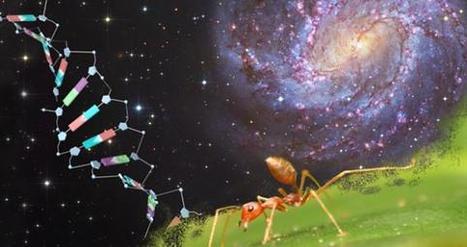
The “study of complexity” refers to the attempt to find common principles underlying the behavior of complex systems—systems in which large collections of components interact in nonlinear ways. Here, the term nonlinear implies that the system can’t be understood simply by understanding its individual components; nonlinear interactions cause the whole to be “more than the sum of its parts.”
How Can the Study of Complexity Transform Our Understanding of the World?
Melanie Mitchell
One of my favorite complexity authors. An excerpt: "In the past it was widely assumed that such phenomena are hard to predict because the underlying processes are highly complex, and that random factors must play a key role. However, Complex Systems science—especially the study of dynamics and chaos—have shown that complex behavior and unpredictability can arise in a system even if the underlying rules are extremely simple and completely deterministic. Often, the key to complexity is the iteration over time of simple, though nonlinear, interaction rules among the system’s components."
This insight is at the core of Decision Intelligence, which adds an understanding of these emergent behaviors to the usual big data/predictive analytics/optimization stack.
|
|
Scooped by
Decision Intelligence
January 22, 2014 1:55 PM
|
Scoop.it!
Adding predictive intelligence to the big data stack combats unintended consequences in complex situations, uses human insight.
|
|
Scooped by
Decision Intelligence
January 15, 2014 9:16 PM
|
Scoop.it!
Watching HANK on Netflix tonight. Worth a watch. Another data point validating our intuition of increasing complexity in recent times:
"Along with innovation came complexity.
And complexity is the enemy of transparency.
And complexity is not a good thing in finance."
[24:33]
...
"The domino theory isn't an accurate one here.
The best way to describe it is the popcorn theory.
We had this giant popcorn popper, and it had been heating these kernels for a year as the crisis went on.
And Lehman may have been the first to pop, and even with Lehman we knew that the same weekend that Lehman was going down we had Merrill Lynch and AIG. So we had three institutions going down. And Merrill Lynch and AIG weren't going down because of Lehman. They were going down because they had their own bad loans...
That week was like no other week I've ever had.
…
We were juggling difficult decisions, each of which would have demanded 100% of my time at any other time."
[56:00]
|
|
Rescooped by
Decision Intelligence
from Non-Equilibrium Social Science
January 13, 2014 2:28 PM
|
Scoop.it!

Computers that learn from and repeat human behaviour save time and money, but what happens when they repeat flawed traits or errors thousands of times per second?
The complexity of business / policy decisions seems to be increasing. But is that only an illusion? Here's one reason it's real: automation is magnifiying the speed of our mistakes at the same time it's increasing productivity.
|
|
Scooped by
Decision Intelligence
January 7, 2014 11:06 PM
|
Scoop.it!

Microsoft executive Dave Campbell outlines plans for Hadoop, machine learning, high-performance computing and data and analytic offerings on Azure.
Ah, Microsoft friends, you are getting better, but there's one last step that's missing.
1) "it's not just about offering data sets; it's also about analytic models and other things."
Good so far.
2) "There are fairly well-known models for things like fraud detection, spam detection and such. People are going to be building these models, and we expect to package them with a deployment environment on Azure. For every one person who can build a model, there might be 500 who could deploy it and run it in our cloud environment. Where do they get the data they'll need? That's going to be available on Azure as well. "
Yes, very nice. This is the Market of Models...
3) "We demonstrated one example at a supercomputing conference where we took historical meteorological data over decades and historical airline flight-delay data over decades and we built a predictive model that combined them. We could then ask, "On a clear day, what are the probabilities of delay for various airlines, airports and times?" Based on the historical meteorological data, we could also ask, "What do those probabilities look like when there's six inches of snow in Detroit?" If you then add meteorological forecast data, you can ask, "What are the chances I'll miss a 30-minute-window connection in Detroit next Tuesday?" "
Getting closer, you're starting to connect the dots.
*But*...
The question is not "what are the chances I'll miss my connection", but "what flight should I book to a) minimize my chances of making it; b) make it most likely I can fly on a 787; c) minimize my miles in the air; d) avoid Detroit if at all possible?" Microsoft, you need to ask the *decision* questions, and connect *all* the dots to include the outcomes as well as the full decision model chain.
Call me, friends, let's talk.
|
|
Rescooped by
Decision Intelligence
from CORPORATE SOCIAL RESPONSIBILITY –
January 4, 2014 11:29 PM
|
Scoop.it!
Fritjof Capra, in his book ‘The Hidden Connections’ applies aspects of complexity theory, particularly the analysis of networks, to global capitalism and the state of the world; and eloquently argues the case that social systems such as organisations and networks are not just like living systems – they are living systems. The concept and theory of living systems (technically known as autopoiesis) was introduced in 1972 by Chilean biologists Humberto Maturana and Francisco Varela.
This is a complete version of a ‘long-blog’ written by Al Kennedy on behalf of ‘The Nature of Business’ blog and BCI: Biomimicry for Creative Innovation http://thenatureofbusiness.org/2012/08/15/superorganisations-learning-from-natures-networks/
Sustainable Brands, January 2, 2014
-▶ SUSTAINABILITY AS AN EMERGENT PROPERTY: WHAT CAN WE LEARN FROM THE SUPER-ORGANISMS? http://www.sustainablebrands.com/news_and_views/collaboration/victoria-kindred-keziah/sustainability-emergent-property-what-can-we-le
-▶ MIMICKING NATURE: ORGANIZE LIKE ANTS TO MOVE MOUNTAINS http://sco.lt/5DcYXh
-▶ NATURE HAS THE ANSWERS. WE ARE SURROUNDED BY GENIUS - WHOLE SYSTEMS DESIGN BY NATURE http://sco.lt/7maN5V
Conservation - University of Washington
▶ DESIGN GENIUS - NATURE'S MOST ELEGANT DESIGNS MAY HOLD THE KEY TO UPER-EFFICIENT, ECOFRIENDLY TECHNOLOGY http://www.conservationmagazine.org/2011/09/design-genius/
June 17, 2013 Global Possibilities
▶ BEST OF BIOMIMICRY http://www.globalpossibilities.org/best-of-biomimicry/
Smithsonian Magazine
▶ HOW BIOMIMICRY IS INSPIRING HUMAN INNOVATION: Creative Minds Are Increasingly Turning to Nature - Banyan tree leaves, butterfly wings, a bird's beak -- for fresh design solutions http://www.smithsonianmag.com/science-nature/How-Biomimicry-is-Inspiring-Human-Innovation-165592706.html
▶ THE EVOLUTION OF BUSINESS: HOW A NEW BUSINESS ERA INSPIRED BY NATURE, NOT GREED, CAN BENEFIT US ALL http://sco.lt/97vmc5
The Nature of Business, November 26, 2013
-▶ WHERE'S THE VISION FOR THE FUTURE? ... WHAT'S THE NEW PARADIGM? http://thenatureofbusiness.org/2013/11/26/wheres-the-vision-for-the-future-whats-the-new-paradigm/
-▶ A GREEN COMMON-BASED GOVERNANCE: THE RIGHT TO A CLEAN AND HEALTHY ENVIRONMENT FOR ALL SPECIES http://sco.lt/8qokwj
A great resource in the Decision Intelligence for Sustainability space.

Fritjof Capra, in his book ‘The Hidden Connections’ applies aspects of complexity theory, particularly the analysis of networks, to global capitalism and the state of the world; and eloquently argues the case that social systems such as organisations and networks are not just like living systems, they are living systems. This parallel relationship between nature and technical complex systems Kelly describes as “vivi-systems” and he proposes that the “world of the made will soon be like the world of the born: autonomous, adaptable, and creative but, consequently out of our control. ” The hyper connection and web of life we can now experience through the use of digital tools and platforms will allow us to circumnavigate the old paradigm and develop for the collective greater good.
So how can we look to nature and use Biomimicry to help us optimise our groups and organisational communications to create real value in our social networks, to build or shape networked businesses that are built for resilience?

YOU ARE INVITED TO FOLLOW MY NEWS AGGREGATES @pdjmoo
▶ CLIMATE CHANGE http://www.scoop.it/t/changingplanet
▶ BIODIVERSITY http://www.scoop.it/t/biodiversity-is-life
▶ OUR OCEANS http://www.scoop.it/t/our-oceans-need-us
▶ OUR FOOD http://www.scoop.it/t/agriculture-gmos-pesticides
|
|
Scooped by
Decision Intelligence
January 4, 2014 12:05 PM
|
Scoop.it!
"We don't know what to do with it, but we're sure we should have it, so we are going to give storage and server vendors lots of money while we figure it out."
|
|
Scooped by
Decision Intelligence
January 3, 2014 9:17 PM
|
Scoop.it!
A landmark paper and the most accessible treatment I've seen on why more data does not produce better decisions.
"Consider a block sliding down an inclined plane. To address the micro scale—the molecules—we average over them and, using thermodynamics, describe their temperature and pressure. To address the macro scale—the block and the inclined plane—we use Newtonian physics to talk about their large scale motion (see Fig. 2). In this case, the pieces can be considered to be acting either independently (the random relative motion on the micro scale) or coherently (the average motion on the macro scale) and since the scales ares ufficiently distinct we do not encounter a problem in describing them separately.
But many systems, especially those we are interested in understanding and influencing, are not well described by two separate levels. Consider a flock of birds as it leaves a tree in response to a crack of thunder. If all of the birds flew independently in different directions, we would need to describe each one separately. If they instead all went in the same direction, we could simply describe their average motion. On the other hand, if we were interested in how the birds move from the initial mostly independent directions of movement, into groups and then came together as a flock, describing each bird’s motion would be too much information and describing the average would be too little information."
This is the press release. The paper is here: http://www.necsi.edu/projects/yaneer/information/infoimportance.pdf

This important paper which cuts through the hype of big data and focuses on complex systems, universality, and behaviors if helpful for understanding complex organizations and insightful for forming leadership strategies.
|
|
Scooped by
Decision Intelligence
December 15, 2013 8:39 PM
|
Scoop.it!

Startups are becoming a significant engine of our economy. I've been at the center of several. Baker Street Publishing is the latest. If you are reading this you have probably already read The ...
Why is this relevant to decision intelligence? Because, according to Steve (imho one of the smartest DI guys around), effective decision making is a key competency as your startup grows through the 10 people / $5M in revenue mark.
Organizations require daily workouts similar to physical workouts but focused on organizational fitness in leadership, innovation, and agile processes.













When Decision Intelligence is introduced to organizations, it is essential to consider people and process along with technology. This has been my experience with a numbe of clients, where executive sponsorship and visibility along the full management chain is essential.
From the article: "If you are facing a transformational change, you had better be ready for it. Your staff had better be ready for it. Because the people who are going to be changed need to own the change. This is one of those unusual instances where leadership is actually essential. Because the people who may have to accept the most risk of change are the leaders themselves."