Your new post is loading...

|
Scooped by
Complexity Digest
October 1, 2024 1:37 PM
|
Either/or thinking is a major stumbling block to human development and understanding. In this book Kelso & Engstrøm offer a whole new way of looking at the world, awakening a “sixth sense” that people didn’t realize they had. It draws on the profound relationship between nature’s many complementary contraries and the paradigm shifting science of coordination called Coordination Dynamics. The human brain~mind, through the multi- and metastable modes of its coordination dynamics, gives rise to a sentient faculty called the squiggle sense. Nature's contraries are perceived not only as opposing polar states, but as coexisting complementary tendencies, symbolized by the squiggle (~). Use this book to nudge your brain~mind into its metastable mode again and again, to better perceive the complementary dances of contraries, and to transcend the detrimental narrow-mindedness of polarized, either/or thinking. As a "Metastabilian" you can wield your squiggle sense to enhance and advance your life! Read the full article at: link.springer.com
|
|
Scooped by
Complexity Digest
September 21, 2024 2:01 PM
|
Once there was a thing called Twitter, where people exchanged short messages called ‘tweets’. While it had its flaws, I came to like it and eventually decided to teach a short course on entropy in the form of tweets. This little book is a slightly expanded version of that course.
It’s easy to wax poetic about entropy, but what is it? I claim it’s the amount of information we don’t know about a situation, which in principle we could learn. But how can we make this idea precise and quantitative? To focus the discussion I decided to tackle a specific puzzle: why does hydrogen gas at room temperature and pressure have an entropy corresponding to about 23 unknown bits of information per molecule? This gave me an excuse to explain these subjects:
• information
• Shannon entropy and Gibbs entropy
• the principle of maximum entropy
• the Boltzmann distribution
• temperature and coolness
• the relation between entropy, expected energy and temperature • the equipartition theorem
• the partition function
• the relation between entropy, free energy and expected energy • the entropy of a classical harmonic oscillator
• the entropy of a classical particle in a box
• the entropy of a classical ideal gas. Read the full book at: math.ucr.edu
|
|
Scooped by
Complexity Digest
August 13, 2024 7:24 AM
|
This textbook serves as an introduction to the rising field of complexity economics. In thirteen chapters, it provides a comprehensive and systematic overview of the concepts and methods of complexity economics and their applications to economic issues.
The book explains that the complexity approach is not just another method, but a worldview that is different from the one of academics with neoclassical training. By contrasting complexity economics with neoclassical economics, the readers are induced to reflect on their own unconscious beliefs about the economic world and develop their own approach to dealing with the pervasive complexities and uncertainties of reality. The first five chapters serve as an introduction and overview. Chapters 6 - 12 present the core concepts of the book. Each of the seven chapters introduces a key concept of complexity and provides applications to economics topics. The final chapter discusses the implications of complexity thinking for economic policy and for the future development of economics.
This textbook addresses advanced undergraduate students and graduate students of economics, interested in a better understanding of the concepts and the way of thinking in complexity economics, as well as in acquiring a sound technical foundation to understand most of the research literature. More at: link.springer.com
|
|
Scooped by
Complexity Digest
June 28, 2024 2:45 PM
|
The book offers an exciting, non-technical intellectual journey around applying feedback control to emerging and managing local and global crises, thus keeping the world on a sustainable trajectory. There is a narrow border between destruction and prosperity: to ensure reasonable growth but avoid existential risk, we must find the fine-tuned balance between positive and negative feedback. This book addresses readers belonging to various generations, such as: young people growing up in a world where everything seems to be falling apart; people in their 30s and 40s who are thinking about how to live a fulfilling life; readers in their 50s and 60s thinking back on life; and Baby Boomers reflecting on their past successes and failures. Read the full article at: link.springer.com
|
|
Scooped by
Complexity Digest
May 2, 2024 5:32 PM
|
We live in an age of increasing complexity, where accelerating technology and global interconnection hold more promise – and more peril – than any other time in human history. As well as financial crises, issues around climate change, automation, growing inequality and polarization are all rooted in the economy, yet standard economic predictions fail us. Many books have been written about Doyne Farmer and his pioneering work in chaos and complexity theory. Making Sense of Chaos is the first in his own words, presenting a manifesto for doing economics better. In a tale of science and ideas, Farmer fuses his profound knowledge with stories from his life to explain how to harness a scientific revolution to address the economic conundrums facing society. Using big data and ever more powerful computers, we can for the first time apply complex systems science to economic activity, building realistic models of the global economy. The resulting simulations and the emergent behaviour we observe form the cornerstone of complexity economics. This new science, Farmer shows, will allow us to test ideas and make significantly better economic predictions – and, ultimately, create a better world. More at: www.penguin.co.uk
|
|
Scooped by
Complexity Digest
March 29, 2024 3:38 PM
|
How computers simulate cities and how they are also being embedded in cities, changing our behavior and the way in which cities evolve. At every stage in the history of computers and communications, it is safe to say we have been unable to predict what happens next. When computers first appeared nearly seventy-five years ago, primitive computer models were used to help understand and plan cities, but as computers became faster, smaller, more powerful, and ever more ubiquitous, cities themselves began to embrace them. As a result, the smart city emerged. In The Computable City, Michael Batty investigates the circularity of this peculiar evolution: how computers and communications changed the very nature of our city models, which, in turn, are used to simulate systems composed of those same computers. Batty first charts the origins of computers and examines how our computational urban models have developed and how they have been enriched by computer graphics. He then explores the sequence of digital revolutions and how they are converging, focusing on continual changes in new technologies, as well as the twenty-first-century surge in social media, platform economies, and the planning of the smart city. He concludes by revisiting the digital transformation as it continues to confound us, with the understanding that the city, now a high-frequency twenty-four-hour version of itself, changes our understanding of what is possible. More at: mitpress.mit.edu
|
|
Scooped by
Complexity Digest
March 25, 2024 3:30 PM
|
There are many images of science and the activities of scientists. Some would imply that science will eventually reach the limits of knowledge while others create an expectation of endless horizons. Some people would believe that science has or will provide the answers to key open questions that lie ahead, while others experience fear regarding its development. In this book, we will look at all these aspects, going from particles, via atoms, cells, stars, galaxies, our place in the universe, to explore what makes us, human beings, really unique in nature: our ability to imagine and shape the future by making use of the scientific method. The book is an EPS action designed to address the social dimension of science and the grand challenges in physics that will bring radical change to developed societies, raise standards of living at the global scale, and provide basic understanding of nature on the horizon 2050. Read the full book at: iopscience.iop.org
|
|
Scooped by
Complexity Digest
March 11, 2024 6:13 PM
|
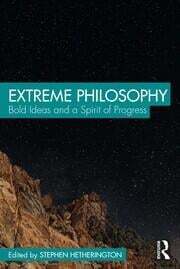
Philosophy’s value and power are greatly diminished when it operates within a too closely confined professional space. Extreme Philosophy: Bold Ideas and a Spirit of Progress serves as an antidote to the increasing narrowness of the field. It offers readers–including students and general readers–twenty internationally acclaimed philosophers who highlight and defend odd, extreme, or ‘mad’ ideas. The resulting conjectures are often provocative and bold, but always clear and accessible.
Ideas discussed in the book, include:
propaganda need not be irrational
science need not be rational
extremism need not be bad
tax evasion need not be immoral
anarchy need not be uninviting
democracy need not remain as it generally is
humans might have immaterial souls
human minds might have all-but-unlimited powers
knowing might be nothing beyond being correct
space and time might not be ‘out there’ in reality
value might be the foundational part of reality
value might differ in an infinitely repeating reality
reality is One
reality is vague
In brief, the volume pursues adventures in philosophy. This spirit of philosophical risk-taking and openness to new, ‘large’ ideas were vital to philosophy’s ancient origins, and they may also be fertile ground today for philosophical progress.
More at: www.taylorfrancis.com
|
|
Scooped by
Complexity Digest
December 18, 2023 7:40 PM
|
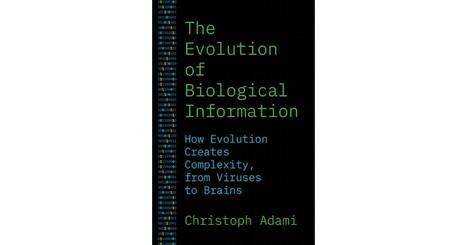
Why information is the unifying principle that allows us to understand the evolution of complexity in nature More than 150 years after Darwin’s revolutionary On the Origin of Species, we are still attempting to understand and explain the amazing complexity of life. Although we now know how evolution proceeds to build complexity from simple ingredients, quantifying this complexity is still a difficult undertaking. In this book, Christoph Adami offers a new perspective on Darwinian evolution by viewing it through the lens of information theory. This novel theoretical stance sheds light on such matters as how viruses evolve drug resistance, how cells evolve to communicate, and how intelligence evolves. By this account, information emerges as the central unifying principle behind all of biology, allowing us to think about the origin of life—on Earth and elsewhere—in a systematic manner.
Adami, a leader in the field of computational biology, first provides an accessible introduction to the information theory of biomolecules and then shows how to apply these tools to measure information stored in genetic sequences and proteins. After outlining the experimental evidence of the evolution of information in both bacteria and digital organisms, he describes the evolution of robustness in viruses; the cooperation among cells, animals, and people; and the evolution of brains and intelligence. Building on extensive prior work in bacterial and digital evolution, Adami establishes that (expanding on Dobzhansky’s famous remark) nothing in biology makes sense except in the light of information. Understanding that information is the foundation of all life, he argues, allows us to see beyond the particulars of our way of life to glimpse what life might be like in other worlds. Read the full article at: press.princeton.edu
|
|
Scooped by
Complexity Digest
December 3, 2023 4:56 AM
|
Amil Merchant, Simon Batzner, Samuel S. Schoenholz, Muratahan Aykol, Gowoon Cheon & Ekin Dogus Cubuk
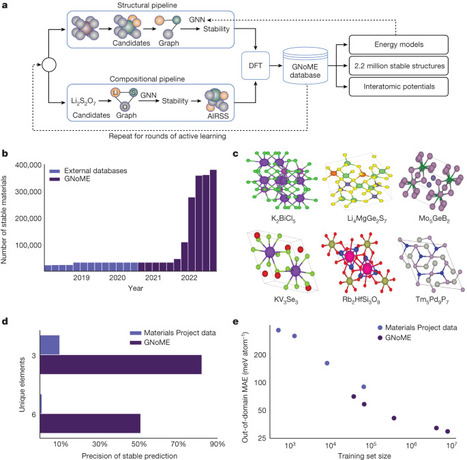
Nature (2023) Novel functional materials enable fundamental breakthroughs across technological applications from clean energy to information processing1,2,3,4,5,6,7,8,9,10,11. From microchips to batteries and photovoltaics, discovery of inorganic crystals has been bottlenecked by expensive trial-and-error approaches. Concurrently, deep-learning models for language, vision and biology have showcased emergent predictive capabilities with increasing data and computation12,13,14. Here we show that graph networks trained at scale can reach unprecedented levels of generalization, improving the efficiency of materials discovery by an order of magnitude. Building on 48,000 stable crystals identified in continuing studies15,16,17, improved efficiency enables the discovery of 2.2 million structures below the current convex hull, many of which escaped previous human chemical intuition. Our work represents an order-of-magnitude expansion in stable materials known to humanity. Stable discoveries that are on the final convex hull will be made available to screen for technological applications, as we demonstrate for layered materials and solid-electrolyte candidates. Of the stable structures, 736 have already been independently experimentally realized. The scale and diversity of hundreds of millions of first-principles calculations also unlock modelling capabilities for downstream applications, leading in particular to highly accurate and robust learned interatomic potentials that can be used in condensed-phase molecular-dynamics simulations and high-fidelity zero-shot prediction of ionic conductivity. Read the full article at: www.nature.com

|
Suggested by
zwick@pdx.edu
August 3, 2023 9:03 AM
|
This textbook is built around the central proposition that systems theory is an attempt to construct an “exact and scientific metaphysics” (an ESM). Read the full article at: link.springer.com
|
|
Scooped by
Complexity Digest
July 24, 2023 4:13 PM
|
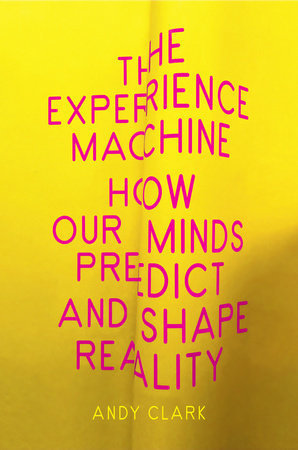
For as long as we’ve studied human cognition, we’ve believed that our senses give us direct access to the world. What we see is what’s really there—or so the thinking goes. But new discoveries in neuroscience and psychology have turned this assumption on its head. What if rather than perceiving reality passively, your mind actively predicts it? Widely acclaimed philosopher and cognitive scientist Andy Clark unpacks this provocative new theory that the brain is a powerful, dynamic prediction engine, mediating our experience of both body and world. From the most mundane experiences to the most sublime, reality as we know it is the complex synthesis of sensory information and expectation. Exploring its fascinating mechanics and remarkable implications for our lives, mental health, and society, Clark nimbly illustrates how the predictive brain sculpts all human experience. Chronic pain and mental illness are shown to involve subtle malfunctions of our unconscious predictions, pointing the way towards more effective, targeted treatments. Under renewed scrutiny, the very boundary between ourselves and the outside world dissolves, showing that we are as entangled with our environments as we are with our onboard memories, thoughts, and feelings. And perception itself is revealed to be something of a controlled hallucination. Unveiling the extraordinary explanatory power of the predictive brain, The Experience Machine is a mesmerizing window onto one of the most significant developments in our understanding of the mind.
More at: www.penguinrandomhouse.com
|
|
Scooped by
Complexity Digest
July 11, 2023 4:47 PM
|
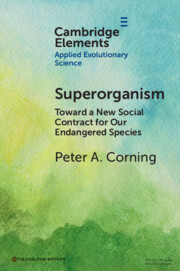
As evidence of our global survival crisis continues to mount, the expression 'too little, too late' comes to mind. We all live in an interdependent world which has an increasingly shared fate. We are participants in an emerging global 'superorganism' that is dependent on close cooperation. Indeed, positive synergy (cooperative effects) has been the key to our evolutionary success as a species. However, our ultimate fate is now in jeopardy. Going forward, we must either create a more effective global society (with collective self-governance) or our species will very likely be convulsed by mass starvation, waves of desperate migrants, and lethal social conflict. The greatest threat we may face is each other, and a regression into tribalism and violent conflict. This Element has a more hopeful prescription for a new global social contract. It is based on the many examples of superorganisms – socially organized species – in the natural world, and in evolution. More at: www.cambridge.org
|
|
|
Scooped by
Complexity Digest
September 26, 2024 11:41 AM
|
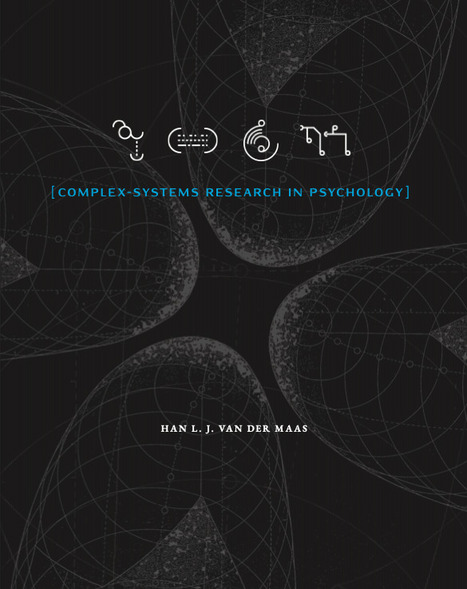
Humans are the ultimate complex systems. In this monograph intended for psychologists and social scientists interested in modeling psychological processes, Han L. J. van der Maas argues that we can only succeed in exploring the psychological system by understanding its complexity. By applying the tools of complexity science to psychology, researchers and practitioners can achieve desperately needed breakthroughs in the social sciences.
The book has three primary objectives: to provide a comprehensive overview of complex-systems research, with a particular emphasis on its applications in psychology and the social sciences; to provide skills for complex-systems research; and to foster critical thinking regarding the potential applications of complex systems in psychology. Readers should have a basic understanding of mathematics and knowledge of the programming language R.
Complex-Systems Research in Psychology explores a range of topics, including chaos, bifurcation, and self-organization in psychological processes, psychological network analysis, as well as agent-based modeling of social processes. It offers applications in various areas of psychology, such as perception, depression, addiction, cognitive development, and polarization.
Download full book at: www.sfipress.org
|
|
Scooped by
Complexity Digest
September 17, 2024 11:45 AM
|
The Complex World, originally published in Volume 1 of Foundational Papers in Complexity Science, presents an entirely new framing of nature, of the human role in the natural and technological worlds, and what it means to prosper on a living planet. We live in a complex world—meaning one that is increasingly connected, evolving, technological, volatile, and potentially poised for catastrophe. And yet we continue to treat the world as if it were simple: linear, unchanging, disconnected, and infinitely exploitable. Complexity science is an approach to understanding and surviving in a complex world. In this concise and comprehensive introduction, Santa Fe Institute President David C. Krakauer traces the roots of complexity science back to the nineteenth-century science of machines—evolved and engineered—into the twentieth-century science of emergent systems. By combining insights from evolution, computation, nonlinear dynamics, and statistical physics, complexity science provides the first scientific framework for understanding the purposeful universe. More at: www.sfipress.org
|
|
Scooped by
Complexity Digest
July 2, 2024 8:56 PM
|
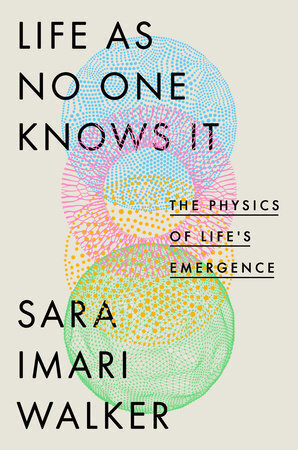
An intriguing new scientific theory that explains what life is and how it emerges.
What is life? This is among the most difficult open problems in science, right up there with the nature of consciousness and the existence of matter. All the definitions we have fall short. None help us understand how life originates or the full range of possibilities for what life on other planets might look like.
In Life as No One Knows It, physicist and astrobiologist Sara Imari Walker argues that solving the origin of life requires radical new thinking and an experimentally testable theory for what life is. This is an urgent issue for efforts to make life from scratch in laboratories here on Earth and missions searching for life on other planets.
Walker proposes a new paradigm for understanding what physics encompasses and what we recognize as life. She invites us into a world of maverick scientists working without a map, seeking not just answers but better ways to formulate the biggest questions we have about the universe. The book culminates with the bold proposal of a new theory for identifying and classifying life, one that applies not just to biological life on Earth but to any instance of life in the universe. Rigorous, accessible, and vital, Life as No One Knows It celebrates the mystery of life and the explanatory power of physics.
More at: www.penguinrandomhouse.com
|
|
Scooped by
Complexity Digest
May 6, 2024 11:28 AM
|
Foundational Papers in Complexity Science maps the development of complex-systems science through eighty-eight revolutionary works originally published between 1922 and 2000. Curated by SFI President David C. Krakauer, each seminal paper is introduced and placed into its historical context, with enduring insights discussed by leading contemporary complexity scientists.
These four volumes are a product of collective intelligence. More than a compilation, Foundational Papers represents large-scale collaboration within the SFI community—brilliant thinkers who have contextualized the work that shaped their own research, resulting in a sparkling demonstration of how complexity shatters the usual scientific divisions and a look back at the path we’ve followed in order to gain a clearer view of what lies ahead. Read the full article at: www.foundationalpapersincomplexityscience.org
|
|
Scooped by
Complexity Digest
April 29, 2024 9:57 PM
|
Beyond is a Socratic love story, a Platonic dialogue, a Bhagavad Gita of our times: a philosophical quest folded into an epic exploration of the world. Imagine an encounter with unconfused human existence. What does it mean to fall in love with God? Can the Good only adopt the role of a servant, or can it rise to provide a beacon of light ruling us?
How often we are caught in the myopic perspective that the material world is all there is! And yet, mathematics and science themselves point to a greater, all-embracing, unchanging reality. This insight suffices to move past selfishness and advance humanity to the next level. Beyond dismantles the artificial borders that have for too long separated genres: here, science confronts philosophy, mathematics engages religion, poetry brings nonfiction to life, time meets infinity. Beyond is sui generis. Read the full article at: angelicopress.com
|
|
Scooped by
Complexity Digest
March 26, 2024 9:27 AM
|
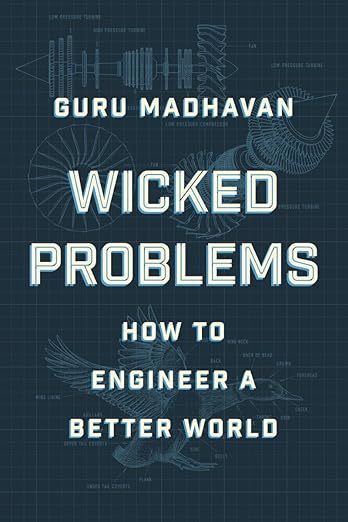
An ode to systems engineers―whose invisible work undergirds our life―and an exploration of the wicked problems they tackle. Our world is filled with pernicious problems. How, for example, did novice pilots learn to fly without taking to the air and risking their lives? How should cities process mountains of waste without polluting the environment? Challenges that tangle personal, public, and planetary aspects―often occurring in health care, infrastructure, business, and policy―are known as wicked problems, and they are not going away anytime soon. In linked chapters focusing on key facets of systems engineering―efficiency, vagueness, vulnerability, safety, maintenance, and resilience―engineer Guru Madhavan illuminates how wicked problems have emerged throughout history and how best to address them in the future. He examines best-known tragedies and lesser-known tales, from the efficient design of battleships to a volcano eruption that curtailed global commerce, and how maintenance of our sanitation systems constitutes tikkun olam, or repair of our world. Braided throughout is the uplifting tale of Edwin Link, an unsung hero who revolutionized aviation with his flight trainer. In Link’s story, Madhavan uncovers a model mindset to engage with wickedness. An homage to society’s innovators and maintainers, Wicked Problems offers a refreshing vision for readers of all backgrounds to build a better future and demonstrates how engineering is a cultural choice―one that requires us to restlessly find ways to transform society, but perhaps more critically, to care for the creations that already exist. More at: www.amazon.com
|
|
Scooped by
Complexity Digest
March 24, 2024 11:41 PM
|
This book provides a unified, theory-driven introduction to key mathematical and agent-based models of social dynamics and cultural evolution, teaching readers how to build their own models, analyze them, and integrate them with empirical research programs. It covers a variety of modeling topics, each exemplified by one or more archetypal models, and helps readers to develop strong theoretical foundations for understanding social behavior. Modeling Social Behavior equips social, behavioral, and cognitive scientists with an essential tool kit for thinking about and studying complex social systems using mathematical and computational models. More at: press.princeton.edu
|
|
Scooped by
Complexity Digest
December 23, 2023 6:45 PM
|
Why do we get certain diseases, whereas other diseases do not exist? In this book, Alon, one of the founders of systems biology, builds a foundation for systems medicine. Starting from basic laws, the book derives why physiological circuits are built the way they are. The circuits have fragilities that explain specific diseases and offer new strategies to treat them. By the end, the reader will be able to use simple and powerful mathematical models to describe physiological circuits. The book explores, in three parts, hormone circuits, immune circuits, and aging and age-related disease. It culminates in a periodic table of diseases. Alon writes in a style accessible to a broad range of readers - undergraduates, graduates, or researchers from computational or biological backgrounds. The level of math is friendly and the math can even be bypassed altogether. For instructors and readers who want to go deeper, the book includes dozens of exercises that have been rigorously tested in the classroom More at: www.taylorfrancis.com
|
|
Scooped by
Complexity Digest
December 4, 2023 2:54 PM
|
A Passion for Cooperation is the exciting autobiography of Robert Axelrod, one of the most acclaimed and wide-ranging scientists of the last fifty years. After being recognized by President Kennedy for being a promising young scientist while in high school, Axelrod built a career dedicated to collaborating with business school professors, international relations scholars, political scientists, computer scientists, and even evolutionary biologists and cancer researchers. Fifty years later, he was honored by President Obama with the National Medal of Science for scientific achievement and leadership and his work has been referred to as the gold standard of interdisciplinary research. Yet Axelrod’s autobiography is not just an account of his wide-ranging passion for cooperation. It reveals his struggles to overcome failures and experience the joys of gaining new insights into how to achieve cooperation. A Passion for Cooperation recounts Robert Axelrod’s adventures talking with the leader of the organization Hamas, the Prime Minister of Israel, and the Foreign Minister of Syria. Axelrod also shares stories of being hosted in Kazakhstan by senior Soviet retired generals and visiting China with well-connected policy advisors on issues of military aspects of cyber conflict. Through stories of the difficulties and rewards of interdisciplinary collaborations, readers will discover how Axelrod’s academic and practical work have enriched each other and demonstrated that opportunities for cooperation are much greater than generally thought. More at: press.umich.edu
|
|
Scooped by
Complexity Digest
August 29, 2023 9:45 AM
|
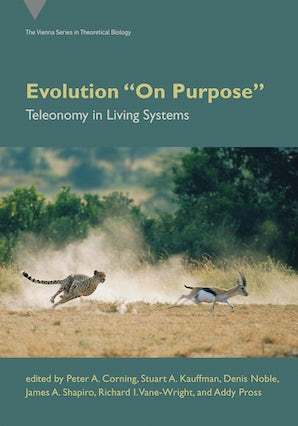
A unique exploration of teleonomy—also known as “evolved purposiveness”—as a major influence in evolution by a broad range of specialists in biology and the philosophy of science. The evolved purposiveness of living systems, termed “teleonomy” by chronobiologist Colin Pittendrigh, has been both a major outcome and causal factor in the history of life on Earth. Many theorists have appreciated this over the years, going back to Lamarck and even Darwin in the nineteenth century. In the mid-twentieth century, however, the complex, dynamic process of evolution was simplified into the one-way, bottom-up, single gene-centered paradigm widely known as the modern synthesis. In Evolution “On Purpose,” edited by Peter A. Corning, Stuart A. Kauffman, Denis Noble, James A. Shapiro, Richard I. Vane-Wright, and Addy Pross, some twenty theorists attempt to modify this reductive approach by exploring in depth the different ways in which living systems have themselves shaped the course of evolution. Evolution “On Purpose” puts forward a more inclusive theoretical synthesis that goes far beyond the underlying principles and assumptions of the modern synthesis to accommodate work since the 1950s in molecular genetics, developmental biology, epigenetic inheritance, genomics, multilevel selection, niche construction, physiology, behavior, biosemiotics, chemical reaction theory, and other fields. In the view of the authors, active biological processes are responsible for the direction and the rate of evolution. Essays in this collection grapple with topics from the two-way “read-write” genome to cognition and decision-making in plants to the niche-construction activities of many organisms to the self-making evolution of humankind. As this collection compellingly shows, and as bacterial geneticist James Shapiro emphasizes, “The capacity of living organisms to alter their own heredity is undeniable.” More at: mitpress.mit.edu
|
|
Scooped by
Complexity Digest
July 25, 2023 6:32 PM
|
|
|
Scooped by
Complexity Digest
July 16, 2023 1:36 PM
|
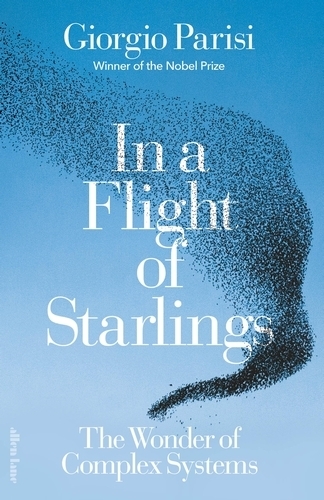
The world is shaped by complexity. In this enlightening book, Nobel Prize winner Giorgio Parisi guides us through his unorthodox yet exhilarating work to show us how. It all starts with investigating the principles of physics by observing the sophisticated flight patterns of starlings. Studying the movements of these birds, he has realized, proves an illuminating way into understanding complex systems of all kinds - collections of everything from atoms to planets to other animals like ourselves.
Along the way, Parisi reflects on the lessons he's taken from a life in pursuit of scientific truth: the importance of serendipity to the discovery of new ideas, the surprising kinship between physics and other fields of study and the value of science to a thriving society. In so doing, he removes the practice of science from the confines of the laboratory and into the real world. Complexity is all around us - from climate to finance to biology, it offers a unique way of finding order in chaos.
Part elegant scientific treatise, part thrilling intellectual journey, In a Flight of Starlings is an invitation to find wonder in the world around us. More at: www.penguin.co.uk
|