Your new post is loading...

|
Scooped by
Complexity Digest
July 14, 8:21 AM
|
Explore academic impact beyond rankings. Rankless offers a fresh perspective on how universities influence each geography and topic, emphasizing diverse forms of impact and providing a richer understanding of academic influence. Read the full article at: www.rankless.org
|
|
Scooped by
Complexity Digest
July 3, 7:48 AM
|
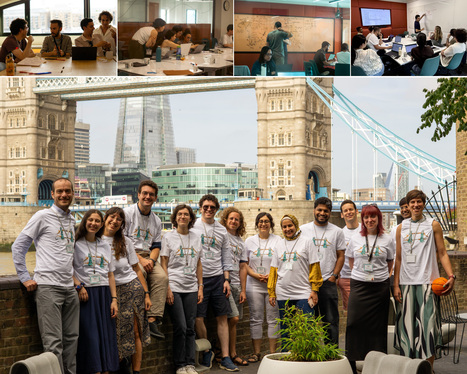
The 2026 edition of the Complexity 72h Workshop has wrapped up in London, bringing together roughly 60 participants and 14 tutor teams for five days of intensive, collaborative science. Hosted by Northeastern University London and the Network Science Institute (NetSI) at their Devon House campus—a striking location overlooking London’s historic St Katharine Docks, the event carried on a tradition launched in 2018 where researchers form small teams around a specific project and work flat-out for 72 hours, with the goal of having a paper ready for an online repository by the time the clock runs out. The track record so far is perfect — all 33 projects from past editions have resulted in preprints, and 9 have gone on to become peer-reviewed publications, leading to long-term collaborations. This year's cohort tackled a notably wide range of questions. Projects spanned political polarization and belief networks, brain connectivity and the social self, regional greenhouse-gas trends, emergent deception in LLM-based agent models, statistical signatures of success in NBA basketball, patterns in egocentric communication networks, and the long-term impact of AI on education. The diversity of topics is part of what makes the format so productive: participants arrive from different disciplines and leave having genuinely done science together. True to the workshop’s mission of producing a research preprint within 72 hours, the results of the seven projects can already be viewed on arXiv Read the full article at: www.networkscienceinstitute.org
|
|
Scooped by
Complexity Digest
May 1, 1:49 PM
|
This initiative aims to identify and structure the foundational contributions that define complex systems, network science, and related domains, across theory, methods, and applications. The goal is to build a coherent, field-wide reference that reflects how the discipline is actually used and understood across different subdomains.
In recent years, large-scale models and automated systems have made it possible to synthesize vast amounts of scientific information. However, identifying what is foundational — what truly shapes the conceptual and methodological backbone of a field — still requires distributed expert judgment. This effort is designed to complement algorithmic approaches by leveraging collective intelligence: many independent perspectives, aggregated into a structured view.
The objective is not to produce a simple ranking of famous papers, but to build a structured map of the field’s foundations, including works that may be missing from keyword-based or citation-based approaches. Read the full article at: manliodedomenico.com
|
|
Scooped by
Complexity Digest
February 20, 8:10 PM
|
The yrCSS Advisory Board is composed of six members and is partially renewed every year. This year, there are three vacant places with a mandate of two years. We are therefore looking for motivated early-career researchers who wish to be a part of the Advisory Board. Please, consider applying and/or spreading this call. Application deadline: February 28th Voting: March 1-15th More at: yrcss.cssociety.org
|
|
Scooped by
Complexity Digest
February 17, 2:10 PM
|
Complexity72h is a cross-disciplinary workshop where young researchers work in small interdisciplinary teams on a real research project in complex systems over 72 intense hours. 📍 June 21–26, 2026 | Northeastern University London
👩🔬 Open to Master’s students, PhD students, and postdocs
📌 Application deadline: February 28th, 2026 Registration fee: €710 (includes 5 nights accommodation, workshop facilities, coffee breaks, lunches, invited lectures, and social events). More information and applications: https://complexity72h.com
|
|
Scooped by
Complexity Digest
December 4, 2025 4:30 PM
|
Complex systems fascinate because of the way dynamic microscopic interactions give rise to striking, often unexpected macroscopic structures: convection cells in fluids, patterns in ecosystems, networks in societies, and organization in biology. What unites these diverse examples is the deep link between how the agents in systems move and what structure emerges. While diverse approaches have been proposed, in addition, a unifying language may lie in variational principles and optimal control in stochastic and dissipative regimes which can offer a powerful language for understanding this interplay. Action principles are among the most unifying ideas in science: from Lagrangian mechanics to quantum field theory, they describe how nature selects pathways. The stochastic-dissipative extensions of the principle of least action in the form of path integrals, such as by Onsager-Machlup and more recent versions provide a natural framework for describing how agents and processes, obeying fundamental physical laws, select the most probable and efficient pathways under constraints. These pathways not only govern system dynamics but also generate—and are constrained by—emergent structures. Feedback between dynamics and structure thus shapes evolution, with frozen accidents and historical contingencies balanced against tendencies toward action-efficient configurations. If dynamics select the most probable, efficient pathways, then structure itself may be seen as the lasting imprint of such pathways. Can such principles also help explain the emergence of complexity? This Collection aims to gather theoretical, computational, and empirical contributions that advance the use of variational principles to explain and predict structure–dynamics interplay in complex systems. By doing so, we hope to move toward general non-equilibrium thermodynamics capable of grounding complexity science in physics while connecting to diverse domains of application. Contributions are welcome across disciplines, from mathematics and physics to biology, engineering, and social sciences. Themes may include, but are not limited to: - Stochastic and dissipative formulations of variational principles.
- Path integrals and optimal control.
- Structure formation in non-equilibrium thermodynamics.
- Agent-based simulations and computational models.
- Empirical case studies from physical, chemical, biological, or social systems.
- Comparative perspectives with non-variational approaches.
The aim is to advance a physics-grounded framework for understanding how complex structures emerge and persist under dynamic constraints. The objective of this Collection is to foster dialogue among researchers working on different manifestations of the same fundamental questions: How do dynamics give rise to structure, how structure determines dynamics, and how can variational principles provide the key to understanding this process across scales and systems? Can variational pathways explain the emergence of complex structures from dynamics across nature and society? More at: www.nature.com
|
|
Scooped by
Complexity Digest
September 10, 2025 9:29 AM
|
The Evolving Landscape of Complex Systems is a curated special collection in npj Complexity inspired by themes explored at the Conference on Complex Systems 2025 (CCS25). This collection consolidates emerging advances in theory, methodologies, and applications across the multifaceted area of complexity science. It seeks contributions that span the full spectrum - from novel computational frameworks and multiscale analyses to domain-adaptive models and novel complexity science applications - reflecting the discipline’s rapid evolution.
This collection invites novel research that explores:
Conceptual foundations and theory: advancements in network science, emergent dynamics, agent-based modelling, nonlinear systems, and adaptive behaviours, providing refined lenses for interpreting complex phenomena.
Cross-scale integration and robustness: studies elucidating how micro-level interactions scale up to macro-level patterns, resilience, and adaptation in systems spanning biological, social, technological, and ecological networks.
Computational innovation: cutting-edge analytical and computational methods - ranging from data-driven approaches and AI-augmented modelling to novel simulations and multilevel inference - that enhance the understanding and manipulation of complex systems.
Interdisciplinary and application-oriented research: compelling case studies where complexity science addresses urgent global challenges - such as pandemics, misinformation, climate change, socioeconomic inequality, inclusivity and diversity, and governance - demonstrating adaptability and societal relevance.
Submissions are welcomed from all researchers working in complexity science, regardless of conference participation. More at: www.nature.com
|
|
Scooped by
Complexity Digest
April 10, 2025 10:40 AM
|
For decades Hiroki Sayama has sought to achieve what a century ago would have been mere science fiction—creating life on our computers. Read the full article at: amahury.github.io
|
|
Scooped by
Complexity Digest
March 5, 2025 10:10 AM
|
The goal of this course is to help produce a community of leaders that is equally knowledgeable in neuroscience, cognitive science, and computer science and will lead the scientific understanding of intelligence and the development of true biologically inspired AI. Course/Program Dates:
Aug 03, 2025 - Aug 24, 2025
Application due date:
Mar 24, 2025 The basis of intelligence – how the brain produces intelligent behavior and how to endow machines with human-like intelligence – is arguably the greatest problem in science and technology. To solve it, we will need to understand how natural intelligence emerges from computations in neural circuits, with rigor sufficient to reproduce similar intelligent behavior in machines. Success in this endeavor will ultimately enable us to understand ourselves better, to produce smarter machines, and perhaps even to make ourselves smarter. Today’s AI technologies are impressive but quite different from human intelligence. We still do not understand the mechanisms underlying the robustness, the generalization, and the continual learning capabilities of biological intelligence. The synergistic combination of cognitive science, neurobiology, engineering, mathematics, and computer science holds the promise of significant progress. Elucidating how human intelligence works will in turn lead to more sophisticated AI algorithms. The goal of this course is to help produce a community of leaders that is equally knowledgeable in neuroscience, cognitive science, and computer science and will lead the scientific understanding of intelligence and the development of true biologically inspired AI. Apply at: www.mbl.edu
|
|
Scooped by
Complexity Digest
February 25, 2025 2:28 PM
|
EPJ Data Science Submission deadline 31 July 2025 Digital, information and communication technologies, together with Big Data, the Internet of Things, and Artificial Intelligence, are reshaping almost every aspect of our societies. From traffic to logistics, from mobility to smart cities and societies, much of this gears towards more predictability, controllability, and automation, using digital twins and many other approaches. Optimizing performance, sustainability, resilience, and health are often stated goals. But what roles will complexity and collective intelligence, democracy and human rights, ethics, agency and freedom, co-creation and co-evolution play? And how can scientific disciplines – from data science and complexity theory to computational social science, network analysis, transportation modeling, game theory, and agent-based as well as AI-driven models – contribute to understanding these challenges and to shaping future solutions? This special collection seeks to reflect on recent advances in these fields and explore visions for the future. It will provide a platform for critical reflection on the scientific methodologies and technological strategies currently driving our world. We invite inspiring contributions that provoke innovative thoughts and stimulate rigorous debate on the future trajectory of these technologies and the socio-technical systems that are expected to result from them. Submit at: link.springer.com
|
|
Scooped by
Complexity Digest
February 3, 2025 2:26 PM
|
Applications for the third Complexity Global School (CGS) are now open. Like last year, the school will be hosted at Universidad de los Andes (Uniandes), in Bogotá, Colombia, but for the first time, applicants from all countries are eligible to apply. Roughly 60 students will be selected for the school, which will run July 28 – August 8, 2025. Supported by the Omidyar Network and the Ford Foundation, the school is free for all admitted students — tuition, room, board, and a travel stipend are included. Applications are due by March 2, 2025. Apply at: www.santafe.edu
|
|
Scooped by
Complexity Digest
January 29, 2025 11:24 AM
|
Ole Teutloff, Johanna Einsiedler, Otto Kässi, Fabian Braesemann, Pamela Mishkin, R. Maria del Rio-Chanona Journal of Economic Behavior & Organization We examine how ChatGPT has changed the demand for freelancers in jobs where generative AI tools can act as substitutes or complements to human labor. Using BERTopic we partition job postings from a leading online freelancing platform into 116 fine-grained skill clusters and with GPT-4o we classify them as substitutable, complementary or unaffected by LLMs. Our analysis reveals that labor demand increased after the launch of ChatGPT, but only in skill clusters that were complementary to or unaffected by the AI tool. In contrast, demand for substitutable skills, such as writing and translation, decreased by 20–50% relative to the counterfactual trend, with the sharpest decline observed for short-term (1-3 week) jobs. Within complementary skill clusters, the results are mixed: demand for machine learning programming grew by 24%, and demand for AI-powered chatbot development nearly tripled, while demand for novice workers declined in general. This result suggests a shift toward more specialized expertise for freelancers rather than uniform growth across all complementary areas. Read the full article at: www.sciencedirect.com
|
|
Scooped by
Complexity Digest
January 9, 2025 1:01 PM
|
Robert Rosen was a leading theoretical biologist in the tradition of relational biology, making important contributions to the understanding of living systems. We believe that Robert Rosen’s work represents valuable perspectives on biology, causality, and science as a whole, and that it deserves to be more widely known and read. Over the last four years, we have taken care in classifying his complete published works, including articles, chapters, commentaries, and books both in and out of print, and most importantly, scanning and sorting a small part of his vast collection of unedited notes, which contain ideas that extend beyond his published works. Our hope is that interested readers will find a foundation here for a new science of biological systems, one that reflects the nature and complexity of these systems. Visit: www.rosenlife.org
|
|
|
Scooped by
Complexity Digest
July 5, 7:51 AM
|
Nathaniel J. Gaut, Christopher Deich, Brock Cash, Tanner Hoog, Aaron E. Engelhart, Katarzyna P. Adamala Prof. Kate Adamala and her team at the University of Minnesota have built SpudCell, a cell-like system constructed entirely from known chemical components that can perform a complete cell cycle. The system contains 36 purified enzymes, a 90,000 base pair genome spread across nine separate DNA molecules, and a lipid membrane. SpudCell is able to grow, replicate its genome, divide, and undergo selection and competition across multiple generations. Unlike earlier work on minimal cells that carved down living cells, SpudCell is built entirely bottom-up from individually purified, non-living components. It is the first time such a system has demonstrated a complete cell cycle. Read the full article at: biotic.org
|
|
Scooped by
Complexity Digest
May 29, 2:44 PM
|
Queen’s University Belfast is delighted to launch the recruitment process for 20 Early-Stage Researchers (ESRs) as part of its Foresighters Doctoral Training Programme. This offers an exceptional opportunity for future research leaders to access an innovative programme of doctoral training at one of the UK’s leading universities and engage in high impact, inter-disciplinary research with a wide range of non-academic partners. FORESIGHTERS (Future ORiEnted Skills, Innovation for Governance for Health, Technology, EneRgy, citieS and creativity) offers unique opportunities to build a future research career that tackles complex societal problems. While researchers will be based in academic units across the university, from engineering, humanities, social science and the arts, they will be working within one of 5 interdisciplinary research themes (Health, Technology, Energy, Future Cities, and Creativity). The cohort of researchers will be bound by a common perspective and training in Futures Thinking and Futures Literacy and will develop the skills and capabilities to understand, imagine, and critically use different ideas about the future to better understand key challenges. In addition to advanced training offered by the Thomas Moran Graduate School, FORESIGHTERS ESRs will be trained in skills for anticipating change and using multiple possible futures to stimulate reflection, creativity, resilience and focus for contemporary action. The training programme also has a strong emphasis on the development of sustainable, diverse, and equitable research environments. More at: www.qub.ac.uk
|
|
Scooped by
Complexity Digest
February 23, 2:19 PM
|
The Max Planck Institute for Demographic Research (MPIDR) in Rostock is one of the leading demographic research centers in the world. It's part of the Max Planck Society, the internationally renowned German research society.
More at: www.demogr.mpg.de
|
|
Scooped by
Complexity Digest
February 12, 3:11 PM
|
The Complex Systems Society (CSS) organizes every year the Conference on Complex Systems (CCS), the flagship annual meeting of the international complexity science community.
The CSS hereby invites bids to host the 2028 edition of CCS.
The conference is typically held in September–October and is intended to be primarily an in-person event, in order to preserve the value of direct interaction and collective discussion that characterize CCS. Hybrid formats may nevertheless be considered in a limited form, in particular to ensure inclusivity for participants who are unable to travel.
Interested organizing teams are invited to submit a proposal document outlining their bid.
More at: cssociety.org
The Max Planck – University of Helsinki Center for Social Inequalities in Population Health is currently seeking to appoint one or more full-time post-doctoral researchers. We welcome applications from researchers with a PhD in demography, sociology, statistics, epidemiology, public health, biology, anthropology, economics, computer science, and allied fields. The successful candidate(s) will work on the role of genetic factors in shaping health inequalities, and/or they will develop novel techniques for leveraging genetic data. We are also open to applicants interested in the other research themes of the Center (family and health, health inequalities in an international perspective), and in other topics covered in the Department Social Demography at the Max Planck Institute for Demographic Research (MPIDR), including fertility, mortality and morbidity, and labor markets. The successful candidate(s) will develop their own agenda within the Center, and they will contribute their skills and knowledge to other projects in the Center and to the MPIDR. We are seeking creative, self-driven, and collaborative scholars. Advanced knowledge of quantitative methods and statistical software such as R, Python, or Stata is required. Read the full call at: www.demogr.mpg.de
|
|
Scooped by
Complexity Digest
August 6, 2025 3:38 AM
|
The Santa Fe Institute is now accepting applications for the 2026 Complexity Postdoctoral Fellowships! Complexity fellows contribute to SFI’s research and collaborate with leading researchers worldwide. If you recently completed your PhD in any scientific discipline and are interested in transdisciplinary research, consider applying. SFI offers independent research opportunities and support to explore big questions across disciplines.
|
|
Scooped by
Complexity Digest
March 5, 2025 10:36 AM
|
Submission Deadlines:
Abstracts: 01 April 2025
Full Papers: 01 August 2025
Publication: March-April 2026 Cybernetics and systems education have long played a vital role in understanding complex, purposeful and adaptive systems. With the advent of next generation artificial intelligence and with the vast range of complex socio-technical systems that require collective transformation, cybernetic and systems principles have only become more relevant. There is a growing, transnational need for education programs to prepare the current and next generation to operate within and beyond these frameworks. This special issue seeks to bring together educators, researchers and practitioners to explore the past, present, and future of cybernetics and systems education. We aim to examine how cybernetic concepts and systems thinking have been previously and/or are currently integrated into educational paradigms, showcase novel approaches to teaching these principles, and envision transformative methodologies that may shape the future of cybernetics and systems education. Through this special issue we seek to create and promote a transnational network to further cybernetic and cybernetically informed systems education. Read the full article at: onlinelibrary.wiley.com
|
|
Scooped by
Complexity Digest
March 2, 2025 9:45 PM
|
Complexity and Networks COmmunity and REsources (CORE) is an organization dedicated to connecting scientists and organizations in the fields of Complexity and Network Science. We enhance collaboration among organizations that organize talks, seminars, and events, and we collect all conference and job application deadlines to create a hub where scientists can find relevant news and information. On this page, you will find information about the organizations and contributors involved in this project. CORE Members: NetPlace, yrCSS, WiNS, Complexity Cat, WWCS, Complexity72h. More at: complexity-core.github.io
|
|
Scooped by
Complexity Digest
February 23, 2025 9:28 PM
|
The scientific community is increasingly aware of the profound challenges associated with research evaluation, particularly the reliance on quantitative journal metrics such as the impact factor as proxies for scientific quality. These practices have entrenched a system where researchers are compelled to publish in high-cost, high-impact journals to advance their careers, often at the expense of broader scientific contributions. Despite the growing adoption of initiatives like DORA (https://sfdora.org), Plan S (https://www.coalition-s.org), CoARA (https://coara.eu), or PEER Community (https://peercommunityin.org), which aim to reform research assessment and promote open science, progress has been slow, and deeply-ingrained evaluation schemes still dominate. Thus, initiatives that support dissemination of knowledge (outreach, extension), data curation and sharing, research in non-academic contexts (which is more “messy”, difficult to conduct) and in response to real-world needs and with impact is not sufficiently valued. These issues are compounded by the dominance of commercial publishers, whose exorbitant article processing charges (APCs) and profit-driven models exploit the academic community creating inequalities, fostering an unsustainable and unfair publishing system that threatens the very preservation and dissemination of scholarly knowledge. Read the full article at: cssociety.org
|
|
Scooped by
Complexity Digest
February 2, 2025 4:45 PM
|
|
|
Scooped by
Complexity Digest
January 28, 2025 3:40 PM
|
The Complex Systems Seminar Series covers a wide range of topics, providing an opportunity for presenters to share and attendees to become exposed to the latest research from different fields and disciplines.
Agent-based simulation, artificial intelligence, artificial life, genetic algorithms, machine learning, neural networks, signal processing, social networks, system dynamics, and science itself are just a few of the many diverse topics that have been presented, all in an informal environment where questions and discussion are encouraged. Schedule at: www.pdx.edu
|