There are only two smartphone companies that matter: Samsung and Apple.
This chart shows preliminary smartphone shipment estimates for Q1 from analyst Horace Dediu of Asymco. As you can see, it's a two horse race. Everyone else is irrelevant.
Facebook today announced that it has agreed to acquire the photo-sharing app Instagram for $1 billion in cash and stock. The deal is expected to close later in the June quarter.
The Bring Your Own Device (BYOD) movement has gained unstoppable momentum. And thanks to the burgeoning mobile app market, employees have high expectations for these tools. They want an attractive user experience tailored to their devices. In other words, companies need to invest in building apps, period. During my two decades of working in enterprise IT, I’ve observed the client-server revolution, the internet explosion and the service-oriented architecture (SOA) boom. Despite all the buzz around cloud and big data, I believe mobile will dominate enterprise IT transformation over the next decade and help to shape those other two trends. Our company, Layer 7 Technologies, and competitors such as Apigee and Mashery, are providing API management solutions to support mobile integration for the consumer app market. I believe that BYOD will spark an ever greater demand for API management to address enterprise mobile apps.
Activist hedge funder Dan Loeb created this chart which shows the diminishing value of Yahoo's core business over the last seven years.
He says the core businesses value has gone from $30 billion in 2008 based on the Microsoft buyout offer to $2 billion in the last six and half years.
Loeb arrived at the value for Yahoo's core business by backing out the value of its cash, its stake in Alibaba (after taxes), and Yahoo Japan (after taxes). Importantly, this isn't necessarily a reflection of the true value of the business, just what the market thinks, says Loeb.
The Apple Store is already way more efficient than shopping in most other stores -- there are usually dozens of clerks walking around with handheld card readers, so you never have to wait in a long line for a cash register. But sometimes the store gets so crowded, it's hard even to find a clerk to check you out. That's where the Apple Store App comes in. It was released last week for the iPhone 4 and 4S, and lets you buy small items like chargers, cases, or packaged software without ever talking to a single person in the store.
The latest comScore data (period ending February) shows that Android added 2.87 million users to its base while iPhone added 1.52 million. If we assume that Android sold a minimal number of replacements (due to the limited time in use of bulk of units) and round up to 3 million for February, and if we assume that Apple sells as many iPhones as Android (which is what Walkley suggests) then we can conclude that in the US roughly half the iPhones are bought as replacements for existing iPhones.
Extrapolating this to global markets may be risky but already we can begin to form a picture of how the iPhone franchise is becoming an annuity-based business.
Apple's gains are the result of a few key factors, all of which demonstrate that Apple learned a searing lesson from its failure in the 1990s PC market:
• First, in the U.S, Apple has finally broadened distribution of the iPhone to Verizon and Sprint, instead of just selling through AT&T • Second, Apple introduced a "low-price" version of the iPhone--the 3GS--which gives price-conscious consumers an Apple alternative (lots of Android phones are cheap) • Third, Apple broadened its distribution channels to major retailers like Walmart, Amazon, and Best Buy, which has given it access to consumers it might not otherwise have reached • Fourth, and critically, Apple's products now cost the same as high-end alternatives, instead of selling at a "premium price." In the 1990s, Macs were always more expensive than PCs. Some Apple fanatics were willing to pay these high prices, but most normal people weren't. This contributed to Apple becoming a niche player.
The title is a little too much... Remember Talleyrand ?
The main advantage of Apple is in the much bigger serials because of a very limited range for dozen of millions each.
But, in the contrary, Apple need to maintain very high profits... which, in any market, keep competitors alive, many competitors and some big like Samsung (40% of iPad3 comes from Samsung).
Android is not dead in the water...
The business insider slide shown above has a sister which shows that Google is winning big on mobile ads and nobody comes close.
Google's investment arm, Google Ventures, doesn't divide its $1 billion into tech-specific funds. Even so, big data is one area it has begun to focus, says partner Karim Faris. Faris is one of the backers of ClearStory Data, a big data startup that launched this week. But he told Business Insider that he and other partners will be launching more in the next few weeks. Google is almost uniquely qualified to identify big data startups given that much of the new technology is based on techniques invented at Google, like MapReduce and Google File System (GFS). "We're lucky to have in our backyard dozens of people that know a lot about the problem in real life," he says. "So we've got a good understanding of the issues and the opportunities. There's going to be a lot coming out of us in the next few months in this space," he adds.
This chart compares Apple and Research In Motion's stocks over the last twelve months. It pretty much tells the tale of the two smartphone companies. One is ascendant, while the other is in free fall.
Brutal demise of an icon. Although their model was platform based (both ends of the value chain), they did not resist the 2007 shift toward both touch UIs and Open OS app platforms.
The smart move was Instagram’s when they chose to not integrate their app with Facebook last year. It must have taken balls to resist the temptation, but they made it. Because the service was growing independently of Facebook, capturing TSO and growing their user base very fast, they became a threat.
With the $50mm round they were raising at $500mm value a few days ago, they were on the path to becoming an unaffordable threat, in both senses. Facebook had one bullet, and they fired it quickly. Investors at $500mm valuation would not have agreed to selling at a small premium. Hence the offer that made the deal, at a x2 valuation: $1bn.
The hardware of the iPad has matured to the point where it is almost transparent. This means that the most interesting signs of its growth and maturity as a platform come in the apps that we’re seeing for it. And those apps are largely boring slaves to the standard touch gestures and interface conventions that Apple released with the iPhone back in 2007. It’s now 5 years after multitouch and it’s time for the iPad to move beyond those basic interface tricks into uncharted interface territories. iPhoto for iOS is here to help us realize that there is more to touch than pinch, swipe and tap, and that we’re just seeing the tip of the iceberg in touch control.
Releasing an app in order to push the boundaries and move the platform forward is nothing new for Apple. Just look at Garage Band and iMovie from last year. They’re still arguably some of the best and most feature-rich apps on the App Store and they proved that there was room for serious creative apps on the tablet.
How does Facebook deploy improvements to one of the world's largest websites—and do so every day? Thank BitTorrent, IRC, karma, and a department called "release engineering." We go onsite with the team.
The Pew Internet and American Life Project says 21% of Americans have read an e-book in the last year as of February. That's up from 17% in December.
It also surveyed Americans to find out what they like about e-books versus print books. The result is above. As you can see, print books are only better for reading with a child, and sharing with friends.
"1998: Ken files a patent that classified how search results and ad results are sorted based on the number of click-thrus an ad gets. He sells the company to Lycos for $40 million. Ken Lang becomes CTO of Lycos and they take over his patents. $40 million! What? And then Lycos stock skyrockets up. I can’t believe it. I’m happy for my friend but also incredibly jealous although later in 1998 I sell my first company as well. Still, I wanted to be the only one I knew who made money. I didn’t think it was fun when other people I knew made money. And, anyway, weren’t search engines dead? I mean,what was even the business model? Fast forward: the 2000s. Almost every search engine dies. Excite, Lycos, Altavista. Before that “the world wide web worm”. Lycos got bought by a Spanish company, then a Korean company, then an Indian company. To be honest, I don’t even know who owns it now. It has a breathing tube and a feeding tube. Somehow, in a complete coma, it is being kept alive. One search engine, a little company called Google, figured out how to make money."
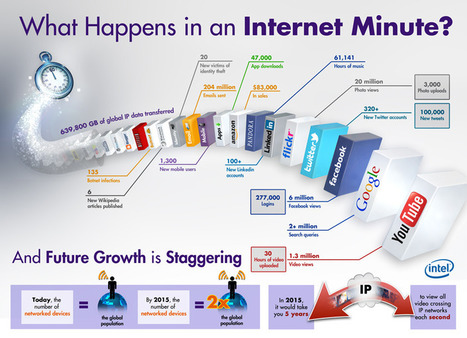
Do you know what happens in one minute on the Internet? In just one minute, more than 204 million emails are sent. Amazon rings up about $83,000 in sales. Around 20 million photos are viewed and 3,000 uploaded on Flickr. At least 6 million Facebook pages are viewed around the world. And more than 61,000 hours of music are played on Pandora while more than 1.3 million video clips are watched on YouTube. Computing is transforming and touching more people in a wider range of devices. From smartphones to tablets, netbooks and notebooks and even automotive; it can often seem like every one of us is connected. But while it’s hard to miss the proliferation of portable devices, it’s what we don’t see that’s the bigger issue. What many don’t see is that the increase in mobile devices has had a tremendous impact on the amount of data traffic crossing the network. It’s a little easier to comprehend once we think about all that’s done on a connected device like a smartphone. Listening to music, watching videos, downloading photos, playing online games, refreshing Twitter feeds and status updates – all of those activities generate network traffic. Following is an infographic illustrates just how much data passes through the network in 60 seconds. Nearly 640K Gb of global IP data is transferred in just one Internet minute!
Les Etats-Unis ont débloqué 200 millions de dollars pour développer les technologies de Big Data dans le domaine de la recherche scientifique. En France, ce sont 25 millions d’euros qui seront alloués à des projets de Big Data.
To get content containing either thought or leadership enter:
To get content containing both thought and leadership enter:
To get content containing the expression thought leadership enter:
You can enter several keywords and you can refine them whenever you want. Our suggestion engine uses more signals but entering a few keywords here will rapidly give you great content to curate.


 Your new post is loading...