Your new post is loading...

|
Scooped by
Leona Ungerer
October 22, 2012 11:20 AM
|
"Unlike classroom training, e-Learning is very visible. While much of the classroom experience is packaged in the instructor, and in fact varies from class to class, you can easily see and hear all elements of e-Learning. Everything from screen color to content accuracy to the types of practices is readily available for scrutiny. Decisions about e-Learning courseware must begin with an understanding of how the mind works during learning and of what research data tell us about what factors lead to learning. This is where decisions must begin. Naturally factors other than psychological effectiveness come into play in your multimedia learning decisions. For example, instructional strategies will be shaped by parameters of the technology like bandwidth and hardware, and by environmental factors such as budget, time, and organizational culture".
|
|
Scooped by
Leona Ungerer
October 21, 2012 5:30 AM
|
Future educators who want to get a jump on their careers should join social media sites like Twitter, Google+, and LinkedIn.
"Social media allows for the free and open exchange of information and empowers its users to create their own communities. In these communities, ideas, questions, connections, and content are what are drive the user experience. For the educator this means engaging, sharing, and collaborating with other educators to build learning communities around their individual professional learning needs as well as creating authentic learning experiences for their students".
|
|
Scooped by
Leona Ungerer
October 18, 2012 6:00 AM
|
"In the digital age students learn in rich and stimulating environments. Their role has shifted from being passive consumers to active producers of information. The teacher for them is but an initiator, a mediator, a collaborator, a coach, and a mentor. This new transformation of roles has brought about a change of the educational system at play. We moved from class system to community system where knowledge is socially constructed".
|
|
Scooped by
Leona Ungerer
October 17, 2012 9:30 AM
|
Trend 5:"The classroom is getting wired". Apps, parent/teacher portals, tablets, and mobile devices are becoming the norm in classrooms. "Technology is second nature today, so it only makes sense that we use it as an educational tool." The concern of the “digital divide”, however, remains. Only higher-income school systems tend to benefit from these types of technology.
|
|
Scooped by
Leona Ungerer
October 16, 2012 12:36 PM
|
A list of free online courses offered by leading universities. Most of these free courses offer “certificates” or “statements of completion.” (A key is provided for interpreting the credentials offered by each course).
|
|
Scooped by
Leona Ungerer
October 16, 2012 4:00 AM
|
HP Labs India won the Education Technology category in The Wall Street Journal's 2012 Technology Innovation Awards for its VideoBook educational system. It collects videos from online sources to enrich digital texts. The VideoBook educational system collects videos from YouTube and other online sources to enrich digital texts.
|
|
Scooped by
Leona Ungerer
October 14, 2012 11:01 AM
|
Technology forms part of our daily lives. According to a recent report, however, students and teachers feel they are not yet using it sufficiently for learning purposes during the school day. They want to use technology to help change the way they learn and teach.
|
|
Scooped by
Leona Ungerer
October 13, 2012 10:01 AM
|
"The Google Cultural Institute launched 42 new online historical exhibitions yesterday. The new exhibitions feature images, documents, and artifacts from some of the most significant cultural events of the last one hundred years. The exhibitions are built as interactive slideshows that you can scroll and click through to discover the artifacts and stories".
|
|
Scooped by
Leona Ungerer
October 12, 2012 8:04 AM
|
A few brief, high-impact guidelines for using technology in the classroom. Some of the ‘truths’ are: 1. The learning objective comes first. 2. No technology is perfect.
3. You've got to know it to believe in it. 4. Make do. 5. Leaders have followers. 6. Teaching and learning aren't the same.
|
|
Scooped by
Leona Ungerer
October 10, 2012 4:36 AM
|
"Physical spaces are central to creating a new paradigm for learning". Some suggestions are provided on what these physical spaces should include or what they may look like. New/futuristic looking learning spaces may better prepare better for participation in the 21st century global economy than traditional classrooms.
|
|
Scooped by
Leona Ungerer
October 8, 2012 6:56 AM
|
Probably mostly reflecting conditions in a developed country context, but this may serve as indication of what is to come in developing countries.
|
|
Scooped by
Leona Ungerer
October 5, 2012 7:07 AM
|
It is suggested that education should reflect and evolve with innovations in technology. Merely providing students with laptops, for instance, would not mean they will automatically learn more than with paper and a pen. Schools should first consider the educational content and the learning outcomes that can be achieved and delivered using a particular device. It is suggested that we should look at technology through the eyes of a teacher and think how technology can be integrated into pedagogy. This may lead to an ideal symbiosis of education and technology.
|
|
Scooped by
Leona Ungerer
October 4, 2012 3:44 AM
|
Game-based Learning (GBL) or gamification is a particularly popular topic in education because of the potential for learning that play holds for students. Traditional classroom experiences can be enhanced or even replaced by learning that is fun, engaging, and more effective. This happens when learners play games, particularly educational video games that help them learn content while they are deeply involved in the process. In situations such as these, learning becomes something students want to do, instead of something they have to do.
|
|
|
Scooped by
Leona Ungerer
October 22, 2012 11:11 AM
|
Distance Education grows at ISUIndiana StatesmanAccording to a report from the U.S. "Indiana State defines distance education in two ways: distance–delivered courses and distance-delivered programs, Brauchle said. A distance-delivered course is when majority of instruction is via electronic media. A distance-delivered program is where 50 percent or more of the required courses are online. According to the university website, currently 10 distance-delivered programs exist at ISU".
|
|
Scooped by
Leona Ungerer
October 19, 2012 3:58 AM
|
"Digital technology offers a better alternative to the traditional classroom—especially in parts of the world where schools and classrooms barely exist". "The way we teach and learn is at a once-in-a-millennium turning point. The old classroom model simply doesn’t fit our changing needs. It’s a fundamentally passive way of learning, while the world requires more and more active processing of information. The old model is based on pushing students together in age-group batches with one-pace-fits-all curricula and hoping they pick up something along the way. This certainly is not the best classroom model anymore". "Technology has the power to make education more portable, flexible, and personal; to foster initiative and individual responsibility, and to restore excitement to the process of learning. Technology offers another potential benefit as well: the Internet can make education more accessible, so knowledge and opportunity can be more broadly and equitably shared". Some views by Salman Kahn, founder of the Khan Academy, which provides free online courses.
|
|
Rescooped by
Leona Ungerer
from News and Resources for Teachers
October 18, 2012 4:56 AM
|
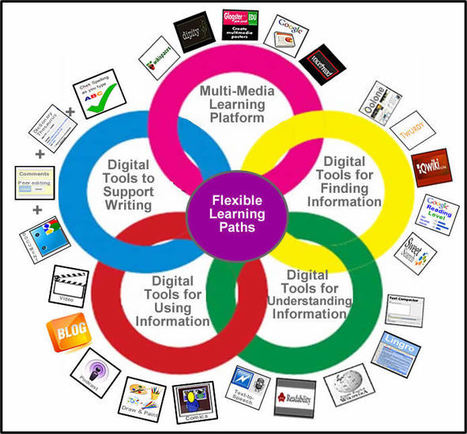
Use multi-media to design student-driven learning experiences that are fueled by standards-based Essential Questions and facilitated by digital tools to provide students with flexible learning paths.
Via Steve dembo, Brenda Doucette, taipeilibrarian
|
|
Scooped by
Leona Ungerer
October 17, 2012 8:58 AM
|
The internet has a significant impact on the way educational institutions can perform. Contact learning is important, but a distribution system like the internet offers the possiblity of delivering education on a larger scale.Live chat, video lectures and video conferencing, online quizzes, interactive image displays and screen sharing tools can fill the gap when there is no teacher in front of learners. "Institutions such as the UCT Centre for Educational Technology, running out of Cape Town, South Africa, have been exploring this for some time".
|
|
Scooped by
Leona Ungerer
October 16, 2012 8:02 AM
|
The document appears a bit 'bland' because it does not include any images, but it includes valuable information. The two draft 'lenses' are particularly interesting: - The SCONUL Seven Pillars of Information Literacy through a Digital Literacy lens, updated January 2012
- The SCONUL Seven Pillars of Information Literacy through an Open Content lens, 2011
|
|
Rescooped by
Leona Ungerer
from E-learning arts
October 15, 2012 7:19 AM
|
Innovative design crosses over all aspects of education. The American Society for Innovation Design in Education, or ASIDE, seeks to infuse curriculum with new approaches to teaching and thinking.Don't miss the presentation, The 8 Hats of Data Visualisation by Andy Kirk.
Via Baiba Svenca, Stefano D'ambrosio
Bloom's digital taxonomy Wheel and Knowledge Dimension
An impressive digital animation, and a must-see for educators who want to provide students with a deep understanding of content and concepts. For some background. Link to the original scoop.
Via Gust MEES, Paulo Simões, Shary Lyssy Marshall, Lynnette Van Dyke, Freddy Håkansson, Katharina Kulle, Rui Guimarães Lima, R.Conrath, Ed.D., Jimun Gimm, Laurent Blanquer, Délégation Académique au Numérique Educatif - Académie de Nice
|
|
Scooped by
Leona Ungerer
October 12, 2012 8:24 AM
|
A list of 50 educational blogs. It is suggested, "If you’re an RSS lover or want to cram your brain full of even more innovative insight, then there’s a few dozen blogs you should know about. From learning about traditional elementary education to education technology to education policies, there’s something for everyone".
|
|
Scooped by
Leona Ungerer
October 11, 2012 8:32 AM
|
It is suggested that academics and universities have responded quite favourably to the idea of Massive Open Online Courses (MOOCs), but they may become less enthusiastic when they experience the dramatic, unintended consequences for higher education.
|
|
Scooped by
Leona Ungerer
October 8, 2012 9:06 AM
|
John Hennessy, president of Stanford University, suggests that the most important question facing universities and colleges (in the West) is whether online education can provide a way to control rising costs without decreasing student learning. He posits that online education may offer tertiary education institutions their best chance at doing so.
|
|
Scooped by
Leona Ungerer
October 8, 2012 3:46 AM
|
The button that stands between machine and master.
The escape button dates to 1960 and it was created by an I.B.M. programmer, Bob Bemer who invented it as a way for programmers to switch from one type of code to another. When computer codes were eventually standardized, ESC became a kind of “interrupt” button on the PC — a way to tell the computer, “Cut it out.”
|
|
Scooped by
Leona Ungerer
October 4, 2012 8:19 AM
|
One of the reasons why games based learning is so effective is that it, amongst others, incorporates different learning styles. Kinaesthetic learning, for instance, can occur by means of learning simulations - a real world scenario or situation can be recreated and the learners can ‘learn by doing’ actions in a safe environment.
|