Your new post is loading...
When leading money managers embrace the need for corporations to be socially responsible and the Business Roundtable (BRT) declares that the purpose of a corporation is “to create value for all stakeholders,” it is safe to say that purpose has gone mainstream in the corporate narrative. A consensus is emerging that society and diversified investors are best served by companies that focus on sustainable value creation and respect the legitimate interests of all stakeholders, not just stockholders. But how can these high ideals be put into practice? That corporate employees and host communities have borne the brunt of the economic effects of the current pandemic only underscores the deepening sense that our corporate governance system’s empowerment of the stock market has undermined the fairness of our economy.
The number of women running America's largest corporations has hit a new high: 37 of the companies on this year's Fortune 500 are led by female CEOs. The Fortune 500, which ranks America's largest companies, has long been seen as a microcosm of U.S. business at large. For that reason, the number of female chief executives on the list is closely watched statistic among those who track gender diversity in board rooms and C-suites across the country. This year's tally soundly beats last year's 33, which was itself a new record. Yet the big picture is less encouraging: even with a record 37 female CEOs, women run just 7.4% of the 500 businesses on the ranking. (For perspective: Twenty years ago, women ran two.) Only in the past four years has the growth of women in these roles accelerated past 30—a general upwards trend, though there have been dips along the way.
The Securities and Exchange Commission (SEC) regularly reviews financial filings to ensure compliance with accounting standards and other disclosure requirements. The SEC review team analyzes firm’s financial filings and asks questions (in a comment letter) about perceived deficiencies. A comment letter may request clarification regarding an accounting or reporting issue and may ask a firm to revise or update its financial reports. According to the SEC, this comment process “deters fraud and facilitates investor access to information.” Comment letters are publicly available on EDGAR, and both accounting and law firms monitor comment letters to ascertain where the SEC is directing its review effort. For example, all of the Big Four accounting firms provide summaries of recent comment letter trends, and common topical areas include, for example, management’s discussion and analysis (MD&A), non-GAAP measures, fair value measurement, and revenue recognition.
Fifty years ago this year, Milton Friedman, later to be a Nobel laureate in economics, famously argued that corporate governance should focus solely on shareholder value maximization, while conforming to applicable laws and regulations. That view was controversial then. After years of dominance as a governance idea, shareholder primacy is once again controversial. We argue that it is more or less still correct. Recently, the Business Roundtable’s Statement on the Purpose of a Corporation commits the board to other stakeholders as well — including customers, employees, suppliers, and communities the company operates in. But importantly, if labor markets and product markets are competitive, the shareholder primacy and stakeholder paradigms would lead to identical corporate policies.
The damage to Canada’s labour market has been swift and unsparing. Weeks after the COVID-19 pandemic started to rip through the economy in early March, three million fewer people were employed. An additional 2.5 million still had jobs in mid-April, but lost the majority of their work hours because of the pandemic. Over all, more than one in four Canadian workers were significantly affected by lockdown restrictions aimed at curbing the spread of a deadly virus. But this might be as bad as it gets. Provinces are cautiously reopening their economies. Applications for emergency financial aid have tapered off. Thousands of companies have recently applied for wage subsidies. And new job postings have perked up. When the May employment numbers are released early next month, they could very well show a nascent rebound.
The need to restart production lines and reopen offices idled by the coronavirus pandemic mean issues such as sick pay and working conditions are suddenly a top priority for the C-suite and, for some investors, a golden opportunity to apply the principles of ethical investing. Buying into companies based on environmental, social and governance (ESG) factors was growing in popularity before the virus started spreading. But the focus was largely on how companies were dealing with climate change and overly generous executive pay – the E and G – rather than social issues such as the well-being of staff. The virus is driving a reassessment. “Someone the other day said ‘has environment taken a back seat? And my reply was ‘no, it’s more the ‘S’ has climbed into the front seat’,” John Goldstein, head of the Sustainable Finance Group at Goldman Sachs, told a media conference call in April.
PARIS—France is empowering regulators to slap large fines on social-media companies that fail to remove postings deemed hateful, one of the most aggressive measures yet in a broad wave of rules aimed at forcing tech companies to more tightly police their services. France’s National Assembly passed a law Wednesday that threatens fines of up to €1.25 million ($1.36 million) against companies that fail to remove “manifestly illicit” hate-speech posts—such as incitement to racial hatred or anti-Semitism—within 24 hours of being notified. The law also gives the country’s audiovisual regulator the right to audit companies’ systems for removing such content and to fine them up to 4% of their global annual revenue in case of serious and repeated violations. The measure takes effect on July 1.
The specter of war is frequently invoked in discussions about the COVID-19 pandemic. Heads of state and government leaders from Donald Trump to Emmanuel Macron have employed wartime rhetoric to describe the crisis—“we are at war,” Macron declared in his March television address announcing a nationwide lockdown, while Trump has tweeted about the virus as “the invisible enemy.” And as the death toll rises in the United States, many have made comparisons to the number of those killed in the Vietnam War.
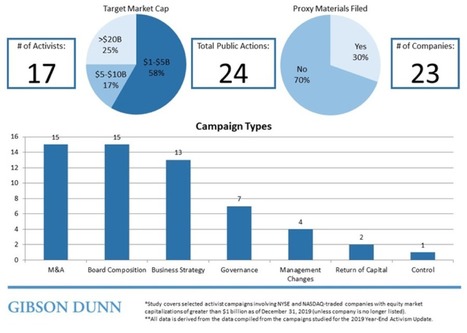
This Client Alert provides an update on shareholder activism activity involving NYSE- and Nasdaq-listed companies with equity market capitalizations in excess of $1 billion and below $100 billion (as of the last date of trading in 2019) during the second half of 2019. Announced shareholder activist activity declined relative to the second half of 2018. The number of public activist actions (24 vs. 40), activist investors taking actions (17 vs. 29) and companies targeted by such actions (23 vs. 34) each decreased substantially. The slowdown was in contrast to the first half of 2019, during which period shareholder activism activity was robust. On a full-year basis, however, 2019 represented a slowdown in activism versus 2018, as reflected in the number of public activist actions (75 vs. 98), activist investors taking actions (49 vs. 65) and companies targeted by such actions (64 vs. 82).
By putting environmental, social, and governance (ESG) at the heart of the world’s largest pension fund’s investments, Hiromichi Mizuno (known as Hiro) not only rocked the world of traditional pension finance but also had a profound impact on the cause of socially responsible investing. During his tenure as the Executive Managing Director and Chief Investment Officer of Japan’s $1.5 trillion Global Pension Investment Fund (GPIF), Mizuno reached the conclusion that the fund had become so big that it essentially owns the whole investable universe, so it should focus on making the market better for society. Mizuno led the GPIF from January 2015 until March 2020, but left in March of this year and joined Tesla’s board of directors and audit committee effective April 23. In his first interview since leaving the GPIF, he talks about his crusade for ESG investing.
A familiar refrain has emerged as the COVID-19 pandemic continues: companies will be judged for years based on the actions they take today. Perhaps no other issue will generate such long-lasting implications—to a company’s reputation, brand, and resiliency—as how a company treats its people during these trying weeks and months. It would be naïve to suggest that there is a single right path to manage workforce size, employee health and safety, and the many other human capital issues amplified by the crisis; there are simply too many sector-and company-specific variables. What is clear, however, is the need for companies to proactively communicate their chosen path forward to their stakeholders, and to do so in a transparent, context-rich manner that goes beyond what is disclosed in calmer times. Indeed, the dialogues that companies have today with their investors will impact those relationships—for good and bad—in years to come.
The Covid Crisis will affect every aspect of litigation. Growing familiarity with video-conferenced hearings likely will lead to the elimination of wasteful status-conference calendars, in which scores of lawyers sit around a courtroom for hours waiting for a 10-minute appearance to update the court on developments in a particular case. Courtroom automation, largely limited thus far to fancier projectors and displays, will adopt efficient technologies used in everyday business interactions. This is the right time for the legal profession—and the business community more broadly—to reinvent depositions. Like many of the discovery rules adopted in the 1930’s and ’40’s, depositions had a noble objective: to eliminate trial by surprise. The theory was: give both sides full information, and the case will either be settled earlier or be tried more efficiently.
EU officials are seeking to finalise a plan for public stakes to be taken in key European companies to shield them from the economic fallout of the COVID-19 pandemic, three sources familiar with the matter told Reuters. The European Union is looking to take decisive, unified action to support corporates after plans to help struggling southern states became mired in dispute and led to some politicians questioning the future of the European project. On May 5, after weeks of negotiations, France called for “an equity fund, either to recapitalise or to acquire shares in strategic companies that need capital, especially for those operating in European strategic value chains”, according to a proposal submitted to the EU commission and seen by Reuters. [...] Another could see European companies issue convertible bonds to the European Investment Bank, the EU’s lending arm, that could later turn into an equity stake, said two of the sources.
|
The SEC’s whistleblower program has long been a centerpiece of its enforcement efforts. Over the past seven weeks alone, the Commission has announced eight whistleblower awards totaling more than $56 million, including a single award on April 16 of $27 million, the largest of the year and the sixth largest award overall since the inception of the program. Because the coronavirus pandemic has understandably dominated the news over that same period, this striking accumulation of whistleblower awards has received little press attention. But we think these recent awards provide a telling and significant reminder of the critical importance, even in the current challenging environment, of keeping employee hotlines open and of responding to internal compliance reports promptly and effectively.
Cybersecurity firm Rapid7 Inc. last year installed tiny cameras around its Austin, Texas, office to track how its staff used the space. Now it’s using those same cameras to keep workers apart. People-counting cameras, also known as artificial-intelligence-powered sensors, have become a niche tool in recent years to help companies better use their office space, and in some cases trim real-estate costs. They are now being repurposed to meet a surge in demand from employers eager to comply with government guidelines on social distancing because of the coronavirus pandemic. However, that versatility is also a concern for privacy advocates, who worry the technology could be changed again to track individuals and monitor productivity.
COVID-19 had a marked impact on M&A in April, extending the decline observed in March across all measures. Globally, the number of deals decreased by 24.2%, to 2,036, and total deal value[1] decreased by 44.3%, to $118.34 billion. U.S. M&A activity also declined, with the number of deals decreasing by 32.2%, to 473, and total deal value significantly decreasing by 69.6%, to $16.60 billion. Significantly, average deal value declined to $58.1 million globally and to $35.1 million in the U.S. (reductions of 26.5% and 55.1%, respectively).
From a systemic risk point of view, the SEC’s primary responsibilities[1] in this period of stress are three-fold: (1) Market function. Using our authority, expertise and experience to help ensure the continuing, orderly and fair function of the securities markets—including equities, fixed income securities, funds and other products.
(2) Market monitoring. Monitoring market prices and price movements, flows of capital and availability of credit to assess functionality and resiliency of the capital markets—and taking action, including providing regulatory relief and guidance, as appropriate.
(3) Corporate and other issuer disclosure. Monitoring and providing guidance concerning, and emphasizing, timely and accurate issuer and other disclosures, recognizing that transparency and broad disclosure of material information are fundamental to market function and resiliency.
It wasn’t long ago that enterprise CISOs were trying to gain the attention of the board of directors. Before the massive data breach at Equifax, the leak involving the personally-identifiable information of more than 500 million Facebook users, or any number of other high-profile security incidents that have dominated headlines the past couple of years, issues concerning security were typically included in the broad category of risk, which often fell under the purview of the COO or CFO. But as Bob Dylan crooned, “The times, they are a-changin.”
Brookfield Asset Management has unveiled sweeping changes to its unusual ownership structure that for decades has given a secretive group of self-styled partners the right to wield huge influence over the US$500-billion investment firm. The move follows a Financial Times report earlier this year that detailed how Brookfield’s jigsaw-like structure had made it difficult to identify the investors behind deals struck with counterparties including the family of Jared Kushner, the son-in-law and adviser of U.S. President Donald Trump. The reforms strip Partners Limited, Brookfield’s governing “partnership,” of wide-ranging rights to control the NYSE-listed company. They represent some of the biggest changes to Brookfield’s governance since the group parted ways with members of the Bronfman dynasty in the 1990s, setting out on a path to become one of the world’s biggest alternative asset managers, with interests stretching from Manhattan real estate to Australian railways and French mobile phone masts.
he airline industry is understandably focused on the coronavirus pandemic’s impact on growth, along with the health and livelihoods of its millions of workers. This year now represents the biggest retrenchment in the history of aviation, with airline capacity down roughly 75 percent as of early April. That means an industry with a predictably steady growth rate has suddenly shrunk to a fraction of its size. It is unclear how protracted the decline will be, though demand is likely to bottom out in 2020 before returning to pre-crisis levels several years from now. The timing will depend on many factors outside the industry’s control.
Amid the turbulence in stock markets, retail investors continue to look for investment ideas. With thousands of publicly-traded stocks available, many retail investors often resort to their recent personal experiences when deciding on which stocks to buy or sell. Maybe a surge in video conferencing or home deliveries will prompt them to invest in companies involved in those businesses. They could even be inspired by ads they see on TV. [...] Our analysis used the IP addresses of investors, and minute-by-minute television advertising data involving some 326,000 ads, 301 firms, and $20 billion in ad spending. These extensive data made it possible for us to examine the real-time effects of TV advertising on investor searches for online financial information and subsequent trading activity.
Facebook's board of directors has formed a formal privacy committee, as required under the company's settlement with federal regulators after the Cambridge Analytica scandal. On Wednesday, Facebook announced that the committee's members were the directors Peggy Alford, Nancy Killefer, and Robert M. Kimmitt, with Killefer acting as the committee's chair. The formation of the committee marks the latest step in Facebook's attempts to move on from its scandal-ridden past. The political research firm Cambridge Analytica's misappropriation of 87 million users' data that came fully to light in 2018 was one of a chain of privacy-related scandals for the company and ultimately resulted in a $5 billion settlement with the US Federal Trade Commission.
Fortune editor-at-large Justin Fox once asked: "Why do companies have boards of directors, anyway?" Why aren't corporations run using "direct democracy—putting all major corporate decisions, including the choice of a new CEO, to a shareholder vote"? Or by "absolute corporate monarchy—allowing management to make all the decisions without oversight"? Good questions, all. On close examination, however, the modern system of corporate governance in which the corporate hierarchy is topped by a small committee of independent board members, who typically lack both day-to-day management power and any significant equity stake in the corporation, turns out to be a highly efficient solution to the problems of making decisions in complex organizations.
The COVID-19 pandemic has introduced new corporate disclosure issues and increased the attendant risk of securities fraud actions, as evidenced by plaintiffs’ initial filings across the country in the past few weeks. This article discusses the significance of those initial suits to public reporting companies and how companies can tailor and update their disclosures to lessen the risk of future lawsuits. We also explore potential D&O liability risk arising in the context of the pandemic, including risk in the context of insolvency that is facing many companies for the first time.
Airbnb, born in 2008, famously disrupted the hotel industry. It stole market share, put pressure on hotel rates, inspired the creation of affordable brands and saw hotels across the spectrum create restaurants, bars and lobbies that channeled the local vibe. Airbnb’s recent layoff of a quarter of its work force indicates the financial strain the company is under. Now the question is: Has Covid-19 disrupted the disrupter? “I do think hotels may have a near-term advantage,” said Henry Harteveldt, a lodging industry analyst and the founder of Atmosphere Research Group, predicting that hotels will have the edge on hygiene and standardized social-distancing policies. As the industry seeks to recover, the contest between hotels and home shares finds both struggling to convince the public that their rooms are virus-free, their terms are fair and their offerings are social-distancing appropriate.
|