Your new post is loading...
Buffet hasn't had a good crisis, but he is unequivocal that the best way to return value to shareholders is by reinvesting profits back into a business. It has been a dismal year for income investors. The economic shock from COVID-19 has proved deadly for dividends, with scores of companies reducing, deferring or cancelling their payouts to investors altogether. When income stalwart Royal Dutch Shell Plc. cut its dividend for the first time since the Second World War, some said it heralded the death of equity income as we know it. Others were less pessimistic, hoping the income drought could be temporary. Last week, property company Land Securities became the first FTSE 100 firm to say it intended to restart dividend payments later this year. However, the economic impact of the virus is likely to weigh on the level of payouts for some time to come. Historic yields for global equities are now roughly in line or slightly below long-term averages. While we can expect a recovery in dividends as economies ‘normalise,’ we don’t know how long this might take, or indeed, what ‘normal’ might look like. The Sage of Omaha is unequivocal that the best way to return value to shareholders is by reinvesting profits back into a business. Although Berkshire Hathaway has proved itself to be a cash generating machine over the years, it has almost never paid a dividend. The one exception was back in 1967 and Buffett often jokes that he must have been in the bathroom when the decision was made.
The investor landscape around E&S metrics in executive compensation programs is quickly evolving as institutions are pressured to set stricter, and more public, policies covering this formerly niche area, rating agencies are increasingly reporting on the use of E&S compensation metrics, and there are a growing number of shareholder resolutions requesting the adoption and disclosure of E&S compensation metrics. Companies will need to enhance disclosure of E&S compensation metrics in executive incentive programs in next year’s proxy, and better show how executives are compensated against ESG goals, not simply financial performance. E&S-remuneration shareholder resolutions increase despite overall decrease in shareholder activism. [...] Below is a list of factors that ESG rating providers evaluate with regards to the “E&S” and “G” components of executive compensation. According to the MSCI ESG Ratings Methodology, the following metrics are considered when evaluating executive compensation programs:
(A) Compensation-related E&S factors:
(1) Has the company, if designated as having either a high environmental or social impact, failed to incorporate links to sustainability performance in its current incentive pay policies?
(2) High Environmental Impact: If any of the following ESG Ratings Key Issues carry more than a 5% weight: Carbon Emissions, Water Stress, Toxic Emissions & Waste, Product Carbon Footprint, Raw Material Sourcing, Packaging Material & Waste, Electronic Waste, Biodiversity & Land Use, Energy Efficiency.
(3) High Social Impact: If any of the following ESG Ratings Key Issues carry more than a 5% weight: Labor Management, Health & Safety, Product Safety & Quality, Supply Chain Labor Standards, Human Capital Development.
The Giant Shadow of Corporate Gadflies, by Yaron Nili and Kobi Kastiel, (download at SSRN) is one of the more objective reviews of the recent influence of “gadflies” on corporate governance in America. It might have been even better if the authors had discussed their work with the subjects of their study – the gadflies. (Disclosure: I am a gadfly.) [...] My purpose is not to criticize the authors but to help future researchers avoid the same mistakes and to think more carefully about shifting more rights and responsibilities from regular people to “professionals.” The day before posting this, the authors now want to discuss and revise their paper before publishing. Dialogue can lead to real progress. [...] Nili and Kastiel have done excellent work documenting the key role currently played by gadflies and they do point to real problems concerning our dependency on a few individuals. So, let’s offer them some solutions that might actually work.
(1) Real-time proxy votes. One problem is that fund proxy votes don’t often reflect the full values of their investors. [...]
(2) Encourage funds to be more democratic. ISS is often criticized by business organizations for dictating how customer funds vote their proxies. [...]
(3) Hedge limited liability. A good portion of the problem of capitalism, as currently practiced, is that investors have limited liability. [...]
(4) Promote employee stock ownership plans (ESOPs), with voting power passed to employees.
In corporate democracy, the default system for electing directors is voting, but shareholders are free to commit their votes by contract. In private companies, shareholders routinely do so, using shareholder agreements – contracts among the owners of a firm – to bargain directly over directorships and other rights of control. In recent years, disputes involving these agreements have increasingly appeared before Delaware’s courts. In late 2019, the Delaware Supreme Court issued a controversial decision addressing whether the parties to a shareholder agreement together formed a controlling shareholder and holding that, in this case, they did not. Economists and legal scholars, however, have tended to overlook the distinctive questions raised by shareholder agreements. In a new paper, I explore shareholder agreements conceptually, empirically, and doctrinally, and show how they raise deep questions about the architecture of corporate law.
DONALD TRUMP’S odds of being re-elected this November appear to have shrunk dramatically this past month. Our election-forecasting model now gives him just a one-in-ten chance of being re-elected in November. But as his prospects for a legitimate victory have faded, his critics worry that he may try to hold on to power by illegitimate means. Theories about what might happen range from Mr Trump claiming fraud and refusing to leave the White House after his challenger, Joe Biden, is inaugurated next January, to armed insurrection and violence against Democrats. A new report from the Democracy Fund Voter Study Group, a collective of public-opinion researchers and political scientists, suggests that a surprisingly large minority are prepared to question the result of the election in November, and even to support violence. According to their survey of 5,900 Americans, detailed in a report released in June, 18% of respondents (including 29% of Republicans) think it would be appropriate for Mr Trump to refuse to leave office if he claims he lost because of widespread illegal voting. To many, Mr Trump has already set the stage for this in his opposition to postal ballots, tweeting that “Mail in ballots substantially increases the risk of crime and VOTER FRAUD!” (Political scientists who have studied the matter disagree.)
Why do difficult board meetings occur? The issue is complex and often rests on the core governance principle that a board doesn’t make decisions based on majority vote but on group consensus. Differing viewpoints, differing personalities, unbalanced personal agendas, unresolved relationship issues and conflicts of interest are often a cause. Adding a new complexity is the unfamiliarity with the nuances of virtual meetings. Chairs need to address each of the above head on, cut through the agenda task at hand and keep a meeting focused and a board efficient and effective. And the most effective chairs do so with skilled facilitation, diplomacy, emotional intelligence, conflict resolution, impartiality, empathy and courage. There is the fundamental question of whether having a difficult meeting is actually a good or a bad thing? It is clearly useful to have healthy constructive conflict and robust debate. It’s an antidote to groupthink and provides difficult decisions with the time and perspective to work through. However, when healthy disagreement moves into an unhealthy disagreeable state, the cost of difficult meetings becomes apparent: loss of cohesion, lack of closure, the potential loss of good directors, the inability to maximise objectives for the organisation, objective financial and emotional costs of boardroom dysfunction, and the knock on brand and reputational effects of this dysfunction.
Nonfinancial information about how a company does business (e.g., a bank’s cybersecurity program) could be an indicator of its long-term financial performance. Investors have been asking companies to disclose more on these environmental, social, and governance topics (known as “ESG”). We reviewed disclosures from 32 companies. Most included some of this information, but it wasn’t always clear or useful. For example, it was hard to compare climate or resource-related information when companies used different calculation methods or reported results in different units of measurement. We discussed several options to improve these disclosures.
Private Equity (PE) funds have returned about the same as public equity indices since at least 2006. Large public pension funds have received a net Multiple of Money (MoM) that sits within a narrow 1.51 to 1.54 range. The big four PE firms have also delivered estimated net MoMs within a narrow 1.54 to 1.67 range. Three large datasets show average net MoMs across all PE funds at 1.55, 1.57 and 1.63. These net MoMs imply an 11% p.a. return, which matches relevant public equity indices; a result confirmed by PME calculations. Yet, the estimated total performance fee (Carry) collected by these PE funds is estimated to be $230 billion, most of which goes to a relatively small number of individuals. If all vintage years are included to 2015, Carry collected is $370 billion, with a performance similar to that of small cap indices, but higher than that of large cap stock indices. The number of PE multibillionaires rose from 3 in 2005 to 22 in 2020. Rebuttals from the big four and the main industry lobby body are provided and discussed.
In the public imagination, Wirecard was Germany’s biggest tech company success story – a €24 billion high-growth payment processor doing deals across the globe and pioneering new technologies. While naysayers complained about its opaque corporate and financial practices and raised doubts about its business model, most observers admired its nimble approach to surmounting regulatory barriers to international expansion. In a world intoxicated by companies with unlimited growth prospects, it was a winner. The reality was much different. Most of Wirecard’s reported business didn’t exist. And the company hadn’t made any money in years. How could something like this happen in our modern, ostensibly transparent world? It will take years to sort out questions of liability, but responsibility is a different matter. There the answer is clear. The supervisory board at Wirecard – which was amply warned over many years that something was amiss – utterly failed to protect shareholders, creditors, employees, and customers from malfeasance by management.
n Dohmen v. Goodman, the Delaware Supreme Court declined to impose an affirmative fiduciary duty of disclosure on a general partner arising out of the general partner’s solicitation of capital contributions from a limited partner where the general partner knowingly made misrepresentations in the process. The court’s decision provides a comprehensive roadmap not only for general partners in assessing the scope of their fiduciary duties when communicating with limited partners under Delaware law, but also corporate fiduciaries more generally. [...] The court’s decision in Dohmen is a helpful roadmap for fiduciaries and their counsel seeking to better understand the contours of the duty of disclosure. Dohmen makes clear that fiduciaries only owe a duty of disclosure to equityholders when soliciting equityholder action [3] and that transactions with individual equityholders do not constitute a solicitation for equityholder action. In the context of individual transactions with equityholders, however, fiduciaries must still communicate honestly and fairly with the equityholders as the duties of loyalty and care still attach (albeit with heightened pleading requirements). As a practical matter, in addition to relying on those fiduciary duties, individual stockholders can also rely on contractual representations made by the entity in any such transaction and recover for breach of contract and common law fraud in the instance of any affirmative misrepresentations made to them.
Though progress has undoubtedly been made on the COVID-19 front, companies are remaining vigilant—and understandably so—as they continue to direct their attention to the crisis and to its impact on their employees, customers, communities and business relationships. One such impact relates to severe market volatility and is the source of several financial market aggressions. Boards of directors and management at public companies across different industries are experiencing declining share prices and considerable changes in share ownership and are finding that this makes them more vulnerable to certain financial market aggressions. This post focuses on two—unsolicited hostile takeover bids and short selling—and suggests defensive measures that public companies can take. [...]
1) Hostile takeover activity
Foster board-management engagement. Your directors should regularly engage with management to better understand the impact of COVID-19 on the industry and on business because having that understanding is key for a board to be able to carefully respond to any takeover bid. Your directors should also continuously evaluate the value of your business so that they’re able to measure any bid against future business expectations, especially since share price valuations may not accurately reflect the value given market volatility and the unknowns surrounding COVID-19. [...]
2) Short selling
Monitor your stock activity and related news. Given recent market fluctuations, you may see a rise in another one of the COVID-19 financial market aggressions—short selling—as investors bet against the market attempting to capitalize on the volatility. Some short sellers take it a step further and publicly discredit the stocks that they’re shorting in the hope of accelerating a price drop, a ploy that has come to be known as a short-and-distort scheme. It’s difficult to watch out for this risk. SEC rules don’t require disclosure of short positions, and it remains to be seen whether the SEC will issue any rulemaking to that effect during the COVID-19 crisis.
In this paper, we investigate how auditors respond to shareholder activism against their clients. Our study is important because activism may be viewed by auditors as a source of increased engagement risk, thereby impacting audit outcomes. The potential relationship between shareholder activism and audit outcomes leads us to predict that activism targets will pay higher audit fees and also will be more likely to receive adverse internal control opinions and first‐time going concern opinions. Our results, which support all three predictions, suggest that the public scrutiny associated with activism campaigns heightens auditors’ concerns about reputational damage and litigation risk. Consistent with this notion, we find that activism targets are more likely to experience accounting‐related lawsuits. We also find that the increased likelihood of adverse internal control opinions documented in our baseline tests reflects higher quality reporting rather than increased auditor conservatism. Overall, our findings suggest that activism campaigns spur auditor diligence while also increasing the possibility of negative outcomes that may not be fully anticipated by activist investors.
Amanda Blanc will have to justify why a breakup of U.K. insurer Aviva isn't the way forward. It’s time for someone else to have a go at one of the toughest jobs in European finance: deciding the future of Aviva Plc. The U.K. insurer’s pick of Amanda Blanc as chief executive officer has brought a leader with the necessary sense of urgency. The appointment of a woman to such a prominent leadership role at a European financial institution should be celebrated too, not least given it’s mainly men who enter the actuarial profession. [...] There are no big-bang fixes without snags. The weak share price precludes a transformative merger or acquisition. Some investors want a breakup, potentially separating Aviva’s life and general insurance pieces. Unfortunately, that would end the capital benefits in combining the two. But there are moves that could work over time, so Blanc’s promise of an end to “business as usual” is unlikely to be a hollow claim. Slaying sacred cows could mean gradually selling off some of Aviva’s businesses to buyers who put more value on them than what’s implied by Aviva’s lowly 11 billion-pound ($14 billion) market capitalization. For instance, there’s no need for the company to own its own fund management unit when it can buy in those services externally. [...] The difficult question is why Aviva hasn’t attracted an activist investor when some of its rivals have. The likely answer is that Aviva is just next on the list.
|
This essay argues that, to address the Covid-19 crisis, in addition to creating a special temporary insolvency regime, relaxing provisions for companies in the vicinity of insolvency, and enabling companies to hold virtual meetings, policymakers should tweak company law to facilitate equity and debt injections and address the consequences of the extreme uncertainty faced by European firms. After some general reflections upon the type of rules that are needed in these exceptional times, examples of temporary corporate law interventions for the emergency are provided. Specifically, rules to facilitate injections of equity capital and shareholder loans are suggested, together with relaxations of directors’ liability rules and measures to protect firms against hostile takeovers. All of these measures should apply merely by default and only for so long as the emergency lasts. The essay concludes with some thoughts about how to make normal-times corporate law ready for similar emergencies in the future. The goal is both to reduce the risk that the temporary extreme measures enacted for this crisis are made permanent under the pretence that another crisis may hit again and to have quick adaptation mechanisms already in place to respond to such a crisis.
Hedge-fund billionaire William Ackman has come roaring back after years of dwindling assets and a self-imposed exile from the spotlight. But the famed activist investor’s recent wins haven’t been fueled by publicly agitating for companies to change. They have instead come from outside-the-box moves like the one that will be on display next week, when Mr. Ackman is expected to launch an initial public offering of the biggest blank-check company ever, raising money to take a future acquisition public. Mr. Ackman hasn’t initiated a public shareholder-activism campaign since he lost a proxy fight with Automatic Data Processing Inc. in 2017. Instead, he has made long-term bets on large companies where he remains an involved shareholder, like Starbucks Corp. Earlier this year, he made a prescient bearish wager that enabled his fund to sidestep the stock market’s plunge. Now he is taking a big swing in the IPO market. [...] Then, his fortune turned. A big bet on drugmaker Valeant began to unravel, ultimately costing the fund billions of dollars and driving losses for three consecutive years. A bet against Herbalife Nutrition Ltd. also floundered, and despite Mr. Ackman’s many public appearances deriding the company’s accounting and business practices, the stock kept rising. Between 2015 and 2019, his private fund shrunk by roughly $9 billion. [...] Next week, he will take another blank-check company public with the aim of raising $3 billion in its IPO. Pershing Square could add another few billion dollars to the pot, bringing the total amount for the SPAC to invest in a company to nearly $6.5 billion. The goal: to use the money to bring a large private company public, according to a regulatory filing—potentially a “mature unicorn” valued at billions in the private market—and continue Mr. Ackman’s recent winning streak.
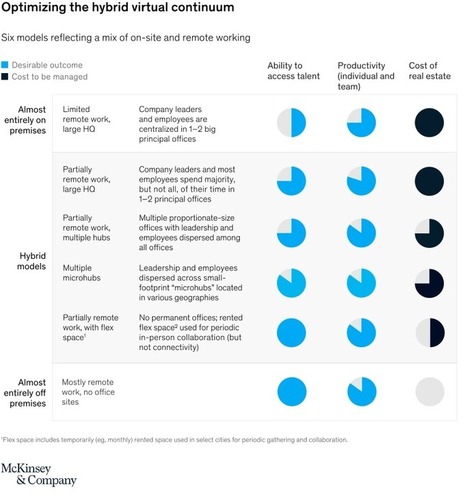
Pandemic-style working from home may not translate easily to a “next normal” mix of on-site and remote working. As the pandemic begins to ease, many companies are planning a new combination of remote and on-site working, a hybrid virtual model in which some employees are on premises, while others work from home. The new model promises greater access to talent, increased productivity for individuals and small teams, lower costs, more individual flexibility, and improved employee experiences. While these potential benefits are substantial, history shows that mixing virtual and on-site working might be a lot harder than it looks—despite its success during the pandemic. Consider how Yahoo! CEO Marissa Mayer ended that company’s remote-working experiment in 2013, observing that the company needed to become “one Yahoo!” again, or how HP Inc. did the same that year. Specific reasons may have varied. But in each case, the downsides of remote working at scale came to outweigh the positives. These downsides arise from the organizational norms that underpin culture and performance—ways of working, as well as standards of behavior and interaction—that help create a common culture, generate social cohesion, and build shared trust. To lose sight of them during a significant shift to virtual-working arrangements is to risk an erosion over the long term of the very trust, cohesion, and shared culture that often helps remote working and virtual collaboration to be effective in the short term.
Charles Lu reclassified the supervoting shares of one representative to shares with weaker voting rights. A fight for control of Luckin Coffee Inc. is hamstringing the embattled company, which has yet to release the results of a controversial shareholder vote that took place over the weekend. Luckin on Sunday held an extraordinary general meeting in Beijing, during which its chairman and co-founder, Charles Lu, asked shareholders to vote out four of the company’s eight directors—including himself—and replace them with two individuals whom he nominated as independent directors. Some shareholders saw it as an attempt by Mr. Lu, who is at risk of losing most of his voting rights at Luckin, to hang on to control of the upstart coffee chain via proxies. During the nearly four-hour meeting, representatives of some Luckin shareholders raised objections to the proceedings and the way that votes were counted, according to people familiar with the matter. One sticking point was a decision by Mr. Lu to reclassify the supervoting shares of one representative to shares with weaker voting rights, they said.
Finance Minister Bill Morneau will forecast a deficit in excess of $300-billion Wednesday, sources say, as the government announces for the first time how shutting down large swaths of the economy and spending billions on emergency pandemic programs is affecting Ottawa’s bottom line. Two senior government officials told The Globe and Mail the minister will announce a forecast deficit that is more than $300-billion. A third senior government official said Wednesday’s report will forecast the deficit for only the current fiscal year and it will not include any new policy announcements. The Globe is not identifying the officials because they were not authorized to comment publicly on the matter. The details of the fiscal snapshot will be released Wednesday at about 1:40 pm ET, when Mr. Morneau will address Parliament. The unprecendented size of the deficit – which has grown more than tenfold in seven months – has raised questions about how the government plans to phase out the heavy pandemic spending. [...] Several independent forecasters have pegged the size of this year’s federal deficit at between $250-billion and $300-billion. Parliamentary Budget Officer Yves Giroux reported in June that the deficit could be about $256-billion this year, a figure that was compiled before the government announced a further $20-billion in spending. The government usually includes additional potential spending as a contingency in its deficit forecasts.
Les hedge funds veulent opportunément profiter de l'engouement massif pour l'investissement socialement responsable. Ils diversifient leurs stratégies, sources de revenus et clientèle tout en redorant leur image. La vertu ne paie pas toujours en termes performances délivrées. Les hedge funds n'échappent pas à la vague verte qui submerge le monde de l'investissement, des banques centrales aux gérants d'actifs. Marshall Wace, le redoutable hedge fund anglais , va lancer un nouveau fonds de 1 milliard de dollars selon le « Financial Times ». Il achètera les sociétés vertueuses qui respectent l'environnement, les droits sociaux et affichent une bonne gouvernance. Il sanctionnera les mauvais élèves en les vendant à découvert et exclura de son univers d'investissement les « actions du péché » (armement, tabac…). Lansdowne, un des principaux concurrents de Marshall Wace, va fermer un de ses principaux fonds pour cause de contre-performance. Va-t-il lui aussi « se mettre au vert » et lancer un fonds ISR ?
Why do difficult board meetings occur? The issue is complex and often rests on the core governance principle that a board doesn’t make decisions based on majority vote but on group consensus. Differing viewpoints, differing personalities, unbalanced personal agendas, unresolved relationship issues and conflicts of interest are often a cause. Adding a new complexity is the unfamiliarity with the nuances of virtual meetings. Chairs need to address each of the above head on, cut through the agenda task at hand and keep a meeting focused and a board efficient and effective. And the most effective chairs do so with skilled facilitation, diplomacy, emotional intelligence, conflict resolution, impartiality, empathy and courage. There is the fundamental question of whether having a difficult meeting is actually a good or a bad thing? It is clearly useful to have healthy constructive conflict and robust debate. It’s an antidote to groupthink and provides difficult decisions with the time and perspective to work through. However, when healthy disagreement moves into an unhealthy disagreeable state, the cost of difficult meetings becomes apparent: loss of cohesion, lack of closure, the potential loss of good directors, the inability to maximise objectives for the organisation, objective financial and emotional costs of boardroom dysfunction, and the knock on brand and reputational effects of this dysfunction.
Governments and companies can reinforce each other in their pursuit of sustainable development, which is based on three pillars: economic, social and environmental. An impact economy, in which governments and companies balance profit and impact, is best placed to achieve the United Nations sustainable development goals. How can governments and companies be jointly empowered to have a positive impact on the sustainable development goals? The current economic system is largely geared towards increasing economic growth. But this could come at the expense of rising social inequality and environmental degradation. This paper examines the link between economic system outcomes and corporate sustainability outcomes. We provide evidence that governments and companies can reinforce each other in their pursuit of sustainable development. Sustainable development is based on three pillars: economic, social and environmental. These pillars should be assessed and balanced in an integrated way. An impact economy, in which governments and companies balance profit and impact, is best placed to achieve the sustainable development goals.
As ESG investing continues to accelerate, the Department of Labor (“DOL”) has proposed for public comment rules that would further burden the ability of fiduciaries of private-sector retirement plans to select investments based on ESG factors and would bar 401(k) plans from using a fund with any ESG mandate as the default investment alternative for non-electing participants. The proposal asserts that “ESG investing raises heightened concerns under ERISA,” and, in contrast to the broader investor community’s recognition that ESG is about value and performance, and despite growing evidence that the investment returns of ESG funds can outperform those of non-ESG funds, the proposal reflects the DOL’s continued concern that ESG investment might “subordinate return or increase risk for the purpose of non-pecuniary objectives.” In terms of defining what would be an ESG-themed fund or mandate triggering heightened scrutiny and procedural requirements, the proposed rule casts the net widely to reach those featuring “one or more environmental, social, corporate governance, or similarly oriented assessments or judgments in their investment mandates, or that include these parameters in the fund name.” Such assessments and judgments have, of course, become common and mainstream, with investors, companies and fiduciaries of all kinds bringing their business determinations to bear.
A new agreement for the Big Four accounting firms to split their U.K. auditing and consulting arms is a cosmetic exercise that won’t improve audit quality or independence, multiple analysts and investors argue. “It’s not only voluntary, but parts of it are weak to the point of harmful. No wonder the Big Four signed up to it,” Tim Bush, head of corporate governance at Pensions & Investment Research Consultants Ltd, said in a call voicing a concern echoed by other critics. The Financial Reporting Council on Monday announced an agreement with the Big Four—KPMG LLP, Deloitte LLP, PricewaterhouseCoopers LLC and Ernst & Young LLP—on an operational separation of their audit and consulting arms by 2024 to avoid conflicts of interest, averting temptation for firms to perform soft audits to chase juicy consulting contracts from their clients. The pact comes amid pressure on the government to honor a promise to act on the findings of several reports it commissioned into audit market reform after a series of scandals such as the collapse of Carillion Plc in 2018. The reports recommended changes including forcing the big accounting firms to separate audit and consulting activities and creating a more powerful accounting watchdog. “These principles have been achieved without the need for legislation, hence they are ‘voluntary,’” FRC spokesman Peter Timberlake said in an email about the new agreement.
straining global supply chains. This is pushing many firms into financial distress and sparking government interventions to protect incomes, jobs and firms. In some cases, governments are taking equity stakes in troubled firms. Based on the OECD Product Market Regulation (PMR) indicators, this note considers the policy challenges raised by such interventions, with a special focus on the governance of state-owned enterprises and exit strategies from state ownership. [...] In response to the COVID-19 crisis, governments are rolling out a vast array of policy measures to support the business sector, including taking equity stakes in companies in financial distress. State ownership is already extensive in many OECD countries. The OECD Product Market Regulation (PMR) shows that most governments control firms that undertake commercial activities in a significant number of sectors, notably energy, rail transport, finance, and telecoms. Good governance of state-owned enterprises (SOEs) is essential for these firms to perform efficiently and compete fairly with private firms. Micro-level evidence from the air transport and automotive sectors in OECD countries shows that, on average, SOEs tend to have significantly lower returns on equity than private firms. However, in countries where SOEs are subject to the same market pressures as their competitors and are insulated from political interference, SOEs perform as well as private firms.
Luckin Coffee founder and chairman Charles Zhengyao Lu has been ousted by shareholders at the scandal-hit Chinese coffee chain, just days after a proposal to unseat him failed to win board approval. Three other directors, including two major investors in the company and Sean Shao, head of a special committee investigating the accounting fraud at the group, were also removed from the board while two independent directors were added at an extraordinary meeting in Beijing on Sunday. The shake-up is the latest twist in the Luckin saga after Nasdaq last month delisted the company, known as China’s answer to Starbucks. That followed an earlier disclosure that the chain had fabricated Rmb2.2bn ($313m) in sales last year, equivalent to three-quarters of the sales for the nine months the fraud covered. Luckin went from launch to a New York listing in just 18 months, disclosing the falsified accounting in April, less than a year after its market debut when it raised $695m. The revenue scandal has prompted a backlash against US-listed Chinese companies, with the US Congress passing bills in May to strengthen disclosure requirements for foreign groups. [...] The board reshuffle left many stock market investors convinced that Mr Lu, who is widely suspected of involvement the fraud, was still exercising control from behind the scenes. “He initiated the meeting knowing that he would be asked to resign,” said one person close to the internal probe on Monday. [...] “There is no way the board could challenge the will of major shareholders,” the lawyer added.
|