Your new post is loading...

|
Scooped by
Institut sur la gouvernance (IGOPP)
August 21, 2020 10:34 AM
|
The ipo is dead, long live the ipo. When the pandemic hit in March, initial public offerings, particularly those by technology startups, were predicted to be among the early victims. After all, who wants to go public in a once-in-a-century crisis? Quite a few people, it turns out. In the past couple of months ipos, which all but dried up until late May, have come back with a vengeance in America. None of Silicon Valley’s recent and upcoming listings rivals that of Ant Group. The payments affiliate of Alibaba, an online giant, wants to raise a record $30bn in China by October, which could value the firm at around $200bn. But America’s technology startups have brought in $10bn so far this year (see chart 1)—and there is more to come. On August 19th Airbnb, which rents homes to travellers, filed for an ipo. Other privately held “unicorns” reportedly ready for public pastures include Snowflake Computing, which makes cloud software; DoorDash, which delivers food; and Instacart, which delivers groceries. Add Palantir, a cryptic data-management firm preparing for a direct sale of existing shares in public markets, and the latest combined valuation of these five is $80bn, according to Pitchbook, a data provider. Even if they float only a portion of their shares, billions-worth of fresh tech stocks will soon trade publicly.
|
|
Scooped by
Institut sur la gouvernance (IGOPP)
August 21, 2020 10:15 AM
|
The Delaware Court of Chancery (Vice Chancellor Zurn) recently held in DLO Enterprises, Inc. v. Innovative Chemical Products Group, LLC, 2020 WL 2844497 (Del. Ch. June 1, 2020), that the seller in an asset transaction retains attorney-client privilege over its pre-closing deal communications unless the asset purchase agreement explicitly provides otherwise. This rule, the court explained, contrasts with the default rule in a merger, where the privilege over the target’s pre-closing communications by operation of law, upon the effectiveness of the merger, vests in the surviving corporation (absent any contractual provision to the contrary). [...]
Key Takeaways
(1) The default rule in an asset purchase is that sellers retain privilege over their own pre‑closing deal communications unless the parties explicitly agree otherwise.
(2) This rule differs from the default rule in a merger, where the surviving corporation acquires the privilege over the target’s pre-closing communications.
(3) As with all default rules, the parties to the transaction may agree to alter these default rules through contract.
(4) A seller in an asset sale might waive privilege over pre- and post-closing emails by transferring those email accounts to the buyer upon closing and continuing to use those transferred accounts after closing.
|
|
Scooped by
Institut sur la gouvernance (IGOPP)
August 21, 2020 10:12 AM
|
In In re HomeFed Corporation Stockholder Litigation (July 13, 2020), the Delaware Court of Chancery held that the going-private transaction involving HomeFed Corporation (the “Company”) and its controlling stockholder, Jefferies Financial Group Inc., did not meet the prerequisites, under MFW, for business judgment review. Chancellor Bouchard, at the pleading stage of the litigation, found that it was reasonably conceivable that MFW’s “ab initio” requirement had not been met–that is, that the controller had not conditioned the proposed transaction on approval by both an independent special committee and a majority of the minority stockholders before the controller engaged in “substantive economic negotiations.” Chancellor Bouchard rejected the defendants’ motion to dismiss and ruled that the transaction will be reviewed under the more stringent entire fairness standard.
Key Points:
(1) The decision amplifies the court’s recent focus on direct discussions between a controller and minority stockholders as a basis on which MFW business judgment review may be rendered unavailable.
(2) The decision emphasizes the importance of the special committee’s role in “disabling” a controller’s influence.
(3) HomeFed and Dell Technologies reach unsurprising results, but may reflect a trend toward a more stringent approach by the court in determining MFW (and Corwin) applicability.
|
|
Scooped by
Institut sur la gouvernance (IGOPP)
August 21, 2020 9:52 AM
|
Academics and practitioners, including lawyers, emphasize the importance of conservative accounting to lenders and corporate boards, allowing them to intervene and take corrective actions at an early stage. However, conservative accounting may also increase the risk of false alarms and prompt excessive interventions. In light of this downside, the overwhelming and in many cases unconditional support that conservative accounting often receives is puzzling. We aim to reconcile the support for conservatism with the concern for false alarms by showing that managers’ ability to gather additional evidence following accounting reports changes the balance between the benefits and costs of conservative accounting.
|
|
Scooped by
Institut sur la gouvernance (IGOPP)
August 20, 2020 11:40 AM
|
For the first time in years, the plurality of investors plan to put more money in hedge funds, not less. Forty-four percent of hedge fund investors surveyed by Preqin in June said they intended to increase their commitments to hedge funds over the next year — nearly double the proportion from a year ago. This group far outweighs the 28 percent intending to downsize their hedge fund allocations. These findings mark a sharp change from the last four years, when investors were more likely to lower their hedge fund allocations than raise them. “Volatile markets have increased appetite for hedge funds,” Preqin said in its mid-year report on alternative assets. Among other alternative investments, only private debt saw a larger increase in investor appetite, with 48 percent of surveyed investors planning to expand their commitments to that asset class. But nearly half of surveyed investors were disappointed by their hedge fund managers’ performance over the last year. Forty-seven percent said their portfolios had performed worse than expected, while just 6 percent reported exceeding them. Despite this, investors were more optimistic about hedge funds than they were about any other alternative asset class. Thirty-nine percent predicted that hedge funds would perform better over the next year, compared to 28 percent who thought hedge funds would perform worse.
|
|
Scooped by
Institut sur la gouvernance (IGOPP)
August 20, 2020 11:30 AM
|
The hedge fund manager selected to run Norway’s US$1.2 trillion sovereign wealth fund faces growing political opposition after a parliamentary majority emerged to demand that his contract be reviewed for potential conflicts of interest. Nicolai Tangen, the founder of AKO Capital LLP, is due to start as chief executive of the world’s biggest wealth fund on Sept. 1. But on Wednesday, Norway’s Progress Party tipped the scales against a smooth appointment when it threw its weight behind demands that the government review the recruitment process. “Progress fears that this situation can hurt the reputation and the management” of the wealth fund, said lawmaker Hans Andreas Limi in an emailed statement. The development creates a seemingly intractable conflict around the giant investor. The government doesn’t think it has the legal right to intervene. But with the Progress Party’s announcement, the ruling coalition -- parts of which have also openly criticized the hiring process -- is now outnumbered. “This conflict must be solved immediately,” Limi of the Progress Party said. On Thursday, the government ordered a fresh legal review to find out what steps it can take. Finance Minister Jan Tore Sanner also said he would initiate a dialogue with Norges Bank, which manages the wealth fund. [...] Tangen is under pressure to do more to distance himself from his hedge fund. He’s already reduced his stake in AKO to 43 per cent and put his holdings in a blind trust. He’s also made clear he doesn’t want to run the wealth fund if it means he’ll be forced to divest entirely.
|
|
Scooped by
Institut sur la gouvernance (IGOPP)
August 20, 2020 10:54 AM
|
Back in 2016, North Korea’s freshly minted leader, Kim Jong-un, held the country’s first ruling Workers’ Party’s congress in three decades and laid out an ambitious five-year economic plan to build what he called a “great socialist country” by 2020. On Thursday, he admitted that the plan had failed. One calamity after another has hit North Korea since 2016. Led by the United States, the United Nations Security Council imposed devastating economic sanctions to retaliate against the North for its pursuit of nuclear weapons and long-range ballistic missiles. Then came the global coronavirus pandemic, followed by massive flood damage because of torrential rain. Mr. Kim now plans to chart a new course. North Korea on Thursday announced plans to hold a rare Workers’ Party congress in January to work on a new plan to shore up its economy. Mr. Kim’s blunt admission of policy shortcomings during a formal party meeting was an indication of how much the North Korean economy had been hammered by the triple crises. Plans to improve the national economy has been “seriously delayed” by “severe internal and external situations and unexpected manifold challenges,” the Central Committee of the Workers’ Party concluded during the meeting in Pyongyang, the capital, the North’s official Korean Central News Agency reported on Thursday.
|
|
Scooped by
Institut sur la gouvernance (IGOPP)
August 20, 2020 10:36 AM
|
Intellectual-property assets such as brand names, customer data and trademarks are gaining value as the Covid-19 pandemic upends traditional models for retailers, restaurants and other struggling businesses. The recent wave of corporate bankruptcies shows intellectual property, or IP, is one of the most valuable assets a struggling business holds, financial experts, lawyers and contract analysts say. The sale of intellectual property out of bankruptcy has become an important source of cash for distressed companies looking to unlock value that could be used to pay off creditors. In recent weeks, IP—trademark-protected names, symbols and logos, as well as patents, copyrights, trade secrets, data and software—tied to Brooks Brothers Inc., Lucky Brand Dungarees LLC and Pier 1 Imports Inc. have changed hands in bankruptcy court for millions of dollars. “IP assets are going to continue to grow in importance as bankruptcies continue,” said Jennifer Tsai, legal knowledge analyst at Toronto-based contract review and analysis software company Kira Inc. Retailers’ branding and e-commerce IP assets have become more valuable because of the expedited shift to online shopping due to the pandemic. Shoppers are more likely to support and trust brand names they recognize, further bolstering the IP value. “It is interesting that in the retail environment, the intellectual property is worth more than the business itself,” said bankruptcy expert Chuck Tatelbaum, a lawyer at Fort Lauderdale-based law firm Tripp Scott. “What an unusual turn of events.” Intangible assets accounted for more than 80% of the total $25 trillion in assets of S&P 500 companies as of 2018, according to global professional services firm Aon PLC. The value of IP in the U.S. alone is about $6.6 trillion, according to the U.S. Chamber of Commerce.
|
|
Scooped by
Institut sur la gouvernance (IGOPP)
August 20, 2020 9:36 AM
|
Competition v Privacy. Competition and consumer authorities are increasingly considering the implications of digital platforms’ ownership and use of consumer data and whether concerns about harm to privacy are indicative of a lack of competition. For a long time the orthodoxy in the EU had been that competition authorities were sensitive to the possible issues of data concentration, but, equally, were careful to contain their analysis. The prevailing view was best summarized by the EU Court of Justice that “any possible issues relating to the sensitivity of personal data are not, as such, a matter for competition law, they may be resolved on the basis of the relevant provisions governing data protection”. While the accumulation of personal data could raise competition issues in particular circumstances, data privacy issues were firmly within the remit of the EU data protection rules. More recently, however, there has been an increasing focus led by national European competition regulators on the intersection between protecting consumers and their data, and promoting fair competition and market conditions.
|
|
Scooped by
Institut sur la gouvernance (IGOPP)
August 19, 2020 11:54 AM
|
Apple Inc., on Wednesday, became the first U.S. public company to eclipse $2 trillion in market value, a dizzying achievement that highlights the iPhone maker’s commanding role in the world economy. Shares of Apple rose as much as 1.2% to $467.97, eclipsing the $467.77 mark needed to reach the milestone. The stock has more than doubled from its March 23 low, boosted by steady demand for the company’s devices and better-than-feared results in its core iPhone business as millions of Americans work from home. Consumers’ increasing reliance on technology is driving growth for Apple and other large internet companies such as Amazon.com Inc. That has created a chasm between the tech industry and other sectors from energy to travel that have seen the coronavirus sap demand and fuel a wave of bankruptcies. The technology sector is one of the few industries expected to continue expanding in the years ahead, pushing investors large and small to pour money into the group. [...] Analysts say Apple could be joined in the $2 trillion club by other tech behemoths soon. Growth in e-commerce and cloud computing has given Amazon and Microsoft Corp. market values of about $1.6 trillion. Google parent Alphabet Inc. is valued at roughly $1 trillion, and Facebook Inc.’s market capitalization is up to about $760 billion. The five biggest U.S. companies made up about 25% of the S&P 500 at the end of July, up from 12% four years earlier. Their rise helps illustrate how the market continues to climb near records even as many sectors and the broader economy flounder.
|
|
Scooped by
Institut sur la gouvernance (IGOPP)
August 19, 2020 11:38 AM
|
This report provides guidance to boards of directors on how to enact purpose. It draws on research findings from different academic disciplines together with best practice insights from some of the UK and continental Europe’s leading businesses and institutions. It is a first in a series of reports capturing views of a range of organisations from the world’s largest economies.
|
|
Scooped by
Institut sur la gouvernance (IGOPP)
August 19, 2020 11:08 AM
|
We’ve certainly seen any number of examples of companies taking a big hit when sexual harassment of employees by key executives comes to light—sometimes someone even makes a pretty good movie about it. But what about your everyday non-CEO harasser? Does workplace sexual harassment affect the value of the company? Some might argue that it’s just a case of correlation, not causation, but in this study, the authors found that a high incidence of workplace sexual harassment has a powerful adverse impact on company value. Toxic culture, it turns out, matters when it comes to shareholder value. In the study, the authors estimated the incidence of sexual harassment by analyzing crowd-sourced, typically anonymous, data from two major career intelligence websites—1.65 million online job reviews, published between 2011 and 2017, covering nearly 1,100 companies. Using that data, the study was able to consider the impact of a potentially larger number of incidents of harassment—including events that victims may have been unwilling to report publicly or even self-identify. The authors limited the sample to public companies with at least 200 published reviews to minimize the impact of outliers. For each company, the authors determined an “SH score,” an annual measure of the proportion of sexual harassment reports by company.
|
|
Scooped by
Institut sur la gouvernance (IGOPP)
August 19, 2020 9:46 AM
|
Washington State is the latest state to respond to studies showing a gap between the percentage of women in the workforce and the percentage of women serving on corporate boards. Referencing a 2018 report from Deloitte and the Alliance for Board Diversity, Missing Pieces Report: The 2018 Board Diversity Census of Women and Minorities on Fortune 500 Boards, the Washington Legislature passed the Women on Corporate Boards Act, effective June 11, 2020. Who Does the Law Apply To? The Washington law applies to public companies which are defined as corporations that have a class of shares registered with the federal securities and exchange commission pursuant to section 12 or 15 of the Securities Exchange Act of 1934, or section 8 of the Investment Company Act of 1940. RCW 23B.01.400(28). [...] What is a “Gender-Diverse Board”? A pubic company board with at least 25% of the directors serving who self-identify as women is a gender-diverse board. Whether this requirement is met is measured by whether a board of directors met the threshold for at least 275 days of the fiscal year immediately preceding the annual meeting of the shareholders. What are the Consequences for Failing to Meet the Gender-Diverse Standard? Effective January 1, 2022, a public company that does not have a gender-diverse board must deliver to all of its shareholders entitled to vote at its annual meeting a “board diversity discussion and analysis.” A public company may fulfill this reporting requirement through posting the information on the company’s website or including such information in the company’s proxy statement.
|
|
|
Scooped by
Institut sur la gouvernance (IGOPP)
August 21, 2020 10:32 AM
|
On a white board in his office earlier this year, Trump trade adviser Peter Navarro made a list of potential companies that could manufacture pharmaceuticals in the U.S. He separated them into three columns, one for each stage of the production process. Eastman Kodak Co. KODK -7.24% stood out, overlapping two of the three columns. The way Mr. Navarro saw it, he recalled, Kodak could help produce the ingredients to jump-start generic drug production and ease the country’s reliance on foreign supplies. When a proposed $765 million contract was made public in late July between Kodak and the federal government, investors and lawmakers had questions, chief among them: Why pick Kodak, a struggling photography company? Many of the answers point back to Mr. Navarro, who spearheaded the idea and then used his sway within the administration to help Kodak navigate the bureaucracy to be first in line for the potential contract, including tapping an obscure government agency to help push the loan through the final stages. The deal came together in “Trump time,” Mr. Navarro said when it was announced, using a phrase he likes to describe speed. Today, the arrangement is on life support and Mr. Navarro is distancing himself from it. Under pressure, Kodak rushed out an announcement before it was finalized, according to a person familiar with the company. The company bungled its release to local media, sending Kodak’s stock on a roller coaster. The Securities and Exchange Commission is investigating how the company disclosed the loan and congressional committees are probing. In an interview, Mr. Navarro said, “we did everything right in moving the project forward but something on Kodak’s end appears to have gone wrong.” He said his work was part of a “much broader effort” in which the administration is evaluating more than 30 new potential drug manufacturers. In a recent CNBC appearance he said, “What happened at Kodak was probably the dumbest decisions made by executives in corporate history.”
|
|
Scooped by
Institut sur la gouvernance (IGOPP)
August 21, 2020 10:14 AM
|
Retail investors in mutual funds are faced with a bewilderingly wide choice of products. Traditionally, they would be guided by their broker, but increasingly they are investing in mutual funds through online investment platforms, or ‘fund supermarkets’. These platforms produce recommendations of funds to help investors make their choice. Using a unique, largely non-public, dataset sourced from the United Kingdom financial regulator, the Financial Conduct Authority (FCA), we address three questions about these ‘best-buy’ lists— how they are drawn up, whether investors follow them, and whether they add value. We investigate whether platforms’ recommendations are tilted towards two categories of funds from which they are especially likely to benefit: funds affiliated with the platforms themselves and those which share a large part of their own commission revenues with the platforms.
|
|
Scooped by
Institut sur la gouvernance (IGOPP)
August 21, 2020 10:10 AM
|
In this episode, I talk with James McRitchie, a shareholder advocate and one of the three most active individuals filing shareholder proposals at U.S. public companies. He follows a long tradition of gadflies such as the Gilbert brothers, Wilma Soss, Evelyn Davis, John Chevedden, the Steiners and a few others. Last year Jim and his wife filed 50 shareholder proposals, averaging more than 50% support. In his words, his proposals seek to make corporations more democratic and accountable. Jim is the publisher of CorpGov.net since 1995, the first corporate governance blog on the internet. We talk about his motivations and thoughts around boardroom governance and the future of the public corporation.
|
|
Scooped by
Institut sur la gouvernance (IGOPP)
August 20, 2020 11:43 AM
|
The venture capital industry is weathering the Covid-19 pandemic better than many parts of the world economy, according to researchers from Harvard University, University of British Columbia, University of Chicago, and Stanford University. Fifty-two percent of VC investors globally told the researchers that their portfolios have had stronger performance in the pandemic or have been unaffected by it, Harvard’s Paul Gompers, UBC’s Will Gornall, University of Chicago’s Steven Kaplan, and Stanford’s Ilya Strebulaev said in a paper this month. They surveyed more than 1,000 institutional and corporate venture capitalists from June 29 to July 15, a period in which the pandemic was “controlled or slowing in Western Europe and most of Asia but was still active and growing in the United States.” Relatively strong VC performance in the economic downturn induced by Covid-19 may be tied to the nature of the business, as venture-capital-owned companies use little debt, have large cash reserves, and are set up to more quickly pivot to remote work, according to the paper. The researchers also suggested that VC holdings benefit from disruptive environments. “If portfolio companies are real options on innovative technologies and business models, an increase in volatility may increase the value of those options,” the authors said in the paper. “The turbulence produced by the pandemic has created winners and losers, with the winning companies offsetting the losing companies for the typical fund.”
|
|
Scooped by
Institut sur la gouvernance (IGOPP)
August 20, 2020 11:38 AM
|
[...] 200 Chinese firms, including names every China investor knows: Alibaba Sina, Baidu. You name it. They each have a decision to make: comply with SOX, or list someplace else. The Holding Foreign Companies Accountable Act could potentially lead to Chinese companies delisting from the NYSE and Nasdaq exchanges, so it is not a sure thing yet. The legislation does not target a specific nationality, but Chinese companies will find it difficult to comply with its requirements because — if one goes by the idea that no company is truly a private one in China — then state’s secrets come into play for everyone. This may be able to be avoid at the major Chinese tech firms that want to remain listed here, but it won’t work for the truly state owned enterprises like Petrochina. The broad-based legislation requires companies listed here demonstrate that ‘they are not owned or controlled by a foreign government’. [...] Aberdeen Standard Investment’s Head of Corporate Governance for Asian Equities, David Smith, has been watching this closely. He is mainly concerned that small shareholders will not be in tune with what is going on and will watch their share value evaporate. Sarbanes-Oxley is a complex financial law. It includes issues that are within the control of the publicly traded companies, as well as issues that are more broadly focused. [...] The PCOAB has been complaining about China for years and any moves to remedy the situation has been slow. Now Congress is getting in on the act and the SEC is being pressured to think twice about the double standards here. Most of the companies not complying with SOX are Chinese. Chinese companies also have very little influence over their ability to facilitate these audits, so at a time when their country is seen as the bad guy, they may feel they are being treated unfairly. Not wanting to deal with the drama, there is a risk that companies will delist.
|
|
Scooped by
Institut sur la gouvernance (IGOPP)
August 20, 2020 10:58 AM
|
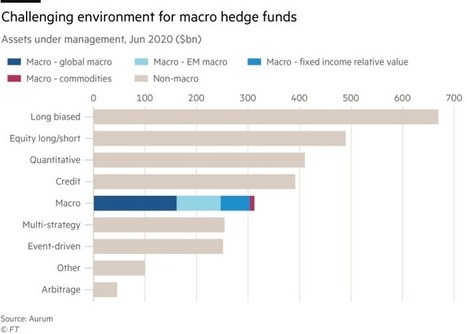
Three years ago, Hugh Hendry, one of the UK’s highest-profile hedge fund managers, called it quits. A career forged making bold bets on global economic trends was faltering badly, taking the fun out of it for the 48-year old — and his few remaining investors. In a final letter to them in September 2017, before swapping London for the Caribbean, Mr Hendry blamed massive central bank stimulus for choking off the volatility craved by the “pirates” of global macro investing, a prominent hedge fund strategy that involves wagering on the fate of nations and governments through bonds, currencies and commodities. “The business was becoming joyless, and it felt like an impossible task,” Mr Hendry admitted in an interview from his bolt-hole in St Barts. Surfing actual waves rather than economic ones was therefore more attractive. But now volatility is back with a vengeance as the coronavirus crisis has engulfed the global economy. This has nurtured a renaissance for many macro hedge funds, with some notching up gains not seen since their 1990s heyday.
|
|
Scooped by
Institut sur la gouvernance (IGOPP)
August 20, 2020 10:50 AM
|
Stock buybacks by US companies nearly halved in the second quarter to the lowest level in eight years as businesses grappled with a sharp rise in uncertainty and a swift decline in profits. Provisional figures show the total spent on buybacks by companies in the S&P 500 was about $89.7bn, according to S&P Dow Jones Indices, down 46 per cent from the same quarter last year. The data is based on results from 95 per cent of the companies in the index. If the estimate holds true, it would mark the lowest quarterly total for buybacks since the first quarter of 2012. The decline was steeper than the fall in corporate profits, which contracted by a third in the quarter among companies in the S&P 500 due to the coronavirus pandemic. The drop in buybacks would have been steeper still without a big one-off share repurchase by T-Mobile US, the telecoms company. Share repurchases have drawn criticism over the past decade for juicing earnings per share growth at the expense of making investments in the underlying business, and for potentially inflating stock market valuations. The pullback in purchases did not stop the S&P 500 rallying hard in the second quarter, however, and the US benchmark this week closed at a record high. [...] “The market is up without share buybacks because we see the light at the end of the tunnel and can see where economic growth is going,” said Diane Jaffee, a senior portfolio manager at asset manager TCW. Buybacks were “really only the propellant when there was not a lot of earnings or potential economic growth and that was the only game in town”, she added. [...] One result of the overall drop in buybacks: S&P 500 companies spent more on dividends than on share repurchases for the first time since 2009. Companies returned $119bn of their profits in the form of dividends in the quarter, up slightly from a year ago despite the coronavirus crisis.
|
|
Scooped by
Institut sur la gouvernance (IGOPP)
August 20, 2020 10:01 AM
|
Public commentary on this Consultation Paper will help shape an Exposure Draft, the initial version of the Standard, which is expected to be issued in May 2021. Comments should be provided in the designated Response Form and submitted to standards@cfainstitute.org. You may address as few or as many of the Consultation Paper’s questions as you wish. A complete list of the Consultation Paper questions appears in Appendix B. This Consultation Paper and the designated Response Form are available here on the CFA Institute website. The deadline for providing feedback is 19 October 2020. Comments received after 19 October 2020 will not be considered. Unless otherwise requested, all comments will be posted on the CFA Institute website
|
|
Scooped by
Institut sur la gouvernance (IGOPP)
August 19, 2020 11:56 AM
|
Uber Technologies and Lyft have said they may suspend their ride-hailing operations in California as soon as Friday, escalating a high-stakes battle with their home state over how their drivers should be classified. California sued the companies in May, alleging they were violating a new state law that requires companies to treat workers as employees rather than independent contractors if they are controlled by their employer and contribute to its usual course of business, among other things. As employees, drivers would be eligible for sick days and other benefits, issues that have become more pressing during the coronavirus pandemic. Uber and Lyft, both based in San Francisco, have argued that they are technology platforms connecting riders with drivers, not transportation companies, so the drivers aren’t part of their usual course of business. A state judge agreed with California last week and gave the companies until midnight this Friday to reclassify their drivers as employees. The companies appealed the decision and requested the judgment be paused while it is being challenged. But unless an appeals court decides to stay the ruling, the deadline stands. [...] Both companies argue that the reclassification will require drivers to work prescheduled shifts, robbing them of the flexibility they currently enjoy. The companies say they would be forced to consolidate their fleet to fewer drivers who work more hours a week; drastically reduce their footprint in the suburbs, where demand is spotty; and raise prices for rides to offset the new costs associated with recruiting, monitoring and managing driver operations.
|
|
Scooped by
Institut sur la gouvernance (IGOPP)
August 19, 2020 11:41 AM
|
In these stressful, surreal times, it’s understandable for CEOs to fixate on urgent corporate priorities at the expense of more intangible, personal considerations. How important is getting your people to think about their “purpose in life” right now when you’re worried about their well-being—not to mention corporate survival? It’s more important than you think. During times of crisis, individual purpose can be a guidepost that helps people face up to uncertainties and navigate them better, and thus mitigate the damaging effects of long-term stress. People who have a strong sense of purpose tend to be more resilient and exhibit better recovery from negative events. Indeed, our research conducted during the pandemic finds that when comparing people who say they are “living their purpose” at work with those who say they aren’t, the former report levels of well-being that are five times higher than the latter. Moreover, those in the former group are four times more likely to report higher engagement levels. Purposeful people also live longer and healthier lives. One longitudinal study3 found that a single standard deviation increase in purpose decreased the risk of dying over the next decade by 15 percent—a finding that held regardless of the age at which people identified their purpose.
|
|
Scooped by
Institut sur la gouvernance (IGOPP)
August 19, 2020 11:23 AM
|
Spruce Point Capital Management, a U.S. short-seller with a fondness for Canadian targets, has set its sights on GFL Environmental Inc., casting doubts on the debt-heavy company’s ability to ever show consistent profits. Shares of the Vaughan, Ont.-based waste company, which went public earlier this year, were down as much as 12 per cent in Tuesday’s trading before closing at $25.53, down 9 per cent from Monday’s close. In a statement after the market closed, GFL called the report “baseless” and said it contained “numerous inaccuracies and mischaracterizations.” GFL did not specifically identify inaccuracies or respond to any details in the report. Short-selling is a bet that shares will drop, with an investor borrowing the shares, selling them and repaying the loan by returning new shares, preferably bought at a lower price. Spruce Point has a string of Canadian wins, but its two most recent short picks have shown resiliency. [...] Spruce Point’s 2018 short on Maxar Technologies Corp. worked out well, with the shares collapsing 90 per cent in the months to follow. Maxar and three previous Canadian shorts fell an average 77 per cent, Spruce Point says. However, its subsequent targets – Dollarama Inc. in October, 2018, and Canadian Tire Corp. Ltd. in December, 2019 – are now trading above where they were when Spruce Point issued its reports.
|
|
Scooped by
Institut sur la gouvernance (IGOPP)
August 19, 2020 10:23 AM
|
It was Jeffrey Immelt’s fate to follow Jack Welch — the 20th century’s highest-profile corporate boss — as chief executive of General Electric, the company that was for decades a bellwether for corporate America. One common defence of the affable Immelt, recalled in Lights Out, is that he was dealt a difficult hand. GE’s reputation with investors rested on preternaturally smooth earnings growth, buttressed by the financial operations of GE Capital, which Welch had expanded. Welch’s hard-nosed managerial approach, including ruthless pruning of underperformers, earned him the nickname he hated, “Neutron Jack”. By the time of his departure, the group relied on a spread of activities running from NBC, the broadcaster, via fridges to the manufacture of aircraft engines and vast power turbines. Immelt then had to cope with the shocks of the 9/11 terror attacks (just after he took over) and the 2008 financial crisis. And all the time, there was Welch, sniping away at his successor via regular television interviews. [...] Despite its sometimes wearying, choppy, short-chapter style, and occasional diversions into numbing accounting detail, Lights Out is a hard-nosed, well-written analysis of what went wrong (albeit one disputed by some of Immelt’s defenders). [...] I think this analysis of the overarching challenge of running GE invites a little more respect for Immelt’s 16-year plate-spinning feat than the authors allow. Like many chief executives, including Welch, he certainly outstayed his welcome, and grew to believe his own publicity as the man modernising and streamlining the company for the digital and eco-friendly age. GE directors must take some blame for not challenging him sooner or more aggressively.
|