Your new post is loading...

|
Scooped by
Institut sur la gouvernance (IGOPP)
August 25, 2020 11:12 AM
|
This paper examines the possible effects of corporate governance (GC) on audit quality (AQ) among the FTSE 350 companies. Using a sample of 180 companies from 2012 to 2017 (i.e. 1080 firm-year observations) a binary logistic model has been employed to investigate the CG-AQ nexus. This analysis was supported by conducting a probit logistic model as a sensitivity analysis. Our findings are associative of a heterogeneous impact of CG on AQ post the implementation of the 2012 CG reforms in the UK. For example, although institutional ownership and management ownership can predict AQ, board independence, non-executive directors and audit committee are not attributed to AQ in the UK. This implies that corporate compliance with good CG practices has a limited impact on the decision to select a Big4 auditor in the UK. Despite the limitations of our study, we hope it can motivate further investigations in this area.
|
|
Scooped by
Institut sur la gouvernance (IGOPP)
August 25, 2020 11:07 AM
|
The board of GFL Environmental Inc. said it reviewed a short-seller’s report that questioned the waste hauler’s accounting methods and found it “deeply flawed,” standing by the firm’s management. “The GFL board of directors stands 100 per cent behind the company’s management team, strategy and focus on long-term shareholder value in the face of Spruce Point’s misrepresentation of the company’s public disclosures and their confusion about our industry and even basic accounting principles,” Dino Chiesa, lead independent director of the board of GFL, said in a statement Tuesday. Last week, Spruce Point Capital Management LLC released a 107-page report that accused GFL of having an “aggressive and opaque business model” and claimed Chief Executive Officer Patrick Dovigi has “questionable” business connections. The allegations have not been proven. Dovigi said on Aug. 18 the statements made by Spruce Point were “misleading” and contained factual errors, without specifying what they were. Shares of GFL plunged 14 per cent in two days after the report was released. GFL, based in Vaughan, Ontario, went public on March 3, just as a stock market sell-off sparked by COVID-19 was gaining momentum. Two previous attempts at IPOs had failed; among investor concerns were the company’s large debt level and spending on acquisitions. In its statement Tuesday, the company said it closed a US$750-million debt offering. “The notes offering also demonstrates that investors are aligned with our strategy, supportive of management and not easily swayed by the malicious innuendo and flawed analyses in Spruce Point Capital Management’s self-serving attack on the Company,” Dovigi said.
|
|
Scooped by
Institut sur la gouvernance (IGOPP)
August 25, 2020 10:43 AM
|
CEOs who are serious about maximizing shareholder value can profit from studying the playbook that activist investors use. Generations of CEOs have been told they could maximize value by managing a portfolio of businesses. Some of these would be cash cows and others might be fast-growing stars, requiring investments and management attention. The growth-share matrix guided CEOs to divest dogs, milk cash cows, and invest in stars. This model worked well in a world where investors bought shares of publicly-traded companies and trusted management to deliver results over the long term. There was no need to worry about the valuation effects of running businesses that required different amounts of capital and management attention, or that had disparate rates of return. This conventional wisdom no longer works well as markets today penalize companies that hold onto businesses with disparate growth, margins or capital intensity. This means that by milking a cash cow to invest in a star could reduce the value of the overall portfolio if those businesses require different amounts of capital and management attention, or have disparate rates of return. And it may not just be the dogs that need to be divested—some businesses may be candidates for divestiture, even if they are strong performers, simply because they are too different from the rest of the portfolio.
|
|
Scooped by
Institut sur la gouvernance (IGOPP)
August 25, 2020 10:26 AM
|
Nicolai Tangen will divest his shareholding in the $20bn hedge fund he founded in order to become chief executive of Norway’s $1tn oil fund after a fierce row between the Scandinavian country’s politicians and its central bank. Mr Tangen will transfer his entire holding in AKO Capital, a London-based hedge fund, to the charity he set up, AKO Foundation. He will also sell out of all his personal fund investments, with his assets — which he said would be about NKr7bn ($780m) — held as bank deposits. “I have taken these actions to remove any doubt about which hat I am now wearing. I want to be CEO of the oil fund, and have only one objective: creating wealth for future generations,” Mr Tangen said at a hastily arranged press conference on Monday evening. The storm has been the deepest crisis in the oil fund’s 24-year history, as politicians from across the Norwegian spectrum have criticised the country’s central bank — which houses it — for failing to eliminate Mr Tangen’s conflicts of interest. They were also deeply concerned about some of AKO’s funds being based in the Cayman Islands, something leftwing politicians in particular were worried could compromise the oil fund’s fight against tax havens. [...] Mr Tangen had originally said his holding in AKO would be reduced from 78 per cent to 43 per cent and would be placed in a blind trust but that he would take over the stake once his five-year period as chief executive of the fund ended. [...] Mr Tangen admitted that had he known he would have to sell out of AKO he would not have applied for the job in December. He joked that he had asked if he could hold his NKr7bn in cash at Norges Bank but was not allowed, and that after the entire process Mr Olsen now “owes me a beer”.
|
|
Scooped by
Institut sur la gouvernance (IGOPP)
August 25, 2020 9:51 AM
|
The once-in-a-hundred years global pandemic and once-in-a-generation global protests have created a seminal moment for companies and their leaders to reestablish and reinforce the basic tenets by which they run their businesses. The expansiveness of the role of the CEO and the board, as demonstrated by environmental, social, and governance (ESG) issues, will continue. Many changes are underway with the expanded attitude of stakeholder capitalism, the broader mandate of running a business, and positioning its governance. These changes will need to be communicated effectively to all stakeholders. One of the first opportunities for companies to rearticulate their values, strategy, board roles, and management actions is in the cycle of fall shareholder engagement. For this pivotal year of 2020, the traditional fall shareholder engagement season takes on heightened significance. In that regard, how should companies prepare for those engagement discussions with investors, and what will be asked of them and their leaders?
|
|
Scooped by
Institut sur la gouvernance (IGOPP)
August 25, 2020 9:44 AM
|
Unpredictability has dominated the economic climate over the last six months and likely will continue in the months ahead. Companies that swiftly and thoughtfully assess and respond to evolving challenges will most effectively manage through the pandemic. This theme applies with equal force when it comes to executive compensation. The volatility of the business cycle challenges compensation committees to proactively assess compensation programs and to pivot, fine-tune or stay the course, as events warrant. Director discretion will be as important as ever when it comes to assessing and rewarding 2020 performance.
|
|
Scooped by
Institut sur la gouvernance (IGOPP)
August 24, 2020 12:01 PM
|
Catie McKee was nervous. It was last October, and the 31-year-old hedge fund analyst, who had been scrutinizing the mortgages on the nation’s malls, was convinced that some of those malls would default on their loans. She and her colleagues had even bet a substantial amount of money on that likelihood. Ms. McKee was about to make her case to Carl Icahn, one of the country’s best-known investors, who had made a similar wager and invited her team to discuss the trade. Nothing would bolster her confidence — and the prospects for her trade — more than if the billionaire and onetime corporate raider backed her up. She needn’t have worried. As Ms. McKee sat in Mr. Icahn’s wood-paneled boardroom with a sweeping view of Manhattan’s Central Park, discussing her thesis with the 83-year-old investor, she realized they shared the same outlook. Both agreed that e-commerce, changing consumer habits and evolving demographics had pummeled all malls to some degree in recent years, but some were far worse off than others. So by betting on their demise, both could profit handsomely — which they did. Mr. Icahn, whose hostile takeover of TWA in the 1980s established him as a major dealmaker, has made $1.3 billion on the trade since that meeting. And the investors that made the trade within Ms. McKee’s firm, MP Securitized Credit Partners, more than doubled their money. They are among a handful of investors who have, collectively, made hundreds of millions of dollars on similar trades this year.
|
|
Scooped by
Institut sur la gouvernance (IGOPP)
August 24, 2020 11:54 AM
|
The Basel AML Index is an independent annual ranking that assesses the risk of money laundering and terrorist financing (ML/TF) around the world. Published by the Basel Institute on Governance since 2012, it provides risk scores based on data from 16 publicly available sources such as the Financial Action Task Force (FATF), Transparency International, the World Bank and the World Economic Forum. The risk scores cover five domains:
#1. Quality of AML/CFT Framework
#2. Bribery and Corruption
#3. Financial Transparency and Standards
#4. Public Transparency and Accountability
#5. Legal and Political Risks
The Public Edition of the Basel AML Index 2020 covers 141 countries with sufficient data to calculate a reliable ML/TF risk score. A comprehensive list of scores and sub-indicators for 203 countries is available in the Expert Edition, a subscription-based service used by companies and financial institutions as an ML/TF country risk-rating tool for compliance and risk assessment purposes. Subscription is free for academic, public, supervisory and non-profit organisations. The Basel AML Index is developed and maintained by our International Centre for Asset Recovery (ICAR).
|
|
Scooped by
Institut sur la gouvernance (IGOPP)
August 24, 2020 10:05 AM
|
General Electric Co.’s board extended Chief Executive Officer Larry Culp’s contract by two years after the coronavirus pandemic upended his plan to turn around the ailing industrial giant. Culp will lead GE through at least August 2024 with the option for a one-year extension after that, the company said in a regulatory filing. The board also revised how Culp would be compensated, making it easier for him to take home as much as US$230 million at the end of his contract. The extension represents an endorsement of Culp’s revitalization strategy even after the shares tumbled 44 per cent this year as the pandemic gutted demand for GE’s jet engines, power equipment and medical scanners. The new contract also preserves a key stock-based piece of his compensation package to offset the share drop. [...] Since taking the reins in late 2018, Culp has slashed debt, sold assets and focused on turning around GE’s beleaguered gas turbine business, a major source of the company’s cash woes in recent years. His efforts caught on with Wall Street last year as GE posted its biggest share-price gain since 1982, when Jack Welch was starting in the top job. “Larry has made significant progress in transforming GE’s operations and culture,” lead director Tom Horton said by email. “Larry’s compensation remains overwhelmingly tied to producing results for shareholders, with nearly 90 per cent of his annual pay at risk.” [...] The pandemic also dealt Culp a personal blow by drastically reducing his chances for a big stock payout -- a fate the board remedied with his new contract. When Culp signed on to take the CEO job, the stock fetched around US$12.40, less than half where it had traded two years earlier and far below its peak two decades ago. To push Culp to boost the stock price, the board put in place a big incentive.
|
|
Scooped by
Institut sur la gouvernance (IGOPP)
August 24, 2020 10:00 AM
|
For many, the 2020 proxy season required channeling of Winston Churchill for needed encouragement: “If you’re going through hell, keep going.” With companies, investors, and the public focused on the COVID-19 pandemic and racial equality movement, many spring discussions between companies and their shareholders had little to do with the ballot items at the upcoming shareholder meetings. Yet these meetings proceeded apace—albeit in a virtual format that presented its own challenges—and several noteworthy environmental, social, and governance issues (ESG) trends emerged from the final tallies. Outside of the 2020 annual meetings, it was equally clear that investors’ attention to ESG is accelerating. [...] Here, we discuss six themes –driven by events both in and outside of this year’s shareholder meetings—that should be front of mind as public companies prepare for fall engagements with their investors.
1. The “S”—human capital and diversity in particular—takes front and center.
2. The other half of the “S”—companies’ social capital and purpose—cannot be ignored.
3. Executive compensation faces enhanced scrutiny—and 2021 will be even more challenging.
4. Climate change remains a top ESG priority, and will only intensify in attention.
5. Robust sustainability reporting becomes a “must have”—and momentum builds behind SASB.
6. Activists wait in the wings.
|
|
Scooped by
Institut sur la gouvernance (IGOPP)
August 24, 2020 9:52 AM
|
The special purpose acquisition company (“SPAC”) is on the rise. A surge of offerings by a series of high-profile SPACs in the last several months has led to record levels of capital being raised by SPACs in 2020. As SPACs become a routine part of M&A processes, private company sellers and their shareholders are being presented with new opportunities that require informed and creative navigation. A SPAC is a company formed to raise capital in an initial public offering (“IPO”) to finance a subsequent merger or acquisition within a time frame specified in its charter, typically two years. The target firm, which must not yet be identified at the time of the SPAC’s IPO, becomes public as a result of the transaction (often referred to as a “business combination” or a “de-SPAC transaction”). So far this year, a total of $30.4 billion of capital has been raised by SPACs in over 75 IPOs, a marked increase from the previous record, set in 2019, of $13.6 billion raised in 59 IPOs. The average size of SPAC IPOs has also grown from approximately $230 million in 2019 to more than $400 million so far in 2020.
|
|
Scooped by
Institut sur la gouvernance (IGOPP)
August 24, 2020 9:37 AM
|
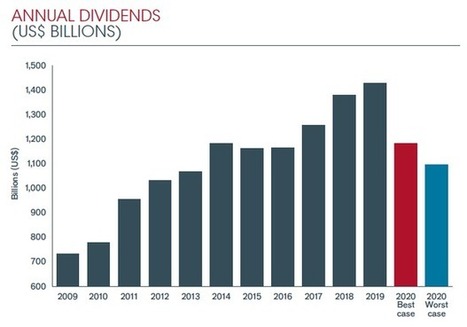
The coronavirus crisis will see the world’s biggest firms slash dividend payouts between 17%-23% this year or what could be as much $400 billion, a new report has shown, although sectors such as tech are fighting the trend. Global dividend payments plunged $108 billion to $382 billion in the second quarter of the year, fund manager Janus Henderson has calculated, equating to a 22% year-on-year drop which will be the worst since at least 2009. All regions saw lower payouts except North America, where Canadian payments proved to be resilient. Worldwide, 27% of firms cut their dividends, while worst affected Europe saw more than half do so and two thirds of those cancel them outright. “2020 will see the worst outcome for global dividends since the global financial crisis,” Janus Henderson said in a report published on Monday. “We now expect headline global dividends to fall 17% in a best-case scenario, paying $1.18 trillion... Our worst-case scenario could see payouts drop 23% to $1.10 trillion.” [...] “Dividend trends are reflecting the trends in society and the stock market at the moment,” said Janus Henderson’s head of global equity income, Ben Lofthouse. [...] The most obvious is the path of the coronavirus, but there is also what U.S. firms do later this year and whether Europe’s banks get the green light early next year to restart their payments. “The big question for the U.S. is what will happen in the fourth quarter. If many companies make significant cuts to their dividends, payouts will be fixed at a lower level until towards the end of 2021.”
|
|
Scooped by
Institut sur la gouvernance (IGOPP)
August 21, 2020 10:42 AM
|
When stay-at-home orders swept the US in March, the rubbish stopped piling up outside shops, schools and stadiums, slashing $40m from Waste Management’s revenues in two weeks. Jim Fish, its chief executive, responded not by slashing costs but by guaranteeing his full-time staff’s pay for the pandemic’s duration and offering small businesses a free month’s service once they reopened. “The shareholders were kind of secondary or tertiary in my mind,” he recalls. “Did I in the back of my mind know there was going to be a cost to shareholders? Of course I did, but really what I was thinking . . . was ‘if I have to lay off a bunch of people, how are they going to provide for their families?’” The waste disposal business is not known for bleeding hearts, and shareholders are used to being the top priority of CEOs. But Mr Fish’s actions reflected a mood change in corporate America since the global financial crisis, which nothing captured more strikingly than the statement issued this time last year by Washington’s leading big business lobby group. In it, the Business Roundtable redefined the purpose of America’s corporations, to emphasise their commitments to customers, employees, suppliers and communities. Last on that list of “stakeholders” were the investors who, under a consensus tracing back to the 1970s economist Milton Friedman, had previously basked in the assumption of “shareholder primacy”. The letter was signed by 181 CEOs, from Amazon’s Jeff Bezos to Walmart’s Doug McMillon. A year on, however, they are struggling to convince doubters that it changed much, as the Covid-19 crisis puts unprecedented pressures on their businesses and an array of investors, academics and activists argue that more exacting changes are needed if stakeholder capitalism is to live up to its billing.
|
|
|
Scooped by
Institut sur la gouvernance (IGOPP)
August 25, 2020 11:11 AM
|
Nine super tactics and one superpower board chairs can use to make the most of the board experience and prime their organizations for success. Super board chairs don’t just consider the near term; they make sure the institutions they serve endure shifts in leadership and deliver social impact that can cascade down the generations. We both love to chair. Between us, we’ve chaired seven social enterprise boards. And while we can’t claim to be super chairs, we’ve seen some. We’ve also learned a few important lessons for ourselves the hard way. We’ve chaired meetings as if we were doing our day job, collecting information to help make decisions but encouraging little other discussion. We’ve bored our boards rather than engage them. We’ve failed to leverage board members’ time and wisdom in collective decision-making. Over time, we came to appreciate that the stakes involved in chairing were high and the effects of our work were long-lasting. [...] Chairs also need a unique set of capabilities. We’ve also both been chief executives and found that chairing a board was not the same as running an organization. Some skills transferred. Some did not. Chief executives need to be decisive. Chairs lead a decision-making team. Effectively navigating these circumstances and becoming a super chair requires a range of tactics. Here are nine of our favorites:
1. Create a Culture for Good Collective Decision-Making
2. Clarify Expectations
3. Create a Value Proposition for Each Member
4. Run a Great Meeting
5. Make the Executive Director’s Success Your Success
6. Continually Update Succession Plans
7. Demand Professional-Quality Recruiting
8. Pare Deadwood
9. Solicit Feedback
|
|
Scooped by
Institut sur la gouvernance (IGOPP)
August 25, 2020 11:03 AM
|
Exchange operator Nasdaq Inc (NDAQ.O) has filed with U.S. regulators to change its rules to enable companies that debut on the stock market through a direct listing to raise capital, as an alternative to an initial public offering. The move underscores a desire for an alternative route to the public markets to an IPO, for decades the avenue used by the likes of Amazon.com Inc (AMZN.O) and Apple Inc (AAPL.O), amid criticism by venture capital firms that investment banks underprice IPOs to help investors score big gains. Nasdaq made the proposed rule change in a filing submitted on Monday and which is set to be published by the U.S. Securities and Exchange Commission (SEC) on Tuesday. Nasdaq has been working on the filing for around a year, according to a person familiar with the matter. The SEC already allows direct listings for companies that do not raise capital in the process. In 2018, music streaming business Spotify Technology SA (SPOT.N) was the first major company to go public through a direct listing. The rival New York Stock Exchange (NYSE) in June submitted an amended rule change with the SEC that would also enable companies to raise capital through a direct listing. Nasdaq’s proposal would see a company, with the help of an investment bank, set a non-binding price range in advance of the first trade on the exchange, with a fixed number of shares being sold. There is no limit on how much above the price range a company’s share price could open; the stock would not open more than 20% below the range.
|
|
Scooped by
Institut sur la gouvernance (IGOPP)
August 25, 2020 10:37 AM
|
Let’s take a break from worrying about the global pandemic to check on the health of your equity incentive plan. While we recommend that clients conduct a checkup every year, it is even more important when the economy is less stable. The following outlines some of the best practices in reviewing equity incentive plans maintained by privately held companies. Publicly traded companies should engage in the same exercise, but are advised to consider slightly different issues in light of the impact of Institutional Shareholder Services (ISS) and/or Glass Lewis, securities regulations, and listing requirements.
(1) Review the Share Reserve
(2) Check the Expiration Date.
(3) Repricing?
(4) Review Performance Metrics.
(5) Governance.
|
|
Scooped by
Institut sur la gouvernance (IGOPP)
August 25, 2020 9:53 AM
|
Initial press reports last November that the Committee on Foreign Investment in the United States (CFIUS) had commenced a review of ByteDance’s acquisition of Musical.ly, the service that was merged into ByteDance’s video-sharing site TikTok and helped fuel its expansion, were not particularly surprising to those familiar with CFIUS and its concerns. However, recent departures from established CFIUS processes in the TikTok matter are striking and concerning for persons engaging in cross-border transactions involving the United States, calling into question the scope, apolitical nature, confidentiality, and security focus of the CFIUS process.
|
|
Scooped by
Institut sur la gouvernance (IGOPP)
August 25, 2020 9:49 AM
|
A novelty in the C-suite not so long ago, the chief sustainability officer (CSO) is fast becoming a fixture in companies of note as climate change and inequality increasingly dominate global attention. In the past year alone Citigroup, General Motors and International Paper have each appointed their first CSO. They join Diageo, P&G, Mastercard and Tyson Foods on the growing list of firms that have added a CSO to their top management team in recent years. Yet these firms are hardly trailblazers. Between 2004 and 2014, the number of S&P 500 companies that have a CSO increased from 25 to 90. The ranks of CSOs can only swell from here. Investors as well as lenders now factor ESG—environmental, social and governance— into investment and lending decisions, says a study by Oxford University. Firms ignore sustainability at their own peril. BlackRock, the world’s largest asset manager, took voting action this year against 53 companies for not doing enough on climate issues. “Shareholder expectations of what banking and the private sector can do has never been higher,” observed Val Smith, Citigroup’s new CSO. The CSO’s main job is to monitor and identify areas of concern and action and to offer suggestions on how the company might be able to perform better Less clear is the CSO’s remit and how the role affects a company’s sustainability performance. Having come into being only in the last two decades, the CSO is still evolving. Studies show that the role varies from industry to industry and from company to company, depending on the level of commitment to sustainability. Indeed the CSO also goes by other titles, such as chief environmental officer. In general, the CSO’s main job is to monitor and identify areas of concern and action and to offer suggestions on how the company might be able to perform better. This involves more engagement in socially responsible activities and less in socially irresponsible ones.
|
|
Scooped by
Institut sur la gouvernance (IGOPP)
August 25, 2020 9:43 AM
|
CEOs have increasingly been speaking out on social issues that are not directly related to their core businesses. Why are they doing so, and what are the consequences for their companies? In a new paper, I examine the phenomenon of CEO activism. Using textual analysis of the public statements and social media posts of CEOs, I classify a statement as activist if the CEO comments on gender equality, racial diversity, immigration, gun control, environmental issues, universal healthcare, or human rights. In total, there are 187 activist statements by CEOs of S&P 500 firms in the 2014-2019 period – most of which are on gender issues, LGBT rights, and racial injustice. First, I examine the motivations for CEO activism. CEO’s social statements can reflect a growing demand of customers for corporations to engage with societal concerns. Indeed, a survey by Stanford University shows that U.S. customers generally support CEO social activism. The risk of taking a stance on a social issue is that the CEO will antagonize people with opposing views. The same Stanford University study found that the respondents were more likely to stop using a company’s product if they disagree with the activist stance of the company’s CEO.
|
|
Scooped by
Institut sur la gouvernance (IGOPP)
August 24, 2020 11:56 AM
|
The deal to normalise relations between Israel and the United Arab Emirates (uae), announced on August 13th, was a diplomatic coup. Might it be a commercial one too? Moneymen in Dubai, the uae’s largest financial centre, are hoping to cash in on increased investment and travel between the two countries. Israelis are expected to join the hordes of well-heeled foreigners who have opened businesses or bought swanky pads in the coastal emirate. Dubai, one of seven emirates that make up the uae, will be glad of the custom. Its media may be full of feel-good financial stories—drooling, for instance, over the recent foundation-pouring for the world’s tallest hotel, set to rise to 82 storeys, and the unveiling of “the world’s highest infinity pool”—but closer to earth things look less impressive. Thanks to overbuilding, property prices remain far below peaks reached six years ago. Covid-19 has clobbered an economy built largely on retail and hospitality. Low oil prices have strengthened the headwinds: Dubai is not hydrocarbon-rich but its economy feeds on petrodollars. Adding to the challenges, Dubai faces increasing international pressure to clean up its act. It has long been less than discerning about the provenance of money flowing in. Its property market is heavily stained with laundered loot. If Dubai is forced to tighten standards, that would dent business in the short term, complicating its efforts to push its way into the premier league of financial centres.
|
|
Scooped by
Institut sur la gouvernance (IGOPP)
August 24, 2020 10:06 AM
|
Governance failures at for-profit corporations are the topic of frequent media stories, judicial opinions, and academic analyses. Nonprofit governance, however, has received significantly less attention. This lack of attention is not because nonprofits are immune from governance failures, and recent allegations against the National Rifle Association (NRA) may prove the point. In our paper, Nonprofit Governance in an Age of Compliance, we identify the factors that give rise to critical nonprofit governance failures, and we offer attainable reforms to address them. Most nonprofit governance failures stem from the key legal difference between nonprofit and for-profit corporations. By law, nonprofits are prohibited from distributing accrued earnings to private individuals. Nonprofits, therefore, have no owners in the traditional sense and by extension no discrete class of people with the financial motivation to monitor management. As a result, nonprofits have been vulnerable to corporate governance problems like self-dealing or fraud. And since the nonprofit sector accounts for $1 trillion of US GDP and 12 million jobs, the consequences can be severe.
|
|
Scooped by
Institut sur la gouvernance (IGOPP)
August 24, 2020 10:02 AM
|
The 2020 proxy season saw companies and investors navigating a rapidly evolving business environment, including new virtual modes of communication and working. The COVID-19 pandemic, including its widespread, multidimensional impacts and acceleration of changes and risks, is casting a spotlight on corporate resiliency. It is also challenging recent company commitments to stakeholder capitalism, driving attention to environmental, social and governance (ESG) matters, and reshaping areas of corporate and investor focus. To help boards navigate this new normal and meet evolving stakeholder expectations, this report examines four ESG developments from the 2020 season and considers how investor and corporate perspectives and priorities are changing in the wake of the pandemic, the growing push to eradicate systemic racism, and other macro developments.
|
|
Scooped by
Institut sur la gouvernance (IGOPP)
August 24, 2020 9:56 AM
|
From the Business Roundtable to BlackRock, there’s growing pressure on companies to respect all major stakeholders—employees, customers, suppliers and local communities, as well as investors. Meanwhile, a variety of innovations are effectively making these stakeholders central to long-term company success. Digital technologies, new ways of organizing work and transactions, and the shift to the service economy have forced businesses to prioritize the interests of all stakeholders—adding significant opportunities and risks. As a result, unless the company’s survival is in question, stakeholder-centricity is becoming essential to its overall management. Even under short-term pressures such as pandemics, executives and directors will need to view the company as operating within an integrated ecosystem. Only by supporting all major stakeholders, through calibrated and balanced incentives, will companies achieve sustained success.
|
|
Scooped by
Institut sur la gouvernance (IGOPP)
August 24, 2020 9:48 AM
|
Companies are finding virtual shareholder meetings to be cheaper and less time-consuming, but shareholders complain they don’t get as much time to ask their questions. A majority of the companies in the S&P 500 this year have decided to move their shareholder meeting—usually an in-person event—online due to coronavirus-related restrictions on large gatherings. Faced with the option to postpone the meeting until later, 87% of businesses opted for a virtual event compared with 23% of meetings held remotely in 2019, according to data provider MyLogIQ. Executives and investors usually like that they can dial into these meetings from their homes. But despite the ease of access, shareholders say remote events offer less scope for participation as many companies ask for questions in advance, respond only to a select number of them and don’t disclose how many queries were received. Many companies scrambled to make the switch as the pandemic accelerated in the spring. Numerous businesses weren’t familiar with the technology platforms used for such large, live meetings and quickly had to adapt their protocols to the new format. Remote investor events held by companies in the S&P 500 this year averaged 32 minutes, seven minutes shorter than in-person shareholder meetings in 2019, according to a recent study of more than 90 annual meetings by the Hebrew University of Jerusalem. Further, company executives allocated less time for business updates and for answering shareholders’ questions compared with in-person meetings in 2019, the study said.
|
|
Scooped by
Institut sur la gouvernance (IGOPP)
August 24, 2020 9:20 AM
|
Erin O'Toole has won the leadership for the Conservative Party, promising to present a vision to make Canada more prosperous and reaching out to broaden the party's base of supporters. After a six-hour delay due to glitches with the ballots, O'Toole took 57 per cent of the votes on the third and final ballot, compared to 43 per cent for second-place contender Peter MacKay. O'Toole claimed victory after taking support from Leslyn Lewis, who finished with a surprisingly strong performance but dropped off on the second ballot. Derek Sloan dropped off after the first ballot. In his acceptance speech, O'Toole promised to work to unite the party, champion Conservative values, and hold Prime Minister Justin Trudeau to account. "We must continue to point out Liberal failings and corruption, but we must also show Canadians our vision for a stronger, more prosperous and more united Canada," he said. "Canada can and must do better and Conservatives will work hard to earn the trust and confidence of Canadians in the next election." Acknowledging the party needs to broaden its base to win the next election, O'Toole reached out to all Canadians in all regions of the country and from diverse backgrounds. "I believe that whether you are Black, white, brown or from any race or creed, whether you are LGBT or straight, whether you are an Indigenous Canadian or have joined the Canadian family three weeks ago or three generations ago," he said. "Whether you're doing well or barely getting by. Whether you worship on Friday, Saturday, Sunday or not at all … you are an important part of Canada and you have a home in the Conservative Party of Canada."
|