Your new post is loading...
Call it Newton’s law of corporate ownership. As listed companies come under increasing investor pressure to act on everything from executive pay to carbon emissions, a reaction against those constraints seems to be fuelling a spate of buyouts by private equity firms. The first half of 2021 was a boom period for the sector with $500bn-plus of deals, the highest level since records began four decades ago. [...] But is private equity also reactionary in the conservative backlash sense of the word — facilitating a rebellion against some of the progressive constraints of public company existence, particularly the growing demands of complying with standards on environmental, social and governance issues? The evidence is mounting. [...] Social issues, S of ESG, are also antithetical to much traditional private equity. .
Hedge-fund billionaire William Ackman is dropping plans to use his SPAC to invest in Universal Music Group, saying the Securities and Exchange Commission wasn’t convinced the deal met the rules for such vehicles. Mr. Ackman said his investment firm, Pershing Square Holdings Ltd., would instead take a stake in Universal and become a long-term investor in the company. The U-turn is a setback for Mr. Ackman, who crafted a first-of-its-kind pact that set it apart from a wave of other deals orchestrated recently by special-purpose acquisition companies. In June, Mr. Ackmann said his SPAC had agreed to buy a 10% stake in Universal from French media conglomerate Vivendi SE for about $4 billion. The deal valued Universal at some $40 billion. Typically, such deals involve a previously listed SPAC, or blank-check company, merging with an unlisted business, taking it public. Mr. Ackman’s deal was different: New York Stock Exchange-listed Pershing Square Tontine Holdings Ltd., the SPAC, didn’t intend to merge with Universal but instead become a shareholder ahead of an already-planned listing by Universal in the Netherlands. People familiar with the matter said it was structured that way because of tax and legal implications for Vivendi, The Wall Street Journal reported.
Robust controls over financial reporting enhances trust in business and improves reporting quality. The UK already has requirements in this area but there is widespread agreement among users of financial reporting that there is much room for improvement. In March, the long-awaited consultation on ‘Restoring Trust in Audit and Corporate Governance’ was published by the Department for Business, Energy and Industrial Strategy (BEIS). One of its key proposals is that the UK should adopt a strengthened internal controls framework for companies, similar to the US Sarbanes-Oxley Act (SOX) which requires directors to attest to the effectiveness of internal controls over financial reporting. The proposal explores a number of options featuring varying degrees of auditor involvement with the intention that premium listed companies be required to apply them first, followed by all other Public Interest Entities after two years. [...] The number of restatements reported by US public companies has steadily decreased since the introduction of SOX. It reached its lowest level in 2019 having decreased by over 90 percent in the last 15 years.
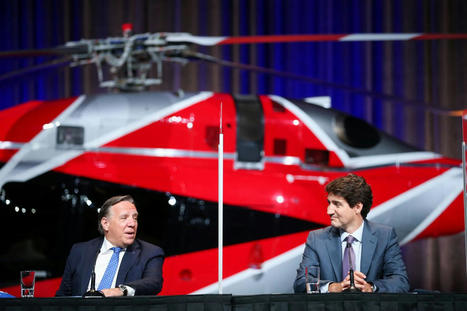
The Canadian and Quebec governments are trying to breathe new life into Canada’s bruised aerospace sector by backing new investments worth $2-billion, as the country tries to preserve its stature as a global aviation hub by developing new emissions-lowering technologies.
Canada will be able to welcome fully vaccinated travellers from all countries by early September if “the current positive path of vaccination rate and public health conditions continue,” Justin Trudeau said.
Premier François Legault had suggested a lottery could be used to boost Quebec’s vaccination rate, hinting at "rewards of all kinds."
Companies largely maintained their focus on supply-chain sustainability goals in 2020 despite the Covid-19 pandemic, and social issues such as worker welfare and supplier diversity gained more attention, according to new research.
Sovereign-wealth funds, which are among the world’s biggest stock-market players, are unleashing more of their firepower at home, as governments lean on them to reboot pandemic-stricken economies.
Join Michael and Robin as they discuss companies taking stands on social and political issues: the pressures they face from employees, and recommendations for addressing the pressures with Paul Washington, Executive Director, The Conference Board Environmental, Social, and Governance (ESG) Center.
IBM’s artificial intelligence was supposed to transform industries and generate riches for the company. Neither has panned out. Now, IBM has settled on a humbler vision for Watson.
Companies are eager to get back to pre-pandemic operations, but the return to office can be quite daunting for employees and business leaders alike. Social and legal issues around office policies are much more complex than meets the eye. What legal issues should organizations be paying careful attention to?
Will now offer investors $20 or 0.25 of a share for each Inter Pipeline share
Dangling the prospect of requiring digital proof of full vaccination by September is a good way to encourage fence-sitters to roll up their sleeves. But so-called immunity passports have to be secure and fair.
|
Happy birthday to the index fund, which this month turned 50 years old — looking fitter, feistier and more controversial than ever. Five decades ago, John “Mac” McQuown, a headstrong former farmhand from Illinois, led a team of brilliant iconoclasts at a Wells Fargo skunk works that cooked up ways to use newfangled computers in finance. Among the things the Management Sciences unit helped birth were Fico’s famous credit scores and Mastercard. But the greatest was the index fund. [...] The success of passive investing has been breathtaking. There is now over $16tn in index funds of various stripes, almost twice the size of the combined private equity, venture capital and hedge fund industries. Throw in non-public internal passive strategies, and we are likely talking of well north of $25tn. Yet this success has naturally fostered fears across parts of the finance industry, which has been rattled by such a tectonic trend. Some of the concerns are overdone and probably a little self-serving, but others have a ring of truth to them.
Key points - Recent UK government consultations have the common aim of reinforcing the UK’s position as a world-class investment destination, but they approach that aim with differing priorities.
- In responding to these consultations, UK shareholders—who overall are staunch defenders of the “one share one vote” principle—are carefully weighing up the costs and benefits of giving greater control to company founders and directors.
- Proposals of BEIS” “Restoring Trust” consultation—such as those on internal controls attestations, the Audit and Assurance Policy, and the Resilience Statement—could help bridge the gap
- The ongoing consultations are a unique opportunity for all stakeholders to influence the direction of corporate governance standards in the UK.
There’s been a flood of reviews and consultations from the UK government on the future of UK PLC as it seeks to “build back better” after the pandemic—a fact that public policy and governance experts can’t fail to have noticed.
The need to alter the economy’s trajectory toward an inclusive, equitable and sustainable future is behind escalating interest in environmental, social and governance (ESG) investing and reporting. To safeguard our collective future, corporate Canada needs to collaborate with community and public sectors to reshape markets in the public interest.
The directive comes after a high-profile government inquiry into bully tactics in the grocery business released its report on the situation on Thursday
Trudeau also said there were ongoing discussions with the United States to begin allowing fully vaccinated U.S. citizens and permanent residents into Canada for non-essential travel by mid-August.
A small number of huge price rises are dragging up the headline rate
Less than six months into the job, Intel Corp. Chief Executive Officer Pat Gelsinger’s approach to reviving the chipmaker’s fortunes is emerging: move quickly and carry a big checkbook.
Move comes as Intel is launching a major push to become a chip manufacturer for others
If the United States’ bout of rising prices soon eases, its economy could fall back into the cycle of weak inflation that preceded the pandemic — a situation much like Japan’s.
The difference between CEO and median employee pay grew in 2020 despite the Covid pandemic and ongoing relief efforts.
An auction for highly prized 5G wireless airwaves has netted around $8-billion for the federal government, making it the highest-grossing spectrum auction in Canadian history, according to sources.
A senior official at the Bank of England said that a sharp uptick in inflation showed that the central bank had underestimated the strength of the rebound in prices, and that monetary policy might have to be tightened earlier than previously thought.
|