Your new post is loading...
Lily Bowles is a Netflix (NFLX) subscriber and shareholder. She believes in the company’s ability to not only entertain but also challenge prejudice and create a greater sense of human connection. As a self-described steward of her capital, Bowles wanted to know how Netflix, whose stock she first bought in 2016, was performing on material environmental, social, and governance risks. These are sustainability issues that can be reasonably expected to have a financial impact on a company. Bowles’ finance background, and her roughly 20 years as a Netflix viewer, made her uniquely positioned to get information on Netflix’s material ESG risk performance. In previous jobs, she had worked with ESG data sets and was curious how truly financially material these risks were--and not just as a public-relations play. “I fundamentally believe that material ESG factors do affect the bottom line, and I have a curiosity of how they’re doing on material ESG issues,” she says. Bowles’ story with Netflix, while a successful one, also highlights how difficult it is for individual investors to engage with companies they own--a task that has only gotten harder since the SEC passed new rules during the waning days of the Trump administration.
Private equity funds are no longer the only way institutions can invest in non-public companies. In the past year, a spate of companies have launched private trading platforms to keep up with market demand for access to assets that are not publicly traded, including those that haven’t yet been tapped by a private equity or venture firm. Most recently, Nasdaq, SVB Financial, Citi, Goldman Sachs, and Morgan Stanley on Tuesday announced a joint venture to build a secondary trading platform for institutional investors. The platform will allow investors to access and execute private company stock transactions using technology. According to the announcement, this will increase transparency for investors.
“The one thing that I think we can all agree to at this point is that the secondary markets are not a moment in time need,” Eric Folkemer, president of Nasdaq Private Market, told Institutional Investor. “Many of the stakeholders or employees expect it to a degree, especially as companies are staying private longer.”
Our examination of the votes cast by 155 mutual funds on over 6 million corporate election items during 2004-2017 led us to a surprising conclusion: We found that Institutional Shareholder Services’ (ISS) proxy advice did not lead funds to vote as if they were informed – more often than not it pushed them in the opposite direction. [...] In our new paper, we estimate the extent to which proxy advice allows funds to vote as if they were informed. Previous research evaluates proxy advice based on whether it leads to value maximization. Our approach recognizes that some investors, such as socially responsible investment (SRI) funds, may have different goals than do traditional investors – and investigates whether advice allows funds to vote in alignment with their goals as they define them.
[...] Orbital debris, also known as space junk, can be anything from a fully intact satellite that no longer works to fragments of an exploded rocket. There are roughly 23,000 pieces of debris larger than a softball orbiting the Earth at speeds of up 28,000 kilometres an hour – fast enough for even a small piece of debris to damage or even destroy a satellite or spacecraft, according to NASA. A Montreal-based company that’s raised more than $80-million from some high profile investors thinks it has the solution. [...] NorthStar’s bid to play traffic cop in space has attracted prominent backers. In 2018, the company raised a total of $83-million from a group of investors including telecom magnate Charles Sirois, the Rogers family trust and the Space Alliance, a partnership between European space firms Telespazio and Thales Alenia Space. (Thales Alenia is also constructing the satellites for the Skylark constellation.) The total also includes $13-million from Investissement Québec and $13-million from the federal government’s Strategic Innovation Fund. The space race that has captured the imaginations of investors is increasing the congestion around Earth – a problem that Mr. Sirois, who is also the chairman of NorthStar’s board – calls “the biggest threat to the space industry itself.” But for NorthStar, the threat also represents a massive opportunity.
Over the past year BlackRock voted on more than 13,000 companies and 165,000 management and shareholder proposals. BlackRock, the $9 trillion asset management giant, has stepped up its efforts to push the corporate world toward better governance and more sustainable business models. Over the past year, it has taken on heavyweights like ExxonMobil and Warren Buffett’s Berkshire Hathaway — and waded into the battle over political donations and lobbying by companies like Pfizer and Tyson Foods, according to BlackRock’s annual investment stewardship report, released Tuesday. After Berkshire refused to engage in “direct dialogue” with BlackRock for years, the firm said it voted against two directors at Buffett’s company. That’s one high-profile example of the 6,560 times the asset manager voted against corporate management last year. BlackRock is known for pushing companies to battle climate change, and the firm was a key vote in the contentious, but ultimately, successful proxy battle at ExxonMobil. BlackRock said it voted for three of the nominees of Engine No. 1, the investment firm trying to move the oil company towards a more sustainable future. All three were elected.
JPMorgan Chase is granting Jamie Dimon a “special award” of 1.5m share options that it said reflected the board’s desire for one of the longest-serving chief executives on Wall Street to stay at the bank for a “significant number of years”. The board is awarding Dimon the options in the form of “stock appreciation rights” that he can exercise at Tuesday’s average price of $148.73, which will allow him to make a profit if the bank’s stock rises above that level in the coming years. JPMorgan’s internal model forecasts the options would yield a profit to 65-year-old Dimon of about $49m after a 10-year vesting schedule, according to people familiar with the matter. [...] The Financial Times reported in May that JPMorgan executives had been told the board wanted the chief executive to stay for another five to seven years. That would extend the reign of Dimon, a cancer survivor who underwent emergency heart surgery last year, into a third decade. Dimon, who has been JPMorgan’s chief executive since 2005, has received special awards from the bank in the past, but this was the first explicitly tied to his remaining at the lender. The options are not part of Dimon’s regular annual compensation, which for 2020 totalled $31.5m. Forbes estimates Dimon’s net worth at $1.8bn.
Special purpose acquisition companies (SPACs)—the shell companies whose sole purpose is to identify a private firm to merge with—have become an increasingly important channel for firms to raise money. In 2020, for instance, in the U.S. alone, 248 SPAC IPOS raised $83.4 billion, much more than that raised by traditional IPOs. However, SPACs are also known for underperforming after the acquisition. Since the identity of the merged firm is not known prior to the IPO, and there is little other advance information, investors must place their trust in SPAC sponsors. And here, our research shows there are discernible factors that can indicate the relative success of a SPAC.
Shareholder pressure on companies including Amazon, Union Pacific and JPMorgan Chase to address race and other diversity issues has risen to record levels this year, after the Black Lives Matter movement and the pandemic focused investor attention on social challenges. Investor support for resolutions at annual meetings that focused on diversity, such as calling for companies to report on their workforce inclusion efforts, has soared this year, according to figures from Proxy Insight, a data provider. The average of investor support for diversity-related resolutions globally in the first six months of 2021 was 42.4 per cent, compared with 23.9 per cent over the whole of 2020, the data showed.
The world’s biggest asset manager BlackRock has increased its opposition to executive pay in Europe over the past year, voting against salary packages for bosses at a swath of companies that laid off workers during the pandemic. Details of BlackRock’s voting record, published on Tuesday, show it has become more willing to use its muscle as a leading shareholder in almost all the world’s largest public companies to try to drive up corporate governance standards. In the past, critics have accused it of not doing enough, given its claims to be a champion of environmental, social and governance standards. BlackRock voted against management on 33 per cent of “say-on-pay” proposals in Europe in the 12 months to the end of June, up from 26 per cent in the previous year.
The Basel AML Index is an independent annual ranking that assesses the risk of money laundering and terrorist financing (ML/TF) around the world. Published by the Basel Institute on Governance since 2012, it provides risk scores based on data from 16 publicly available sources such as the Financial Action Task Force (FATF), Transparency International, the World Bank and the World Economic Forum. The risk scores cover five domains:
#1. Quality of AML/CFT Framework
#2. Bribery and Corruption
#3. Financial Transparency and Standards
#4. Public Transparency and Accountability
#5. Legal and Political Risks
In recent years, the concept of “corporate purpose” has been invoked as a shorthand to address a corporation’s commitment to include stakeholder governance—and with it commitments to sustainability, diversity, inclusion, social responsibility and other ESG issues—as part of a corporate strategy that achieves sustainable long-term growth and creates long-term value for the benefit of all stakeholders. Recognizing the importance of corporate purpose in helping guide efforts to build back better following the pandemic, a distinguished group of academics at Oxford University formed the “Enactment of Purpose Initiative.” The Initiative seeks to encourage the elemental constituencies of a corporation—directors, management, asset owners and managers, and other internal and external stakeholders—to collaborate to articulate an actional principle of purpose, which, when applied to the special circumstances of each corporation, will orient the firm towards mission-driven growth that delivers both profit and social responsibility.
Recently, a materially revised Chapter 11 restructuring plan of reorganization was negotiated, in part, by a purportedly independent special committee of the board of Purdue Pharma LP.[1] In the Chapter 11 case of Purdue Pharma, filed in the U.S. Bankruptcy Court for the Southern District of New York Bankruptcy Court in September 2019, the Purdue debtors stated that the special committee was comprised of "four blue-chip restructuring and pharmaceutical professionals, none of whom had any prior connection to the Sackler Families."[2] However, the independence of that special committee was challenged by a parent — whose child allegedly died as a result of the opioid epidemic — who sought the appointment of an examiner.[3] [...] The appointment of independent directors or special litigation committees by a debtor or prospective debtor in anticipation of a company commencing a bankruptcy case has become a common tool.
Environmental, Social, and Governance (ESG) investing has evolved greatly as a concept over the past two decades. It now reaches nearly every aspect of the corporate and investment decision-making process, and rightfully so. This growth has presented so many amazing opportunities for investors and corporations to measure and improve practices across all aspects of the E, S, and G spectrum. It has also created a host of challenges for investment professionals who are trying to answer the question: “Does ESG matter?” [...] The ESG (Environmental, Social, and Governance) spectrum has always had an implicit fourth pillar – Financial materiality. The last pillar in the ESGF acronym is the one that can help to connect ESG to the investment front office in perhaps the most critical way, by providing a strong motivation to link ESG to portfolio management processes. ISS ESG evaluates the F pillar through the Economic Value Added (EVA) lens. EVA converts accounting profit to economic profit by reversing accounting distortions found within the as-reported financial statements, thereby measuring the dollar value profit after ALL costs, including the cost of giving shareholders a fair return on invested capital.
|
Given the contentious debate over whether the appointment of new directors reduces firm risk, this study explores the effect of board changes on firm risk. Appointing new directors leads to firm risk. A regression kink design shows that boards with more than 30% of new directors experience a significant increase in firm risk for approximately two years. Moreover, the effect of new directors on firm risk is more pronounced for firms with weaker corporate governance mechanisms but is attenuated if the demographic gaps between the new and existing directors are relatively larger. Additionally, the effect is moderated when new directors have interlocking and academic experience. Further analysis reveals that the appointment of new directors is associated with less consistent corporate policies. [...] The findings suggest that corporate management should carefully assess the risk of board change. A large proportion of new director involvement can create challenges in communication, understanding, and cooperation, leading to inconsistent corporate strategies and policies, thus increasing operating volatility. Moreover, this study offers insights to policymakers rethinking board spills in their countries.
The events of last summer galvanized the nation and the world and drew much-needed attention to how systemic racism and injustice continues to burden communities of color, who also disproportionately bore the weight of the pandemic. In the months that followed, we witnessed a marked shift in corporate America. This shift was evidenced not only by the millions of dollars pledged towards fighting racial inequality but also in the growing recognition among business leaders that corporate America ought to play an active role in combatting racial injustice and inequity, both in the communities where they do business and their boards, management, workforce, business partners and customers. One year on, we review the ESG tools and approaches that have helped buttress efforts to address racial inequity and the increasing expectations of investors and stakeholders, and discuss how companies can continue to tackle these issues, including how a strong ESG oversight and governance framework can help boards and management in deciding when and how to speak out with respect to stakeholder priorities.
In 2014, Diane Straka, along with three male associates, formed a corporation for the purpose of providing accounting services. Each of the founders was an officer, director, and 25 percent shareholder of the new entity. A problem soon emerged: One of the corporation’s employees taunted Straka with sexist jokes and cartoons in the office, and her fellow shareholders refused to rein him in. Additionally, Straka’s work was undermined by some of her co-owners, who condescended to her and countermanded her decisions. Eventually, Straka left the firm and brought a lawsuit in New York State court alleging shareholder oppression. Oppression is a cause of action, available in most states, allowing dissolution, forced buyouts, or other remedies when shareholders in close corporations are denied the benefits of their investments. In this case, Straka alleged that the majority’s treatment of her constituted oppressive conduct. After a hearing, the court agreed, writing, “This court finds that …any shareholder of any corporation, should know that a female shareholder reasonably expects to be treated with equal dignity and respect as male shareholders forming the majority.”[1] As a remedy, the court ordered that the firm buy out Straka’s shares.
We study behind-the-scenes investor activism promoting environmental, social, and governance (ESG) improvements by means of a proprietary dataset of a large international, socially responsible activist fund. We examine the activist’s target selection, forms of engagement, impact on ESG performance, drivers of success, and effects on the targets’ operations and value creation. Target firms are typically large and visible, perform well, and have high liquidity (stock turnover) and low ESG performance. Engagement induces ESG rating adjustments: firms with poor ex ante ESG ratings experience a ratings increase after complying with the activist’s demands, whereas firms with high ex ante ESG ratings experience a ratings decrease following the revelation of their ESG problems. Activism that is focused on environmental and social issues is more likely to succeed if targets are ESG-sensitive (i.e., they have a strong ex ante ESG profile). Successful engagements boost targets’ sales. Risk-adjusted excess stock returns (with four-factor adjustment and relative to a matched sample of non-engaged firms) of successful engagements outperform those of unsuccessful engagements by 2.7%. Results are especially strong for firms with low ex ante ESG scores. Specifically, targeted firms in the lowest ex ante ESG quartile outperform matched peers by 7.5% in the year after the end of the engagement. Our results thus suggest that the activism regarding corporate social responsibility generally improves ESG practices and corporate sales and is profitable to the activist. Taken together, we provide direct evidence that ethical investing and strong financial performance, both from the activist’s and the targeted firm’s perspective, can go hand-in-hand together.
How should central banks respond to digital technology? This has become an urgent question. The answer is partly that both they and governments have to get a grip on the new wild west of private money. But it is also that they must now introduce digital currencies of their own. The state must not abandon its role in ensuring the safety and usability of money. The idea that it should is a libertarian fantasy. Moreover, action is now urgent. According to a paper by Gary Gorton of Yale and Jeffery Zhang of the Federal Reserve, innovators have now created more than 8,000 cryptocurrencies. Gorton and Zhang divide these creations into two main categories: unbacked “fiat cryptocurrencies”, such as bitcoin; and “stablecoins”, backed one-for-one by government fiat money. Both are problematic, in different ways.
Life expectancy in the U.S. fell by 1.5 years in 2020, the biggest decline since at least World War II, as the Covid-19 pandemic killed hundreds of thousands and exacerbated crises in drug overdoses, homicides and some chronic diseases. Provisional data released Wednesday by the Centers for Disease Control and Prevention showed that American life expectancy dropped to 77.3 years in 2020, roughly the same level as in 2003, erasing years of hard-won gains in the nation’s public health. It was the largest single-year decline recorded since 1943. It isn’t entirely clear what caused the drop that year, when the U.S. was fighting World War II. “I myself had never seen a change this big except in the history books,” said Elizabeth Arias, a demographer at the CDC’s National Center for Health Statistics and lead author of the report. [...] Life expectancy is a measure of a nation’s well-being and prosperity, based on mortality in a given year. Declines or stagnation in longevity can signal catastrophic events or deep problems in a society, researchers say. Life expectancy fell in the U.S. by 11.8 years in 1918, during a world-wide flu pandemic. Many victims were young.
In 2016, Tide launched Purclean, a new brand of detergent that claimed it was 100% plant-based. However, the National Advertising Division of BBB National Programs analyzed the claim four years later and found that Purclean was only 75% plant-based. While not great, 25% non-plant composition doesn’t sound too bad until you learn that some of the materials are petroleum-based. This was completely counter to Tide’s marketing message, and extremely misleading for consumers. And it’s a classic example of greenwashing, which by definition refers to misleading communication about a company’s environmental practices and impact so as to present an environmentally responsible public image. [...] Meet ClimateBert, an AI tool that deconstructs corporate statements, annual reports, claims, and other materials to assess climate-related disclosures and measure actual performance. It was created by the Task Force on Climate-Related Financial Disclosures (TCFD), which provides a framework for public organizations to more effectively disclose climate-related performance. Because extracting salient information from companies on their climate disclosures is complex and time consuming, TCFD turned to natural language processing and existing deep neural networks for help. The sheer volume of data, often using subtle words, presents a major challenge to analyze in a timely fashion. Thanks to AI tools like ClimateBert, we can now shrink weeks of analysis into just days.
Russia, Iran, China and the U.S. are among the world’s leading practitioners of cyberwarfare -- state-on-state hacking to gain strategic or military advantage by disrupting or destroying data or physical infrastructure. Unlike combat with bullets and bombs, cyberwarfare is waged almost entirely with stealth and subterfuge, so it’s hard to know when and where it’s occurring, or whether full-scale cyberwar is on the horizon.
1. What are the hallmarks of cyberwarfare?
2. What forms can it take?
3. What recent events could have been cyberwarfare?
4. How about the recent ransomware attacks on the U.S.?
5. Why all the worry?
6. Aren’t attacks on civilians supposed to be off-limits?
7. Who are the players?
8. Are actual soldiers involved?
9. What kind of defenses are possible?
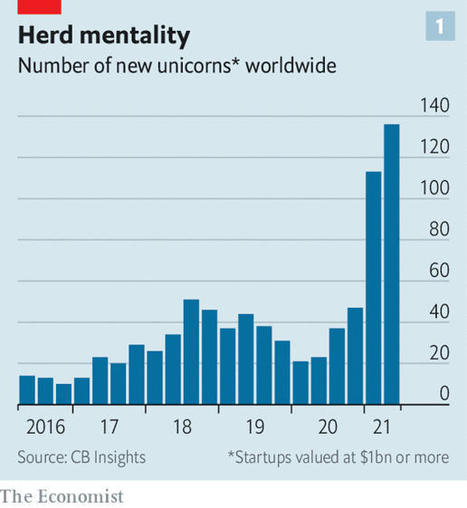
AILEEN LEE, a venture capitalist who founded an investment firm called Cowboy Ventures, coined the term “unicorn” in 2013 to refer to what was then a rare, almost magical species: privately held startups valued at $1bn or more. Any magical attributes aside, today they are commonplace—and becoming ever more so. Consumers, who stand to benefit from an array of novel, often cheap products and services, can expect to enjoy the ride. Investors betting on the unicorn derby should tread more carefully. The world’s unicorn herd is multiplying at a clip that is more rabbit-like. The number of such firms has grown from a dozen eight years ago to more than 750, worth a combined $2.4trn. In the first six months of 2021 technology startups raised nearly $300bn globally, almost as much as in the whole of 2020. That money helped add 136 new unicorns between April and June alone, a quarterly record, according to CB Insights, a data provider (see chart 1). Compared with the same period last year the number of funding rounds above $100m tripled, to 390. A lot of this helped fatten older members of the herd: all but four of the 34 that now boast valuations of $10bn or more have received new investments since the start of 2020.
Sustainable investment assets globally grew 15% over the past two years to reach $35 trillion, according to the Global Sustainable Investment Review 2020 released Monday. With 36% of all professionally managed assets now sustainable assets, "sustainable investing has really become a major force across global capital markets," said Simon O'Connor, chairman of the Global Sustainable Investment Alliance, during a news briefing call about the report from the GSIA and US SIF: The Forum for Sustainable and Responsible Investment. [...] The biennial report found that at the start of 2020, the U.S. and Europe dominated, with 80% of sustainable assets there. Canada's market had the highest proportion of sustainable investment assets at 62%, followed by Europe at 42%, Australasia at 38%, the U.S. at 33% and Japan at 24%.
Quarterly financial reports are an important way for companies to communicate with the capital market, and they clearly affect firms’ access to debt and equity capital. However, the most scarce and sought after resource for many modern, cash-rich companies is not financing but people: human capital. For example, 27 percent of U.S. employees voluntarily changed jobs in 2019, costing firms an estimated $475 billion. For perspective, the total interest expense reported by public companies was $467 billion, indicating that the cost of voluntary employee turnover is comparable to firms’ external cost of debt. Total turnover-related costs are even larger when taking into account the productivity losses from employees who consider leaving but ultimately stay.
There are many lessons to be drawn from the sweep of history. In law, the compelling story repeatedly told is the observable co-movement of law on the one hand, and economic, social, and political changes on the other hand.11See generally Morton J. Horwitz, The Transformation of American Law, 1870–1960 (1992) (comparing the evolution of the common law to economic growth in the U.S). Oliver Wendell Holmes gained much of his stature by being in the vanguard as one who recognized that the law was not simply found in a set of abstract principles received from on high but was rather molded by on-the-ground practical considerations, shaped by interacting social, political, and economic forces. [...] To address this question, we begin by travelling back in time to post-World War II America during the dominance of managerialism, when shareholders were analogous to children—seen but not heard. That model was replaced by today’s monitoring model, which empowers oversight of management in the hands of outside directors, whose obeisance, at least on paper, is anchored in the firm’s residual claimants, the stockholders who elect the directors. But, as we discuss, the monitoring board has something of a checkered history in serving this function. We argue that from its inception the monitoring board was incomplete and board-centric because it was formed in an era where the received model was dispersed, not concentrated, ownership. That, of course, is no longer what characterizes American public companies. Today we believe that the growth of institutional investors’ voting power and the engagement of hedge fund activists have repeatedly demonstrated ways to strengthen the monitoring board and in practice remedied many of its weaknesses.
|