
Connectivism
199.8K views |
+0 today


 Your new post is loading...
 Scoop.it! 
Do we need to conduct such researches? Throughout the past years, there had been researches done on the learning experiences of participants of cMOOCs, and more recently, with the participants of x... 

María Dolores Díaz Noguera's curator insight,
July 9, 2013 2:45 PM
Que implicaciones traen los cMOOCs a las organizaciones del futuro.
Scoop.it!

The Massachusetts Institute of Technology has partnered with Fujitsu Laboratories of America, Inc. to create a new platform for finding open educational resources.

timokos's curator insight,
July 2, 2013 4:21 AM
Interesting: MIT & Fujitsu developed a platform called Guided Learning Pathways' to help students navigate Open Course Ware. If it works it would be another important step in the facilitation of personalized & adaptive online learning
Scoop.it!

High school students have a terrific free option for career exploration with massive open online courses. Numerous MOOCs provide introductions or overviews into areas of study, jobs and paths to a career.
Scoop.it!

Massive open online courses are being promoted "for the students." But software execs and politicians pushing MOOCs have money and disruption at the top of the agenda.
Scoop.it!
Longish online WizIQ presentation that looks mostly at the concept of learning theories and MOOCs. The first part examines in some detail the concept of know...
Scoop.it!

In a speech at the group's annual meeting, its former president, Cary Nelson, warned of a broader battle over intellectual property being waged on college campuses.
Scoop.it!
Weekly MOOC News. A lot of MOOCS are starting just in time for the end of the U.S. school year. Summer of the MOOC maybe?
|
Scoop.it!

I am not sure if people are aware of the vision, mission of the first MOOCs, which were totally different from the present MOOCs. The first MOOCs relate to open education, open teaching and learnin...
Scoop.it!

Connectivism. Developing through communication in social learning networks. Different levels of community.
Scoop.it!

Peter B. Sloep's curator insight,
July 1, 2013 2:57 PM
And that is exactly what this blog post by Rita Kop aka Welsh Cloggy is about, a clickable list of publications focused on one specific MOOC, PLENK2010. For those to whom this doesn't ring a bell, beware. The publications are about cMOOCs, the connectivist variant of MOOCs, which are almost the antithesis of xMOOCs, the ones about which there is so much to do. Not only are cMOOCs the older ones, these articles also provide a lot of pause to think about how we may or could or perhaps even should take xMOOCs forward to provide a less rigid and more social experience to the learners. (@pbsloep)
Scoop.it!
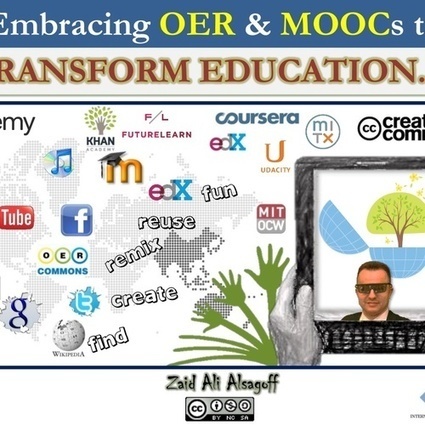
“Presentation slides for the OER and MOOC workshop facilitated at Universiti Utara Malaysia (UUM) on the 25th March, 2013.” (Embracing OER & MOOCs to TRANSFORM EDUCATION...? - Presentation slides for the OER and MOOC workshop...
Scoop.it!

"Welcome to another Textbook Guru review in our series on Massive Open Online Courses (MOOCs). We’ve already reviewed MOOCs as a whole, looked at class structure and reviewed two major players in the space, edX and Udacity. This week we’re taking a look at a clear leader in the MOOC space, Coursera."

Graham Mulligan's curator insight,
June 30, 2013 2:33 PM
I'm doing the Coursera Climate Literacy (UBC) right now.
Scoop.it!

What is online education like? There was an old Chinese motto: Poor rice fields won't attract farmers to plow, but once there are farmers plowing such fields, many other farmers would join in and c...
Scoop.it!

Critics of massive online open courses (MOOCs) are right not to prematurely praise online education, yet online certification programs could help some students stay in school.
Scoop.it!
The global monetary organisation is going to try to teach the world about public finances.
Scoop.it!
Massive open online courses are being promoted "for the students." But software execs and politicians pushing MOOCs have money and disruption at the top of the agenda.
Scoop.it!

What are independent learners and innovative teachers doing now that deserves support, recognition, and scaling up?
Scoop.it!

The idea that massive open online courses (MOOCs) provide a less valid learning experience than face-to-face courses is a furphy. Here are some reasons why the critics are wrong.

Abi James's curator insight,
June 3, 2013 9:33 AM
"Overall, the evidence is that there is no reason to believe that MOOCs provide any less a valid learning experience than face-to-face courses." But are students prepared with the skills and tools needed to studt from online resources? The jump from classroom teaching to lectures is difficult enough but most students have no experience or strategies for learning from online courses without human interaction to guide them. 
elearning at eCampus ULg's curator insight,
June 17, 2013 3:29 AM
Toujours à prendre avec le recul nécessaire mais un point de vue intéressant et des liens conceptuels concrets

António Maneira's curator insight,
June 18, 2013 5:26 AM
That's it! There is no strong apparent reason for MOOCs to be less valid then face-to-face courses. It is an e-learning model for great numbers that in most cases attracts lots of people which is great to researchers as it increase significance of quantitative research studies. |






