


Exploring the analogies we use to explain and argue about MOOCs.

 Your new post is loading...
 Scoop.it! Exploring the analogies we use to explain and argue about MOOCs. 
No comment yet.
Sign up to comment
Scoop.it!
While more and more knowledge is available to us, the amount of time for us to pay attention to it remains the same. What kind of knowledge will be needed in...

Mel Richey's curator insight,
October 21, 2013 4:32 PM
Great overview on the changing role of knowledge and what should be learned. 
Bea Sánchez's curator insight,
February 19, 2014 3:16 PM
Una entrevista muy interesante. Really worth to watch it!
Scoop.it!

MOOCs in Higher Education Today 2013 74% of schools currently offer some type of online course. 16% plan to offer one within 3 years. 13% of schools

Errol Wilson's curator insight,
October 19, 2013 11:24 PM
WE are already using Infographic in the CSUSB MSN Program, nice to know we are in the majority. 
Ante Lauc's curator insight,
October 21, 2013 3:42 AM
I like that my dream is better and better realized. I am sad that my countrymen are far from it! 
Eliana Lobo's curator insight,
October 21, 2013 5:58 PM
I'm taking a course on instructional design right now on Coursera!
Scoop.it!

Habits of Effective Connected Learners by Stephen Downes. Working and learning in an online environment is fundamentally different from working and learning..
Scoop.it!

They may be a little late to the MOOC party, but two newly-launched European open course platforms might still be able to carve out a niche.

Graham Mulligan's curator insight,
October 17, 2013 2:40 PM
It just gets better when there are choices outside the American hegemony.
Scoop.it!

Advocates say higher education would be better served by resources that are truly open -- not just free.
Scoop.it!

The emerging world of K–12 blended learning remains a young field full of promise for personalizing learning and boosting outcomes for all students. More and more bright spots are emerging every day. But there are also challenges.
Scoop.it!

Massive open online courses promise to change the face of higher education, one giant classroom at a time. Here's what they're doing well—and how they can do better. (MOOCs promise to change the face of higher education.
Scoop.it!

GREENSBORO — The hot new thing in higher education is online, open to everyone — and free.
Scoop.it!
This overview of nine key documents published over the past year is provided to support the ongoing debate on MOOCs, Open Educational Resources and online educa
Scoop.it!

FutureGov – Transforming Government | Education | Healthcare (EXPANSION OF MASSIVE OPEN ONLINE COURSES IN ASIA http://t.co/X5Qj08VyKq #MOOC #OER)
Scoop.it!

In the last few months the number of published research papers, which focus on MOOCs has significantly increased and this looks to continue. In May eLearning Papers published a special issue on MOO...
|
Scoop.it!

Last week, I proposed a 2x2 framework summarizing the field of education technology, which asked two questions 1) Are you trying to make a billion dollars? And 2) Do you believe education can be delivered?

David J MacFadyen's curator insight,
October 22, 2013 10:07 PM
Gives an interesting perspective to different platforms and different MOOCs
Scoop.it!
Webinar given for University of Cape Town 17-Oct-2013 exploring the pedagogical differences between cMOOCs and xMOOCs.
Graham Mulligan's curator insight,
October 22, 2013 10:52 AM
Ths is a Slideshare of the early MOOC history. The cMOOC story is told accurately (Which isn't always the case ).
Scoop.it!

Original vision lost in scramble for profit and repackaging of old ideas, say pair

Carlos Fosca's curator insight,
October 20, 2013 5:21 PM
Stephen Downes, senior research officer at Canada’s National Research Council, fears that modern Moocs are placing less emphasis on providing an “interactive and dynamic” approach to learning (such as he championed with his 2008 course) and more on “static and passive” education.
“Moocs as they were originally conceived…were the locus of learning activities and interaction, but as deployed by commercial providers they resemble television shows or digital textbooks with – at best – an online quiz component,” he argues.
Scoop.it!

"Developing countries worldwide are to benefit from an agreement signed last Tuesday by the World Bank Group and Coursera, a leading provider of MOOCs – massive open online courses."
Scoop.it!

Advoctes of MOOCs claim they have the potential to transform higher education by expanding academic access.But it remains to be seen whether this promise can be realized. We asked the WSJ Experts to weigh in.

Nicole 's curator insight,
October 18, 2013 8:56 AM
More online, less on campus instruction.... Is the integrity of the education received still the same? 
Marissa Wilson's curator insight,
October 18, 2013 10:17 PM
Terrific article that weighs the pros and cons of MOOCs.
Scoop.it!

AsstudentsinPekingUniversityandTsinghuaUniversity,twotopuniversitiesinChina,starttheir
Scoop.it!
From
ht

"The Great Backlash against massive open online courses, better known as MOOCs, is in full swing. After an initial flurry of positive press, a firestorm of opposition has mobilized against them. MOOCs, we are told, are either a juggernaut threatening to bulldoze education's core values or an overly hyped bubble about to burst. "

Alexina's curator insight,
October 14, 2013 1:59 PM
Are MOOCs a "techno fad"? Are they Inherently Inferior? These and other questions are presented in this article from the Educause Review Online. Check the Notes section that lists 29 references used for this article.
Scoop.it!

Two Catalan authors see "Three problems with the connectivist conception of learning" and challenge its core ideas. I am not convinced. They seem to have a very different view of patterns than I ha...
Scoop.it!
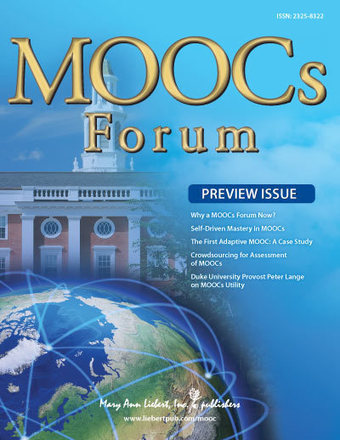
MOOCs Forum is the only international publication dedicated exclusively to shaping the future development, design, and deployment of massive, open, online courses (MOOCs). Multidisciplinary in scope, this authoritative Forum evaluates the components and modules that are critical in creating a global education system and sustainable revenue models for MOOCs, as well as enforcing the integrity behind the creation and use of these systems.
Scoop.it!

Provides an overview of recent reports, writings and opinion on massive open online courses (MOOCs). BIS research paper number 130
Scoop.it!

SPOC, MOOR, And The Walking Dead; MOOC odyssey continues into uncharted waters.

Tom Hood's curator insight,
October 12, 2013 10:37 AM
The speed of learning evolution continues to accelerate as MOOCs (massively open on-line courses) spawn SPOCs (small, private on-line courses) and MOORs (massively open on-line research). Add in social learning, tin can, AICC, and SCORM, we see us quickly moving to just-in-time learning to support the idea of the right talent at the right time with the right skills.
I think we are clearly entering the age of learning as a competitive advantage (for us as individuals and our organizations). in an age of rapid ans accelerating change and complexity, the winners will be those who can keep their L>C, their rate of learning must be greater than the rate of change and greater than their competition.
For learning strategy and resources see www.blionline.org
Alexina's curator insight,
October 12, 2013 1:07 PM
What are SPOC and MOOR? The article mentions their website's list of MOOC providers — now up to 40. See http://www.technoduet.com/a-comprehensive-list-of-mooc-massive-open-online-courses-providers/
Scoop.it!

I am a lifelong, an adult learner. I like that term better than nosy. My curiosity and wish has been mistaken as snoopy in the past but alas, thanks to learning theory, my inquisitiveness has a muc...
|






