This Concept Map, created with IHMC CmapTools, has information related to: Learning Theory v5, Organisation Kolb, Psychology Vygotsky, Psychology Bloom, Piaget genetic epistemology, Psychology Skinner, Montessori constructivism, Dewey constructivism, radical constructivism Knowledge as mental representation: 1a. Knowledge is not passively received either through the senses or by way of communication; 1b. Knowledge is actively built up by the cognising subject; 2a. The function of cognition is adaptive, in the biological sense of the term, tending towards fit or viability; 2b Cognition serves the subject’s organization of the experiential world, not the discovery of an objective ontological reality., social constructivism connectivism, Taylor Organisation, Holt homeschooling, unschooling, constructivism radical constructivism, Kolb experiental learning, Montessori Montessori education, Social anthropology Lave & Wenger, Vygotsky zone of proximal development, Lave & Wenger situated learning, Education Illich, scientific pedagogy Education based on science that modified and improved the individual., communities of practice Groups of people who share a concern or a passion for something they do and learn how to do it better as they interact regularly.
The value of this concept map is how it diagrammatically illustrates the association between the various learning theories and the differences between the approaches . A diagram of this type represents a large amount of data /information presented in a simple way . This is particularly important to visual learners
I love infographics like this that depict the 10,000 foot view to show the overall subject, the various theories or parts, and how the pieces fit together and influence one another.
Are we using the right metrics to evaluate the success of MOOCs?
"Stephen Downes hits the nail on the head in a new post about this issue, Like reading a newspaper. If we compare a regular course to a book which must be read from cover to cover then a MOOC is more like a newspaper that you read very selectively. . . Downes suggests that the connectivist MOOCs he's associated with offer learners a range of learning paths and a flexibility in approach that is unlike a regular course."
I liked this video because it revised the key concepts of learning theories. It also highlighted my journey so far of how I have learnt from the internet. Up till this course, I was very much learning cardiology from textbooks and now I have discovered the rich resources available from the internet.
Mind map: Connectivism -> Simemens (BIOGRAPHY, Interview with George Siemens about Connectivism), Siemens Map and Theory (New node, New node), Continual learning based on the student´s necessities. (Communication, Problem solving, Global awareness, Self direction, Critical thinking), Learning theory for a digital age (Connectivism proposes , more effective learning systems, Learning and knowledge rests in diversity of opinions.), Connectivism was introduced in 2005. (cristobal quispe), critics of connectivism, Connectivism Concept (According George Siemens his developer, In learning, Another developer is Stephen Downes), connectivism articles, Connectivism concept (New node), (online courses), New node (Newttp://en.wikipedia.org/wiki/Stephen_Downes node, Newedutechwiki.unige.ch/en/special book sources/9781105778469 node, http://www.downes.ca/post/58207), 3 theories exceeded (behaviorism, cognitivism, constructivism), principles of connectivism , Learning in a complex, Adaptive age, Connectivism is a successor to behaviorism, cognitivism, and constructivism., conectivism and the informal learning (New node), is the thesis that knowledge is distributed across a network of connection, New node, IMPORTANCE OF CONECTIVISM (New node), Is the integration of principles explored by chaos, network and complexity, and self-organization theories. (SIEMEN´S PRINCIPLES OF CONNECTIVISM), Connectivism is a learning theory advocated by George Siemens and Stephen Downes, among others, which emphasises the importance and role of networks and connections between people (and things?) as preminent (central) to the learning process, Connectivism is a learning theory for the digital age. (New node), connectivism in our brain (connectivism, )
A discussion over the different definitions of "Open" (Open as in oer and open as in MOOC #connectivism #mooc http://t.co/YxhxvZSc5g via @patlockley)...
Useful discussion prompt for openness - in professional learning, and when considering development of MOOC learning materials. Massive benefit if these can become part of the OER ecosystem.
George Siemens Designing, development, and running (massive) open Online Courses George Siemens, at the Technology Enhanced Knowledge Research Institute at A...
George Siemens proposes connectivism as a learning theory for a digital age and lists several core principles, among them: Learning is a process of connecting specialized nodes or information sources.
My EdTech543 assignment this week certainly stretched my creativity, but since I'm a wanna-be chemist at heart, I had to try it. The assignment was to non-linguistically represent the dense concept...
The learning model of Connectivism implies a great challenge to European universities and further education. Over the last years many teachers and trainers h...
Webinar given for University of Cape Town 17-Oct-2013 exploring the pedagogical differences between cMOOCs and xMOOCs. Pedagogical recommendations given alon...
The learning model of Connectivism implies a great challenge to European universities and further education. Over the last years many teachers and trainers h...
In attempting to add to the Connectivisim Theory discussion I have created a mind map using bubbl.us. You can view it here if you wish. Margie Nightingale made mention of Stephen Downes and Erin ad...
Massive open online courses were developed to offer universal free access to high-quality higher education, and may offer new opportunities in nurse education (RT @MERLOTorg: Article in the Nursing Times about nursing education & #MOOCs
With many developing nations having strong roots in critical and libration pedagogies its not surprising this situation arises. The teacher as little more than a subject matter expert has had little relevance to education for half a century at least.
Instructivism is dead. Gone are the days of an authoritarian teacher transmitting pre-defined information to passive students. In the 1990s, constructivism heralded a new dawn in instructional desi...
It’s no secret that good learner-centered teaching is meaningful and interesting, requires active participation from learners, uses different methods to incorporate all students’ preferred learning styles and is differentiated at an appropriate level. Vygotsky (1978) stated that learning is achieved by the active construction of knowledge supported by various perspectives within meaningful contexts; making meaning. ...
Written and Narrated by Dave Cormier Video by Neal Gillis Researchers: Dave Cormier Alexander McAuley George Siemens Bonnie Stewart Created through funding r...
Gily Salmon's first MOOC that she is leading, Carpe Diem - Learning Design, starts March 10, and we took the opportunity to discuss some of the differences between course design for "traditional" online learning and for MOOCs
Organizational Impact of Connectivism and Networked Learning University of Alaska Fairbanks November 12, 2007 George Siemens (RT @apuustin: Organizational Impact Of Connectivism And Networked Learning http://t.co/rVgEQ9oiwM...
Serial entrepreneur Steve Blank's Udacity lectures now have over 250,000 students, and they're widely used by other entrepreneurs. Here's what he learned by "flipping" the online classroom idea.
Presentation at the 2013 Conference on Distance Teaching and Learning, Madison, Wisconsin, by Roz Hussin and Paul Kim, in conjunction with WOOC MOOC - Worksh...
To get content containing either thought or leadership enter:
To get content containing both thought and leadership enter:
To get content containing the expression thought leadership enter:
You can enter several keywords and you can refine them whenever you want. Our suggestion engine uses more signals but entering a few keywords here will rapidly give you great content to curate.


 Your new post is loading...


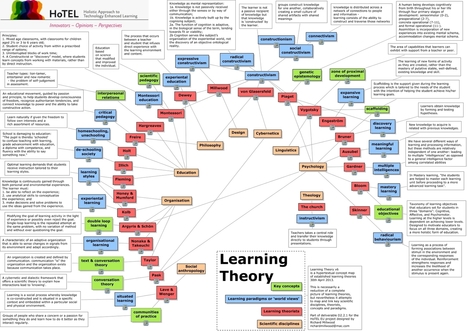













The value of this concept map is how it diagrammatically illustrates the association between the various learning theories and the differences between the approaches . A diagram of this type represents a large amount of data /information presented in a simple way . This is particularly important to visual learners
Learning theories
I love infographics like this that depict the 10,000 foot view to show the overall subject, the various theories or parts, and how the pieces fit together and influence one another.