


Making sense of text complexity and helping students with reading skills. Many of my students, just like Alex, are in the eighth grade and have trouble reading a grade level text book.

 Your new post is loading...
 Scoop.it! Making sense of text complexity and helping students with reading skills. Many of my students, just like Alex, are in the eighth grade and have trouble reading a grade level text book. 
No comment yet.
Sign up to comment
Scoop.it!

The report also notes that many students with disabilities struggle academically. Only 11 percent of California schools met federal benchmarks for English language arts and math proficiency in 2011. California provides special services to 686,000 children, 10 percent of public school enrollment.
Scoop.it!

By Chester E. Finn, Jr. and Michael J. Petrilli For months now, critics inside and outside the Hoosier State have been attacking Indiana’s decision to adopt the Common Core State Standards; unhappiness on the right may have contributed to...
Scoop.it!

Students' "college readiness" in math in 22 states and the District of Columbia will be determined by an end-of-course test in the last of a three-course sequence, a common-standards assessment consortium has decided. The decision by the Partnership for Assessment of Readiness for Colleges and Careers, or PARCC, resolves the question of which tests would be used to decide whether students may skip remedial college mathematics and enroll directly in certain credit-bearing entry-level courses. Higher education and K-12 representatives of each PARCC governing state voted to base the college-readiness determination only on the terminal test in each three-course sequence.
Scoop.it!

In the past few years, Illinois and most states have put in place the new "common core" standards for what students should know and be able to accomplish. At Perez Elementary School in Pilsen, for instance, performance on the Illinois Standard Achievement Test and other benchmarks in 2010 earned an elite Level 1 ranking from CPS. But that changed when they took tests aligned with common core. Barely one-third of third-, fourth- and fifth-grade students at Perez scored at or above their grade levels in reading and slightly more than one-third did so in math. An official at the school said then that the results were shocking.
Scoop.it!
New computerized assessment will represent one of the largest technological shifts in K-12 education
"This is a very different type of test," said Leslie Arnold, the Clark County School District's director of research, data and assessment. Preparing for the new test "is a big task for a district our size."
Scoop.it!

Jennifer G. Beasley, Ed.D. is an assistant professor at the University of Arkansas. The short answer is yes. The Common Core State Standards are not arbitrary but draw on a firm foundation of the National Assessment of Educational Progress (NAEP) frameworks in reading and writing as well as conclusions from the Trends in International Mathematics and Science Study (TIMSS) report.
Scoop.it!

Inside Higher Ed January 4, 2013 A study released Thursday by the National Center for Education Statistics, "First-Year Undergraduate Remedial Coursetaking: 1999-2000, 2003-04, and 2007-08," shows that the proportion of first-year undergraduate students reporting that they took remedial courses rose slightly from 2003-4 to 2007-8, to 20 percent from 19 percent. But the 2007-8 figure was significantly lower than the 26 percent reported by first-year students in 1999-2000, a pattern that holds for many different types of institutions and students, as seen in the tables below.
Scoop.it!

With the Common Core State Standards hovering, a middle school math teacher discusses her efforts to help her students reason abstractly and approach problems more systematically.

Nicole Cooley's curator insight,
January 4, 2013 6:17 AM
This is exactly how we are trying to train teachers to teach with the Mathematical Practices in mind. Also, look at the Tier 2 Vocab. the teacher is using: "conjecture" and "discourse"
Scoop.it!

masaaki miyara / Flickr "Alarmist articles decrying the replacement of classic literature, such as The Catcher in the Rye, with instruction manuals are far off base from the language and intent of the Standards, which is, simply: read better texts."
Scoop.it!

Veteran Education Week reporters Catherine Gewertz and Erik Robelen bring you news and analysis of issues at the core of classroom learning.
Scoop.it!
Resources related to the English Language Arts Curriculum
|
Scoop.it!

As literacy expert Elfrieda H. “Freddy” Hiebert points out, “An additional 7 minutes of reading per day has been shown to differentiate classrooms in which students read well from those in which students read less well [and] can make a huge difference in students’ knowledge acquisition and capacity for reading complex text.” Imagine the power that would accrue if students read an additional 7 minutes in school each day, and another 7 minutes—or more—after school. Imagine what that collective knowledge and wisdom might mean for our nation.
Scoop.it!
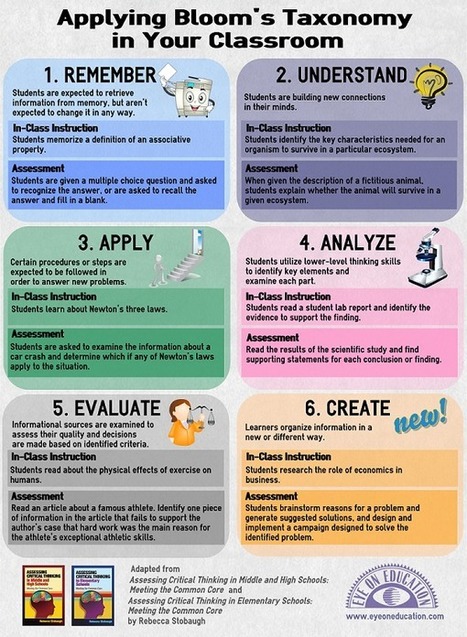
Eye On Education Assessing Critical Thinking in Middle and High Schools: Meeting the Common Core, by Rebecca Stobaugh is a practical, very effective resource for midd...
Scoop.it!

Elena Aguilar, an experienced K-12 educator, is a transformational leadership coach in the Oakland, Calif., school district.
Scoop.it!

WASHINGTON - January 9, 2013 - Achieve, in partnership with College Summit, the National Association of Secondary School Principals (NASSP), and the National Association of Elementary School Principals (NAESP), has released a series of action briefs on the role of school counselors, secondary school leaders, and elementary school leaders in the implementation of the Common Core State Standards (CCSS).

Missouri Secondary Principals's curator insight,
January 15, 2013 11:19 AM
Good resources for principals
Scoop.it!
Mel Riddile's insight:
"Literacy is the common ground of the Common Core" - Janet Allen With the emphasis of having students read from a variety of increasingly complex texts, the school librarian becomes a central figure in successful implementation of the CCSS.
Scoop.it!

Whole Child Education "Because the standards are not simply an upgrade to what we've been doing, but rather a whole new approach, we have an opportunity to also address more comprehensively the needs of the whole child."
Scoop.it!

41 Resources, Tools, And Apps To Improve Writing Skills by Tom Vander Ark first appeared on gettingsmart.com Math gets all the love–at least that appears…
Scoop.it!

Starting next school year, public schools in Pennsylvania and in much of the country will use a more rigorous curriculum aimed at unifying educational standards. Critics lashed back in some states that adopted the standards, but in Pennsylvania limited resistance resulted when the Pennsylvania State Board of Education, a 21-member panel with 17 members appointed by the governor, approved their adoption in 2010. “That‘s because the standards are not really in any conflict with standards that Pennsylvania already has,” said Ron Cowell, president of the nonprofit Education Policy and Leadership Center in Harrisburg.
Scoop.it!

The bell rang and students barely had time to get in their seats before math teacher Mike O'Connell started with the Algebra I lesson. "Start with question 38," O'Connell said. "How would you...
Scoop.it!

Florida's schools are adopting uniform academic standards shared with most other states, but the move is not creating the kind of uproar that's surrounded some other major changes in public education.
|






