 Your new post is loading...

|
Scooped by
Mel Riddile
June 13, 2013 10:16 AM
|
School Chiefs recommend "flexibility" in Common Core Implementation
The council wants states to be allowed to do the following: - Identify their lowest-performing schools at the end of this school year and maintain those designations and support through the assessment transition period (the 2013-14 and 2014-15 school years).
- Base teacher evaluations on measures other than the Common Core tests during the transition years and phase in the use of their educator evaluation systems in making personnel decisions.
- Decide which tests to use during the 2013-14 transition year and not be required to double test students.
|
|
Scooped by
Mel Riddile
June 12, 2013 2:37 PM
|
One of the things that drew me to the Common Core initially was its great potential as a platform to develop new, cool technologies that teachers all across the country could use to improve their i...
|
|
Scooped by
Mel Riddile
June 11, 2013 9:09 AM
|
Assessment Planner: Alignment to PARCC’s Blueprints and The Common Core | Partner in Education
|
|
Scooped by
Mel Riddile
June 10, 2013 7:32 PM
|
The standards are goals, not mandates. Teachers at individual schools will continue to decide what to teach and how to help children meet the basic goals.
|
|
Scooped by
Mel Riddile
June 9, 2013 7:17 AM
|
Elsewhere I have written about the potential power of narrative to help students understand and remember complex subject matter (Willingham, 2004 ; 2009). Now a new study ( Arya & Maul, 2012 )...
|
|
Scooped by
Mel Riddile
June 9, 2013 7:12 AM
|
|
|
Scooped by
Mel Riddile
June 9, 2013 6:33 AM
|
By Catherine Gewertz
"The next couple of years will be rough going. That's no surprise to anyone who's been tracking the Common Core State Standards and waivers from key parts of the No Child Left Behind Act."
|
|
Scooped by
Mel Riddile
June 9, 2013 6:28 AM
|
What are the Common Core State Standards? The CCSS are a set of internationally benchmarked K-12 educational standards to ensure every students’ college and career readiness in English language arts and mathematics. These standards increase rigor in every school, and provide clarity and consistency for what all students need to know once they graduate from high school. To date, 45 states, the District of Columbia, Guam, American Samoan Islands, U.S. Virgin Islands and the Anchorage, AK School District have voluntarily adopted CCSS.
|
|
Scooped by
Mel Riddile
June 7, 2013 10:07 AM
|
|
|
Scooped by
Mel Riddile
June 7, 2013 9:56 AM
|
Computer-adaptive testing, designed to respond to students' answers and more accurately pinpoint their performance level, is gaining support in both chambers of Congress as lawmakers consider proposals to reauthorize No Child Left Behind.
"Adaptive tests are already being used in several states, including Delaware, Hawaii, and Oregon, and at least 20 states plan to use adaptive tests by 2014-15.
|
|
Scooped by
Mel Riddile
June 7, 2013 9:22 AM
|
With just a couple weeks left of school, most educators and students are ready for much needed breaks. But before we know it, summer will sail by and it’ll be back to the grind. With 2014 and the i...
|
|
Scooped by
Mel Riddile
June 7, 2013 9:18 AM
|
Major education organizations say teachers and students aren't ready.
|
|
Scooped by
Mel Riddile
June 6, 2013 12:34 PM
|
Education Trust June 5, 2013
"Programs like Advanced Placement (AP) and International Baccalaureate (IB) are designed to provide high school students with challenging academic course work and a head start on a college education. But despite aggressive efforts to expand participation, there remain significant differences in the rates at which students from different racial and economic groups gain access."
|
|
|
Scooped by
Mel Riddile
June 13, 2013 6:15 AM
|
The increase, which follows more than two decades of slow growth in college completion, appears to be driven by the recent recession and the creation of new types of jobs.
|
|
Scooped by
Mel Riddile
June 11, 2013 12:52 PM
|
Given that 20 states and most test publishers (CTB, ETS, NWEA, Measured Progress, Pearson, Scholastic, Scantron, Cambium-Voyager) currently report student reading ability on the Lexile scale from MetaMetrics, it seems like a logical choice for a common reference point. In addition to test publishers, all the major text and trade book publishers have elected to use Lexile measures as a way to describe text complexity.
Instructional companies are building intervention and instructional programs around Lexile measures. For example, Scholastic Reading Inventory and Curriculum Associates' i-Ready have also linked their assessments with the Lexile Framework illustrating the practicality of a common scale.
|
|
Scooped by
Mel Riddile
June 10, 2013 8:10 PM
|
Republican Gov. Rick Perry of Texas today signed legislation to rewrite state graduation requirements, reducing from 15 to five the number of end-of-course exams students must pass to earn a high school diploma.
|
|
Scooped by
Mel Riddile
June 9, 2013 7:25 PM
|
Recently, I had a conversation with a group of math coaches who are working with elementary teachers on implementation of the Common Core Standards for Mathematics. The discussion turned to a description of rigor in the classroom. The coaches commented that many of their teachers were confused by exactly what was meant by teaching and learning with rigor. The coaches weren’t sure how to respond.
|
|
Scooped by
Mel Riddile
June 9, 2013 7:14 AM
|
This study examines Ohio’s current math content standards in comparison to TIMSS, PISA, high performing international counterparts, and the recently released Common Core. Specifically, it examines whether the state’s standards are “a mile wide and inch deep.”
Ohio’s standards generally are less focused than the international comparisons, not very aligned to TIMSS and PISA, and have lower cognitive expectations.
The CCSS have greatly increased that focus by reducing the number of topics in the analyzed grade levels while increasing the levels of cognitive expectations.
|
|
Scooped by
Mel Riddile
June 9, 2013 6:34 AM
|
|
|
Scooped by
Mel Riddile
June 9, 2013 6:31 AM
|
Are new standards really leveling the playing field? Or is the game prearranged so that many, if not most, of the players will fail?
|
|
Scooped by
Mel Riddile
June 8, 2013 11:34 AM
|
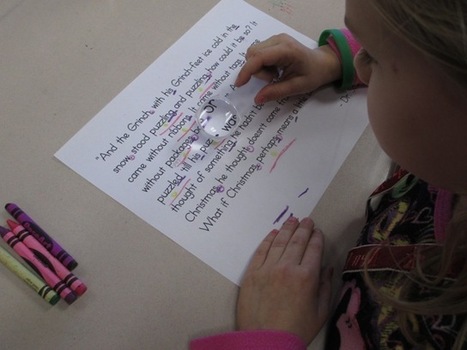
Up-Close Reading: Tackling Complex Text | Scholastic.com
Are your students ready to attack complex text and break it down for absolute understanding? They will be well on their way with these strategies!
|
|
Scooped by
Mel Riddile
June 7, 2013 10:03 AM
|
- LearnZillion is a free resource that provides teachers, parents and students with Common Core aligned lessons that focus on the use of narrated video for instruction.
- TenMarks is a web based resource designed to help individualize learning as students work through interactive worksheets for assessment and access videos to learn concepts one step at a time.
- Learning Farm is a very simple Common Core aligned tool designed to provide individualized self-paced practice and assessment through the use of interactive quizzes and games.
|
|
Scooped by
Mel Riddile
June 7, 2013 9:27 AM
|
Cold Versus Warm Close Reading: Stamina and the Accumulation of Misdirection by Catherine Snow
"The tasks were more rigorous and more challenging than most students currently have access to, and undeniably would constitute a better preparation for the demands of college and the work place – if students can actually engage them. But if students find the tasks too difficult or too irrelevant to bother with, then the rigor will be of little value."
|
|
Scooped by
Mel Riddile
June 7, 2013 9:20 AM
|
Though much of it is focused on the broader ideas of the Core Standards, we thought that a number of the statistics contained in this handy infographic / Common Core guide were interesting.
|
|
Rescooped by
Mel Riddile
from Leading Schools
June 6, 2013 2:28 PM
|
- Offer a rigorous curriculum beginning in elementary grades
- Expand access to gifted programs
- Analyze student results on precursors to college entrance exams--like PSAT and EXPLORE--to identify potential AP students and actively recruit them to enroll in AP courses
- Provide extra academic and social support to students
- Dramatically increase the number of AP course offerings
- Offer additional teacher training and professional development
- Instill confidence in students about their college-going potential
- Educate parents about the benefits of AP
|












Using Common Sense w/ CC